Tia News
Is it cheaper to bundle tutoring for multiple students?
Bundle tutoring for siblings only when the family total beats separate plans. Compare student access, subject coverage, teaching format, and terms for 2026.
By Tia Education Team · Published

Bundling tutoring for siblings is cheaper only when the combined bill is lower than separate plans for the support each student actually needs. Buying several subjects is not the same as buying access for several students. If you are comparing family tutoring in 2026, check who is covered before comparing the totals.
- Bundle tutoring for siblings only when the confirmed family total beats separate plans for the same support.
- A subject bundle does not establish that multiple students are included.
- Tia fits families seeking personalized tutoring with parent learning records; confirm sibling access before choosing a plan.
- Keep each student's learning goals and progress distinct, even when billing is combined.
Why this matters
One student needs algebra help. Another needs support with essay writing. You want a manageable bill, but you also need both students to get teaching that fits.
The word bundle does not answer that question. It can describe subjects, students, sessions, or a longer commitment. Start with the support your family needs, then use the same criteria across providers. The guide to finding affordable tutoring offers a broader starting point for that decision.
Combine the bill only if you can preserve the right support for each student. A simpler payment arrangement is useful. It is not a substitute for individual teaching.
Is it cheaper to bundle tutoring for multiple students?
It is cheaper when a provider's confirmed multi-student total is lower than the total for equivalent separate plans. Compare the same students, subjects, billing period, and teaching format. Otherwise, you are comparing different services rather than identifying a saving.
For your 2026 comparison, distinguish the arrangements below. These are buying formats to ask about, not promises that every tutoring provider offers them.
| Arrangement | Best for | Main advantage | Main limitation | What to confirm |
|---|---|---|---|---|
| Separate student plans | Siblings with different needs | You can choose support individually | You manage separate subscriptions or bookings | What each student receives |
| Multi-student bundle | Families seeking combined billing | It groups eligible students under one arrangement | Included subjects or access can differ | Exactly which students are covered |
| Subject bundle | A student needing several subjects | It combines subject access | It does not establish sibling access | Whether coverage applies per student |
| Shared tutoring session | Siblings working on a suitable common topic | Students work together | Teaching time and attention are shared | Whether both students' goals fit the session |
| Annual commitment | Families confident about ongoing use | It establishes a longer billing period | You commit before knowing every future need | Renewal, changes, and cancellation terms |
Do not treat these formats as interchangeable. A shared lesson and separate one-on-one lessons are different services, even if they cover the same subject.
Ask for a written total for your actual household. List each student and subject in the request. A clear answer should let you identify what changes when you add another student, another subject, or a longer commitment.
A sibling bundle covers students, not just subjects
A sibling arrangement needs to identify who can use the service. Look for an explicit explanation of student access rather than relying on words such as family, complete, or bundle.
Before choosing, ask:
- Does the quoted arrangement cover every student you named?
- Does each student have a distinct learning history?
- Can siblings study different subjects and levels?
- Can students use the service at the same time?
- What happens if only one student continues?
These questions matter even when siblings share a grade level. They can need different explanations, different practice, and different amounts of help. A shared household does not establish a shared learning need.
Best for: families whose provider confirms suitable access for every participating student. The limitation is straightforward: combined billing alone tells you nothing about how individually the service teaches.
A subject bundle solves a different problem
A subject bundle groups areas of study. It does not, by itself, establish that siblings can share the subscription.
For example, your older student might need math and science while your younger student needs English. You need confirmation that the proposed arrangement covers that combination across both students. A list of included subjects does not answer the account-access question.
Best for: a student who needs ongoing support across several included subjects. The trade-off is paying for broader coverage when only a narrow part of it fits the student's current needs.
Start with the learning problem, not the longest feature list. If your student needs help organizing an essay, additional science access does not resolve that writing need. Broader access is useful only when your family has a reason to use it.
Shared sessions are not the same as individual tutoring
Siblings can work together on a common topic without having identical learning goals. Ask how the tutor will handle different starting points before choosing a shared session.
A useful question is: what happens when one student understands the explanation and the other does not? You need a teaching plan for that moment, not just confirmation that both can attend.
Best for: siblings with compatible goals who are comfortable learning together. The limitation is shared attention, so do not compare a joint session with separate tutoring as though the teaching format were unchanged.
Keep independent work visible, too. Ask each student to explain the idea in their own words. One student's correct answer does not establish the other student's understanding.
Why the total varies
The total depends on what you are buying and who can use it. Use these factors to organize your questions rather than assuming a particular provider charges for each one.
- Student coverage: Confirm whether the arrangement applies to an individual student, several named students, or an account with defined permissions.
- Subject coverage: Identify the subjects each student needs. Do not confuse access to more subjects with access for more students.
- Teaching format: Distinguish individual instruction, shared sessions, and independent practice. Compare like with like.
- Billing period: Put every quote on the same time basis. An annual commitment and a monthly arrangement carry different obligations.
- Usage rules: Ask about sessions, access limits, scheduling, and simultaneous use. Read the actual terms rather than inferring them from a plan name.
- Changes over time: Find out how the arrangement handles a student finishing a subject, needing different support, or stopping tutoring.
For a 2026 decision, use current terms supplied by the provider. Keep a copy with your comparison so you know which conditions your decision relied on.
How do I compare sibling tutoring plans fairly?
Use the same household requirements for every quote. You should not have to reconstruct the offer from a headline and several assumptions.
- List student needs. Write down each student's subject, current topic, and reason for seeking help. Keep the goals separate.
- Confirm student access. Ask which students the proposed arrangement includes. Check whether each receives an individual learning record.
- Match teaching support. Compare the explanation, practice, feedback, and parent information included. A resource library is not automatically equivalent to a personal tutor.
- Compare family totals. Request the complete total for the same billing period. Include any required charges disclosed in the terms.
- Check change terms. Establish what happens if your family needs less, more, or different support. Keep that answer alongside the quote.
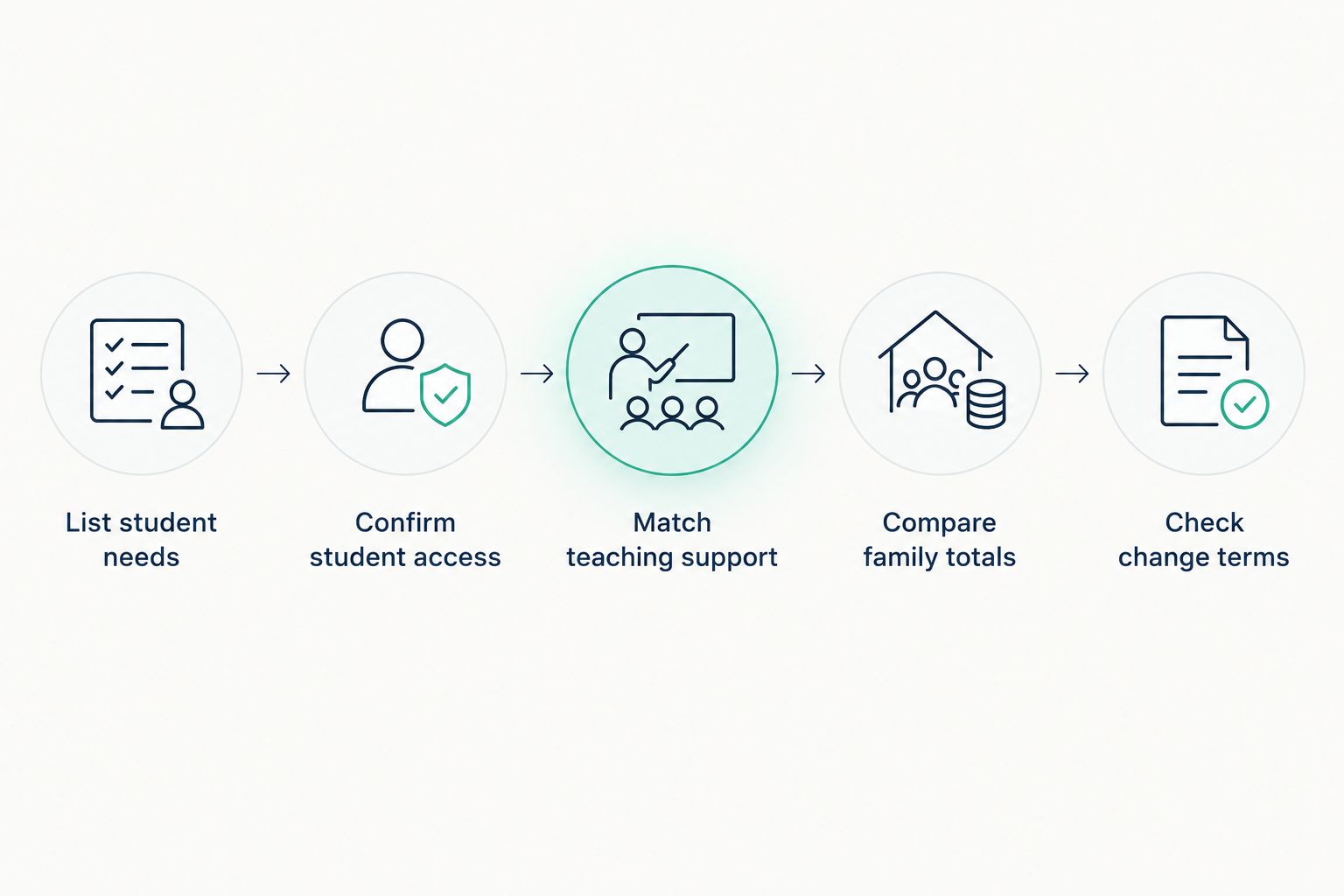
Make your final choice from the written offer, not the label attached to it. If the terms leave a question unanswered, resolve it before enrolling another student.
Where Tia fits in a sibling tutoring decision
Tia personalized tutoring is best for families seeking adaptive teaching with parent learning records. It teaches Math, English, and Science across grades 5 to 12, adapting to the student's pace, level, and interests.
The distinction matters when siblings learn differently. One student's useful explanation does not have to become the template for another. The teaching should meet each student where they are while staying aligned with the relevant curriculum.
Tia also measures mastery from student answers, maps that information to the curriculum, and includes it in reports. Its Bayesian Knowledge Tracing method updates an estimate of skill mastery over time. That is a learning estimate, not an infallible measure or independently verified exam-score result.
Parents also receive a live dashboard, engaged-time measurement, and self-writing records for homeschool reporting. Those features address visibility into learning. They do not establish multi-student subscription terms or replace your local reporting requirements.
The practical limitation is that subject coverage alone does not answer the sibling-access question. Before choosing Tia, confirm the arrangement for your named students, their subjects, and their individual records. Do not assume a subject bundle is a household subscription.
Should I choose monthly or annual tutoring for siblings?
Choose the commitment after establishing that the teaching fits each student. A longer billing period does not resolve uncertainty about access, learning needs, or willingness to use the service.
In your 2026 comparison, keep the commitment decision separate from the sibling decision. First confirm which students are covered. Then compare the billing periods available under that same arrangement.
Ask what happens if one sibling finishes a topic while another needs ongoing help. Also check the applicable renewal and cancellation terms. Do not build your family plan around an assumed pause, refund, or transfer policy.
Choose the shortest commitment that matches what you actually know about your family's needs. Revisit a longer arrangement once you have seen how the support fits.
How do I know whether both students benefit?
Look at each student's learning separately. A combined household bill should not produce a combined judgment about progress.
Ask each student what they worked on, where they needed help, and what they can explain independently. Review the learning record alongside those conversations. Completion and time spent are useful context, but neither alone answers whether a student understands.
Small regular sessions can fit a family routine, including as little as 10 minutes a day when that suits the student. That duration is an option, not a promised route to a particular result. Choose the rhythm around the learning task and the student's response.
FAQ
Is it always cheaper to bundle tutoring for siblings?
No. A sibling bundle is cheaper only when its confirmed total is lower than equivalent separate arrangements. Match student coverage, subjects, teaching format, and billing period before deciding.
Can siblings share a tutoring subject bundle?
Only if the provider's terms explicitly permit that arrangement. A subject bundle does not, by itself, establish access for multiple students or separate learning records.
Should siblings use the same tutor?
Choose the tutor around each student's needs, not the convenience of a shared name on the bill. Ask how the tutor handles different levels, explanations, and learning goals.
Is a shared tutoring session the same as one-on-one tutoring?
No. A shared session divides teaching attention among participating students. Confirm that both siblings' goals fit the session before comparing it with individual instruction.
Does Tia personalized tutoring cover more than math?
Tia personalized tutoring covers Math, English, and Science for students in grades 5 to 12. Confirm the subscription arrangement for each participating student rather than assuming subject coverage establishes sibling access.
How can I check whether a tutoring bundle is useful?
Review each student's understanding and learning record separately. Ask students to explain their work independently instead of relying only on completion or time spent.
What should I ask before enrolling multiple students in 2026?
Ask which students are covered, how individual progress is recorded, and what the complete family total includes. Also confirm usage rules and the terms for changing or ending the arrangement.
One last thing
Before you choose, ask this: if only one sibling needed tutoring next month, would the arrangement still fit?
That question separates a useful family plan from a purchase built around everyone needing the same support indefinitely. Keep the teaching individual, even when the billing is shared. You stay in charge of what each student needs.
Related guides
- How adaptive tutoring changes a lesson
- What parents should see in a tutoring dashboard
- How to keep homeschool records without a last-minute scramble
Tia Education Team