Tia News
Is an AI tutor safe for my child's data privacy?
Is an AI tutor safe for my child's data privacy? Check consent, data use, retention, and deletion before signing up, with a clear practical parent checklist.
By Tia Education Team · Published

An online tutor is not automatically safe for your student's data privacy; choose one only after checking what it collects, how it uses information, who can access it, and how you can delete it. If you are staring at another signup form during homework time, you do not need to become a privacy expert. You need clear answers before sharing personal details, because helpful teaching and responsible data handling are separate questions.
- Is an AI tutor safe for my child's data privacy? Check the provider's policies, not its marketing.
- Tia offers personalized tutoring with parent visibility; a dashboard does not establish privacy protection.
- For students under 13, check COPPA requirements and the provider's parental consent process.
- Share learning needs without unnecessary identifying details, and confirm retention and deletion rules before uploading records.
Why this matters
A student can need help with fractions without needing to share a full report card. An essay can need feedback without including a home address. Your first job is to separate the learning task from the personal information attached to it.
A tutoring dashboard serves a different purpose from a privacy notice. The dashboard shows learning activity; the notice explains data handling. Use this guide to what parents should see in a tutoring dashboard to assess visibility, then check the provider's privacy documents separately.
For a 2026 tutoring decision, require both useful teaching and clear data rules. Neither substitutes for the other. A familiar-looking platform still needs the same checks as an unfamiliar one.
Is an AI tutor safe for my child's data privacy?
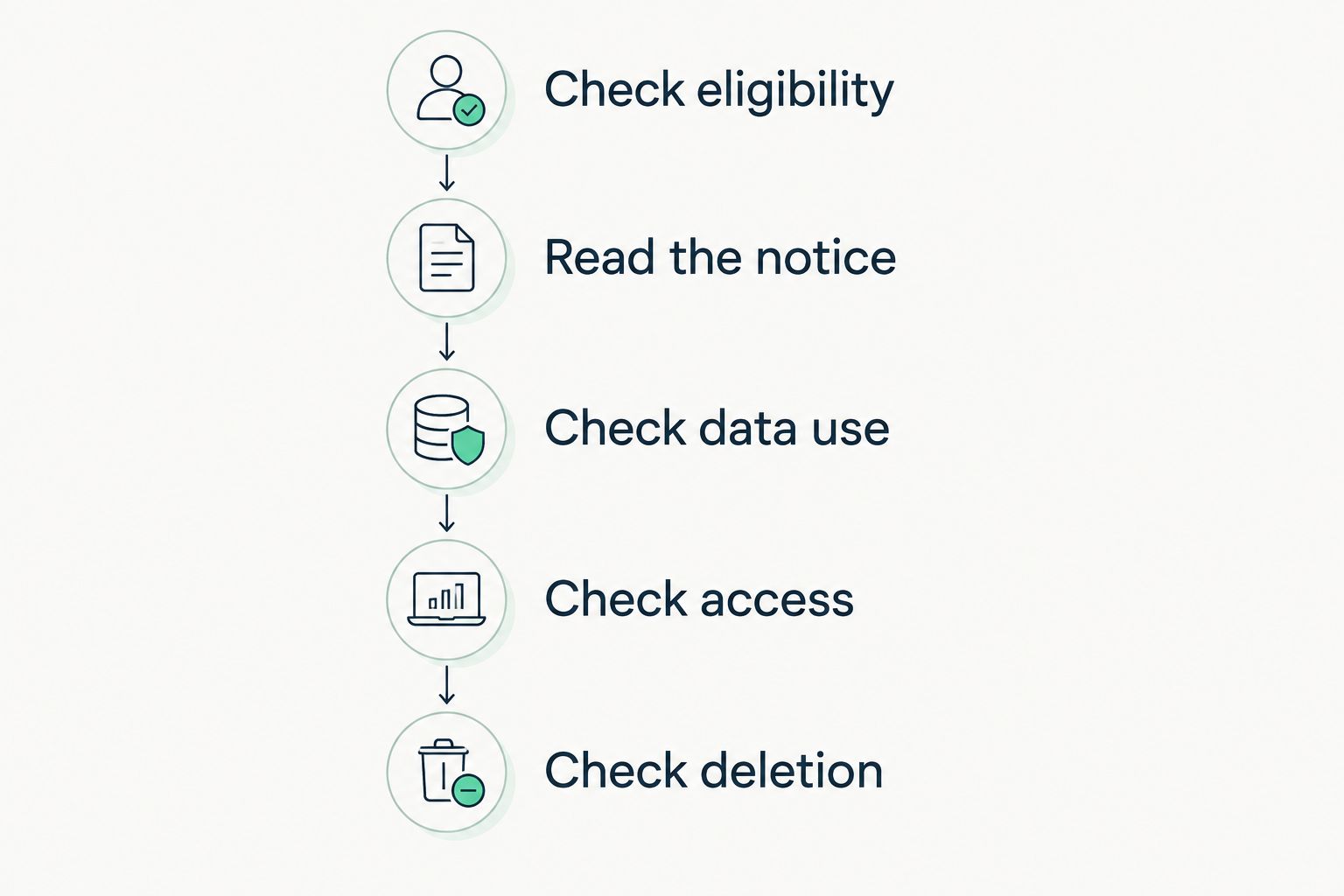
Safety depends on the specific service and how your family uses it. A privacy promise should explain actual practices, not simply describe the service as educational or secure. Before opening an account, work through this sequence.
- Check eligibility. Find the minimum age, account ownership rules, and parental consent requirements. Do not enter a different birth date to bypass an age restriction.
- Read the notice. Identify the operator and the categories of information collected. Look for lesson conversations, uploaded files, account details, device information, and learning records.
- Check data use. Separate information used to deliver tutoring from information used for advertising, analytics, or model training. Ask about each purpose explicitly.
- Check access. Identify who can see student work, including parents, staff, and service providers. Look for a clear explanation of when people review conversations or files.
- Check deletion. Find the request process and the retention rules. Ask what happens to lesson history, uploaded documents, and backups when you close the account.
Use the provider's current documents in 2026, not a review describing an earlier version of the service. Save the relevant policy and the date you reviewed it. If an answer is unclear, pause the signup and ask the provider directly.
What information does tutoring actually need?
Start with the problem your student is trying to solve. A tutor needs enough context to teach effectively, but that is not the same as needing every document your family keeps. Ask which details are required and which are optional.
| Learning task | Useful context | Details to remove when unnecessary |
|---|---|---|
| Help with a math problem | The problem and the student's attempted solution | Full name, school name, student ID |
| Feedback on an essay | The prompt, draft, and assignment requirements | Addresses, contact details, identifying family stories |
| Support with reading | The passage and the specific difficulty | Unrelated assessment pages and personal records |
| Adjusting the teaching approach | Preferred explanation style and current skill level | Full medical history or unrelated diagnoses |
For example, you can describe a need as shorter instructions, worked examples, or extra practice. That keeps the request focused on teaching. Do not upload an entire evaluation merely to communicate a preference that fits in a sentence.
If a service asks for information unrelated to the lesson, ask why it needs that information. A mandatory field deserves an explanation, not an automatic answer. Share the learning need first, not the student's entire history.
What does COPPA mean for students under 13?
In the United States, the Children's Online Privacy Protection Act, or COPPA, applies to covered online services that collect personal information from students under 13 years old. The Federal Trade Commission administers the rule. Its protections include notice, verifiable parental consent in covered circumstances, and parental rights concerning information collected.
COPPA does not mean every educational service is approved by the government. A claim of compliance is not a substitute for reading the provider's notice and understanding its process. Check how the service verifies consent and how you exercise parental rights.
For a 2026 signup, use the FTC's current COPPA guidance alongside the provider's current policy. Rules and implementation requirements deserve a current check. Do not rely on a screenshot of an old policy or a general claim in an advertisement.
Students who are 13 years old or older still need privacy protection. The age threshold does not make unrestricted sharing sensible. Keep the same habits around sensitive records, passwords, and identifying information.
Does FERPA protect a tutoring account you open yourself?
FERPA protects education records at educational agencies and institutions that receive funds under applicable U.S. Department of Education programs. It is not a blanket privacy guarantee for every tutoring account a parent buys independently. The U.S. Department of Education's student privacy guidance explains its scope.
If a school provides the tutoring service, ask how the school manages the provider relationship and student records. If you purchase tutoring directly, read that provider's terms and privacy notice. Do not assume the school's arrangements extend to your separate account.
For homeschool families, keeping educational records and receiving FERPA protection are different matters. A report can be useful for your own reporting without making the service a FERPA-covered institution. Check local reporting requirements separately from the tutor's data practices.
Why privacy protection varies between tutoring services
The label on a tutoring service does not tell you how it handles information. Examine these factors in the actual policies and account settings:
- Collection scope: Check whether the service collects only account and lesson information or also recordings, uploads, and device data.
- Purpose: Identify which information supports teaching and which supports other activities. Ask whether student material is used for model training.
- Access: Check the circumstances in which staff or outside providers can view student information.
- Retention: Look for how long different records remain and what determines that period.
- Parental control: Find the processes for reviewing information, correcting it, withdrawing consent where applicable, and requesting deletion.
- Account context: Establish whether the account belongs to your family or sits within a school-managed arrangement.
These are review criteria, not a claim that any particular tutor follows a specific practice. Compare written answers rather than broad promises. A clear explanation of data handling is more useful than an unexplained safety label.
Can a tutor personalize lessons without a full personal history?
Personalization and privacy are not opposites. A lesson can respond to a student's pace, current understanding, and interests without a parent volunteering unrelated identifying information. The practical question is which information the service actually requires and why.
Tia provides personalized tutoring in Math, English, and Science for students in Grades 5 through 12. It adapts teaching to each student's pace, level, and interests. Parents get a live dashboard, engaged-time measurement, and records for homeschool reporting.
Tia is best for parents seeking personalized tutoring with visibility into their student's learning. That is a learning-fit verdict, not a security certification. Its teaching and reporting features do not, by themselves, establish retention rules, training restrictions, or deletion guarantees.
The benefit is a teaching approach that responds to the student while giving parents information about learning activity. The boundary is just as important: a parent dashboard cannot answer every privacy question. Apply the same policy checks before sharing sensitive information with Tia as you would with another tutoring service.
How can I reduce unnecessary sharing during a lesson?
Set a simple family rule: share the assignment, not everything around it. Before uploading a worksheet, crop the image to the problem. Check headers, handwritten names, school logos, and information visible in the background.
For writing assignments, decide whether the tutor needs the real personal details. A draft about a family experience can contain identifying information even without a name at the top. Replace unnecessary details before sharing, while keeping the part needed for feedback.
Begin with 2 practice questions that contain no identifying details. Use them to understand the lesson process before introducing your student's own documents. This is a practical starting point, not evidence that the service has passed a security assessment.
Keep passwords, verification codes, payment information, and identity documents out of lesson conversations. Students do not need a long lecture to understand that boundary. Explain which information belongs in account settings and which belongs in a learning task.
What should I ask about training, sharing, and deletion?
Ask the provider whether student prompts, answers, and uploaded work are used to train models. Then ask whether the answer applies to its outside service providers as well. Permission to process information for tutoring is a different question from permission to reuse it for training.
Use a short written request:
- Does student work leave your systems for processing, and for what purpose?
- Is lesson content used for model training by you or another provider?
- Can people review student conversations, and under what circumstances?
- How long do you keep lesson content and uploaded files?
- What does a deletion request remove, and what remains in backups or required records?
Account closure and data deletion are not necessarily the same action. Ask whether you must make a separate deletion request. Also ask how you receive confirmation and how the provider explains any information it must retain.
For your 2026 review, keep the answers with the policy you checked. You do not need to store extra student data to document your decision. Save the provider's explanation, not another copy of sensitive records.
Is a parent dashboard enough to protect privacy?
A parent dashboard helps you understand learning activity; it does not establish how information is secured, shared, or retained. Treat it as a visibility feature. Review privacy controls and policies separately.
Check who can access the dashboard and whether a shared device leaves it open after a session. Use a unique password for the account. If the service offers additional login protection, review and enable it when appropriate.
Reports also need care after download. Keep them in a location accessible only to the people who need them, and share only the relevant pages. A provider's safeguards do not control what happens to a file after you send it elsewhere.
When should I pause or stop using a tutoring service?
Pause when the provider cannot explain an important data practice in plain language. That includes unclear age eligibility, unexplained collection of sensitive information, or no identifiable route for privacy requests. Do not compensate for unclear policies by sharing more information.
If you already uploaded something sensitive, stop adding further copies. Contact the provider through its stated support or privacy process, identify the material, and ask what removal involves. Keep the request and response without repeating unnecessary personal details.
Recheck the arrangement when your family starts uploading different material or when the provider changes its policy. A homework-only account and an account containing assessment records deserve different sharing decisions. Your 2026 privacy review should follow how you actually use the service.
FAQ
Is an AI tutor safe for my child's data privacy?
An online tutor is not automatically safe for student data. Check its collection, use, access, retention, and deletion practices before sharing identifying information.
What privacy protections apply to students under 13?
COPPA applies to covered online services collecting personal information from students under 13 years old. Check the provider's eligibility and consent process against current FTC guidance.
Can a tutor use my student's homework to train models?
The provider's policy and terms determine whether it uses homework for model training. Ask separately about the tutor and any outside providers that process lesson content.
Should I upload a full IEP or assessment report?
Do not upload a full report when a short description of the teaching need is enough. If the document is necessary, first check access, retention, and deletion rules and remove unrelated details.
Does Tia's parent dashboard prove that student data is private?
Tia's parent dashboard provides learning visibility, not proof of every privacy safeguard. Review the provider's privacy notice and request process separately from its personalized tutoring features.
Does deleting a tutoring account erase every lesson?
Account deletion does not automatically establish that every lesson record has been erased. Ask what the deletion process covers, how backups are handled, and whether any records must be retained.
Does FERPA cover a tutoring service I buy for homeschooling?
FERPA is not a blanket guarantee for an independently purchased homeschooling tutor. Its scope concerns education records at covered educational agencies and institutions, so check the provider's policies directly.
One last thing
A worksheet photo is also a photo of everything inside the frame. Before sending it, look beyond the math problem. A name label, mail on the table, or another student's work does not help the tutor teach.
Make that check part of the routine, not another task you must remember alone. Let your student crop the assignment and check it with you. You stay in charge of the privacy decision, and your student stays in charge of doing the learning.
Related guides
- How adaptive tutoring changes a lesson
- How to keep homeschool records without a last-minute scramble
- Personalized tutoring for students with IEPs
Tia Education Team