Tia News
Can AI tutors help students who are ahead of grade level?
Can AI tutors help students who are ahead of grade level? Yes, with the right challenge. Compare enrichment, acceleration, and ways to check real understanding.
By Tia Education Team · Published

Yes, AI tutors can help students who are ahead of grade level when they provide appropriate challenge, check understanding, and teach rather than simply supply answers. If your student finishes the lesson before you finish your coffee, the next step is not automatically more worksheets or a higher grade placement. For your 2026 learning plan, separate deeper learning from faster progression, and keep an adult involved in checking accuracy and choosing the next goal.
- Can AI tutors help students who are ahead of grade level? Yes, when challenge matches demonstrated understanding.
- Tia offers personalized Math, English, and Science tutoring for students in Grades 5 to 12.
- Choose enrichment for deeper thinking and acceleration for new material after checking prerequisites.
- Judge progress by independent explanations and unfamiliar problems, not just completed lessons.
Can AI tutors help students who are ahead of grade level?
Yes. The useful distinction is between a tutor that responds to the student's understanding and a tool that only generates harder questions. Advanced students need teaching, not an endless supply of extra work.
Tia provides personalized Math, English, and Science tutoring for students in Grades 5 to 12, adapting to each student's pace, level, and interests. That describes its teaching approach, not a guarantee that every advanced course or specialist topic is covered.
Start your 2026 tutor comparison by deciding what kind of challenge your student needs:
| Approach | Best for | What the student does | Benefit | Limitation |
|---|---|---|---|---|
| Enrichment | Students ready for greater depth | Explains, compares, investigates, or applies familiar ideas | Adds complexity without requiring a grade change | Does not automatically introduce the next course |
| Acceleration | Students ready for new curriculum content | Studies material beyond the current sequence | Moves beyond work already mastered | Requires prerequisite checks and placement planning |
| Targeted gap repair | Students with advanced strengths and specific gaps | Revisits a missing skill within otherwise challenging work | Keeps a narrow gap from controlling the whole lesson | Requires attention to the exact gap, not a general label |
These approaches can work together. A student can explore advanced science ideas while still practicing how to explain evidence clearly.
Why this matters
Being ahead of grade level is not the same as being equally advanced in every skill. A student can calculate quickly but struggle to explain the method, or read demanding texts while needing support with essay structure.
You do not have to choose between holding the student back and moving everything forward. Match the next task to the specific skill. The practical question behind how adaptive tutoring changes a lesson is whether the explanation, pace, and challenge change in response to the student, rather than only changing the worksheet.
Enrichment: go deeper before adding more work
Enrichment is the better starting point when your student understands the current material and wants something more interesting. Keep the concept, but change the thinking required.
In math, ask the student to compare methods, explain why a shortcut works, or construct a problem that meets a set of conditions. In English, move from identifying a theme to defending an interpretation against a competing reading. In science, ask what evidence would support or weaken an explanation.
The advantage is depth without an immediate placement decision. The limitation is that enrichment alone does not resolve a need for an entirely new course.
For your 2026 plan, describe the challenge before choosing the tool. A request to explain why a method works gives a clearer target than a request to make the lesson harder.
Choose enrichment when the student needs more reasoning, not simply more pages. Let the student's interests shape the example, while keeping the academic goal clear.
Acceleration: move forward after checking readiness
Acceleration means introducing material beyond the student's current curriculum sequence. It is different from finishing the same work faster.
Before moving ahead, ask the student to solve an unfamiliar task and explain the reasoning without a worked example beside it. Check the skills the new topic depends on. A correct answer obtained by copying a pattern does not establish independent understanding.
The benefit is access to genuinely new material. The limitation is that a tutoring session does not determine school placement, course credit, or permission to skip a grade.
For school-enrolled students, discuss formal changes with the school. For homeschool students, check your curriculum sequence and applicable local requirements before treating advanced tutoring as a course replacement.
Choose acceleration when the student demonstrates readiness for the next topic. Confirm that the tutor actually supports that topic, including the explanations and assessment work it requires.
Targeted gap repair: keep the challenge and fix the missing skill
An advanced student does not need to restart an entire subject because of a specific difficulty. Identify the missing skill and teach it directly.
For example, a student can understand algebraic relationships while making errors with fraction operations. Another can discuss a novel thoughtfully but need help organizing evidence into a paragraph. These are examples of different skill demands, not diagnoses.
The advantage of targeted support is precision. The limitation is that you need to distinguish a missing skill from an unclear instruction, an unfamiliar format, or a task the student has not been taught.
Ask where the work first stops making sense. Then return to the challenging task after addressing that point.
Choose targeted gap repair when a specific skill interrupts otherwise advanced work. Avoid replacing all challenging material with easier practice because one part needs attention.
Why the usefulness of tutoring varies
A tutor's usefulness for an advanced student depends on the match between teaching and task. Use these factors to guide your decision:
- Supported content: The tutor must teach the actual topic, not merely recognize its name.
- Demonstrated readiness: Choose new material based on independent work and explanations, not speed alone.
- Teaching response: Look for changes in explanation, pace, and challenge when the student needs them.
- Student interests: Use familiar interests to introduce an idea without letting the example replace the lesson.
- Accuracy checks: Verify disputed answers and unfamiliar explanations against the curriculum or an appropriate subject source.
- Parent visibility: Look for evidence of learning and engaged time, rather than relying only on a completion total.
For a 2026 learning plan, write down the desired outcome first. A tool that suits practice is not automatically the right tool for advanced proof, close reading, or a specialist science investigation.
How do you check whether the challenge is right?
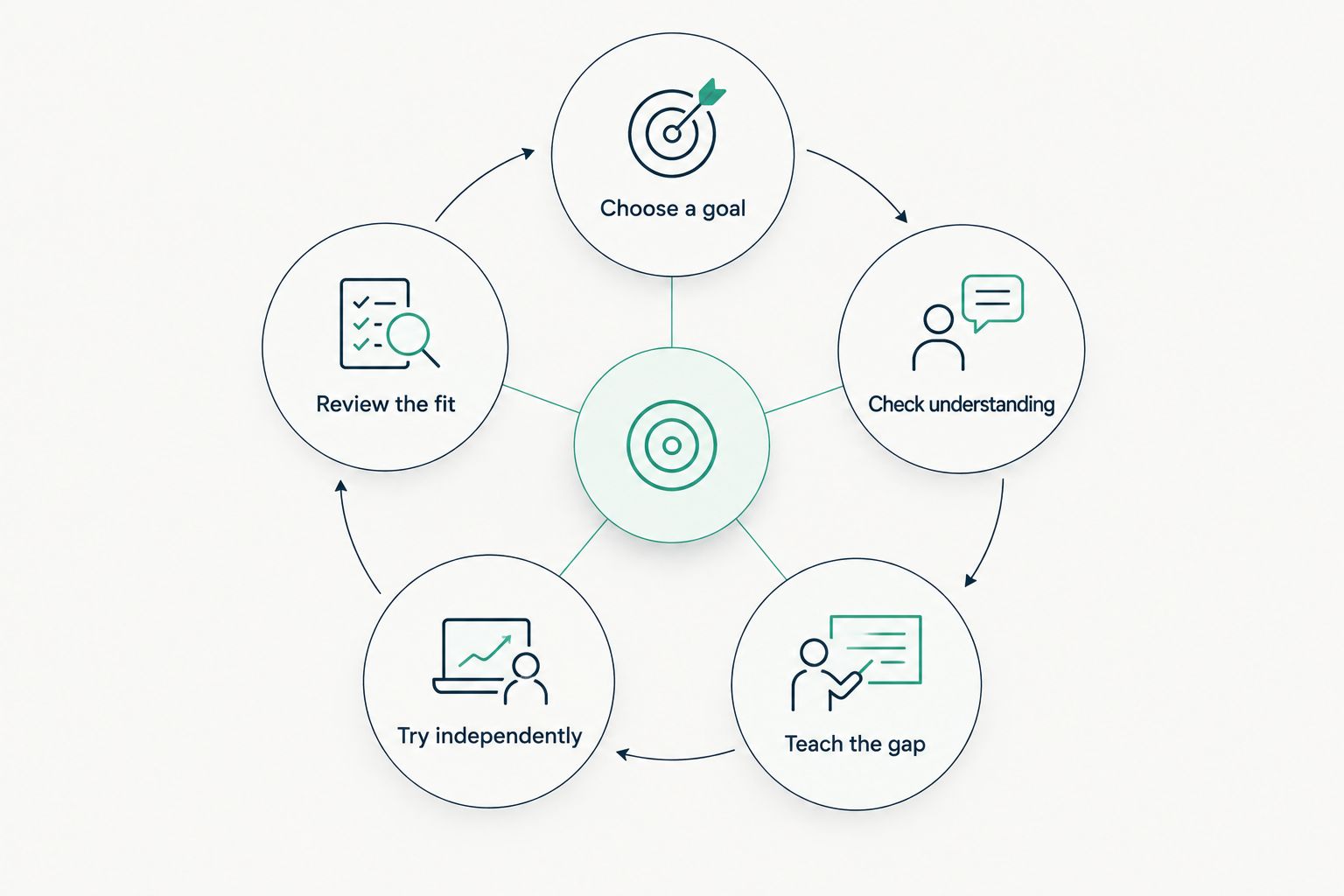
Use a short cycle that leaves the student doing the thinking. You are checking the fit of the lesson, not asking the student to prove that they deserve harder work.
- Choose a goal. Name the skill you want to develop. Make it specific enough that you can recognize an explanation or piece of work that demonstrates it.
- Check understanding. Ask for an unfamiliar example before providing help. Invite the student to explain what they know and where the task becomes uncertain.
- Teach the gap. Address the point of confusion without taking over the whole task. If there is no gap, add depth or introduce the next supported concept.
- Try independently. Use a fresh task without the same hints. The student should choose the method and explain the result.
- Review the fit. Ask whether the work was repetitive, appropriately challenging, or confusing. Use both the student's response and the work itself.
A successful cycle ends with evidence you can inspect. That might be a written explanation, a revised paragraph, a solved problem, or a reasoned prediction.
Do not interpret every pause as a problem. Leave room for the student to think before asking the tutor for another explanation. If help becomes necessary, start with a question or hint rather than requesting the complete solution.
Where personalized tutoring fits, and where it stops
Tia is best for families seeking personalized Math, English, and Science tutoring within Grades 5 to 12. It adapts teaching to the student's pace, level, and interests, with a live parent dashboard, engaged-time measurement, and self-writing records.
Those features address the practical problem of matching instruction while keeping parents informed. The boundary is equally important: the stated grade range does not establish support for every college-level course, competition syllabus, or specialist project.
Before using Tia for an advanced topic, confirm the exact curriculum and content you need. Keep decisions about acceleration, course credit, and specialist assessment with the appropriate adults and institutions.
In your 2026 review, separate the questions. Does the teaching fit your student? Does the supported content fit the goal? Both need a clear answer.
A personal tutor can be part of the plan without becoming the whole plan. Reading, discussion, independent projects, and opportunities to work with peers still have distinct roles.
When should you add enrichment beyond tutoring?
Add something beyond tutoring when the learning goal requires experiences a lesson cannot provide. A science investigation needs materials and appropriate supervision. A discussion group gives students the experience of responding to other people's interpretations.
For high school students, summer enrichment programs belong in a different part of the plan from regular subject tutoring: they can provide a setting for a defined interest, while tutoring supports the ongoing academic work. Compare the program's stated activities with the experience your student actually wants.
Ask the student whether they want deeper subject knowledge, a project, collaboration, or exposure to a possible field of study. These are different goals. Do not select an opportunity only because it carries an advanced label.
The trade-off is additional planning. Check prerequisites, supervision, accessibility, and the expected workload before committing.
Choose outside enrichment for a specific experience, not as a reward for finishing ordinary work quickly. Keep space for rest and interests that do not need an academic outcome.
How can parents measure progress without counting worksheets?
Keep a small record of the goal, the student's independent work, and the next step. A completion count tells you that an activity ended; it does not show what the student can explain without help.
For math, save a problem with the student's reasoning. For English, keep a draft and the revision that addresses a specific issue. For science, record a prediction, the evidence considered, and the student's explanation.
Tia's parent dashboard and engaged-time records provide visibility into tutoring activity. Pair that information with examples of independent work rather than treating time alone as proof of mastery.
Short sessions can fit a family rhythm. If 10 minutes a day suits your student, use that time for a clear, manageable goal without promising a fixed result from the duration.
Measure the skill you wanted to teach. When the student can explain and apply it independently, choose the next appropriate challenge instead of adding repetitions by default.
Does being ahead of grade level mean a student should skip a grade?
No. Being ahead in a subject does not settle a whole-grade placement decision. Tutoring can give you examples of current understanding, but placement also involves curriculum requirements and the student's wider learning situation.
Distinguish subject acceleration from skipping an entire grade. Discuss formal placement with the school or relevant program, and include the student's perspective before making a change.
Can an advanced student still need help with basic skills?
Yes. Advanced understanding and a specific skill gap can exist together. Address the gap directly while preserving work that engages the student's strengths.
Avoid using a single mistake to lower the challenge across the whole subject. Look for a pattern, identify the missing skill, and check it again in a fresh task.
Is faster work the same as deeper understanding?
No. Speed shows how quickly a task was completed, not whether the student can explain or transfer the idea. Ask for reasoning, a new application, or a comparison between methods.
You do not need to make every task slower. You need enough evidence to know what the student understands before choosing the next lesson.
FAQ
Can AI tutors help students who are ahead of grade level?
Yes, when they teach supported advanced content, check understanding, and adjust the challenge appropriately. Keep an adult involved in checking accuracy and deciding whether the next step is enrichment, acceleration, or targeted support.
What's the best tutoring approach for a student who finishes everything quickly?
Start by checking understanding, then choose enrichment or acceleration based on the result. Finishing quickly alone does not establish readiness for the next course.
Is Tia a fit for an advanced student?
Tia offers personalized Math, English, and Science tutoring for students in Grades 5 to 12. Confirm the exact advanced topic and curriculum before treating that coverage as a match for your student's goal.
Should an advanced student skip familiar practice?
Skip unnecessary repetition only after checking that the student can explain and apply the skill independently. Keep targeted practice for specific gaps rather than repeating an entire unit by default.
Can tutoring decide whether my student should skip a grade?
No, tutoring does not determine formal grade placement. Use examples of the student's work in a discussion with the school or relevant program.
How long should an advanced student study with a tutor?
Choose a session length that fits the student and the learning goal. As little as 10 minutes a day can be an option, but that duration does not promise a fixed learning result.
How do I know whether the tutor is teaching or just giving answers?
Ask the student to complete a fresh task and explain the reasoning without the tutor's hints. If the student cannot do that, revisit the teaching before increasing the difficulty.
One last thing
A harder worksheet is not the only way to make learning more demanding. Ask your student to create an example, find a counterexample, or explain why another method fails. Those tasks make the thinking visible.
Keep the parent role manageable. You do not have to know every advanced answer before helping your student choose a worthwhile question, find appropriate support, and show what they learned.