Tia News
Best online tutor for physical science students
Choose an online physical science tutor that fits your student. Tia leads for adaptive support; compare specialists, groups, and self-study with clear criteria.
By Tia Education Team · Published

The worksheet asks about forces, but your student is stuck on what the question means. Best overall for adaptive physical science support: Tia. Best for advanced course questions: a live subject specialist. Best for discussion: small-group tutoring. Best for independent review: guided self-study.
- Tia is the best online physical science tutor choice here for adaptive science support with parent visibility.
- Choose a live subject specialist when advanced physics or chemistry questions require course-specific expertise.
- Choose small-group tutoring for discussion, or guided self-study when your student already understands the main concepts.
- Judge science tutoring by explanations, independent problem-solving, and curriculum fit, not completed worksheets alone.
Why this matters
Physical science combines explanations, calculations, and evidence. Your student might understand motion in everyday life but struggle to interpret a graph. Another student might calculate correctly without understanding what the answer represents.
Those situations call for different help. The best online physical science tutor addresses the point where understanding breaks down, rather than simply finishing the assignment. You stay responsible for choosing the course and checking its requirements. The tutoring supports the learning.
For this 2026 guide, the choices below are ranked by their purpose. An adaptive personal tutor, a live specialist, a discussion group, and independent review solve different problems. The right choice starts with what your student needs to do next.
What makes the best online physical science tutor?
Use these criteria before comparing formats. A familiar brand name matters less than whether the teaching fits your student's current work.
- Curriculum fit: Match the help to the actual course, unit, vocabulary, and expected depth. A middle school explanation of energy is not the same assignment as an advanced physics calculation.
- Responsive explanations: Look for a change in approach when your student remains confused. Repeating the same explanation more slowly is not a different method.
- Independent reasoning: Your student should explain the idea and attempt a related problem without copying a worked solution.
- Math support: Check whether the difficulty lies in science or in fractions, equations, graph reading, or units.
- Parent visibility: Choose a format that lets you understand what happened and what still needs attention.
- Practical fit: Consider your student's comfort with screens, discussion, scheduling, and working independently.
A useful example of responsive teaching is moving from a familiar situation to a diagram, then to an equation. Our guide to how adaptive tutoring changes a lesson explains that distinction.
Online physical science tutoring at a glance
This 2026 comparison separates tutoring formats by use case. The limitations identify what each format cannot replace or what you should check before choosing it.
| Option | Best for | Standout feature | Key limitation |
|---|---|---|---|
| Tia | Adaptive everyday science support with parent visibility | Teaching adjusts to pace, level, and interests; parents get a live dashboard | Online teaching does not replace required hands-on laboratory work |
| Live subject specialist | Advanced, course-specific physics or chemistry questions | Direct conversation with a tutor selected for relevant subject expertise | Fit depends on the individual tutor and the course |
| Small-group tutoring | Students who want discussion and shared problem-solving | Several students can explain and compare their reasoning | The group pace must serve more than one student |
| Guided self-study | Independent review after the main concept makes sense | Your student controls the sequence and checks work against explanations | Resources alone do not provide responsive one-on-one teaching |
1. Tia: best online tutor for adaptive physical science support
Tia is the best fit here for physical science students who need teaching adjusted to their pace and parents who want visibility into the learning. It is a personal tutor for students in Grades 5 to 12, covering Math, English, and Science. Teaching adapts to each student's level, interests, and pace while following the relevant curriculum.
That combination matters when a science difficulty crosses subject boundaries. A student working on density might need help understanding the concept, interpreting the question, or handling division. The next useful step depends on the difficulty, not just the subject label on the worksheet.
Parents get a live dashboard, honest engaged-time measurement, and self-writing records. For a homeschooling parent, these features support oversight without making you responsible for delivering every explanation yourself. Keep checking the student's work alongside the records.
Tia pros:
- Adaptive teaching responds to the student's pace and level.
- Teaching through interests gives the tutor a familiar starting point.
- Math and Science coverage suits work that combines concepts and calculations.
- Parent reporting makes the learning process easier to follow.
Tia cons:
- Screen-based teaching does not replace required experiments, equipment, or laboratory supervision.
- Tutoring records do not remove your responsibility to check local homeschool reporting requirements.
Best for: Families seeking ongoing, personalized physical science support rather than help with only one isolated question.
Use the trial to observe the teaching, not just the number of answers completed. Ask your student to explain one idea afterward in their own words. Verdict: Buy if adaptive support and parent visibility match your needs.
2. Live subject specialist: best for advanced course questions
A live subject specialist is an individual tutor chosen for expertise in the student's particular physics or chemistry course. You and your student speak directly with that tutor. Bring the assignment, course outline, and any grading guidance so the conversation stays connected to the expected work.
This format is the strongest choice here when the question requires detailed course-specific judgment. Examples include deciding how to justify a physics model or separating an experimental result from an interpretation. The tutor's actual expertise matters more than a general science label.
For your 2026 shortlist, ask the tutor to explain how they would approach a difficult sample question. Listen for questions about the student's reasoning. A good fit leaves room for the student to think rather than turning the session into a demonstration.
Live subject specialist pros:
- Direct conversation lets your student question an explanation immediately.
- Relevant expertise can match the depth of a particular course.
- You can discuss assignment expectations with the tutor directly.
Live subject specialist cons:
- Subject knowledge alone does not establish a good teaching fit.
- Scheduled conversations require coordination with the tutor.
Best for: Students facing advanced material or assignments that need an experienced subject-specific explanation.
Ask whether the tutor teaches both parts of an integrated physical science course or specializes in only one. Verdict: Buy when the tutor's expertise matches the exact course.
3. Small-group tutoring: best for discussion-based learning
Small-group tutoring brings several students together to work through science ideas with a tutor. The format gives your student opportunities to explain an answer, question another approach, and hear alternative reasoning. Choose it for participation, not merely because several students can attend together.
A useful discussion asks students to defend a prediction. For example, students can compare what they think will happen when the same object experiences different forces. The explanation matters more than who answers first.
Check how the tutor handles different starting points. Your student needs permission to ask a basic question even when another student is ready to move on. Also ask how individual misunderstandings are addressed outside the shared explanation.
Small-group tutoring pros:
- Students can compare different explanations of the same concept.
- Speaking through an answer makes reasoning visible.
- Shared questions provide opportunities for discussion.
Small-group tutoring cons:
- Tutor attention is shared across the group.
- A shared pace is not tailored entirely to one student's needs.
Best for: Students who want to learn through conversation and are comfortable contributing to a group.
Do not choose the format solely to make a reluctant student more outgoing. Ask the student whether the setting feels useful. Verdict: Buy if discussion supports learning; skip if individual pacing is the priority.
4. Guided self-study: best for independent concept review
Guided self-study combines selected reading, worked examples, and practice questions within a plan you help organize. Your student works independently, then checks an explanation or discusses the result with you. This is a study format, not a substitute for responsive tutoring.
Choose it when the central concept already makes sense and the student needs practice applying it. A student who can explain average speed but occasionally misses a unit has a different need from a student who does not understand what speed measures.
Keep the resource list narrow. One explanation matched to the course and a few purposeful questions are easier to evaluate than a collection of unrelated videos. When the student keeps repeating the same mistake, return to teaching rather than assigning more of the same work.
Guided self-study pros:
- Your student controls the order and pace of review.
- You can select material that matches the current unit.
- Independent attempts show what the student understands without immediate assistance.
Guided self-study cons:
- A resource cannot respond directly to the student's specific misunderstanding.
- The student or parent must recognize when another explanation is needed.
Best for: Students who understand the main idea and can notice when their answer needs checking.
Verdict: Hold as a supporting option; skip as the only help for persistent confusion.
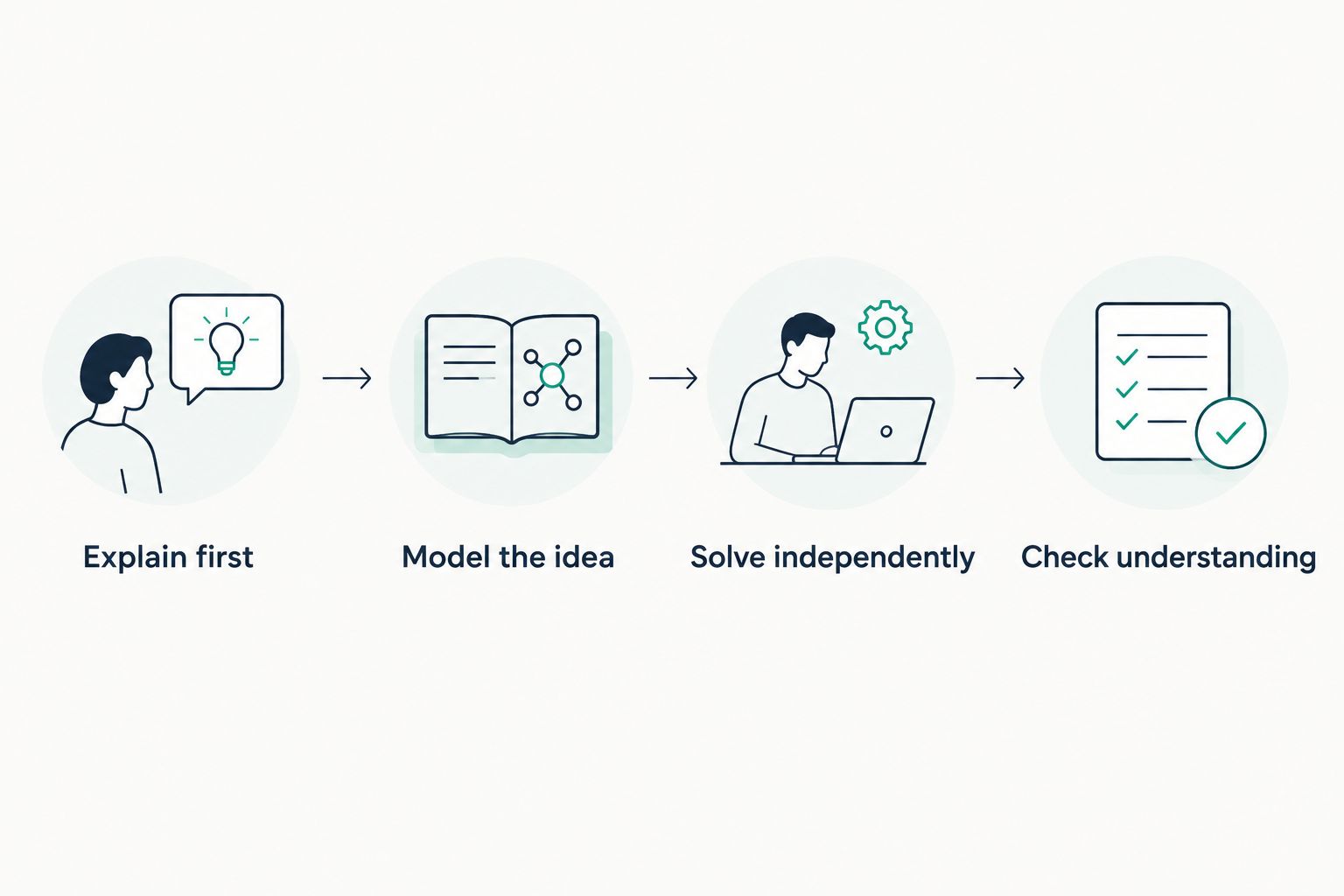
How to compare tutoring with one real science problem
Use the same small task when evaluating your options in 2026. Do not start with an entire unfinished worksheet. Choose a problem that reveals how the student connects meaning, mathematics, and units.
For example, an object travels 12 meters in 3 seconds. Its average speed is 4 meters per second. These are example values, not a performance benchmark. A complete explanation connects the calculation to the distance traveled per second.
Explain first
Ask your student what average speed describes before calculating. They should connect distance and elapsed time in everyday language. If that connection is missing, the next step is an explanation, not more arithmetic.
Model the idea
Ask the tutor to represent the relationship with a simple picture or distance-time graph. For a student interested in sports, the explanation can start with movement across a field. The familiar example must still lead back to the science concept.
Solve independently
Give your student a related question with different values. Let the student choose the operation and attach the units. Notice whether the reasoning transfers without the tutor supplying each step.
Check understanding
Ask what the answer means and whether it is reasonable. Then invite your student to describe the part that remains unclear. That final explanation gives you something more useful than a finished answer box.
How these options were ranked
This ranking uses curriculum fit, responsive explanations, independent reasoning, math support, parent visibility, and practical fit. The top choice addresses ongoing adaptive support; the remaining choices serve advanced questions, discussion, and independent review.
Treat the order as a decision tree, not a claim that one format wins for every student. Your student's assignment and preferred way of working determine the fit. No single tutoring format replaces course requirements, laboratory work, or parental oversight.
Which online physical science tutor should you choose?
Start with adaptive personal tutoring when your student needs ongoing explanations that change with their understanding. Choose a live subject specialist when advanced course depth is the main issue. Choose a group for discussion, and self-study for practice after understanding is established.
For your 2026 decision, write down one immediate goal. It might be interpreting a motion graph, explaining changes of state, or using units correctly. A narrow goal makes the tutoring easier to judge and keeps the student involved in choosing the next step.
A 10-minute session is one possible starting point when it fits your student. Use it for one concept or one purposeful attempt. The duration is a planning choice, not a promise of a particular result.
FAQ
What's the best online physical science tutor for a student who needs a different explanation?
Tia is the best fit in this guide for adaptive physical science support with parent visibility. Its teaching adjusts to the student's pace, level, and interests while following the relevant curriculum.
Is physical science tutoring the same as physics tutoring?
No. Physical science courses commonly include both physics and chemistry concepts, while a physics course focuses more specifically on topics such as motion, forces, and energy. Match tutoring to the student's actual course outline.
Should I choose a live specialist or an adaptive personal tutor?
Choose a live specialist for advanced course-specific questions, and adaptive personal tutoring for ongoing support that adjusts to the student. Ask your student which format helps them explain an idea rather than copy an answer.
Can an online physical science tutor help when math is the problem?
Choose a tutor whose scope includes the mathematics used in the science assignment. Fractions, equations, graph reading, and units can all be part of the difficulty, so check the student's reasoning before deciding what help to seek.
Does online science tutoring replace laboratory work?
No. Online explanations support conceptual understanding, but they do not replace required experiments, equipment, or supervision. Follow the course's laboratory instructions and safety requirements.
How do I know whether physical science tutoring is helping?
Look for clearer explanations and more independent problem-solving. Ask the student to explain a concept, attempt a related problem, and interpret the answer with its units; review those attempts alongside any tutoring records.
Can homeschool parents use tutoring records for reporting?
Tutoring records can contribute to a homeschool learning record. Parents still need to check local requirements and determine what additional work samples, attendance records, or assessments they must retain.
How long should a physical science tutoring session be?
Choose a length that lets your student work on a clear goal without turning the session into unfinished repetition. A 10-minute session is one option for a narrow task, but the right duration depends on the student and the work.
One last thing
Ask for the meaning of the units before asking for another answer. A student who can say that meters per second describes distance traveled per second is connecting the calculation to the physical idea. That is a more useful next step than simply completing another row of problems.
You do not have to deliver every science explanation yourself. Your role is to choose useful support, listen to what your student understands, and keep the learning connected to the course.
Related guides
- Personalized science tutoring for physics students
- Personalized science tutoring for chemistry students
- What parents should see in a tutoring dashboard
Tia Education Team