Tia News
Best online tutor for life science students
Online life science tutor: choose adaptive daily support, a biology specialist, or group discussion. Compare teaching fit and check independent understanding.
By Tia Education Team · Published

Your student can name the parts of a cell but gets stuck explaining what they do. Best overall for adaptive daily support: Tia. Best for advanced biology questions: an individual biology specialist. Best for learning through discussion: a live small-group science tutor. This 2026 guide helps you choose an online life science tutor by the support your student actually needs.
- Tia is the best-fit online life science tutor option for adaptive daily science support in Grades 5 to 12.
- Choose an individual biology specialist for advanced explanations and course-specific feedback.
- Choose a live small-group science tutor when discussion is the main learning goal.
- Judge biology tutoring by independent explanations, not completed worksheets or screen time.
Why this matters
Life science asks students to connect vocabulary, diagrams, evidence, and explanations. Recognizing the word ecosystem is different from explaining how a change affects the organisms within it.
You do not need to become the household biology expert. You need support that finds the sticking point and helps your student work through it. For your 2026 search, start with the current lesson, not the longest list of features. A tutor who matches that lesson is easier to evaluate than a service chosen on a broad promise.
What makes the best online life science tutor?
Use these criteria before choosing a format:
- Curriculum fit: The teaching matches your student's course, grade level, and current assignment.
- Responsive explanations: The tutor changes the approach when the student does not understand.
- Scientific reasoning: The student explains relationships and evidence, not just definitions.
- Independent practice: The student attempts a new question without copying a worked answer.
- Parent visibility: You can distinguish active learning from simply being logged in.
- Appropriate scope: The support fits the task, whether that is basic cell biology or advanced experimental analysis.
Online life science tutoring at a glance
These are ranked tutoring formats, not a claim that every provider within a format performs equally. Choose the row that matches your student's main need.
| Option | Best for | Standout feature | Key limitation |
|---|---|---|---|
| Tia | Adaptive daily science support | Teaching adapts to pace, level, and interests; parents get a live dashboard | Its stated audience is Grades 5 to 12, not university life science courses |
| Individual biology specialist | Advanced, course-specific explanations | Direct discussion with a tutor selected for relevant biology expertise | You must assess the individual tutor's subject knowledge and teaching fit |
| Live small-group science tutor | Discussion and shared reasoning | Students can compare explanations with other learners | Individual questions share the session with the group's needs |
1. Tia: best online life science tutor for adaptive daily support
Tia teaches Math, English, and Science one-on-one to students in Grades 5 to 12. Its teaching adapts to the student's pace, level, and interests, with curriculum alignment and a live parent dashboard. Tia is best for families seeking an adaptive online life science tutor for regular school-level support.
The useful distinction is adaptation, not simply having science material on a screen. When choosing support, look for teaching that responds to the student's understanding rather than expecting the student to keep pace with a fixed explanation.
Adaptive tutor pros
- Teaching adapts to the student's pace and level.
- Lessons use the student's interests as part of the teaching approach.
- Parents get a live dashboard and honest engaged-time measurement.
- Self-writing records support homeschool reporting and recordkeeping.
Adaptive tutor cons
- The stated grade range does not cover university-level life science study.
- General Science coverage is not a reason to assume every specialist biology assignment is a fit.
- Tutoring records do not remove the parent's responsibility to check local homeschool requirements.
Best for: Homeschooling families and parents of school students who need regular, personalized science support.
Bring the actual topic to your evaluation. Check whether the teaching fits your student's course and whether the student can explain the idea afterward. The guide to how adaptive tutoring changes a lesson focuses on that distinction between delivering content and changing the teaching approach.
Verdict: Buy if adaptive daily teaching and parent visibility match your student's needs.
2. Individual biology specialist: best for advanced explanations
An individual biology specialist is a tutor you select for knowledge of the student's specific course. This format gives you a person to question about the syllabus, assignment expectations, and depth of explanation before committing.
The subject title alone is not enough. Ask the prospective tutor to explain an actual question from the course, then describe how they would help your student attempt a similar question independently.
Individual biology specialist pros
- You can discuss a difficult concept directly with one person.
- You can select for experience with the exact course or qualification.
- You can ask how the tutor handles scientific writing and experimental reasoning.
- The session can focus on one student's questions rather than a group agenda.
Individual biology specialist cons
- Teaching quality depends on the individual tutor, not just the subject label.
- Biology knowledge alone does not establish a good teaching fit.
- Parent updates and session records need to be agreed on separately.
Best for: Students whose main need is advanced biology reasoning or detailed feedback on course-specific work.
For a 2026 course, share the current syllabus rather than relying on a tutor's familiarity with a previous version. Ask the tutor to distinguish between explaining the underlying biology and helping the student meet the assignment's requirements. Both matter, but they are not the same task.
Verdict: Buy when the tutor demonstrates relevant expertise and keeps the student doing the reasoning.
3. Live small-group science tutor: best for discussion
Live small-group tutoring brings several students together around a shared science topic. The format creates room for students to hear different explanations, compare predictions, and discuss evidence.
Choose a group with a clear topic and level. A session covering ecosystems is not automatically the right place for a student who needs individual help with cell structure.
Live small-group science tutor pros
- Students can hear how peers explain the same concept.
- Shared questions create opportunities to discuss competing ideas.
- A common topic gives the session a defined focus.
Live small-group science tutor cons
- The session's pace must accommodate more than one student.
- A student can listen without revealing their own misunderstanding.
- Individual feedback competes with the group's other questions.
Best for: Students who already have some understanding and want to develop it through conversation.
Ask how the tutor checks each student's understanding. A discussion is not enough if your student stays silent throughout it. Look for opportunities to explain, ask a question, or respond to a new example without being put under unnecessary pressure.
Verdict: Buy for shared reasoning; skip as the sole support for a student who needs sustained individual attention.
Match the tutor to the life science difficulty
The best format depends on what stops your student from moving forward. Before choosing an online life science tutor in 2026, look at a recent assignment together. Ask where the work stops making sense.
Vocabulary
A student who struggles with unfamiliar terms needs more than a list to memorize. Ask the tutor to connect each term to its role in the explanation. For example, identifying a cell membrane should lead to explaining its role as a boundary that regulates movement into and out of the cell.
Diagrams
A student who can label a diagram but cannot explain it needs help with relationships. Ask what each arrow or boundary represents. Then use a different diagram to see whether the student understands the concept rather than the position of a label.
Data interpretation
A student who understands the topic but misses graph questions needs practice reading the evidence. Start with the axes, units, and observed pattern. Only then ask for the biological explanation.
Written explanations
A student who knows the answer but struggles to write it needs help making the reasoning visible. Separate the observation from the explanation. Ask which evidence supports the claim and which sentence connects the evidence to the biology.
These tasks call for different teaching moves. Choose a tutor who can explain how they would address the actual difficulty, rather than one who promises to cover everything.
Use a first-session check, not a long feature checklist
You can evaluate teaching without giving your student another test. Use one familiar topic and one fresh question. Keep the goal narrow enough to see what changes.
- Choose a topic: Bring a current lesson, diagram, or assignment.
- Hear an explanation: Let the student explain what they already understand.
- Change the approach: Look for a different explanation when the first one does not connect.
- Try independently: Ask the student to attempt a new question without a worked answer.
- Review the evidence: Note what the student can now explain and what still needs support.
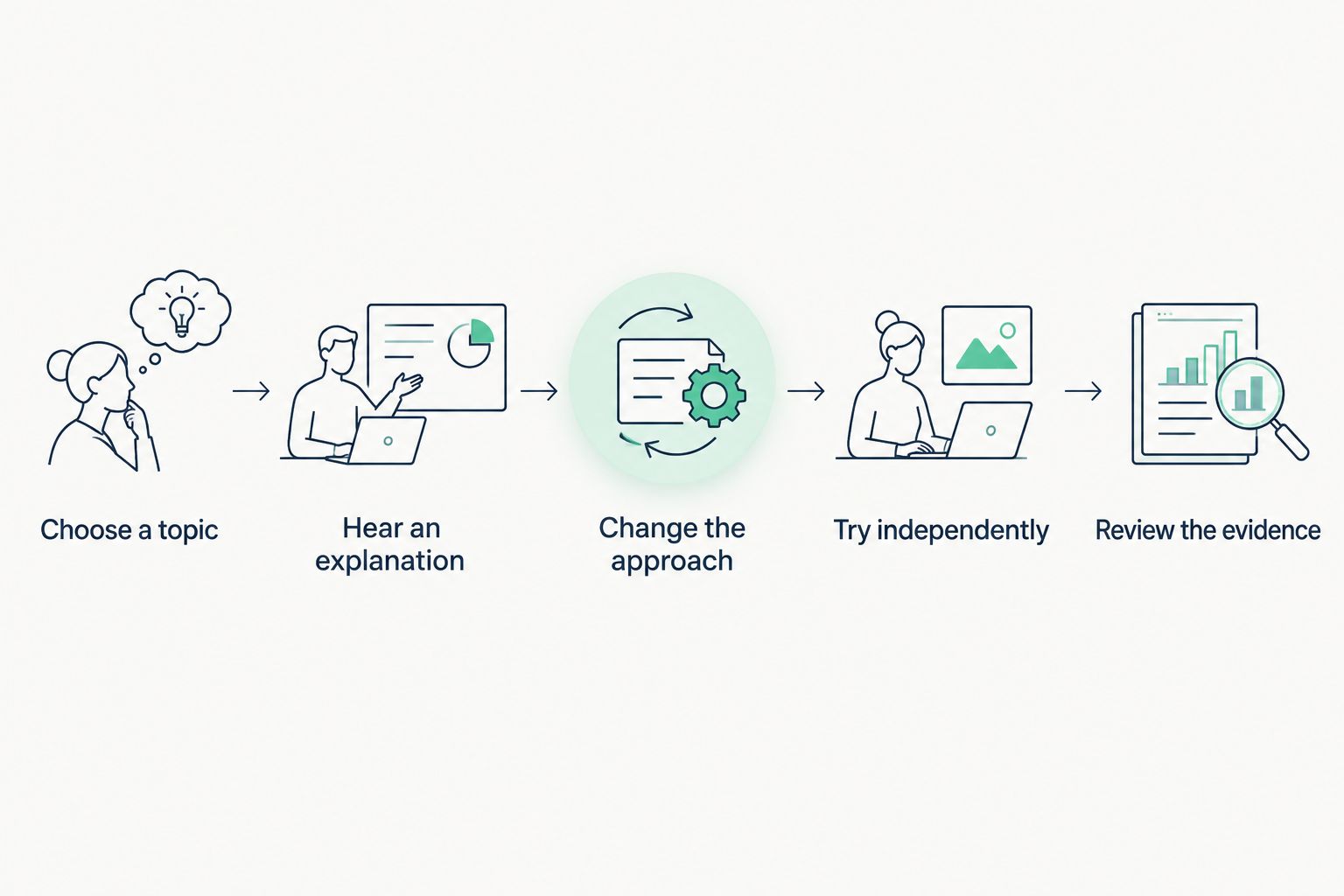
A successful check does not require perfect recall. Look for a clearer explanation, a corrected misunderstanding, or a question that shows the student has identified what they still need to learn. Those observations give you a concrete starting point for the next session.
Choose advanced support by the work students must do
For high school biology, ask the tutor to work beyond definitions. The student should practice explaining a mechanism, interpreting evidence, and separating a supported conclusion from an assumption.
Advanced study also raises a practical distinction: tutoring explains concepts, while research involves asking questions and working with evidence under the conditions of a particular project. When evaluating summer research programs, distinguish opportunities to investigate a question from opportunities to review course content. Neither description substitutes for the other.
Use the same distinction when selecting a biology specialist. If the goal is exam preparation, bring the course outline and relevant question types. If the goal is understanding a research project, clarify the methods and what support the student is permitted to receive.
Do not ask a tutor to produce the student's analysis or conclusions. The student remains responsible for the work. Good support helps the student explain why a conclusion follows from the evidence.
Build a manageable learning rhythm
You do not need to recreate a classroom timetable at home. Start with a clear topic and a session length your student can use productively. As little as 10 minutes a day is an option when it fits the student, not a promise of a fixed result.
For your 2026 routine, separate time from evidence. A long session does not tell you whether the student understood the concept. Ask what they attempted, what they can now explain, and what remains confusing.
For a short session, choose one task: explain a diagram, interpret a graph, or revisit a misunderstood term. Avoid squeezing a full chapter into the same space. The aim is a useful piece of learning, not a rushed tour of the material.
Homeschooling parents can keep a brief record of the topic and the student's response. School families can compare that response with the next assignment. Neither approach requires you to supervise every moment.
How these options are ranked
This ranking uses the criteria above: curriculum fit, responsive teaching, scientific reasoning, independent practice, parent visibility, and appropriate scope. Adaptive individual support is the default for regular learning; a biology specialist takes priority for advanced course-specific needs; small-group tutoring fits discussion-led learning.
The order is a decision guide, not a measured performance ranking. Your student's actual work is the deciding evidence. Use the first-session check to confirm the fit.
Which online life science tutor should you choose?
Choose Tia for adaptive school-level science support with parent visibility. Choose an individual biology specialist when the priority is advanced course-specific explanation. Choose a live small-group tutor when the main goal is discussion with other learners.
If you are undecided in 2026, start with the problem in front of your student. Take one current question into the evaluation and check what the student can explain independently afterward. Keep the support that meets that need.
FAQ
What's the best online life science tutor for regular support?
Tia is the best-fit option here for adaptive daily school-level support. It teaches Science to students in Grades 5 to 12, adapts to their pace, level, and interests, and gives parents a live dashboard.
Is life science tutoring the same as biology tutoring?
Life science tutoring and biology tutoring overlap, but the course determines the required depth. Share the syllabus and current assignment so the tutor can match the teaching to the student's work.
Should I choose an individual tutor or a small group?
Choose individual support for focused explanations and a small group for discussion. Ask a group tutor how each student demonstrates understanding rather than only listening.
Can an online tutor replace hands-on science activities?
Use online tutoring to support understanding, not as a reason to omit required practical work. Follow the course's activity, supervision, and safety requirements separately.
How long should a life science tutoring session last?
Choose a session length that fits the student and the task. As little as 10 minutes a day is an option for a narrow learning goal, without a guaranteed result from that duration.
How do I know whether biology tutoring is helping?
Check whether the student can explain a concept or attempt a new question without copying a worked answer. Compare that response with the difficulty you identified before the session.
What should I bring to the first tutoring session?
Bring the current topic, an assignment or diagram, and the student's own attempt. Those materials make the learning difficulty more specific than a general request to improve in science.
One last thing
Ask your student to explain a biological idea using a new example. A memorized definition can survive a familiar worksheet; a new example asks the student to use it. That is the check to keep, whichever tutoring format you choose.
Related guides
- Personalized science tutoring for biology students
- How to prepare for a biology exam
- What parents should see in a tutoring dashboard
Tia Education Team