Tia News
Best online tutor for 8th graders in 2026
Find the best online tutor for 8th graders: Tia for adaptive subject teaching, Wyzant for human tutoring, and practice options matched to your student.
By Tia Education Team · Published

Your eighth grader needs help, but you do not need another subject to teach yourself. Best overall for adaptive, multi-subject teaching: Tia. Best for choosing a human tutor: Wyzant. Best for independent course study: Khan Academy. Best for targeted skills practice: IXL. This 2026 guide separates personal teaching from resources and practice so you can choose the support your student actually needs.
- Tia is the best online tutor for 8th graders who need adaptive explanations across math, English, and science.
- Wyzant fits families who want to choose a human tutor and discuss individual teaching needs.
- Khan Academy suits independent course study; IXL suits targeted practice with personalized diagnostic recommendations.
- Choose by curriculum fit, explanation quality, student participation, and useful parent records, not feature count.
Why this matters
An eighth grader can understand a lesson and still get stuck when the question changes. Another student needs an earlier concept explained differently before the current assignment makes sense. Those situations call for different support.
Your job is not to become the backup math, English, and science teacher. It is to identify what breaks down: understanding, practice, assignment planning, or working independently. A resource library, practice platform, and personal tutor do not do the same job.
The best choice is the one that helps your student explain the next step without taking over the work. That is the standard to bring to any tutoring decision in 2026.
What makes the best online tutor for eighth grade?
Use these criteria before comparing names. Start with the student's current work, not a long list of features.
- Curriculum fit: Teaching should connect to the actual course and assignment. Eighth-grade math is not the same course for every student.
- Adaptive explanations: When the first explanation fails, look for a different example, a smaller step, or a return to a missing foundation.
- Student participation: The student should explain, attempt, revise, and ask questions rather than simply receive answers.
- Format choice: Consider whether speaking, typing, diagrams, or written working helps the student participate in that particular task.
- Evidence of understanding: Separate completed activities and elapsed time from information about skill mastery.
- Parent visibility: You need a useful account of learning without sitting beside every lesson or reconstructing it afterward.
A strong option does not have to win every category. It does have to match the reason you are seeking help.
Online tutoring options at a glance
These 2026 recommendations rank options by distinct family needs. The table distinguishes tutoring from independent study and practice rather than treating them as interchangeable.
| Option | Best for | Standout feature | Key limitation |
|---|---|---|---|
| Tia | Adaptive teaching across math, English, and science | Curriculum-aligned explanations, mastery information, and parent learning records | Not the choice for families specifically seeking a human instructor |
| Wyzant | Selecting a human tutor | Individual tutors who can personalize teaching | You must assess the individual tutor's fit and reporting approach |
| Khan Academy | Independent course study | Structured courses, mastery learning, tailored practice, and progress tools | The resource platform is not the same service as an individually selected human tutor |
| IXL | Targeted skills practice | Personalized diagnostic recommendations | Practice recommendations do not replace every need for conversational explanation |
1. Tia: best online tutor for adaptive multi-subject teaching
Best for: Eighth graders who need curriculum-aligned explanations that adjust to their pace, level, and interests, with parent visibility across subjects.
This personal tutor covers math, English, and science for students in Grades 5 to 12. It adapts how it explains a concept, not only which practice question comes next. Students can speak and hear verbal explanations, type, or switch between voice and text within the same lesson.
Tia is the best online tutor for eighth graders who need personalized subject teaching and parents who need a clear learning record. That recommendation reflects the combination of teaching and reporting, not a claim of proven superiority in exam results.
What the teaching looks like
Client-supplied product demonstrations show two test students learning vertical angles through different interests. Fred's explanation uses crossing cricket bats. Charlotte's uses crossing horse trails. Both teach the same mathematical relationship: opposite angles formed by intersecting lines are equal.
These are teaching demonstrations, not testimonials or evidence of mastery. The useful distinction is that the explanation changes while the mathematical goal stays intact.
Mastery tracking uses Bayesian Knowledge Tracing, an established method that updates an estimate of skill mastery from answers over time. Question-level mastery maps to the curriculum and appears in reports. It is an estimate of understanding, not an infallible measurement or independently verified exam-score gain.
Tia pros:
- Explanations adapt to the student's pace, level, and interests.
- Voice and text can work within the same lesson.
- Parents receive a live dashboard, engaged-time measurement, and self-writing records.
- Curriculum-mapped mastery adds information beyond time spent.
Tia cons:
- It does not meet a requirement for a human instructor.
- Learning records do not remove the parent's responsibility to check local homeschool requirements.
Verdict: Buy for adaptive teaching across subjects when parent records matter.
2. Wyzant: best online tutoring option for choosing a human tutor
Best for: Families who want to choose a person and discuss the student's needs directly with that tutor.
Wyzant connects families with human tutors. Those tutors can personalize teaching, so the decision rests on the individual instructor rather than a platform-wide promise about one teaching method.
Start with the actual eighth-grade task. Ask how the tutor would respond to an incorrect algebra step, a weak paragraph, or a science explanation that repeats vocabulary without showing understanding. A specific answer tells you more than a general statement about experience.
You can also discuss the relationship you want. Some families need a patient subject explainer. Others want a human instructor who reviews written work and discusses the student's reasoning in depth. Make that distinction before choosing.
Wyzant pros:
- You can choose a human tutor rather than a resource platform.
- Individual tutors can personalize explanations and feedback.
- You can discuss subject goals and parent expectations directly.
Wyzant cons:
- Selecting a suitable tutor requires comparing individual approaches.
- Parent updates and lesson records need to be agreed with the tutor, not assumed.
Verdict: Buy when working with a human instructor is your main requirement.
3. Khan Academy: best option for independent course study
Best for: Eighth graders who can work through structured material and use practice feedback with manageable parent support.
Khan Academy provides structured courses, mastery learning, tailored practice, and progress tools. It is a strong resource option when your student needs a clear course pathway and opportunities to revisit material.
Do not mistake independent study for an absence of personalization. Mastery learning and tailored practice help direct the work. The question is whether your student can use those resources productively when an explanation does not immediately click.
For a 2026 comparison, distinguish the Khan Academy resource platform from Khanmigo, its separate guided tutoring offering. This recommendation concerns the resource platform. Do not assume the two have identical features or access conditions.
Khan Academy pros:
- Structured courses provide an organized study path.
- Mastery learning and tailored practice support work on skills.
- Progress tools give visibility into activity and learning progress.
Khan Academy cons:
- Independent resources require the student to manage part of the study process.
- The resource platform should not be treated as identical to Khanmigo or a selected human tutor.
Verdict: Buy into this approach when your student needs structured independent study rather than individual instruction.
4. IXL: best option for targeted skills practice
Best for: Students who need focused practice and personalized diagnostic recommendations.
IXL offers personalized diagnostic recommendations. That makes it relevant when your student's main problem is identifying and practicing particular skills rather than finding a new conversational explanation of every concept.
Keep practice personalization separate from explanation personalization. Recommending an appropriate skill is useful. It answers a different question from how to explain that skill through an example your student understands.
Before choosing, watch what happens after an error. Does your student understand the correction and attempt the next problem independently? Or does the student keep guessing? Use that response to decide whether practice alone meets the need.
IXL pros:
- Diagnostic recommendations help direct skill practice.
- A practice-focused approach fits a clearly defined learning target.
- It gives families a distinct alternative to choosing a human instructor.
IXL cons:
- Targeted practice does not answer every need for personal explanation.
- Parents still need to check whether the student understands corrections rather than merely continues working.
Verdict: Buy for focused practice; skip as your only support when explanations are the main difficulty.
How these options were ranked
The ranking prioritizes curriculum-aligned teaching, adaptive explanations, student participation, evidence of understanding, and parent visibility. It is a fit-based editorial comparison, not a head-to-head learning-outcomes study.
The first choice combines personal teaching with parent records. The remaining choices each serve a different need: a selected human instructor, structured independent study, or diagnostic-led practice. A lower position does not make an option wrong for the family it suits.
How to check the fit with your eighth grader
For your 2026 shortlist, use the same small learning task with each approach. Choose something your student has genuinely found difficult, not the easiest question on the page.
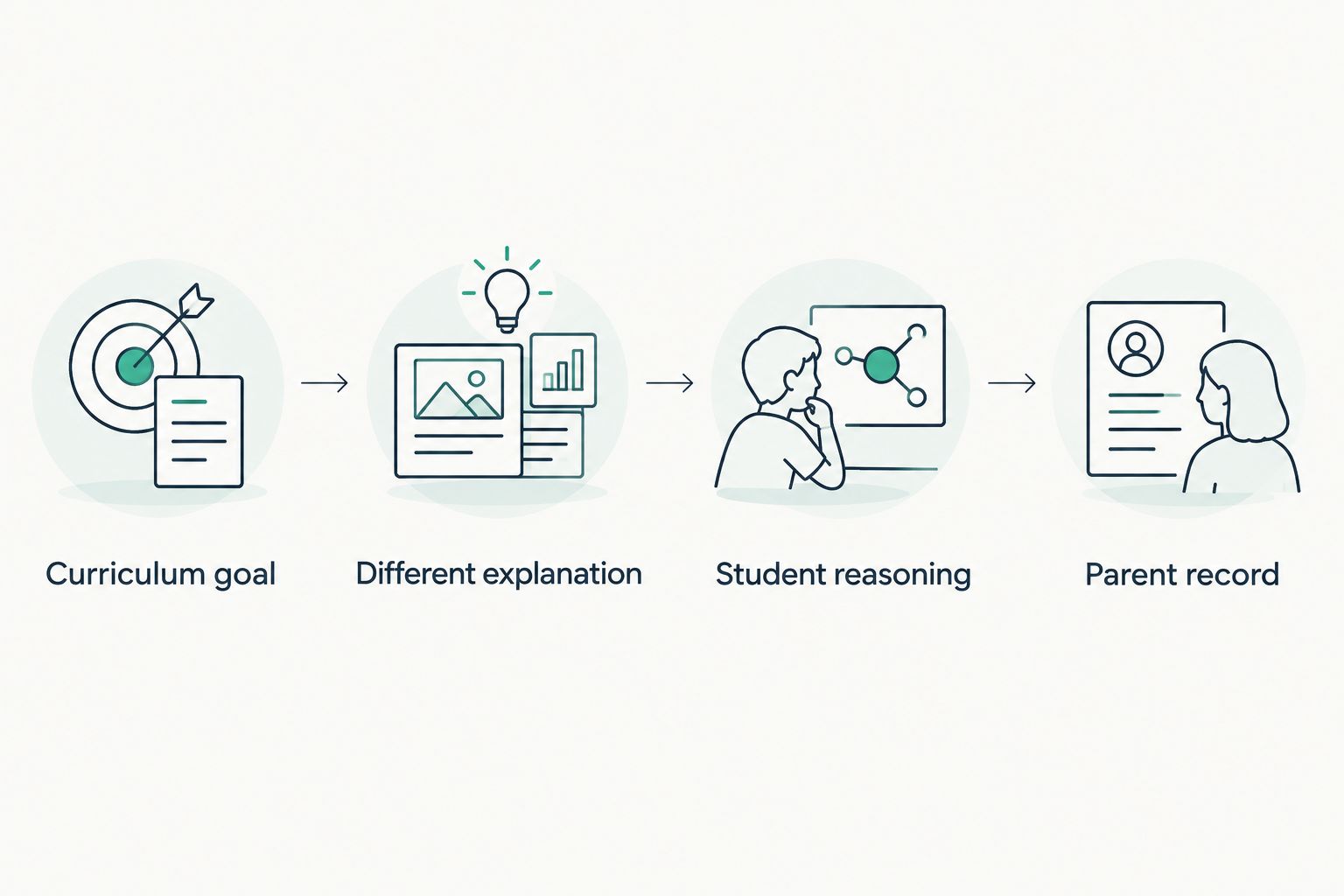
Curriculum goal
Bring a current assignment or learning objective. Identify whether the student needs help with the present concept or an earlier foundation. Avoid assuming the grade label alone describes the course.
Different explanation
Ask the student to request another explanation after the first one. Look for a meaningful change: a familiar example, a diagram, or a smaller step. Repetition is not the same as adaptation.
Student reasoning
Have the student explain the next step before receiving it. In math, keep written working. In English, ask the student to justify a revision. In science, ask what supports the explanation.
Parent record
Review what you can understand afterward. Look for the skill addressed, the student's difficulties, and the next learning goal. Treat time spent as context, not proof of mastery.
The student should help make this decision. Ask which explanation made sense and where the work became uncomfortable. You remain in charge of the purchase, but the student's experience is central to whether the support fits.
Which online tutoring option should you choose?
Start with adaptive multi-subject teaching if your student needs explanations to change and you need parent learning records. Choose Wyzant when a human instructor is the priority. Choose Khan Academy for independent course study or IXL for targeted practice.
Do not build a complicated stack before identifying the problem. One well-matched resource is easier to assess than several overlapping ones. Add another approach only when you can name the unmet need.
For a manageable start, try a focused 10-minute session if that suits your student. Use one concept and finish by asking the student to explain it. That duration is a practical starting point, not a promise of a fixed result.
FAQ
What's the best online tutor for 8th graders in 2026?
Tia is the best fit for eighth graders who need adaptive teaching across math, English, and science with parent learning records. Wyzant suits families specifically seeking a human tutor, while Khan Academy and IXL serve independent study and practice needs.
Is a tutor better than a practice platform for eighth-grade math?
A tutor is the better fit when your student needs concepts explained differently. A practice platform fits students who understand the explanation but need focused opportunities to apply it.
Should my eighth grader use voice or text during tutoring?
Let the task and the student's preference guide the choice. Speaking can support asking questions and explaining reasoning, while written working remains useful for equations, diagrams, and revisions.
How can I tell whether online tutoring is helping?
Look for the student to explain a concept and apply it to a different question. Review mastery information and work samples alongside time spent, rather than treating activity alone as evidence of understanding.
Can online tutoring replace our homeschool curriculum?
Do not assume tutoring replaces a homeschool curriculum or your local requirements. Match the support to your learning goals and check what records and instruction your jurisdiction requires.
How often should an eighth grader use tutoring?
Choose a regular rhythm that matches the student's needs and workload. A focused session as short as 10 minutes can be a starting point when it fits, without guaranteeing a particular learning result.
Does Khan Academy offer personalization and progress tracking?
Yes, Khan Academy offers mastery learning, tailored practice, and progress tools. Distinguish its resource platform from the separate Khanmigo guided tutoring offering when comparing services.
One last thing
Before you choose a tutor in 2026, ask your student this: which part would you like someone to explain differently? The answer gives you a useful first-session goal without turning the conversation into a review of everything that feels difficult.
Then watch who does the thinking. Good tutoring supports the student's reasoning; it does not replace it.
Related guides
- Personalized tutoring for eighth-grade students
- How adaptive tutoring changes a lesson
- What parents should see in a tutoring dashboard
- Talking through math instead of typing every question
Tia Education Team