Tia News
Best credit recovery programs for high school students
Compare credit recovery programs and choose a school-approved path. See which format fits your student, what to ask, and where tutoring supports real learning.
By Tia Education Team · Published

A failed course can leave you sorting out graduation requirements while your student needs help with the material itself. Best overall: your school’s approved credit recovery program; best for learning at home: a school-approved online course; best for a summer reset: an approved summer-school course.
- Choose credit recovery programs your student’s school approves before enrolling.
- School-run recovery is the default; approved online courses fit students who need a home-based option.
- Summer school fits a school-break plan; a full course repeat fits broader learning gaps.
- Tia provides personalized tutoring in Math, English, and Science alongside an approved credit-bearing course.
Why this matters
Credit recovery means earning credit for a course a student previously did not pass. Tutoring serves a different purpose: helping the student understand and practice the material. Keep those jobs separate when you compare options.
For your 2026 plan, start with the school counselor rather than a provider’s enrollment page. Ask which exact course the school will accept and how completion will appear on the transcript. A course title alone does not settle either question.
If understanding the material is the sticking point, personalized tutoring for credit recovery students belongs beside the approved course, not in place of it. You stay in charge of the plan without becoming the instructor for every difficult lesson.
What makes the best credit recovery programs
Choose a program by the problem it solves, not by how quickly its description says students can finish.
- School acceptance: Get written confirmation that the exact course satisfies the missing requirement.
- Learning fit: Ask whether the student will revisit specific gaps or repeat the full course.
- Instructional support: Find out who explains difficult material and how the student requests help.
- Workload fit: Review deadlines, attendance expectations, assessments, and any required supervised work.
- Clear records: Confirm who sends the final record and who checks that the credit reaches the transcript.
- Student participation: Let your student explain what made the original course difficult before choosing the next format.
These criteria put acceptance first and learning second. Both matter. A course that teaches well but does not meet the school’s requirement will not solve the credit problem; an accepted course without suitable support leaves the learning problem unfinished.
Credit recovery options at a glance
This 2026 comparison ranks program types by their role in your decision. It does not rank individual providers or claim that every school offers each format.
| Option | Best for | Standout advantage | Key limitation |
|---|---|---|---|
| School-run credit recovery | Coordinating recovery with the current school | Direct contact with the school handling the transcript | The offered format must still fit the student |
| School-approved online course | Completing coursework from home | A home-based route when specifically approved | Online delivery does not establish school acceptance |
| Approved summer-school course | Using a school break for recovery | A separate window for the unfinished course | The calendar must fit the student’s other commitments |
| Full course repeat | Rebuilding understanding across the subject | Revisiting the whole course rather than selected gaps | Requires space in the student’s schedule |
| Tia alongside an approved course | Personalized subject tutoring during recovery | Adapts Math, English, and Science teaching to the student | Tutoring is not the credit-bearing course |
1. School-run recovery: best credit recovery option for coordination
Start with the recovery route your student’s current school approves and administers. Ask the counselor to identify the missing requirement, the recovery course, and the completion process. This keeps the credit decision with the school responsible for the student’s record.
School-run recovery is the default recommendation because it gives you a direct place to resolve course and transcript questions. It is not automatically the best learning format. Your student still needs instruction that addresses what went wrong the first time.
School-run recovery pros:
- Gives you a direct school contact for approval questions.
- Keeps the recovery discussion connected to the graduation plan.
- Lets you ask about the original course and its replacement together.
School-run recovery cons:
- The school’s offered format might not match your student’s learning needs.
- You still need to confirm the help available during difficult lessons.
Best for: Families who want the school to coordinate the recovery route and transcript process.
Ask who your student should contact after getting stuck on an assignment. Get a name or role, not just an instruction to seek help. Also ask what happens if the student misses a deadline or needs more explanation before an assessment.
Verdict: Choose school-run recovery first when the format and support fit your student.
2. Approved online courses: best credit recovery option for home learning
A school-approved online course puts the credit-bearing coursework in a home-based format. The approval is the deciding detail. Before enrolling, send the counselor the exact provider, course title, and course description.
Do not treat online delivery as a promise of unlimited flexibility. Ask about scheduled sessions, submission deadlines, supervised assessments, and the process for getting instructional help. Choose from the actual course requirements, not the general description of online learning.
Approved online course pros:
- Provides a home-based course route when the school accepts it.
- Lets you review the student’s study setup before committing.
- Gives the family a chance to select a different instructional format.
Approved online course cons:
- Requires explicit confirmation that the exact course will count.
- A student who needs frequent explanations needs a clear help process.
Best for: Students who prefer learning at home and can follow the approved course’s requirements.
For 2026 enrollment, request a sample lesson or course walkthrough if one is offered. Look at the explanation, the practice, and the assessment separately. A format that feels comfortable to your student is useful only if it also supports the work they need to do.
Verdict: Choose an online course after approval, not before.
3. Approved summer school: best credit recovery option for a school-break plan
An approved summer-school course creates a separate period for recovering the unfinished credit. Start by confirming the course dates and requirements. Then compare them with your student’s existing commitments and need for rest.
Summer is not a reason to rush the learning. If the course uses a concentrated schedule, your student needs a realistic plan for lessons, assignments, assessments, and help. Ask for that workload before making the decision.
Approved summer-school pros:
- Places recovery in a distinct school-break window.
- Lets the family plan around a defined course calendar.
- Separates the recovery task from the regular school-day routine.
Approved summer-school cons:
- Competes with rest, work, travel, and other summer commitments.
- A concentrated course requires careful workload planning.
Best for: Students whose approved recovery course fits comfortably within their summer plans.
Ask your student what a workable study day would look like. Include the time needed to get help, not just to submit assignments. Keep space for activities unrelated to the failed course; recovery does not need to become the student’s whole summer identity.
Verdict: Choose summer school when its calendar supports learning rather than merely squeezing it in.
4. Full course repeat: best credit recovery option for broad learning gaps
A full course repeat revisits the subject as a complete course. Discuss this route with the counselor when your student struggled across many units or needs a stronger foundation for the next subject.
Ask what will change during the repeat. A different explanation, a clearer help routine, or more focused practice gives the new attempt a purpose. Simply repeating the calendar does not explain how your student will receive support.
Full course repeat pros:
- Revisits the course as a whole.
- Gives the school a chance to plan support across multiple topics.
- Keeps attention on preparation for the next course.
Full course repeat cons:
- Requires room in the student’s schedule.
- Needs a support plan that addresses the original difficulties.
Best for: Students with broad gaps rather than an isolated unfinished unit or assignment.
For a 2026 schedule, ask how repeating the course affects the next course in the sequence. Also ask how the school records the new attempt. Keep scheduling and transcript questions separate from the discussion about what your student understands.
Verdict: Choose a full repeat when the student needs a foundation, not just a completion route.
5. Tia: best supplemental tutoring option for personalized subject help
Tia is a personal tutor for students in grades 5 through 12, covering Math, English, and Science. It adapts teaching to each student’s pace, level, and interests, with curriculum-aligned learning and a parent dashboard.
Tia is best for credit recovery students who need personalized Math, English, or Science tutoring alongside their school-approved course. Use the approved course for the credit requirements and the tutor for understanding the subject.
Tia pros:
- Adapts teaching to the student’s pace and level.
- Uses the student’s interests in learning.
- Gives parents a live dashboard and engaged-time measurement.
Tia cons:
- Does not replace the school-approved credit-bearing course in this plan.
- Its stated subject coverage is Math, English, and Science, not every high school subject.
Best for: Students who need another explanation or targeted practice while completing an approved recovery course.
Keep tutoring focused on the learning obstacle. If your student struggles with rearranging an equation, work on that skill before returning to the course assignment. The student still does the learning and completes the required work.
Verdict: Choose Tia for subject support; keep credit approval with the school.
How these options were ranked
The order follows the decision you need to make: establish the accepted credit route, choose a workable format, then add support for the learning gaps. School acceptance, instructional help, workload, records, and student fit determine the recommendation.
The 2026 ranking is a decision guide, not a provider performance comparison. No option receives a claim about faster completion or better pass rates. The best choice is the accepted route your student can use with suitable support.
Turn the choice into a workable plan
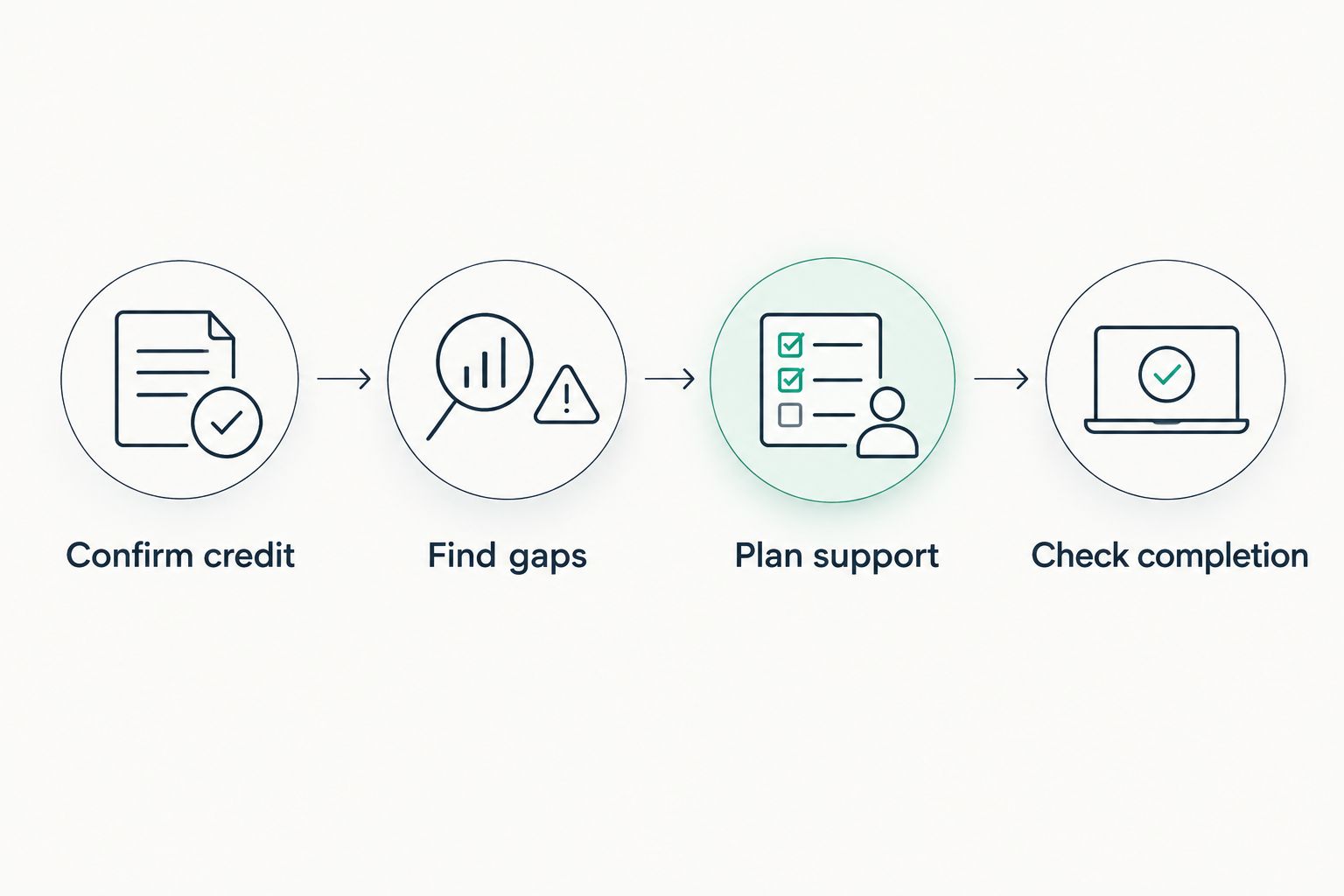
Use this sequence before enrolling. It keeps paperwork and learning from becoming separate, competing projects.
Confirm credit
Ask the counselor to name the exact requirement and approved replacement course. Request written confirmation of the completion deadline, assessment requirements, and transcript process.
Find gaps
Review the original course with your student. Separate misunderstood concepts from missing assignments, attendance issues, or difficulty keeping up with the course format. These call for different kinds of support.
Plan support
Choose the help your student needs and identify who provides it. As a starting point, try a 10-minute practice session on a specific skill when that fits the student. This is a planning suggestion, not a promised route to completion.
Check completion
Track required coursework separately from practice and tutoring. Once the course is complete, confirm that the school received the final record and updated the transcript.
A simple check-in can keep the plan concrete. Ask your student to explain 2 practice problems or show 1 writing paragraph, whichever fits the lesson. These are suggested check-in tasks, not universal requirements or measures of course completion.
Avoid making every conversation about the failed grade. Ask what became clearer and what still needs explaining. That gives you something useful to take to the instructor or tutor.
Which credit recovery option should you choose?
Choose the school-run approved route by default, unless another approved format fits your student better. Select an online course for a workable home-learning plan, summer school for a suitable break-time schedule, or a full repeat for broader gaps.
Then decide whether the student needs additional subject tutoring. An accepted course and a helpful tutor do different jobs. Keeping those roles clear makes your 2026 recovery plan easier to manage.
FAQ
What are the best credit recovery programs for high school students?
The best starting point is a credit recovery program your student’s school approves. Compare school-run recovery, approved online courses, summer school, and a full course repeat by learning fit, support, and completion requirements.
Can my student recover high school credits online?
Your student can use an online recovery course when the school accepts that exact course for the missing requirement. Get written approval before enrolling and confirm how the final record reaches the school.
Is credit recovery the same as tutoring?
No, credit recovery and tutoring serve different purposes. An approved recovery course addresses the credit requirement; tutoring helps the student understand and practice the subject.
Can Tia replace a credit recovery course?
Use Tia as supplemental Math, English, or Science tutoring, not as a replacement for the approved credit-bearing course. Keep course acceptance and transcript decisions with your student’s school.
Is summer school better than an online recovery course?
Neither format is best for every student. Choose the school-approved option whose calendar, instructional help, and workload fit your student’s needs.
How long does credit recovery take?
The approved course’s requirements and schedule determine the completion timeline. Ask about deadlines, required assessments, and what happens if the student needs additional time.
Will credit recovery replace the original grade?
Your school’s transcript policy determines how it records the recovery attempt and the original grade. Ask the counselor to explain the policy before choosing a course.
What should I ask before enrolling in a recovery program?
Ask whether the exact course satisfies the missing requirement and how completion will be recorded. Also confirm instructional support, workload, assessment rules, and the deadline for submitting the final record.
One last thing
Finishing the course and confirming the transcript are separate tasks. Save the completion record, send it through the required process, and ask the school to confirm the update. That final check closes the credit issue without leaving you to assume the paperwork followed the learning.
Related guides
- How adaptive tutoring changes a lesson
- Preparing for the Algebra 1 final exam
- What parents should see in a tutoring dashboard
Tia Education Team