Tia News
Personalized tutoring for credit recovery students
Tutoring for credit recovery closes exact gaps fast, not the whole course. Compare options and see how Tia paces recovery plans for students in 2026.
By Tia Education Team · Published · Updated

Tutoring for credit recovery is one-on-one instruction built around a single goal: closing the exact gaps that caused a student to fail a course, fast enough to meet the deadline a school or provider already set. A credit recovery student doesn't need a full re-teach of the course; they need the three to five topics that broke down the first time, rebuilt at their pace, with proof a school can accept.
- Tutoring for credit recovery works when it targets the exact standards a student failed, not the entire course again.
- Tia is a personalized tutor that adapts pace to a credit recovery deadline and shows parents a live progress record.
- Self-paced recovery software tests knowledge but rarely teaches it; pairing it with one-on-one tutoring cuts wasted repetition.
- Engaged time, not hours logged, is the number that predicts whether a student actually recovers a credit in 2026.
Why personalized tutoring matters for credit recovery students
A student who failed Algebra 1 or English 9 usually didn't fail every unit. They failed a handful of standards, and those standards reappear in the next course up. Skip the fix now and the same gap resurfaces in Algebra 2 or English 10.
The Education Endowment Foundation has found one-to-one tuition adds roughly five months of progress compared to standard instruction, which matters most when a deadline is measured in weeks, not a school year. Bloom's two-sigma research on tutored students found average tutored performance reaching the 98th percentile of a comparison group, a gap that closes when instruction is individual rather than group-paced. Credit recovery is the exact situation where that individual pacing counts: no wasted time on material already mastered, no rushing past the actual gap.
John Hattie's research on achievement also found teacher expectations among the strongest influences on outcomes. A student who's already failed once often carries low expectations of themselves into the recovery attempt. A personalized tutor that treats a failed course as fixable, not as a verdict on the student, changes how that second attempt goes.
How to approach tutoring for credit recovery
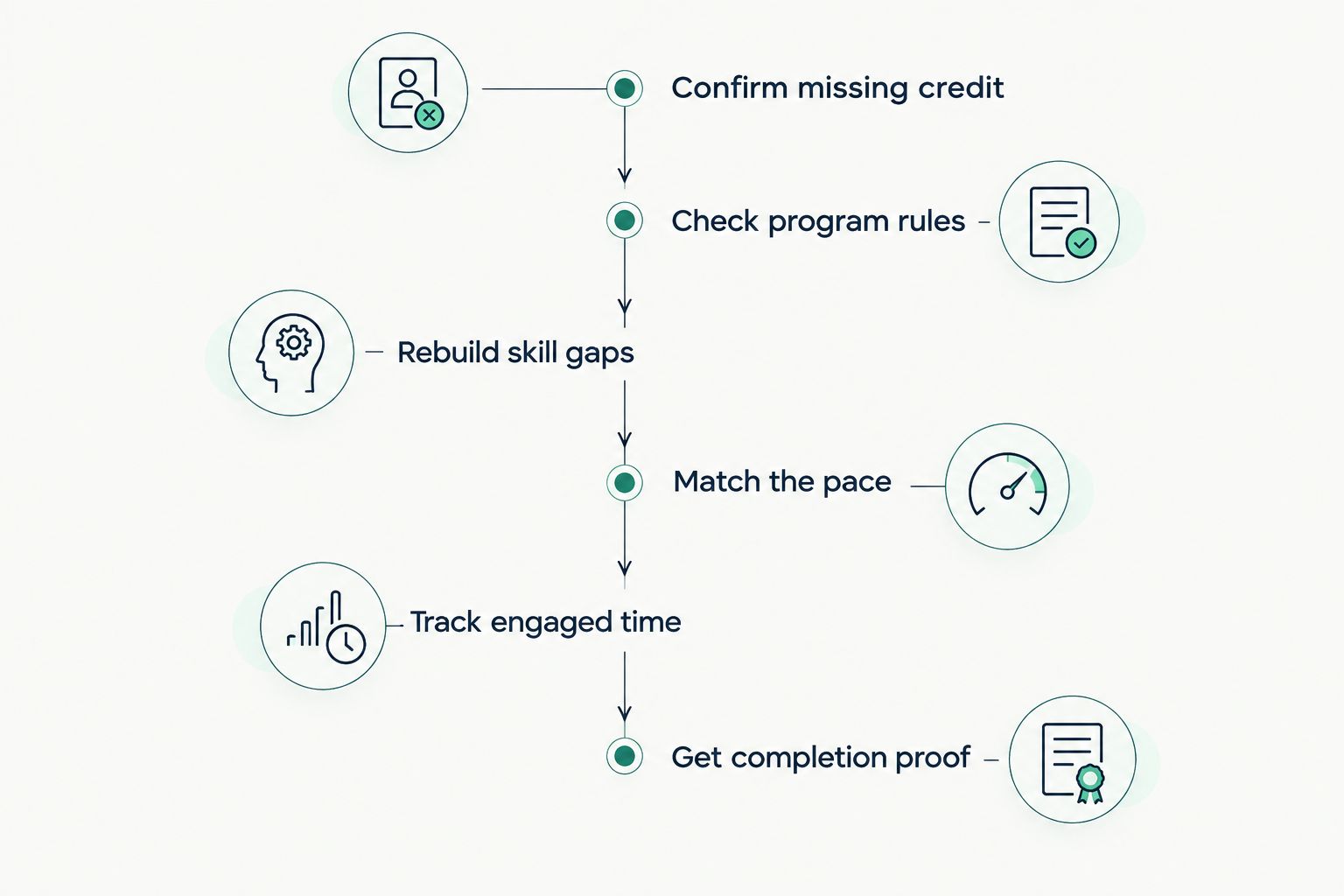
Confirm exactly what credit is missing
Before picking any support, get specific about the gap. A final letter grade tells a parent almost nothing about what actually needs fixing.
- Request the failed course's grade breakdown from the registrar, not just the final grade.
- Ask the school which specific standards or units triggered the fail.
- Check whether the recovery program requires seat-time hours, a final assessment, or both.
- Confirm the hard deadline: end of semester, before senior year clears, or before summer ends.
Check the recovery program's rules before adding outside support
Every district and every online recovery provider sets its own policy, and those policies decide whether extra tutoring even counts.
- Read the provider's policy on whether outside tutoring counts toward completion hours.
- Confirm whether the recovery course is self-paced or runs on a fixed schedule.
- Ask if a teacher of record or proctor has to sign off on completed hours.
- Check the grade cap: many recovery courses award a maximum of a C or a pass/fail mark regardless of the student's actual score.
Rebuild the specific skill gaps, not the whole course
This is where free diagnostics do most of the early work, and where a personalized tutor takes over once the gaps are identified and the clock is running.
- Run a free diagnostic, such as Khan Academy's practice assessments, to flag the exact weak standards.
- List the three to five topics that caused the original fail; ignore units the student already passed.
- Time-box each topic against the recovery deadline instead of studying open-ended.
- If pacing needs to move faster than a parent can manage alone, Tia adapts to the student's level in the failed subject and works from wherever the gap actually starts, without repeating material already mastered.
Match the pace to the deadline, not the calendar
A recovery window is usually shorter than a normal semester. Pacing has to reflect that compression.
- Break the deadline into weekly milestones tied to specific standards, not vague "study more" goals.
- Front-load the hardest topic first, while there's still room to redo it if the first attempt doesn't land.
- Build in one buffer week before the final assessment for review, not new material.
- Adjust pace weekly based on what the student is actually retaining, not what the syllabus assumes they should know by now.
Track engaged time, not just hours logged
Seat-time requirements measure minutes in front of a screen. They don't measure whether the student was actually thinking during those minutes.
- Watch for tab-switching or idle time during self-paced software sessions.
- Ask the student to explain one concept back after each session, out loud, without notes.
- Compare logged hours against actual quiz or checkpoint scores; a mismatch signals disengagement.
- A parent dashboard that reports honest engaged time, not just clock minutes, catches this faster than checking in after the fact.
Get proof of completion the school will accept
Credit recovery only counts once the school or provider signs off. Documentation matters as much as the learning itself.
- Confirm in writing what proof the recovery provider requires: a certificate, a transcript entry, a proctor signature.
- Keep a running record of topics covered and dates, separate from the recovery provider's own log.
- Save any diagnostic or checkpoint scores that show improvement over the recovery window.
- For homeschool families, a self-writing progress record built alongside the recovery attempt can double as documentation if the district asks questions later.
Comparison: options for credit recovery students in 2026
| Option | Best for | Key limitation |
|---|---|---|
| Self-paced recovery software (school-assigned) | Students who mainly need seat-time hours and a final check | Tests knowledge but rarely teaches it; the gap that caused the original fail often repeats |
| School-provided recovery class or summer school | Students who do better with a fixed schedule and in-person accountability | Group pacing isn't built to isolate one student's specific weak standards |
| Private in-person tutor | Students who need direct one-on-one instruction and don't need a documented record | Availability is limited to the tutor's schedule and usually covers one subject at a time |
| Tia (personalized online tutor) | Students who need one-on-one instruction at their own pace, plus a parent-visible progress record | Works alongside the official recovery program's assessment; doesn't replace school enrollment or grading |
Tia works best for a credit recovery student who's close on one or two specific standards and needs pace and a parent-visible record, not for replacing the school's official grading of the recovery course.
Common mistakes with credit recovery students
- Re-teaching the whole course instead of the three to five standards that actually caused the fail, which burns deadline time on material the student already knows.
- Assuming self-paced software teaches when it mostly tests; clicking through the same slides a second time doesn't fix a concept the student didn't understand the first time.
- Missing the program's grade cap or outside-tutoring policy and finding out too late that extra hours don't count toward the official requirement.
- Starting extra support with weeks left, leaving no room for a second attempt at the final assessment if the first one doesn't pass.
- Treating recovery as a formality rather than a real second pass at material that resurfaces later, especially in math sequences where each course builds on the last.
FAQ
What is tutoring for credit recovery?
Tutoring for credit recovery is one-on-one instruction focused on the specific standards a student failed in a course, aimed at helping them pass a recovery program's final assessment before a deadline. It differs from general tutoring by targeting a narrow gap instead of an entire subject.
How is credit recovery tutoring different from regular tutoring?
Credit recovery tutoring works against a fixed deadline set by a school or provider, and it targets only the standards that caused the original fail. Regular tutoring usually covers broader skill-building without that time pressure.
Can a personalized tutor count toward official credit recovery hours?
That depends on the recovery provider's own policy, which varies by district and by program. Always confirm with the school or provider before assuming outside tutoring hours will count toward the official requirement.
How fast can a student recover a failed course with tutoring?
Speed depends on how many standards were failed and how much deadline time remains; a narrow one- or two-standard gap moves faster than a broad course failure. Research on one-to-one tuition from the Education Endowment Foundation shows roughly five months of added progress compared to standard instruction, which is why individual pacing matters most in a compressed recovery window.
Is credit recovery tutoring only for high schoolers?
Most credit recovery programs are tied to high school graduation requirements, so most credit recovery tutoring targets grades 9 through 12. Middle schoolers who fell behind in a required course can use the same gap-focused approach without a formal credit label attached.
Does credit recovery tutoring replace the school's recovery program?
No. Tutoring supports the student through the school's or provider's official recovery program; it doesn't replace the enrollment, assessment, or grading that the program itself requires.
What subjects need the most tutoring support during credit recovery?
Math courses show up most often in credit recovery because each course builds directly on the last one, so a gap in Algebra 1 blocks Algebra 2. English and science courses also recover frequently when reading comprehension or lab reporting were the original weak points.
How much does personalized tutoring cost for credit recovery?
Pricing varies by provider and by country, so check current rates directly on the provider's site before enrolling. Compare that cost against the time saved versus repeating an entire failed course.
One last thing
The single biggest lever in credit recovery isn't more hours, it's isolating the three to five standards that actually caused the fail and ignoring the rest of the syllabus. Hattie's research found teacher expectations among the strongest influences on student achievement, which means how a tutor frames a failed course, as fixable rather than final, can matter as much as the instruction itself. Students who go into recovery believing the gap is narrow and closeable tend to close it faster than students told to "redo the whole course."