Tia News
Utah Core Standards are built into Tia
Tia's Utah curriculum tutor serves 993 Utah Core statements across Math, English and Science, with personalized teaching, voice or text, and parent records.
By Tia Education Team · Published
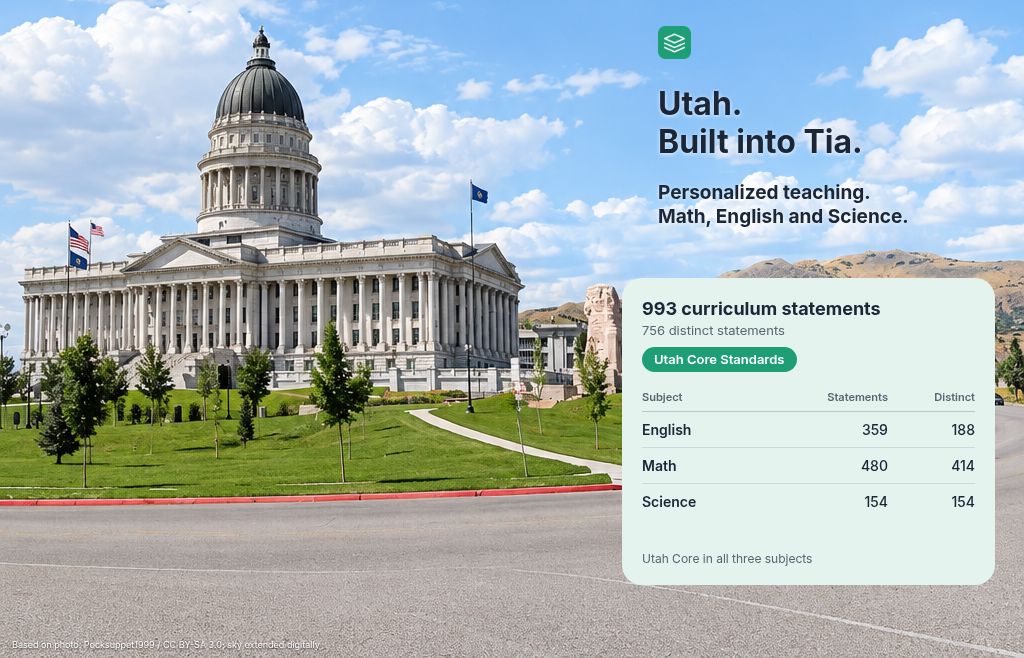
Utah curriculum tutoring connects Utah Core learning goals with teaching that responds to the student. Tia now serves 993 statements across English, Mathematics and Science in its Utah pathway, adapting explanations, pace and examples while keeping the selected learning goal in view.
- Tia's Utah curriculum tutor combines Utah Core Standards with personalized explanations.
- The Utah pathway serves 993 statements, representing 756 distinct statements across three subjects.
- English contributes 359 served statements, Mathematics 480 and Science 154.
- Students can speak or type, switching between voice and text within the same lesson.
- Parents get curriculum-linked mastery information, engaged-time measurement and self-writing records.
When the goal makes sense but the explanation does not
Your student knows what the assignment asks. The example in the book still feels difficult to follow, and repeating it has not made the missing connection clearer.
You do not necessarily need a new resource for the whole subject. You need another way to explain the point where the reasoning stopped.
That is where personalized teaching becomes useful. See how adaptive tutoring changes a lesson when a student needs a smaller step, another example or a different explanation.
Utah provides a local reference for those learning goals. The Utah State Board of Education's Core Standards overview describes the knowledge, skills and competencies students are expected to acquire as they move through public education.
The standards increase in depth and complexity across grades and courses. Personal tutoring adds a responsive explanation within that framework, rather than asking every student to understand an idea through the same example.
Utah Core coverage in Tia
The Utah pathway brings together 993 statements served and 756 distinct statements across English, Mathematics and Science. All three subjects use Utah Core Standards.
| Subject | Statements served | Distinct statements | Source rows |
|---|---|---|---|
| English | 359 | 188 | 383 |
| Mathematics | 480 | 414 | 562 |
| Science | 154 | 154 | 190 |
| Total | 993 | 756 | 1,135 |
The figures describe curriculum coverage. They are not counts of completed lessons or a measure of an individual student's understanding.
Statements served, distinct statements and source rows are separate views of the collection. The 1,135 source rows are not additional learning expectations to add to the 993 statements served.
For parents, the practical starting point remains the student's actual work. Identify the subject, grade and current course before choosing the concept that needs attention.
Tia supports students in Grades 5 to 12. Match the student's current course and learning goal when choosing where to begin.
Why Utah families need a local learning reference
A subject name does not always tell the whole story. In Utah, course names and grade groupings help identify which learning goals a student is following.
The Utah Education Network's Core directory organizes standards by subject and grade or course. English Language Arts includes grade bands, while secondary Mathematics includes named courses.
That structure matters when choosing tutoring. A student studying Secondary Mathematics II needs support connected to that course, not an assumption based only on their age.
The local reference identifies the intended learning. The student's answers help determine how the explanation should proceed.
Tia is a strong fit for Utah families seeking adaptive subject tutoring connected to Utah Core goals, with parent visibility into the learning. Parents remain in charge of the wider education plan.
Utah Math tutoring that follows the reasoning
The Utah Mathematics pathway serves 480 statements representing 414 distinct statements, from 562 source rows. Those figures provide the subject scope for this release.
Utah's Mathematics Core directory lists Secondary Mathematics I, II and III alongside grade-level Mathematics and PreCalculus. The course name is a useful starting point when identifying the learning goal.
For a family seeking a Utah Math tutor, begin with the student's actual course and the step that became unclear. Ask them to explain the last part they understood before trying another method.
A tutor can revisit an earlier idea, slow the explanation or use a familiar example. The student still needs to calculate, reason and explain their choices.
Keep written working alongside the conversation. A spoken question can make the point of confusion easier to describe, while paper preserves the steps the student took.
After the explanation, choose a new problem. Ask why the method applies rather than relying only on whether the original answer is now complete.
Utah English tutoring connected to reading and writing
English serves 359 statements representing 188 distinct statements, from 383 source rows. The reference is Utah Core, with personalized teaching focused on the student's current task.
An English assignment can become difficult for different reasons. A student might understand a passage but struggle to organize a response, or need the instruction clarified before deciding what evidence to use.
For parents looking for a Utah English tutor, keep the actual reading and writing task in view. Start by asking what the student thinks the passage means and what they want their response to communicate.
Talking through an idea gives them another way to explore it. It does not replace reading the text or composing their own answer.
After drafting, return to the response together. Does the writing express the intended idea, and can the student explain the choices they made?
Leave space for independent work. A clear conversation is useful, but it is different from independently reading a new passage or revising a paragraph without prompts.
Utah Science tutoring with SEEd context
Science serves 154 statements representing 154 distinct statements, from 190 source rows. These figures describe Tia's Utah Science collection.
The Utah Science Core directory uses the SEEd name, short for Science with Engineering Education. It lists grade-level standards and secondary courses such as Earth and Space, Biology, Chemistry and Physics.
Use that course context to identify what your student is studying. The official directory describes the wider state framework, while the numbers in this article describe the Utah collection built into Tia.
For a parent seeking a Utah Science tutor, start with the student's explanation of what they think is happening. Ask where the reasoning becomes uncertain before introducing another example.
The explanation can change while the concept stays in view. A student can ask for an unfamiliar term to be clarified or revisit a connection that moved too quickly.
Keep practical investigations, observations and written reasoning in the wider Science plan. Tutoring provides another place to discuss the ideas involved, alongside those experiences.
Personal teaching, with voice and text in the same lesson
A curriculum reference provides direction. It does not decide which explanation will connect with a particular student today.
Tia adapts teaching to the student's pace, understanding and interests. A familiar example can give an abstract idea a starting point, while a smaller step can reveal a connection the first explanation skipped.
Students can speak to Tia and hear verbal explanations, type, or switch between voice and text within the same lesson. Two-way voice is included in all bundle plans at no extra charge.
Voice is an option alongside text, not a claim that every student learns best by listening. A student can ask aloud while drawing a diagram or stay with written questions throughout the session.
The parent chooses the wider learning plan. The student continues to do the thinking, practice and independent work.
A practical way to begin Utah curriculum tutoring
Identify the actual course and learning goal
Start with the student's existing materials. Use the assignment, course name and official Utah reference to clarify the goal before adding another explanation.
- Name the subject and current topic.
- Identify the grade and actual course.
- Read the task together.
- Choose one concept to revisit first.
Ask the student to show the last clear step
You do not need to solve every difficulty in advance. Let the student describe what they understand and identify the next part they cannot yet explain.
- Look at their written work.
- Ask how they reached the current step.
- Separate unfamiliar vocabulary from an unfamiliar concept.
- Keep the original question visible.
Try a different explanation
A sketch, a practical example or the course materials can provide the first alternative. Personal tutoring offers another route when you want help explaining that point.
- Request a smaller step.
- Ask for a familiar comparison.
- Revisit a foundation when needed.
- Return to the selected learning goal.
Offer a choice of speaking or typing
Let the student choose how to ask the question. The format can change within the lesson without changing the subject goal.
- Offer voice and text as options.
- Keep written Math working nearby.
- Discuss an English idea before drafting.
- Retain independent reading and writing.
Check the idea with fresh work
Use a different question after the explanation. A new example gives you another view of understanding beyond completing the original task.
- Ask for an explanation in the student's own words.
- Try another example.
- Review an independent response.
- Decide whether to revisit or continue.
Review the learning record
Bring together the student's work, their explanation and the parent information. That combination helps you choose the next step without reconstructing the session from memory.
- Review the subject studied.
- Look at curriculum-linked mastery information.
- Check engaged time alongside the work.
- Choose a focused goal for next time.
Support alongside school or within home education
Tutoring can begin with one difficult concept rather than a change to the whole education plan. The same question applies in either setting: what does this student need explained differently?
Alongside school, use the student's actual course materials to choose the starting point. Return to the assignment after tutoring and ask whether the next step is clearer.
For parents seeking a Utah homeschool tutor, subject support can sit alongside reading, projects, practical work and a parent-led learning rhythm. You decide which explanations to provide yourself and where another source of help fits.
Learning records support planning and documentation. They do not replace the parent's responsibility for understanding the education requirements that apply to their family.
Choose support for the job in front of you
Different resources can play different roles in the same learning plan. Choose the support that fits the current difficulty rather than expecting one format to do everything.
| Option | Best for | What to keep in mind |
|---|---|---|
| Existing course materials | Identifying the task and intended learning goal | A printed explanation cannot respond to a follow-up question |
| Parent discussion and fresh work | Hearing reasoning and checking independent application | The parent provides the explanation or finds another source of help |
| Tia personal tutoring | Adaptive explanations connected to curriculum goals, with parent records | Independent work and the wider learning plan still matter |
Some families also want a scheduled person present for accountability or specialist support. Adaptive online tutoring does not remove those needs; it offers another format to assess against the student's situation.
What parents can review afterward
The parent dashboard brings together curriculum-linked mastery information, engaged-time measurement and self-writing learning records. It provides context without requiring parents to sit inside every session.
Tia uses Bayesian Knowledge Tracing to update estimates of skill mastery from student answers over time. In plain terms, each answer helps refine the picture of what the student understands.
That estimate is not an infallible measure of everything a student knows. Review it alongside fresh explanations, independent work and your conversations with the student.
Engaged-time measurement distinguishes active learning from simply keeping a session open. Self-writing records reduce the need to prepare a separate summary from memory.
Read what parents should see in a tutoring dashboard for a closer look at useful parent information.
Mistakes to avoid when choosing Utah tutoring
- Choosing by grade alone. Identify the actual secondary course as well as the student's grade.
- Treating coverage as mastery. The 993 statements describe the pathway, not what an individual student already understands.
- Replacing independent work with conversation. Keep written Math, reading, writing and practical Science in the wider plan.
- Changing the goal when only the explanation needs changing. Try another route into the concept before abandoning it.
FAQ
Does Tia offer a Utah curriculum tutor?
Yes. Tia connects Utah Core goals in English, Mathematics and Science with explanations that adapt to the student's understanding, pace and interests.
How many Utah Core statements are built into Tia?
The Utah pathway serves 993 statements: 359 English, 480 Mathematics and 154 Science.
How many distinct Utah statements are represented?
The subject counts total 756 distinct statements: 188 English, 414 Mathematics and 154 Science.
Are the 1,135 source rows additional learning expectations?
No. Source rows, statements served and distinct statements are separate measures of the collection, not figures to add together.
Why does the Utah course name matter when choosing tutoring?
Utah organizes secondary learning by courses as well as grade levels. Identifying the student's actual course helps connect tutoring to the work they are studying.
Can students speak and type during a lesson?
Yes. Students can speak, hear verbal explanations, type and switch between voice and text within the same lesson. Two-way voice is included in all bundle plans at no extra charge.
Can Utah homeschooling families use Tia?
Yes. Families can use subject tutoring, parent progress information and self-writing records within a parent-led learning plan while managing their applicable education requirements.
What do parents see after tutoring?
Parents get curriculum-linked mastery information, engaged-time measurement and self-writing learning records to review alongside the student's independent work.
One last thing
The most useful starting point is often smaller than a whole subject: the step your student cannot yet explain.
Keep the learning goal clear. Change the explanation, then let the student's own words and work guide what comes next.
Related guides
Header image adapted from Utah State Capitol by Pocksuppet1999, CC BY-SA 3.0. Sky extended digitally; reframed and combined with editorial text. Header adaptation shared under the same license.

14-day free trial, no card needed
tia.coach