Tia News
Tia vs Khan Academy: curriculum and individual learning compared
Tia vs Khan Academy: compare teaching and structured practice, with Tia's two-way voice, text switching, curriculum-mapped mastery and parent learning records.
By Tia Education Team · Published · Last updated
Choose Tia when your student needs curriculum-aligned teaching that changes with them, with mastery measured per question and included in parent reports. A course library gives you material to work through; Tia connects the learning goal to your student's pace, interests and understanding. This 2026 guide uses Tia's adaptive teaching approach and two test-student demonstrations to make the distinction concrete.
- Tia vs Khan Academy: Tia brings adaptive teaching and curriculum-mapped parent reports together.
- Tia changes explanations around the student's pace, interests and learning history.
- Mastery is measured per question, mapped to the curriculum and included in the report.
- A structured course does not resolve every need for a different explanation.
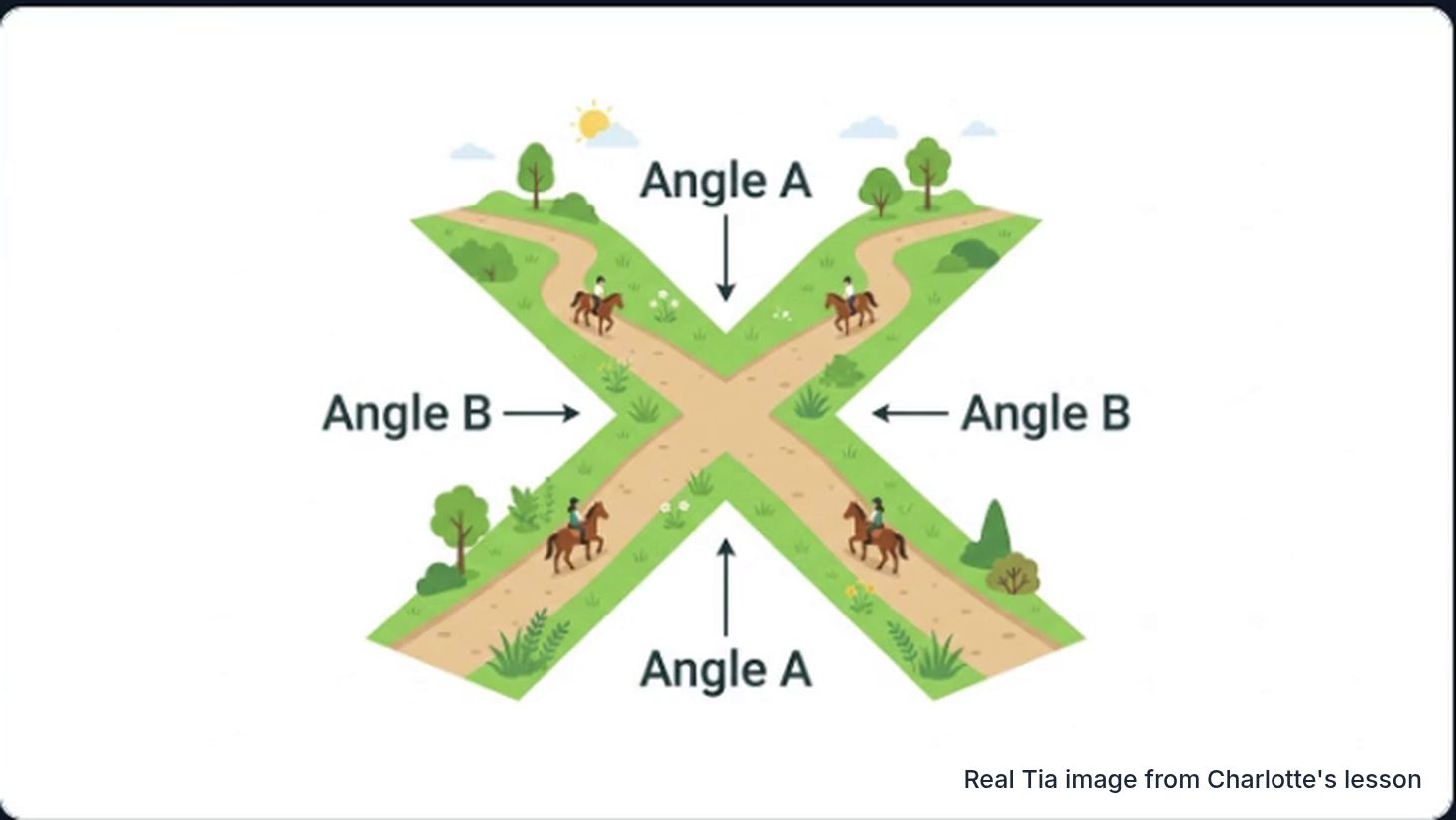
- The horse and cricket demonstrations show two teaching routes into one concept.
Why this matters
Your student has watched the lesson and still cannot explain the idea. Another video might help. So might a question that reveals the misunderstanding, followed by a different explanation.
The decision is not content versus no content. Both services connect to learning goals. The more useful 2026 question is how the route changes when your student gets stuck and what the parent can see afterward.
Tia vs Khan Academy at a glance
| Dimension | Tia | Khan Academy |
|---|---|---|
| Best for | Personal teaching with parent visibility | Structured courses and practice |
| Teaching format | Interactive adaptive tutoring | Core lessons and exercises; Khanmigo adds conversational help |
| Curriculum | Country and curriculum guide the session | Organized courses and standards-related material |
| Individualization | Pace, level, interests and prior work shape teaching | Mastery learning, tailored practice and progress tools |
| Examples | Interest-based explanations illustrated by supplied sessions | Structured course examples; assess Khanmigo separately |
| Parent information | Curriculum-mapped question-level mastery, engaged time and self-writing records | Progress tools; check the specific reports you need |
| Scope | Math, English and Science for grades 5 to 12 | A broader course library |
| Payment model | Subscription | Core platform and Khanmigo are separate offerings |
Tia's advantage is the individual explanation, not just curriculum coverage
Tia's curriculum sets what the student should learn. A learning profile helps determine how to teach it. Interests selected at setup and mentioned during sessions are used in examples, alongside the student's pace, level and prior work.
Tia is best for families seeking a personal tutor that connects the curriculum to their student's way of learning. A parent does not have to invent a new analogy every time a familiar explanation fails. The student still has to reason through the next question.
Bring your student's current work into the trial. Look at how Tia approaches that curriculum goal and what changes when the student needs another explanation.
Tia lets the student choose voice or text in one lesson
Students can now speak to Tia and hear verbal explanations, or keep typing. They can switch between voice and text within the same lesson. Two-way voice is included in all bundle plans at no extra charge.
That choice makes 'Tia adapts to the student, not the other way around' practical. A student can ask for help aloud when typing feels uncomfortable, then return to text when they prefer. Voice is another way into the curriculum-aligned lesson, not a promise of better attention or higher achievement.
This update describes Tia's capability, not a claim that Khan Academy or Khanmigo lacks audio features. The earlier horse and cricket images remain demonstrations of adaptive explanations, not screenshots of voice tutoring.
A course library does not resolve every explanation gap
Khan Academy provides courses, practice and mastery tools. Those resources give you a sequence of material, but selecting a course does not establish that its explanation will make sense to your student.
When the student remains confused, the missing piece can be a new teaching route rather than another exercise. Tia uses the student's pace, interests and earlier work to shape that route while keeping the curriculum goal in place.
Limits to check with a resource-led approach:
- The family must connect selected courses to the student's current work.
- Completing a lesson does not itself demonstrate understanding on a new task.
- Progress tools need checking against the learning records your family requires.
Khan Academy also personalizes practice. The distinction is not whether personalization exists, but how the explanation responds and how curriculum-mapped understanding reaches the parent.
One curriculum goal can have two personal starting points
Two supplied Tia screenshots show test students learning vertical angles. Fred likes cricket; Charlotte likes horses. The mathematical goal stays fixed: recognize the equal angles opposite each other at an intersection.
Fred receives an image of crossing cricket bats. It labels opposite angles of 55 degrees and 125 degrees and asks him to identify an angle pair. Charlotte receives intersecting horse trails, with matching A and B labels marking the opposite pairs. Her session also refers back to an earlier horse-trail analogy.
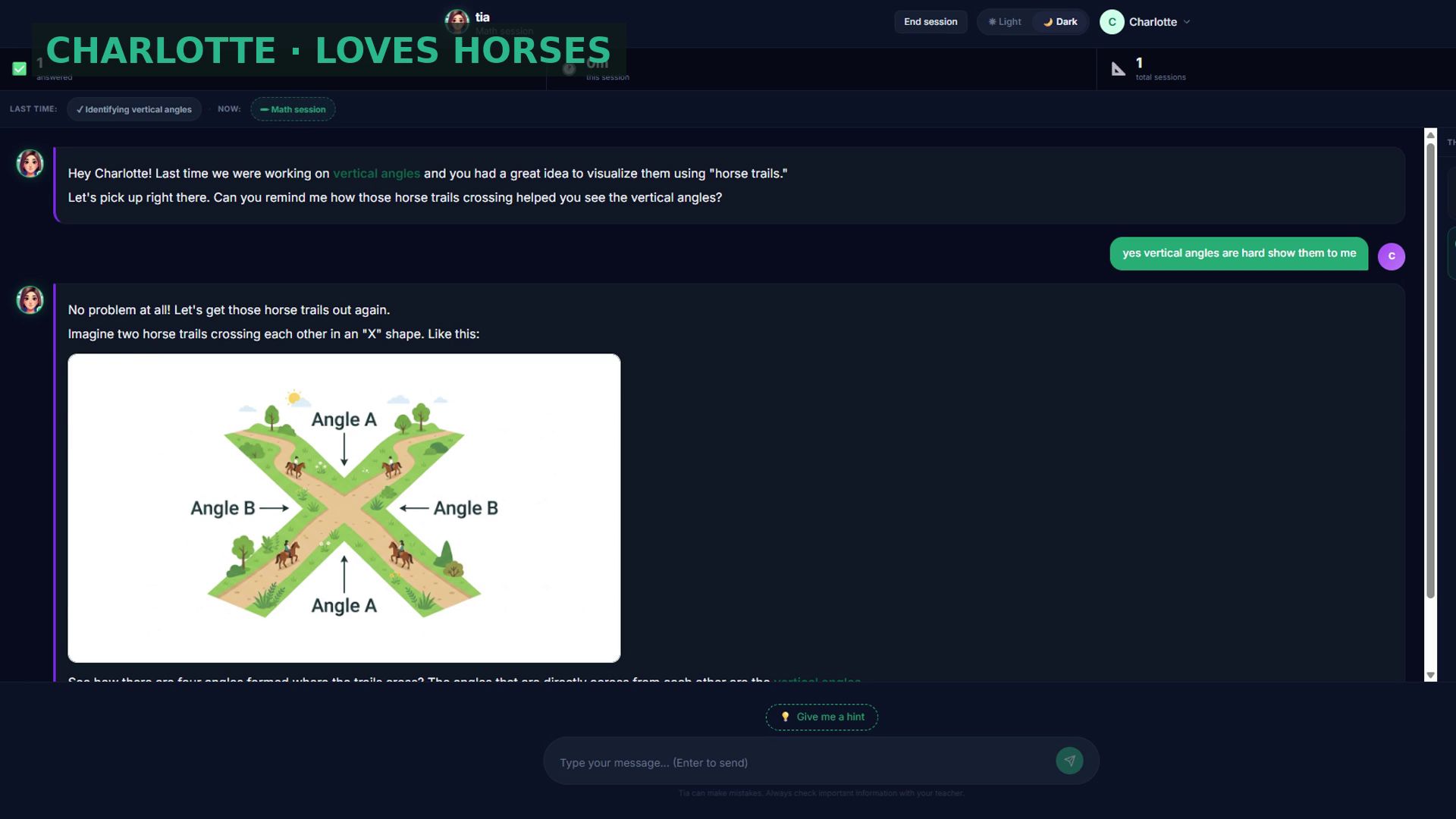
These test-student demonstrations show the explanation, visual context and resumed conversation. They are product demonstrations, not testimonials or a controlled outcome comparison. Tia's question-level mastery reporting provides the separate record of understanding.
| Formal goal | Fred's route | Charlotte's route |
|---|---|---|
| Find the opposite angle pairs | Crossed cricket bats | Crossed horse trails |
| Recognize equal angles | Matching numerical measures | Matching A and B labels |
| Apply the rule | Identify the requested pair | Revisit and interpret the visual |
A useful follow-up removes the familiar setting. Show plain crossing lines and ask the student to identify the opposite angles. If the idea transfers, the example has helped with the concept rather than only entertaining the student.
Tia keeps the tutoring arrangement connected
A parent needs more than access to material: an explanation that responds, continuity into the next session and a useful record afterward. Tia organizes those pieces as one personal tutoring service.
Khan Academy's core courses and Khanmigo are distinct offerings; Khanmigo adds conversational help. This comparison does not treat every Khan Academy experience as videos alone. The focus is what your family receives together through Tia: student-shaped teaching, curriculum context and parent records.
Tia puts parent records beside the teaching
Tia measures mastery per question, maps it to the curriculum and includes it in the report. Its separate parent view also shows session information and engaged time. Self-writing records and weekly summaries help you follow learning without reconstructing it afterward.
A course-progress view and a curriculum-mapped parent record answer different questions. Look for which goals were covered, what the student's answers showed and what needs attention next.
No report guarantees compliance with every local homeschool rule. Check the information your family must retain. The parent stays responsible for that decision.
Both require a check of independent understanding
Tia measures understanding through question-level mastery, not conversation length alone. A fresh example provides another useful check of whether the student can transfer the concept. Ask the student to explain an unfamiliar example, without repeating the analogy or prompting each step. Use that same check with both services.
A useful 2026 comparison records:
- The learning goal.
- The first point of confusion.
- How the explanation changed.
- What the student did without help.
- What the parent could inspect afterward.
This avoids claiming that one format is inherently effective for every student. Some students prefer a structured resource; others need an explanation that changes in conversation.
Compare payment models without confusing the products
Tia is a subscription service. Khan Academy core resources and Khanmigo are distinct offerings, so confirm the current terms of the specific product you want. Do not use the name Khan Academy as shorthand for one tutoring package.
The better choice is the one that fills your actual gap. More resources are not helpful if the student needs a different explanation; more conversation is not helpful if the missing piece is targeted practice.
The 2026 verdict
Choose Tia for student-shaped teaching and records
Choose this route when you want explanations, curriculum context and parent visibility in one tutoring workflow. The horse and cricket examples make the teaching mechanism inspectable.
Tia's scope: personal tutoring in Math, English and Science for grades 5 to 12, not a named human instructor. Match that scope to your student's needs.
Check what a course sequence leaves for you to organize
With a resource-led arrangement, you still need to connect the material to current work and decide what to do when an explanation does not land. Tia brings adaptive teaching and curriculum-mapped reporting together, so your next step can follow the student's learning rather than the size of a resource library.
| What your family needs | What Tia brings together |
|---|---|
| Another route into a difficult idea | Adaptive explanations shaped to the student |
| Continuity | Student profile and prior learning context |
| Understanding against curriculum goals | Mastery measured per question and mapped to the curriculum |
| Parent visibility | Engaged time and self-writing learning records |
FAQ
Why choose Tia instead of Khan Academy?
Choose Tia for adaptive personal teaching with question-level mastery mapped to the curriculum and parent records built in. A course sequence alone does not resolve every student's need for another explanation.
How is an adaptive explanation different from tailored practice?
Tailored practice changes the work selected; an adaptive explanation changes the route into the idea. Tia uses student context to shape the teaching while measuring mastery against curriculum goals.
How does Tia use the curriculum?
The curriculum guides the learning goal while the student's pace, level and interests shape the explanation. Check your particular course during the trial rather than assuming universal coverage.
Are Khan Academy and Khanmigo the same product?
No. Khan Academy's core platform provides courses and practice; Khanmigo adds conversational tutoring and other tools. Evaluate the offering you would actually use.
What do the cricket and horse examples show?
They show test students receiving different explanations of vertical angles. They illustrate how the teaching changes while the curriculum goal stays fixed.
Can parent records replace local homeschool requirements?
No. Records support your documentation, but parents must check local requirements and retain the information those rules call for.
How should I compare the teaching?
Use the same concept, see what changes after confusion and ask the student to apply it to a new example. Compare the parent information afterward.
One last thing
A curriculum tells you the destination. The teaching route determines whether the student can reach it. In 2026, inspect both rather than choosing by the largest course list alone.
See how Tia works: 14-day free trial, no card needed.
Related guides
Tia Education Team