Tia News
Tia vs ChatGPT and Claude: tutoring built around your student
Tia vs ChatGPT and Claude: compare two-way voice, adaptive teaching, curriculum-linked mastery and parent records. Voice is included in all Tia bundle plans.
By Tia Education Team · Published · Last updated
Tia is a personal tutor built around your student: their curriculum, their interests, their pace and what they have already learned. This Tia vs ChatGPT and Claude comparison explains why a continuing tutoring relationship is more than getting a helpful answer, using two examples of adaptive teaching.
- Tia adapts the tutoring to your student, not your student to a fixed explanation.
- The curriculum sets the goal; your student's interests and understanding shape the teaching route.
- Tia measures mastery per question and includes curriculum-mapped understanding in parent reports.
- Fred's cricket bats and Charlotte's horse trails show two explanations of the same math concept.
- Tia includes two-way voice in all bundle plans, with voice and text switching within the same lesson.
Why this matters
Your student asks for help with a math problem. An explanation appears, but it still does not make sense. Now someone needs to find another way in.
For a parent, that is the real question. Not whether a tool can produce an explanation, but whether the teaching adjusts to the student who is sitting in front of it. And whether tomorrow's session builds on what happened today.
Tia connects those pieces. A curriculum-aligned personal tutor changes the pace, level and examples while parents can see what was covered. You stay the parent instead of having to design every teaching step.
Tia vs ChatGPT and Claude: what changes for your family?
| Dimension | Tia | ChatGPT and Claude |
|---|---|---|
| Purpose | Personal subject tutoring | General-purpose assistance, including learning tasks |
| Starting point | Your student's profile and chosen curriculum | The request, supplied materials and account context |
| Teaching route | Pace, level and interests shape the explanation | Responses depend on instructions, context and the features used |
| Continuity | Learning profile and session history support ongoing teaching | Memory and conversation tools vary by service and settings |
| Parent visibility | Separate dashboard with learning information | Account controls and conversations are a different form of oversight |
| Learning records | Question-level mastery mapped to the curriculum, engaged time and self-writing records | A conversation is not itself a curriculum-linked learning record |
| Subjects | Math, English and Science for grades 5 to 12 | A broad range of tasks beyond schoolwork |
| Arrangement | Tutoring subscription; two-way voice included in all bundle plans at no extra charge | General assistant plans |
The difference is how the experience is organized. General assistants can personalize responses and retain context. Tia brings student context, curriculum-aligned teaching and parent learning records together as the tutoring service itself.
Talk, listen or type within the same lesson
Tia now supports two-way voice: your student can ask a question aloud and hear Tia explain it verbally. Text typing remains available, and the student can switch between voice and text within the same lesson. Voice is included in all bundle plans at no extra charge.
Tia adapts to the student, not the other way around. A student can speak when putting a question into writing feels uncomfortable, then type when that suits the task. This is a choice of participation format, not a claim that spoken lessons produce better learning outcomes.
Voice alone is not the distinction from a general assistant. Both ChatGPT's voice documentation and Claude's voice documentation describe spoken conversations and using text alongside voice. Availability and limits depend on the service and account. Tia's distinction is how that conversation sits inside curriculum-aligned tutoring, the student's learning profile, mastery information and parent records.
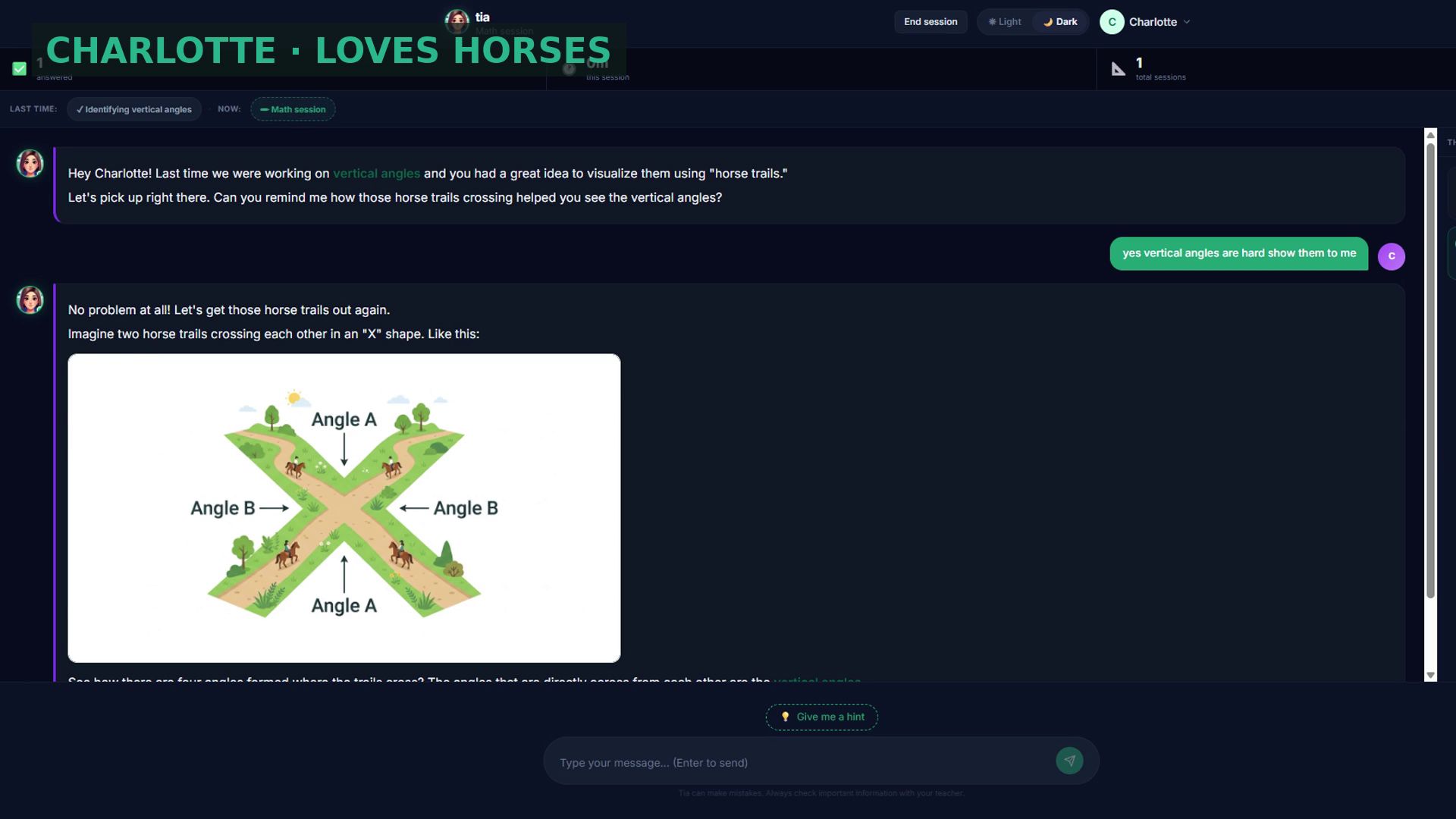
The Fred and Charlotte screenshots below show earlier text-based teaching demonstrations. They illustrate adaptive explanations, not the new voice interface.
The curriculum sets the destination, not one fixed route
A curriculum tells you what your student needs to learn. It does not tell you which explanation will make sense to them today.
Tia uses the chosen curriculum to guide the learning goal. The student's pace, level, interests and previous work help shape the route into that goal. A familiar example can introduce the idea, while a question checks whether the student can use it.
Tia's tutoring adapts to your student without losing the curriculum goal. That is the combination that matters: a personal explanation still has to teach the right concept.
For a 2026 family comparing tutoring options, bring a current assignment into the trial. Look at what changes after your student says they are confused. A personal tutor should do more than repeat the first explanation with different wording.
Fred likes cricket. Charlotte likes horses. Both are learning vertical angles.
Two product demonstrations show this approach in practice. Fred and Charlotte are test students, not testimonials. Their sessions cover the same math concept: vertical angles, the equal opposite angles formed where two straight lines cross.
The learning goal stays the same. The way Tia explains it changes.
Fred's explanation starts with cricket bats
Fred asks for help with vertical angles. Tia acknowledges the difficulty and returns to an earlier cricket-bat example. Two bats cross in an X, with opposite angles labeled 55 degrees and 125 degrees.
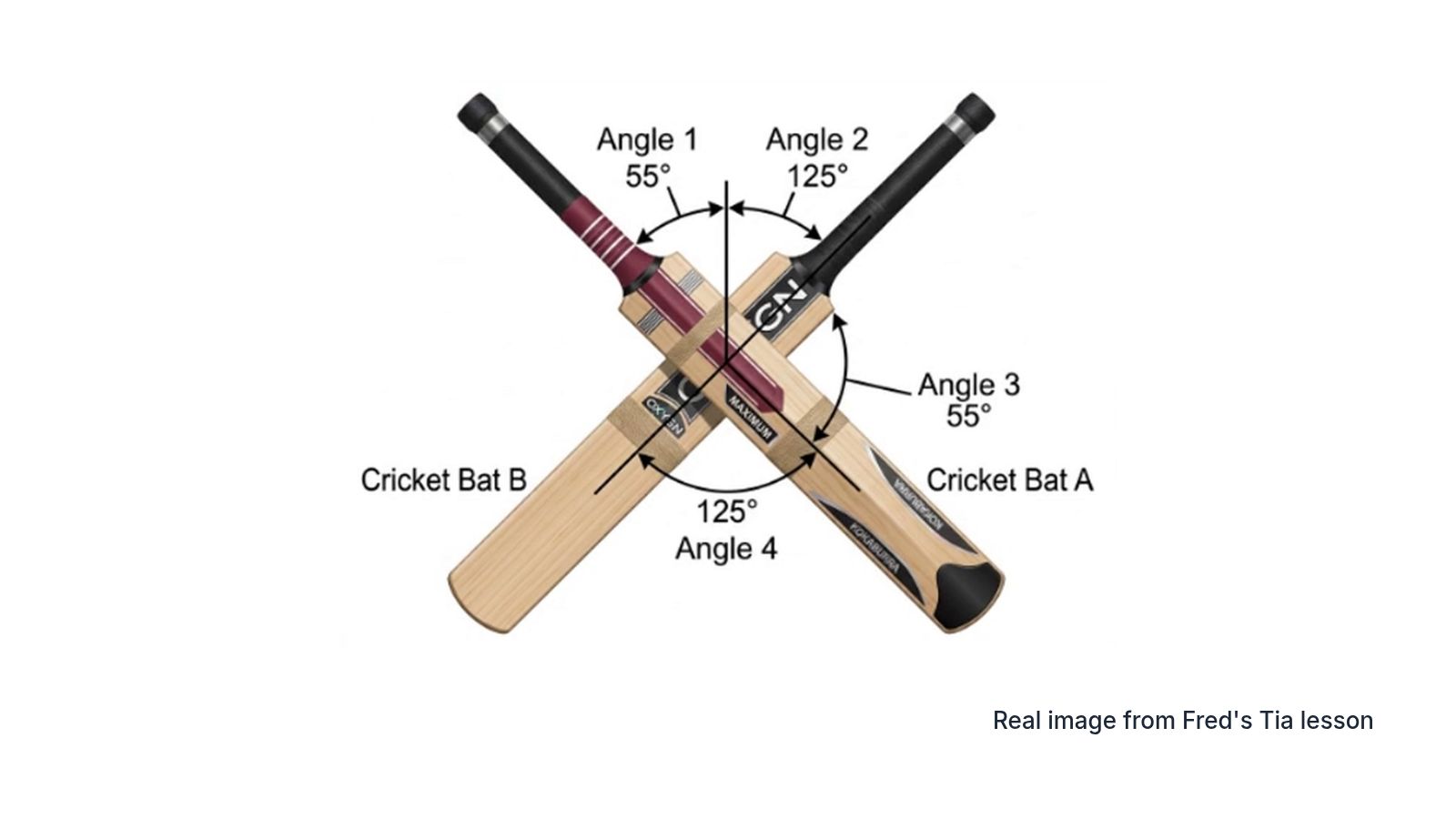
The bats are not decoration. They form the intersection the student needs to understand. The opposite pairs match, and the neighboring angles add to 180 degrees.
Then Tia asks Fred to identify a vertical-angle pair. He still has to do the thinking. The explanation gives him a route into the question rather than completing the learning on his behalf.
Charlotte's explanation starts with horse trails
Charlotte's session begins by referring to the previous horse-trail explanation. When she says vertical angles are hard and asks to see them, Tia presents two trails crossing in an X.
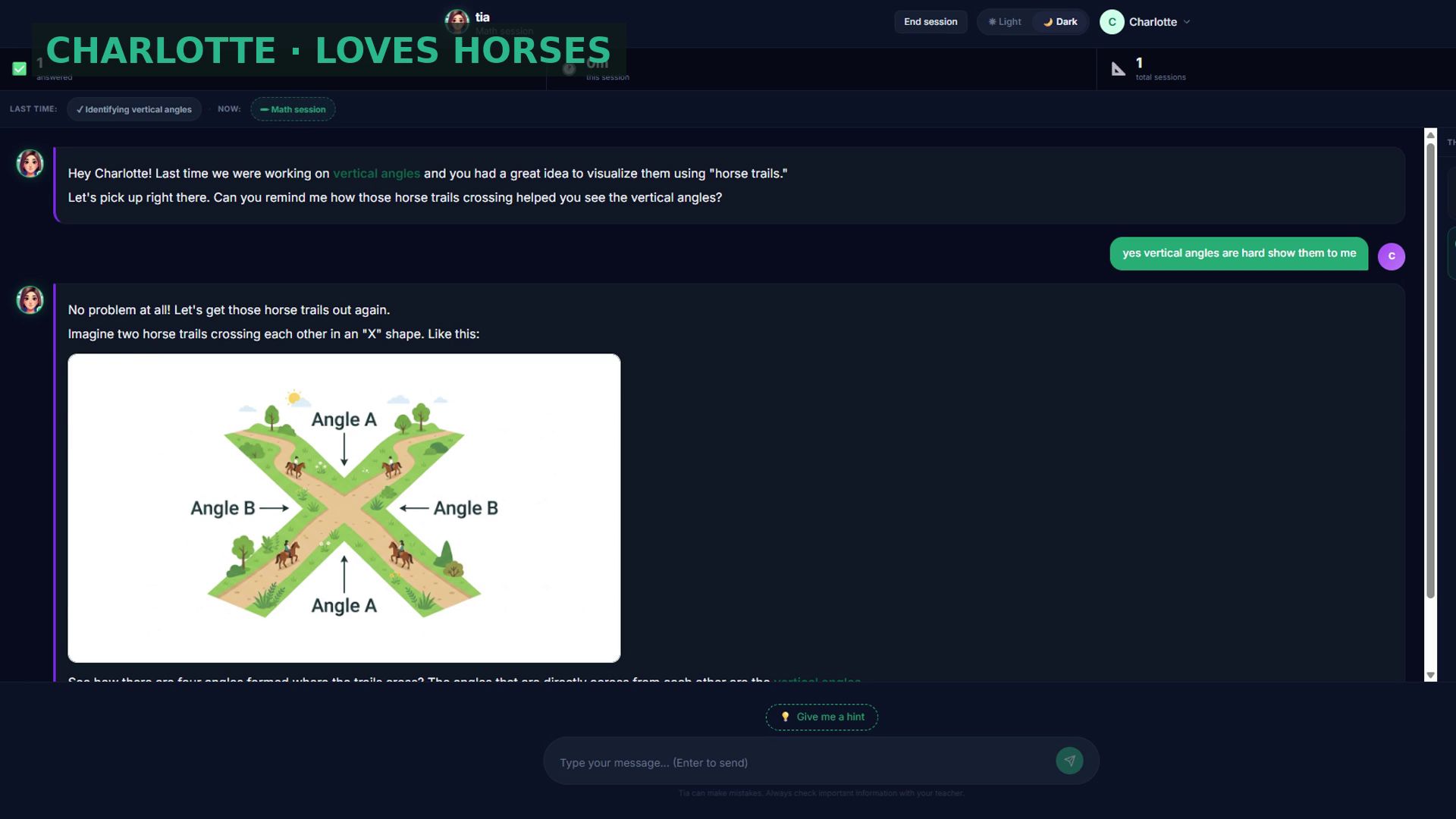
Matching A labels mark the top and bottom angles. Matching B labels mark the left and right angles. The visual connects the familiar setting with the formal relationship.
Charlotte does not have to set aside her interests to enter the lesson. Tia uses them to make the concept approachable, then keeps the teaching connected to the math.
Same concept, different starting points
| Learning goal | Fred's explanation | Charlotte's explanation |
|---|---|---|
| Recognize an intersection | Crossing cricket bats | Crossing horse trails |
| Identify equal opposite angles | Matching numerical measures | Matching A and B labels |
| Continue earlier learning | Returns to the cricket analogy | Recalls the previous horse-trail explanation |
| Apply the idea | Identify an angle pair | Interpret the opposite pairs in the visual |
These 2026 test-student demonstrations illustrate adaptive explanations and resumed context, not a controlled outcome comparison. Tia's question-level mastery reporting provides the separate record of understanding. The next useful check is a plain diagram without bats or horses: can the student recognize the same relationship?
Tia carries your student's learning forward
A student's interest is only one part of knowing them as a learner. The tutor also needs the earlier topic, the point of confusion and the learning that comes next.
Tia's published product description connects interests, subject mastery and session history in a continuing learning profile. That context helps shape future teaching rather than treating each request as a disconnected task.
The screenshots make part of that continuity visible. Charlotte's session recalls an earlier analogy. Fred's explanation returns to the cricket example. Neither needs to reconstruct the starting point shown in the conversation.
For your family, the benefit is a tutoring routine organized around the student. The point is not simply that a fact can be stored. It is that learning information has a place in the next teaching step.
You do not have to build the whole tutoring arrangement yourself
A general assistant can help explain a topic. Turning that help into an ongoing learning routine also means choosing the curriculum context, supplying relevant materials, maintaining the learning goals and deciding what to record.
Tia is organized for that tutoring purpose. Your student has a learning profile, the teaching follows the chosen curriculum, and the parent has a separate view of the activity.
You still choose the curriculum and remain in charge of your student's education. You do not have to become the author of every prompt or assemble every learning record afterward.
In 2026, that is a practical distinction for a parent carrying several responsibilities. A useful service reduces the work around tutoring as well as supporting the student during it.
Parent visibility is part of the service
When the session ends, you need more than reassurance that your student spent time at a screen.
Tia measures mastery per question, maps it to the curriculum and includes it in the report. The parent dashboard also shows learning activity and engaged time, while self-writing records and summaries help you follow what was covered. You can see both participation and understanding without reconstructing them from a conversation.
That gives you a better starting point for checking in:
- What did your student work on?
- Which concept needs another look?
- Was the student actively participating?
- What learning information should you keep?
Tia records participation through engaged time and separately measures curriculum-mapped mastery per question. A fresh example gives you another useful check of understanding. For homeschool documentation, match the records to your local requirements.
A helpful answer is not the whole tutoring experience
Your student's learning does not end when an answer appears. They need an explanation that makes sense, a chance to apply it and a next session that builds on the work.
The reason to choose Tia for tutoring is the connected experience: student profile, curriculum-aligned teaching, adaptive explanations and parent learning records. Those pieces are the focus of the product, not separate tasks for the family to organize around an answer.
For ongoing Math, English and Science support, Tia keeps the teaching centered on your student and the parent informed. You can follow the learning without having to direct every exchange.
Keep the student's reasoning at the center
The strongest part of the cricket example is not the picture. It is the question that follows it.
A completed explanation can feel satisfying while leaving the student's misunderstanding untouched. A follow-up question reveals whether they can use the idea. If not, the teaching needs another step.
For a 2026 trial, choose a concept your student finds difficult. Observe the explanation, the response to confusion and the question afterward. Then return to the topic in another session and check what carries forward.
That gives you a concrete way to evaluate a personal tutor:
- The teaching goal matches the student's work.
- The explanation responds to their understanding.
- The student does the reasoning.
- The next session builds on the earlier work.
- The parent can inspect the learning information.
A focused tutoring role still has boundaries
Tia covers Math, English and Science for grades 5 to 12. It is not a named human instructor, a clinical service or physical supervision for lab work. Some students need specialist support or the accountability of a fixed human appointment.
Its documented safeguards support age-appropriate teaching, but generated responses are not guaranteed always correct or appropriate. Parents should review the fit and keep a clear route for the student to raise concerns.
These boundaries do not change the central offer. They help you understand what the personal tutor is there to do: support learning at the student's pace, with the parent still in charge.
The verdict: tutoring built around your student
If your family needs ongoing subject support, choose a service that connects the learning goal with the individual learner. That is where Tia's curriculum alignment, adaptive explanations and parent records belong together.
Fred and Charlotte make the principle visible. One concept, two interests, two teaching routes. Neither student is asked to become a different kind of learner before the explanation can change.
For your 2026 decision, try that principle with your own student's work. Look for a clear goal, a useful change after confusion and a follow-up question that asks the student to think.
FAQ
Why choose Tia instead of using ChatGPT for tutoring?
Tia brings your student's curriculum, learning profile, adaptive explanations and parent records together in a purpose-built tutoring service. The difference is the ongoing learning arrangement, not just one response.
How is Tia different from Claude for student learning?
Tia is organized for ongoing subject tutoring with a student profile and separate parent learning view. Claude is a general assistant, so the comparison is the complete tutoring workflow rather than whether either product can remember context.
What does Tia know about my student?
Tia's published description includes interests, learning style, subject mastery and session history in its learning profile. That context helps shape curriculum-aligned teaching.
Does Tia change the curriculum to match a hobby?
The curriculum goal stays in place while the explanation changes. Cricket bats and horse trails can introduce the same angle relationship without replacing the mathematical concept.
What do the Fred and Charlotte examples show?
They show test students receiving different explanations of vertical angles, with earlier context carried into the displayed sessions. They are product demonstrations, not testimonials or measured outcomes.
What can parents see after tutoring?
Tia measures mastery per question, maps it to the curriculum and includes it in the report. The separate parent dashboard also shows learning activity, engaged time and self-writing records.
Can my student talk to Tia instead of typing?
Yes. Students can speak to Tia, hear verbal explanations and switch between voice and text within the same lesson. Two-way voice is included in all bundle plans at no extra charge.
How should I assess Tia during the trial?
Bring a real learning difficulty, observe how the explanation changes and ask the student to apply the idea to a fresh question. Return to the topic later to check continuity.
One last thing
Remove the familiar picture before deciding that a concept has landed. If your student can recognize vertical angles without the cricket bats or horses, the example has done its job: it helped them reach the underlying idea.
See how Tia works: 14-day free trial, no card needed.
Related guides
Tia Education Team