Tia News
Should you read aloud to middle and high school students?
Reading aloud to teenagers is worth keeping. Learn how to choose age-respectful texts, share the reading, and protect independent practice without adding pressure.
By Tia Education Team · Published

Yes, reading aloud to middle and high school students is worth keeping when students welcome it. Share age-respectful texts and conversation, but keep independent reading in the routine: listening to a passage does not show whether a student can read it independently.
- Reading aloud to teenagers works best as shared reading, not a replacement for independent practice.
- Let students choose texts and decide whether to listen, follow along, or share the reading.
- Discuss meaning without turning every passage into a quiz.
- Tia offers personalized English tutoring alongside the reading you share at home.
Should you read aloud to middle and high school students?
Yes. Reading aloud gives you a way to share a text, demonstrate phrasing, and discuss meaning together. An older student does not need to struggle with reading to enjoy hearing a story or exploring a difficult passage with you.
The important distinction is between accessing a text and reading it independently. Both belong in a reading routine, but they are not interchangeable. For more on the second goal, see the guide to improving reading comprehension skills.
Choose the format that matches the purpose of the session, rather than treating one format as the right answer every time.
| Format | Best for | What it offers | What it does not show |
|---|---|---|---|
| Parent reads aloud | Sharing a text without requiring oral performance | Students hear phrasing and can discuss meaning | Whether students can read the words independently |
| Shared reading | Students who want to participate aloud | Parent and student can take agreed sections | Independent performance when the parent supplies help |
| Independent reading | Practicing reading without someone supplying the words | Students work directly with the text | Their reasoning unless you discuss their interpretation |
Keep the format flexible and the purpose clear. A student can listen to a difficult passage with you and read a different passage independently. Neither activity needs to become a judgment about maturity.
Why this matters
You finally sit down together, open the book, and hear that your student can do it alone. Respect that. An invitation to share reading should not become a contest over who knows what the student needs.
For your 2026 homeschool plan, start with the reason for reading together. Is it enjoyment, understanding an assigned passage, or noticing how punctuation shapes a sentence? Those are different purposes, and they call for different conversations.
Reading aloud also lets you spend time with the same material without requiring a worksheet afterward. You can disagree about a character, notice an unfamiliar word, or stop at an interesting idea. The student still does the thinking.
The limit matters just as much. If independent reading is consistently difficult, shared reading alone does not identify the difficulty or provide a complete response to it. Keep enjoyment available while you seek appropriate instructional support.
How do you start reading aloud without making it feel too young?
Begin with an invitation and give the student a real choice. Explain what you would enjoy sharing, then agree on the text and the format. You do not need to recreate an elementary-school story time.
1. Choose together
Offer material connected to the student's interests or current work. That might be a novel, a short story, a poem, an essay, or a passage from a subject text. Interest is a starting point, not a promise that every selection will work.
Let the student reject a choice. Ask what felt wrong: the topic, the voice, the difficulty, or simply the timing. You can keep the shared-reading idea while changing the material.
2. Read together
Agree on who reads before you start. The student can listen, follow the text, or take a section voluntarily. Do not make reading aloud the price of joining the conversation.
Start with 1 paragraph as a practical first attempt, not a prescribed dose. Pause at a natural boundary and ask whether to continue. A satisfying stopping point is more useful than finishing an arbitrary amount.
3. Discuss meaning
Invite an observation before asking for an answer. What stood out? Which part was unclear? If the student offers an interpretation, ask where the text supports it.
Choose 1 question rather than attaching a full quiz to the passage. You can explore an answer without correcting every word or redirecting every comment toward the lesson you planned.
4. Read independently
Keep a separate opportunity for the student to read without you supplying the words. Match that work to the instructional purpose and the student's current needs. Shared enjoyment and independent practice do not have to use the same text.
If you want a brief response, ask for 2 sentences explaining an idea and its supporting detail. This is an optional task, not a universal standard. Oral discussion is another way to explore understanding when writing is not the goal.
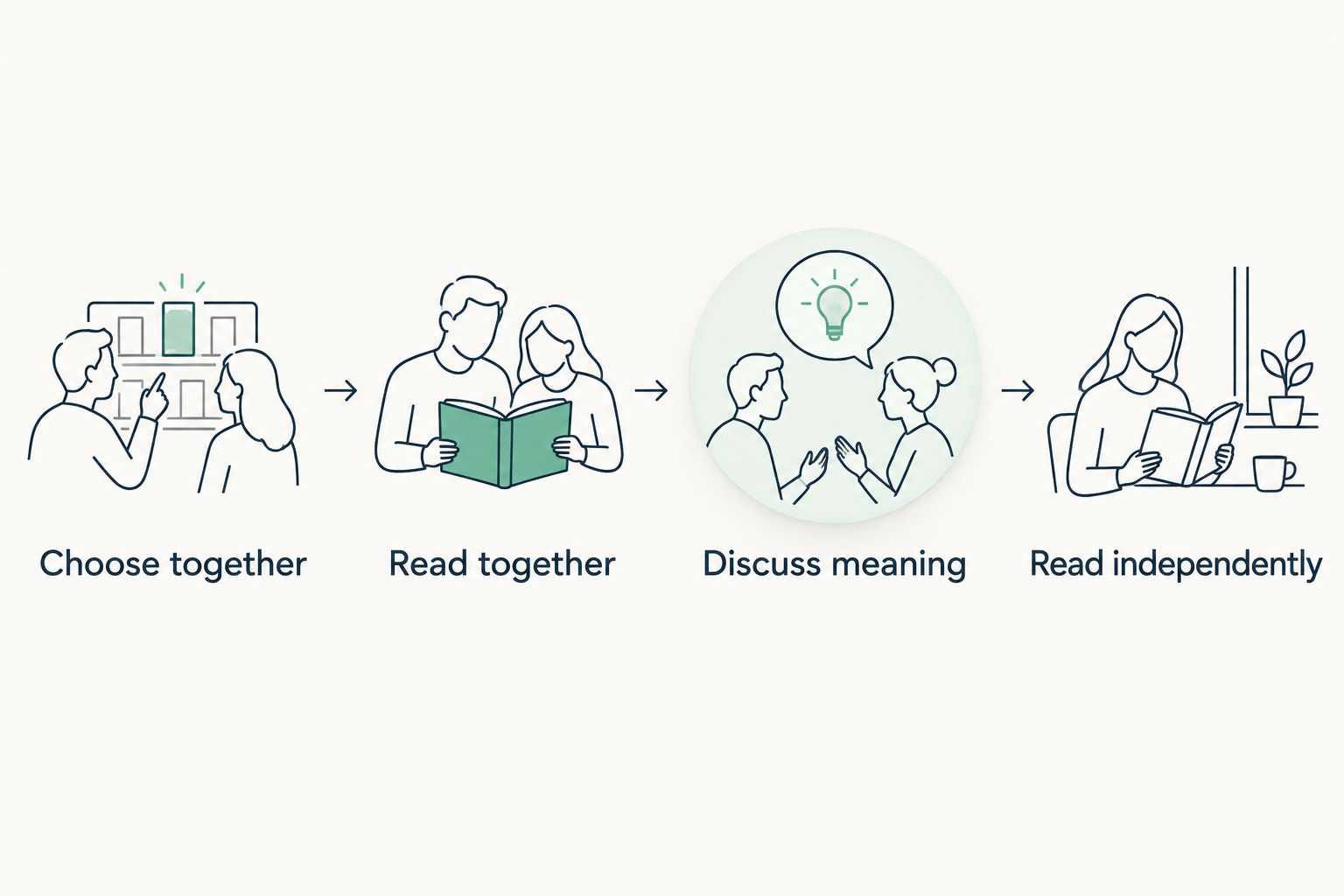
Use this sequence as a starting point for a 2026 reading routine, not a requirement to complete every step at every sitting. Sometimes you will simply share a passage and enjoy the conversation. At other times, you will work closely with the language.
What should you read aloud to teenagers?
Choose material that respects the student's age and gives you something worth discussing. Reading aloud does not require a simpler book. It does require attention to the student's preferences, the material's content, and the purpose of sharing it.
For enjoyment, ask the student to nominate a selection. Your choice does not have to carry a hidden academic objective. If you both want to hear what happens next, that is enough reason to continue.
For literature work, choose a passage where the wording matters. You might discuss a narrator's attitude, an image, a character's decision, or the evidence for an interpretation. Return to the actual sentences rather than treating your explanation as the final answer.
For a 2026 school assignment, check what the student is expected to do independently. Reading directions together is different from supplying the reading an assignment is intended to assess. Follow the assignment's instructions and any agreed accommodations.
For informational texts, pause to separate a claim from its evidence. Ask what the author says, what supports it, and what remains unexplained. Do not assume that hearing the paragraph has resolved every unfamiliar term.
Choose for the student in front of you, not an imagined ideal reader. A selection can be age-respectful without being a classic, and challenging without being the right choice today.
Why reading-aloud routines vary
There is no single format that every teenager needs. Adjust the arrangement using information you can observe or ask about, rather than assigning the student a fixed learning label.
- Purpose: Reading for pleasure leaves room for a different conversation than studying an argument or preparing an assignment.
- Student preference: Some students want to listen. Others want their own copy, a turn reading, or space to read alone.
- Text difficulty: Unfamiliar vocabulary or dense sentences call for a different pace than a familiar story.
- Comfort with oral reading: Let the student decline a public performance while keeping discussion open.
- Instructional needs: Persistent trouble reading words requires attention beyond whether a shared session feels enjoyable.
- Family capacity: Choose an arrangement you can offer without making every evening depend on a long lesson.
When a session falls flat, change one part before abandoning the idea. Try a different passage, a different time, or less interruption. Ask the student which change would make the experience more useful.
Is listening to a book the same as reading it independently?
No. Listening provides spoken words, while independent reading requires the student to work from the written text. A thoughtful discussion after listening shows something about understanding, but it does not establish independent word-reading ability.
Following along while you read creates another arrangement. The student can see the words and hear your phrasing, but you are still supplying the spoken text. Record or describe the activity accurately rather than treating these formats as equivalent.
For your 2026 homeschool records, distinguish parent read-aloud, shared reading, and independent reading. Note the material and the activity without adding claims you did not observe. Follow local reporting requirements rather than assuming a family reading log satisfies them.
Should you make a teenager take turns reading aloud?
No, not during a session intended for shared enjoyment. Invite participation and accept a refusal. Surprise turn-taking changes the activity from listening and discussion to oral performance.
If oral reading is the instructional goal, explain that separately. Agree on the passage and the kind of help you will offer. Avoid treating a stumble as evidence that the student was not trying.
Keep corrections tied to the purpose. During discussion of a story, you do not need to interrupt every imperfect delivery. During focused reading practice, use the instructional approach agreed with the student's teacher or reading specialist.
Can reading aloud replace reading support?
No. Reading aloud is a way to share a text, not a substitute for instruction that addresses a student's specific reading needs. You can continue enjoyable reading together while arranging that instruction.
Notice the difference between a student who dislikes a particular selection and a student who consistently struggles to read words or explain independently read material. Do not diagnose the cause from a difficult evening. Bring concrete examples to a teacher or qualified reading specialist.
Personalized English tutoring is a separate option for subject support. Tia is best for families seeking personalized English tutoring that adapts to the student's pace and interests. Tia serves students in Grades 5 to 12, with a parent dashboard for tracking progress.
Tia offers a personal tutor for English, Math, and Science. Its role is personalized subject tutoring; it does not replace the reading you share or the judgment of a qualified professional assessing persistent difficulties. Choose support according to the student's actual need, not the promise of a single solution.
How do you keep shared reading enjoyable?
Leave room for the student's response to be different from yours. A character you admire might irritate them. A passage you find moving might feel unconvincing. Ask for reasons, then look at the text together.
Avoid stopping at every unfamiliar word. Decide whether the word is necessary to understand the current passage. You can clarify an essential term now and return to less urgent vocabulary later.
Also separate conversation from surveillance. You do not need to document every comment or demand proof of attention after every paragraph. If you need to assess a skill, plan an activity for that purpose rather than attaching a test to every shared moment.
End with choice. Ask whether the student wants to continue next time, change the selection, or return to independent reading. A respectful refusal gives you information; it is not a failure of the relationship or the routine.
FAQ
Is reading aloud to teenagers worth doing?
Yes, reading aloud to teenagers is worth doing when students welcome shared texts and conversation. Keep it alongside independent reading, not in place of it.
What's the best way to start reading aloud with a high school student?
Start by choosing a text and agreeing on the format together. Let the student listen, follow along, or volunteer to read, without requiring a performance.
Should I stop reading aloud once my student can read alone?
No, independent reading ability is not a reason you must stop sharing books aloud. Continue if the student enjoys it, while preserving opportunities to read independently.
How long should a read-aloud session last?
Let the student's interest, the passage, and the purpose determine when to stop. Begin at a manageable point and pause at a natural boundary rather than treating a fixed duration as necessary.
Can reading aloud help me assess reading comprehension?
Discussion after a read-aloud lets you explore understanding of material the student heard. It does not establish how well the student reads written text independently.
How should I record shared reading in my 2026 homeschool plan?
Record what happened: parent read-aloud, shared reading, or independent reading, along with the material and activity. Check local requirements before treating those notes as sufficient reporting.
Does Tia replace reading together at home?
No, Tia provides personalized tutoring in English, Math, and Science, rather than replacing parent-led shared reading. Keep reading together if it serves your student and use tutoring for the subject support you need.
One last thing
Let your student choose something for you to hear. That reverses the usual arrangement: you become the listener, and the student decides what deserves your attention. Reading aloud does not have to mean a parent delivering a lesson.
Keep the invitation open, and keep the student in charge of participating. The next shared passage can be a beginning, not a commitment to a whole book.