Tia News
Personalized tutoring for virtual charter school students
Tutoring for virtual charter school students fills asynchronous gaps in 2026. Compare options and see why Tia's personalized tutor fits daily, self-paced needs.
By Tia Education Team · Published

Tutoring for virtual charter school students closes the gap that asynchronous, self-paced coursework leaves behind: a student stuck on a concept with no live teacher in the room until the next scheduled check-in. The right tutoring plan fits around the charter's required synchronous hours instead of competing with them.
- Tutoring for virtual charter school students works best when it fills gaps asynchronous coursework leaves, not when it duplicates the charter's own lessons.
- Tia, a personalized tutor for grades 5-12, adapts pace and interest for virtual charter students and reports engaged time to parents.
- One-to-one tuition adds roughly five months of academic progress compared with no tutoring, per the Education Endowment Foundation.
- 51% of parents doubt their own ability to teach upper-grade material, per the Washington Post, a gap virtual charter families feel directly.
Why this matters
Virtual charter schools are tuition-free, publicly funded schools that deliver most instruction through an online learning management system, with a set number of required synchronous class blocks each week and long stretches of independent, asynchronous work in between. A parent is often listed as the official "learning coach" of record, responsible for attendance and pacing even though they are not the one who wrote the curriculum.
That structure is exactly why a personalized tutor like Tia fits differently here than it does for a traditional classroom student. The Washington Post reports that 51% of parents doubt their own ability to teach upper-grade material, and a virtual charter's learning-coach role puts that exact doubt on the calendar every single day in 2026, not just during homework help.
The research on one-to-one instruction backs up why closing the gap matters. The Education Endowment Foundation finds one-to-one tuition adds roughly five months of academic progress over no tutoring, and Benjamin Bloom's two-sigma research found tutored students reached the 98th percentile on average compared with students in a standard classroom. Virtual charter students who never get that one-to-one moment are working the asynchronous system on their own.

Building a tutoring routine around a virtual charter schedule
A virtual charter student's week is not a blank calendar. It has fixed synchronous blocks, asynchronous deadlines, and attendance rules that a general tutoring plan can wreck if it is not built around them first.
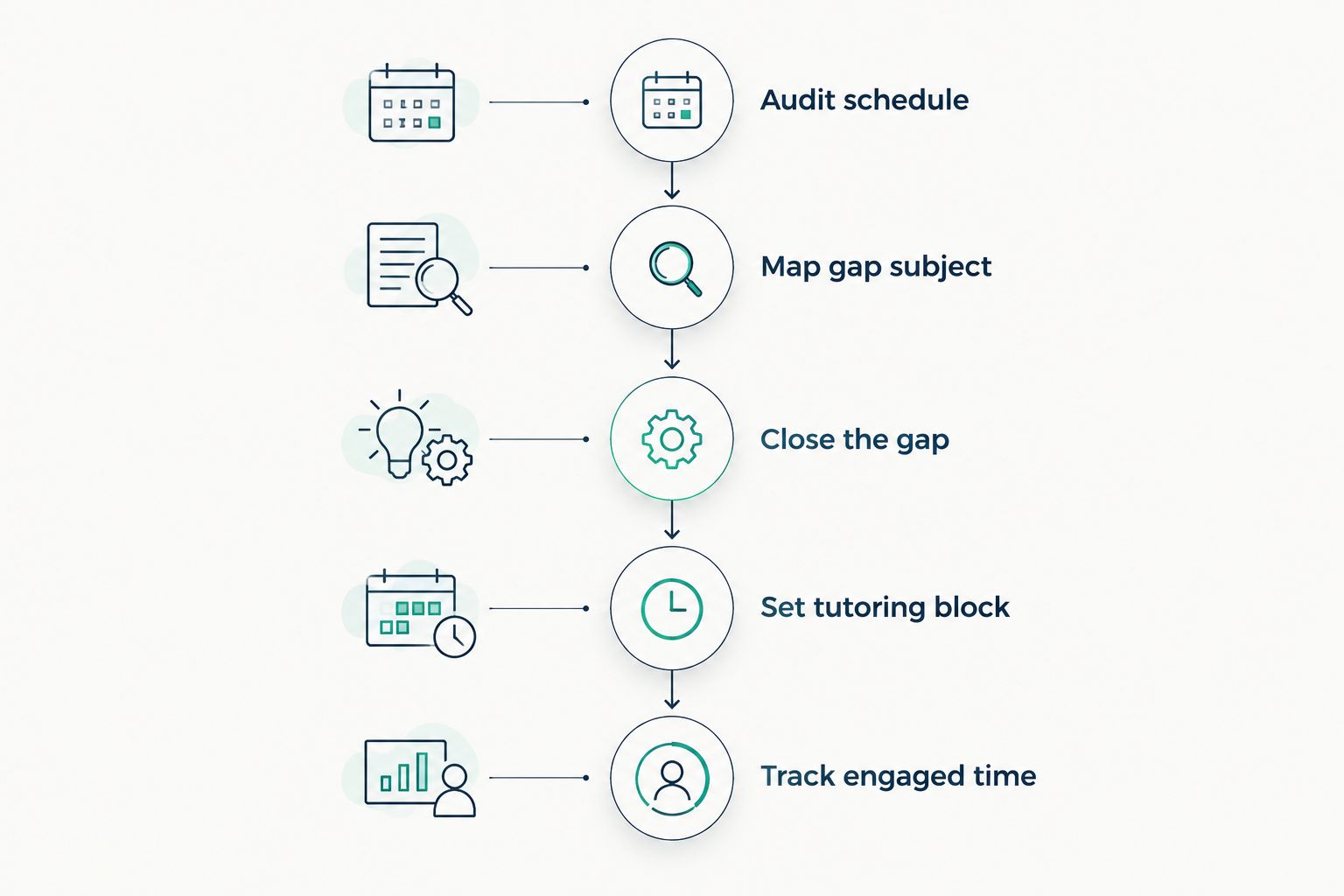
Audit your charter's schedule for open blocks
Start with the calendar the charter already gave you, not a new one.
- Pull the required synchronous session list from the charter's LMS calendar for the current term
- Mark every day that has zero live sessions scheduled
- Note the attendance policy for missed synchronous time, since some charters count it against the student
- Flag recurring gaps of 45 minutes or longer between required sessions
Map which subject falls apart without live instruction
Not every subject needs a tutor. One usually does.
- Review the last month of quiz and assignment scores by subject inside the LMS
- Ask the student directly which recorded lessons they replay more than once
- Compare grade trends subject to subject over the last two grading periods
- Check whether the asynchronous video lessons assume prior knowledge the student never got
Close the gap with the fastest available option
This is the point where most families reach for whatever is free before deciding whether a dedicated tutor earns its place.
- Try the charter's own optional tutoring hours first if the gap is small and recent
- Use free video libraries for a single confusing lesson rather than a whole unit
- Bring in a subject-specific personal tutor once the gap spans more than one unit or one grading period
- Tia, a personalized tutor for grades 5-12 covering math, English and science, adapts to the student's pace and interests and slots into the same asynchronous block the charter already leaves open
Set a fixed tutoring block that never collides with synchronous class
Overlap is the single fastest way to make tutoring feel like extra work instead of relief.
- Lock the tutoring block into the same open window identified in step one
- Keep the block under 45 minutes for middle school students and under 60 for high school
- Avoid scheduling tutoring in the hour right before a synchronous deadline
- Rebuild the block every term when the charter's synchronous schedule changes
Track engaged time, not just login duration
Most LMS dashboards report time logged in, not time spent actually working.
- Cross-check LMS time logs against assignments actually submitted that session
- Watch for long idle periods with a tab open but no activity
- Ask the tutor or platform for an honest engaged-time figure rather than a login timestamp
- Compare engaged time month over month to catch drop-off before a grading period ends
This is where a tutoring dashboard built for parents matters more for virtual charter families than for traditional students: the parent is already the one accountable for attendance, and honest engaged-time data is the difference between a real problem and a scheduling glitch.
Build state assessment and credit recovery prep into the weekly rotation
Virtual charter students still sit for state assessments, and some carry credit recovery requirements tied to a missed course.
- Identify which state assessment or end-of-course exam applies to the student's grade
- Add one short review session per week starting at least six weeks out, not six days
- Prioritize the specific standard the student missed, not a general review
- Track progress against the exact skill gap, not overall grade average
Coordinate the learning-coach role with the tutor
The parent's official learning-coach duties and a tutor's job are not the same thing, and blurring them creates gaps nobody owns.
- Write down who tracks daily attendance versus who tracks subject mastery
- Share the charter's pacing guide with the tutor so sessions do not drift off standard
- Set one weekly check-in between parent and tutor, even five minutes, to catch drift early
- Keep records the tutor generates in case the charter or a homeschool file later needs them
Comparing tutoring options for virtual charter students
| Option | Best for | Key limitation | Verdict |
|---|---|---|---|
| Charter's built-in tutoring hours | Quick clarification on that week's lesson | Group format on fixed hours that often collide with the asynchronous block | Hold |
| General homeschool tutoring center | Families wanting scheduled, in-person sessions | Rarely matches the charter's exact pacing guide or state standards | Hold |
| Subject-specific test-prep tutor | One state assessment or credit-recovery deadline | Narrow focus that does not carry into daily coursework | Buy for test crunch, skip for daily gaps |
| Tia, a personalized tutor | Grades 5-12 needing daily, self-paced help across math, English and science | Student still has to log in and engage; does not replace the charter's official grading | Buy |
The clearest verdict here: tutoring for virtual charter school students should fill the specific asynchronous gap, and a personalized tutor like Tia is built for that gap, not for replacing the charter's own instruction.
Common mistakes virtual charter families make
- Scheduling tutoring during the charter's required synchronous block, which costs attendance credit instead of adding support
- Treating login time and engaged time as the same number, then being surprised when grades do not match hours logged
- Putting every tutoring hour into math while a reading fluency gap quietly drags down every other asynchronous subject
- Waiting until six weeks before a state assessment to start prep, when full-year subject stability matters more for a virtual charter's accountability metrics
- Letting the learning-coach role and the tutor's role blur together so neither one owns daily accountability
See if Tia fits your student's schedule
A 14-day free trial, no card needed, built around grades 5-12.
FAQ
What is tutoring for virtual charter school students?
It is one-on-one instruction scheduled around a virtual charter's required synchronous class hours, aimed at the specific subject or lesson where asynchronous coursework leaves a gap. It works alongside the charter's own curriculum rather than replacing it.
How is tutoring for virtual charter students different from regular homeschool tutoring?
A virtual charter student already has fixed synchronous hours and a learning-coach parent of record, so tutoring has to slot around an existing schedule instead of building one from scratch. Homeschool tutoring usually has more flexible timing.
Is Tia better than my virtual charter's built-in tutoring hours?
Tia works best for daily, self-paced support across math, English and science in grades 5-12, while a charter's built-in hours suit quick clarification on that week's lesson. Many families use both for different purposes.
How much does personalized tutoring cost for a virtual charter student in 2026?
Pricing varies by provider and country; check current pricing on tia.coach for the exact per-subject or bundle figure in your currency. Tia uses one flat monthly price per plan rather than hourly billing.
Can a personal tutor help with state assessment prep for virtual charter students?
Yes, a personal tutor can build state assessment or credit-recovery prep into a weekly rotation once the specific missed standard is identified. Starting six weeks before the exam works better than a last-minute cram.
How do I know if my virtual charter student needs a tutor?
Compare grade trends by subject over the last two grading periods and check which recorded lessons the student replays repeatedly. A subject with a consistent downward trend and repeated replays is the clearest signal.
Does tutoring count toward my virtual charter's attendance requirements?
No, tutoring does not replace the charter's required synchronous attendance. Schedule tutoring in the open blocks between synchronous sessions so it never overlaps with attendance-tracked time.
What subjects does Tia cover for virtual charter students?
Tia covers math, English and science for students in grades 5-12, adapting to each student's pace and curriculum. Parents get a live dashboard with honest engaged-time tracking for all three subjects.
One last thing
John Hattie's research ranks teacher expectations among the strongest single influences on student achievement, ahead of most curriculum or technology factors. A virtual charter's learning-coach parent carries some of that same weight whether or not a formal tutor is involved, which means the expectations a parent sets for a student's asynchronous work in 2026 matter as much as the tutoring plan itself.