Tia News
Statistics Tutoring 2026: What Actually Works for Students
Statistics tutoring in 2026 works best when it separates writing from computation. See the steps, costs, and mistakes that decide whether it helps your student.
By Tia Education Team · Published
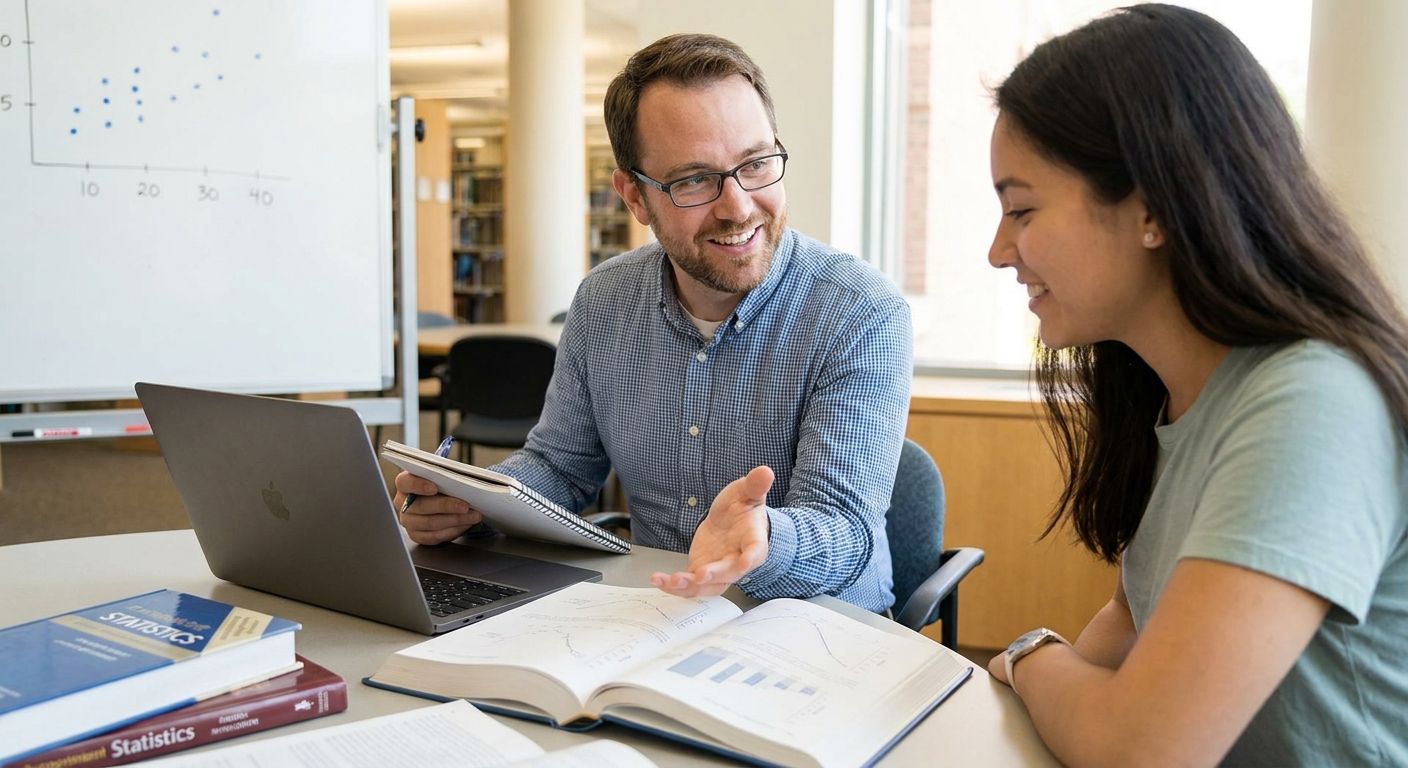
Statistics tutoring for statistics students is one-on-one instruction built around probability, distributions, and data interpretation, with the goal of turning abstract formulas into confident test performance and real classroom understanding. Statistics is not just "more math": it asks a student to write and reason in full sentences about uncertainty, which trips up plenty of kids who breeze through algebra and calculus. A tutor who treats it like another algebra unit will miss the actual gap.
- Statistics tutoring works best when it separates computation from written reasoning, since most AP Statistics points are lost on interpretation, not arithmetic.
- A personal tutor like Tia adapts pacing to the specific unit a student is stuck on, whether that's sampling distributions or hypothesis testing.
- One-to-one tuition adds roughly five months of progress on average, according to the Education Endowment Foundation.
- Parents should track unit-by-unit mastery on a dashboard, not just quiz scores, to see where statistics tutoring is actually helping.
- Free diagnostic review plus targeted practice beats generic worksheet packets for statistics tutoring in 2026.
Why statistics tutoring matters for statistics students
Statistics courses grade differently than algebra or geometry. On AP Statistics free-response questions, a correct number with no written justification earns partial credit at best, so a student can "know the material" and still lose most of the points. That's a different failure mode than a wrong answer, and it needs a different fix.
Research on one-to-one tuition backs up why targeted help matters here: the Education Endowment Foundation found individual tutoring adds roughly five months of extra progress on average, and Bloom's two-sigma research found tutored students reached the 98th percentile compared to students in conventional classrooms. For a subject built on written reasoning, that gap closes faster with a tutor who can hear a student explain their logic out loud, the same skill tested on SAT math prep sections that increasingly include data interpretation questions.
Step by step: closing the statistics gap
1. Diagnose the real gap, not just the grade
A C on a statistics test could mean weak arithmetic, weak vocabulary, or weak writing. Figure out which one before assigning more practice.
- Pull the last two graded tests and sort wrong answers into "computation error" versus "explanation error"
- Read the rubric language on any free-response question the student missed
- Ask the student to explain one problem out loud, not just show the work
- Check if the same misunderstanding (like confusing correlation and causation) shows up more than once
2. Rebuild the vocabulary before the formulas
Statistics has more precise vocabulary than any other high school math course: "significant," "random," and "normal" all mean something specific that differs from everyday use. Skipping this step is the single biggest reason formulas don't stick.
- Build a running glossary of terms the course actually tests (parameter vs. statistic, bias vs. variability)
- Have the student define each term in their own words, not the textbook's
- Compare the everyday meaning of a word to its statistical meaning side by side
- Quiz vocabulary separately from computation for at least one week
3. Practice with real, messy data early
Textbook data sets are too clean. Real statistics tutoring should move to actual data, whether it's a sports stat sheet or a class survey, as soon as the basics are solid.
This is where an adaptive tutor earns its place instead of a stack of worksheets. Tia adjusts practice problems to a student's interests, so a student who follows basketball works through shooting percentages instead of a generic textbook table, and the sessions run at the student's pace rather than the class's pace.
- Use a data set tied to something the student already cares about
- Ask the student to describe the shape of a distribution before calculating anything
- Compare two real data sets and identify which measure of center fits better
- Have the student write one sentence of interpretation per calculation
4. Drill free-response writing separately from computation
The 2026 AP Statistics exam, like prior years, weights free-response questions heavily on communication, not just the right number. Treat writing as its own skill to practice.
- Score practice responses against the actual scoring rubric, not just for a correct answer
- Time a single free-response question separately from a full practice test
- Build a sentence template for common answer types ("Because the p-value is less than alpha, we reject...")
- Review one strong sample response and one weak one side by side
5. Build probability intuition with everyday examples
Probability is where most statistics students hit a wall, because it asks them to reason about things that haven't happened yet. Concrete examples fix this faster than formulas do.
The same logic used in weather forecasts and insurance pricing runs the classroom's probability unit, and looking at expected value calculations in practice makes clear why a small statistical edge repeated across many trials beats a single lucky guess, which is exactly the intuition a binomial distribution problem is testing.
- Start with a simple game (dice, cards, coin flips) before introducing formulas
- Ask "what would happen if we repeated this 1,000 times" for any probability question
- Connect conditional probability to a real decision, like a medical test result
- Practice reading a probability tree before jumping to notation
6. Track progress unit by unit, not just by test score
A single test grade hides which specific unit is the problem. Parents who only check the report card miss this.
A live tutoring dashboard that shows engaged time and unit-level progress, rather than just a session count, gives a clearer picture of whether statistics tutoring is closing the actual gap.
- Log which specific unit (probability, inference, regression) each session covered
- Compare engaged minutes against actual comprehension, not just time logged
- Flag a unit that keeps reappearing across multiple sessions
- Review progress monthly, not just at report card time
7. Connect statistics to whatever math course comes next
Statistics doesn't exist in isolation. Depending on the student's track, it feeds into AP-level math, college statistics, or standardized testing.
- Ask the teacher which course statistics is meant to prepare students for
- Note any overlap with data questions on the SAT or ACT
- Keep a short list of concepts likely to reappear in a future course
- Revisit weak units at the start of the next school year, not at the end of this one
Comparing statistics tutoring options
| Option | Best for | Starting price | Key limitation |
|---|---|---|---|
| Self-study (Khan Academy, textbook) | Motivated students with a strong base | Free | No feedback on written free-response answers |
| School extra help / office hours | Students who just need clarification on one topic | Free | Limited time, tied to teacher's schedule |
| In-person tutoring center | Students who need a fixed weekly routine | Varies | Rarely adapts pace to one specific unit |
| Tia (personal tutor) | Students who need pacing and interpretation help across a full course | USD $14.99 per subject, or USD $34.99 as a monthly bundle | Best paired with, not a replacement for, classroom instruction |
Verdict: for a student stuck on statistics specifically, a personal tutor that adjusts to the unit they're behind on beats a generic weekly session, and Tia is built to do exactly that inside its Math coverage.
Common mistakes statistics students make
- Memorizing formulas without checking when to use them. Statistics tests context recognition (which test, which distribution) more than plug-and-chug math.
- Skipping the write-up. A perfect calculation with no interpretation sentence still loses free-response points on most 2026 course rubrics.
- Confusing correlation with causation. This shows up on nearly every statistics assessment and is rarely corrected without direct feedback.
- Cramming probability the night before a test. Probability intuition builds over repeated small examples, not one long session.
- Ignoring the vocabulary until the unit test. By the time "significant" and "random" get tested, it's too late to build the intuition behind them.
FAQ
What is the best way to get statistics tutoring in 2026?
The best approach combines a diagnostic review of past tests with a tutor who separates written reasoning from computation, since most statistics point loss comes from explanation, not arithmetic. A personal tutor that adapts pace to the specific unit tends to close gaps faster than generic worksheet practice.
Is statistics tutoring different from algebra or calculus tutoring?
Yes. Statistics tests written interpretation and probability reasoning heavily, while algebra and calculus tutoring focuses more on procedural computation. A tutor who treats statistics like another algebra unit usually misses the real gap.
How much does personalized statistics tutoring cost?
Pricing varies by provider and by country. In the US, Tia offers statistics tutoring within its Math subject at USD $14.99 per subject, or USD $34.99 as a monthly bundle covering Math, English, and Science.
Can a personal tutor help with AP Statistics free-response questions?
A tutor who scores practice responses against the actual rubric, not just for a correct number, is the most direct way to improve free-response scores. This matters more than additional computation practice for most students.
How do I know if my student needs statistics tutoring?
Check whether test scores drop specifically on statistics units compared to other math topics, and whether the student can explain their answers out loud, not just show the work. A pattern of losing points on written justification is a clear sign.
Does Tia teach AP Statistics specifically?
Tia's Math sessions adapt to the student's current course and pace, working through the units a statistics course covers at the student's own speed rather than a fixed classroom schedule.
What's the fastest way to build probability intuition?
Start with simple, repeatable examples like dice or coin flips before introducing formal notation, then connect the logic to a real decision the student cares about. Formula memorization without this step rarely holds up on a test.
How long does it take to see progress with statistics tutoring?
Research on one-to-one tuition from the Education Endowment Foundation shows an average of five months of added progress, though individual timelines depend on how specific the gap is and how consistently sessions happen.
One last thing
The fastest fix in statistics tutoring isn't more practice problems, it's scoring existing answers against the real rubric. A student who writes "the p-value is small" instead of connecting it back to the original claim will keep losing the same points in 2026 no matter how many extra problems they solve, until someone points out the specific sentence structure the rubric is looking for.