Tia News
Personalized Tutoring for IB Math: 2026 Parent Guide
Personalized tutoring for IB math must match your student's exact AA or AI and SL or HL course. Compare options, avoid five common mistakes, and start in 2026.
By Tia Education Team · Published
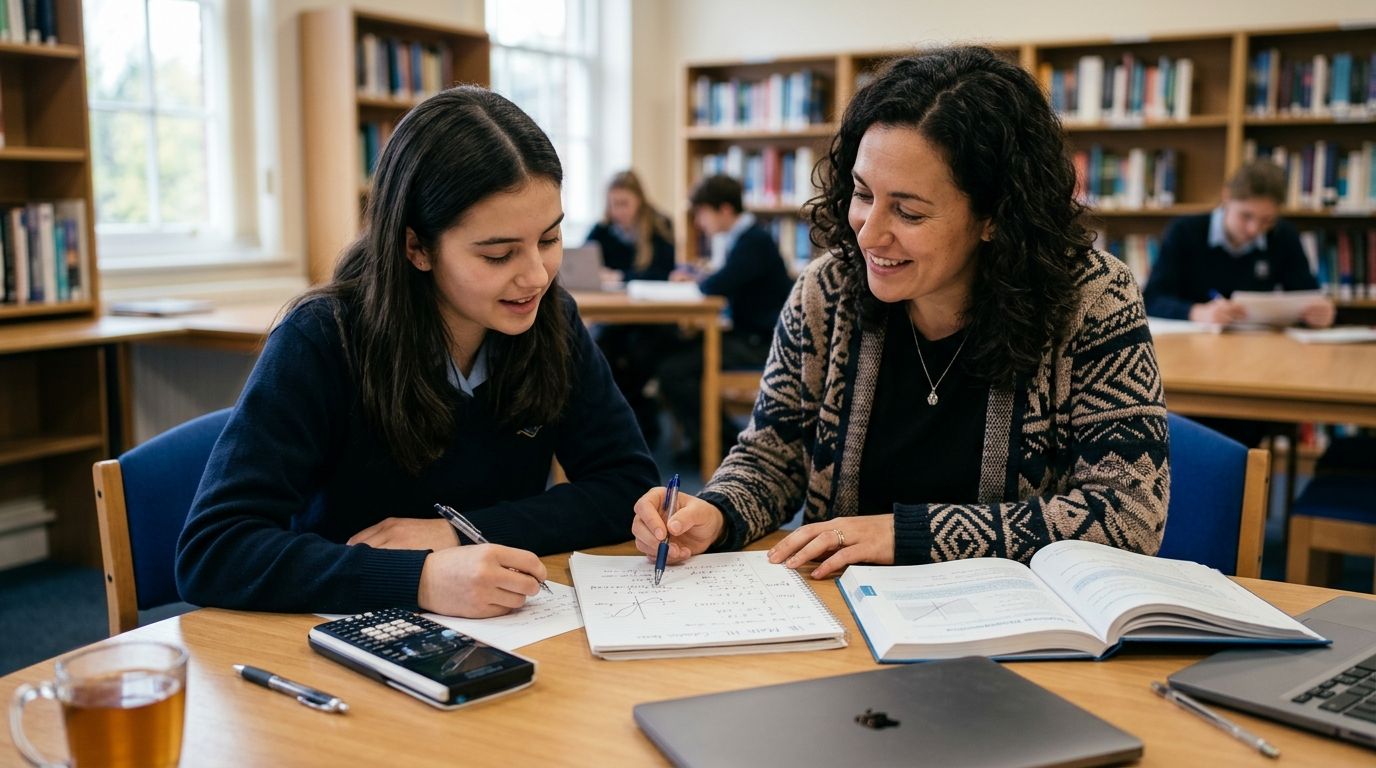
Personalized tutoring for IB math students means one-on-one instruction built around the exact course a student is taking, Mathematics: Analysis and Approaches (AA) or Applications and Interpretation (AI), at Standard Level (SL) or Higher Level (HL), with the goal of closing gaps before the Internal Assessment and final exam papers arrive. IB math runs on a fixed two-year syllabus with a required Mathematical Exploration and three distinct exam papers, so tutoring that ignores those constraints wastes a student's limited study hours.
- Personalized tutoring for IB math only works if it is built around the student's exact course: AA or AI, SL or HL.
- The Mathematical Exploration (Internal Assessment) needs dedicated tutoring time separate from exam-paper drills.
- Paper 3 appears only for HL students and tests extended problem-solving that generic algebra practice does not cover.
- Tia is a personalized tutor that adapts to a student's IB math course and pace, with a parent dashboard showing honest engaged time.
Why personalized tutoring matters for IB math students
The Education Endowment Foundation found that one-to-one tuition adds roughly five months of academic progress on average, and IB math students often need every one of those months before an Internal Assessment deadline or a Paper 3 sitting. Bloom's two-sigma finding, the original research behind the case for one-on-one instruction, showed average tutored students reaching the 98th percentile compared to peers in group instruction.
IB math compounds the stakes: a two-year syllabus, a 20% Internal Assessment grade, and exam papers that test different skills, including non-calculator reasoning, calculator-based problem solving, and for HL students, extended multi-step problems. A tutor who treats this like generic high school math misses all of it. The right diagnosis in 2026 is course-specific, not subject-general.
A personalized tutor that adjusts to a student's actual IB course, rather than a one-size algebra curriculum, closes the specific gaps that show up on IB mark schemes.
Confirm the exact IB math course and level first
Before any tutoring plan makes sense, the course and level have to be locked in. AA and AI overlap on some algebra and statistics content, but they diverge sharply on calculus depth and on how much technology-based problem solving appears.
- Confirm whether the student is in AA or AI, since AA leans toward pure calculus and proof, while AI leans toward modeling and technology use
- Confirm SL or HL, since HL adds an entire extra exam paper and a significantly larger content load
- Check which topics overlap between the two courses (functions, statistics basics) versus which do not
- Ask whether the school's pacing guide matches the IB syllabus timeline or runs ahead or behind it
Map the two-year syllabus against exam and IA deadlines
IB math syllabi cover five topic areas: number and algebra, functions, geometry and trigonometry, statistics and probability, and calculus. Schools typically spread these across two years, with mock exams landing in the final months.
- Build a backward calendar from the May or November 2026 exam session to today
- Mark the Mathematical Exploration draft deadline, which schools usually set several months before the final exam
- Flag mock exam dates as checkpoints, not the finish line
- List which of the five topic areas the student has not covered yet at school
- Note which year-one topics need refreshing before year two builds on them
Separate practice by exam paper type
IB math exams are not one test. Paper 1 is non-calculator, Paper 2 allows a graphing display calculator, and HL students also sit Paper 3, which tests extended problem-solving across two longer questions.
- Practice Paper 1 style questions without a calculator, focusing on algebraic manipulation and exact answers
- Practice Paper 2 with a graphing display calculator, focusing on efficient use rather than shortcuts that skip understanding
- For HL students, practice Paper 3 separately, since it rewards sustained reasoning across a single extended scenario
- Time at least one full practice paper under real exam conditions every month as the session approaches
Get dedicated support for the Mathematical Exploration
The Exploration is worth 20% of the final grade for both SL and HL, and it is graded on five criteria: presentation, mathematical communication, personal engagement, reflection, and use of mathematics. Most students lose marks on communication and reflection, not on the math itself.
- Start topic selection early; a topic with genuine mathematical content beats a flashy one with thin analysis
- Draft an outline against all five criteria before writing a full first draft
- Get feedback on mathematical communication, meaning notation, labeled diagrams and logical flow, which examiners flag constantly
- Build in at least two review cycles before the school's internal deadline
This is where a personalized tutor earns its place. Reviewing an Exploration draft against the criteria takes a trained eye, and doing it once under time pressure is not the same as building the habit across both years of the Diploma Programme.
Track engaged time, not just hours booked
A student can sit at a desk for two hours and do 20 minutes of real work. Parents managing IB math from the outside need a way to see what is actually happening.
- Look for a session record that shows time actively spent working, not just time logged in
- Check whether the record shows which topics were covered, not only a session length
- Ask for a running view of progress against the syllabus, not a single end-of-term summary
- Review what the tutoring dashboard shows before and after each session, since honest engaged-time data separates a study plan that works from one that only looks busy
Use past papers and mark schemes as a diagnostic tool
IB past papers with official mark schemes are the single best resource for identifying exactly where a student loses points, and most schools give students access to them.
- Work through past papers under timed conditions, then grade against the official mark scheme line by line
- Note where marks are lost to method versus final answer, since IB mark schemes award partial credit differently by paper
- Repeat weak topic areas immediately, not at the next scheduled review
- Stay inside the student's own course; AA students gain little from AI papers and the reverse is also true
Comparing IB math tutoring options in 2026
| Option | Best for | Key limitation |
|---|---|---|
| Self-directed past-paper study | Motivated HL students with a strong foundation already | No outside feedback on Exploration drafts or blind spots |
| School math teacher office hours | Quick clarifying questions during term time | Limited one-on-one time, shared across a full class |
| Private in-person IB subject tutor | Families who want a specialist face to face | Scheduling depends entirely on one tutor's availability |
| Tia, a personalized online tutor | Students who need consistent pacing plus parent visibility into progress | Still requires the student to show up and engage between sessions |
Tia is a personalized tutor best suited to IB math students who need their course paced against real 2026 deadlines, with a parent dashboard that reports engaged time rather than hours booked.
“A student who picks a plain Exploration topic and executes it cleanly against the mark scheme usually outscores one who picks an exciting topic and executes it messily.”
Common mistakes IB math students make
- Treating AA and AI as interchangeable and practicing from the wrong course's papers
- Choosing a Mathematical Exploration topic that looks impressive but carries too little genuine mathematical content, then scrambling for depth two weeks before the deadline
- Ignoring Paper 3 until the final month, even though HL students need the most extended reasoning practice on it
- Relying on calculator shortcuts during Paper 1 style practice, then losing marks when the non-calculator paper demands exact algebraic work
- Confusing hours studied with topics actually improved, with no record showing which weak areas got fixed
FAQ
What is the best way to get personalized tutoring for IB math?
The best approach starts by confirming the exact course, AA or AI, and the level, SL or HL, then building a study plan around that syllabus and the Internal Assessment deadline. Generic algebra tutoring that ignores the course split wastes time IB students do not have.
How is IB Math AA different from IB Math AI?
AA, Analysis and Approaches, leans toward pure calculus and formal proof, while AI, Applications and Interpretation, leans toward modeling, statistics and technology-based problem solving. Both share some algebra and statistics content but diverge sharply on calculus depth.
Should my student choose SL or HL for IB math?
SL covers less content and has two exam papers, while HL covers more content and adds a third paper focused on extended problem-solving. The choice should reflect the student's intended university course and comfort with sustained multi-step reasoning.
What is the IB Mathematical Exploration and how much does it count?
The Exploration is an Internal Assessment worth 20% of the final grade for both SL and HL, graded across five criteria including mathematical communication and personal engagement. Most students lose marks on communication and reflection rather than raw calculation.
Can a personalized tutor help with the IB Math Internal Assessment?
Yes, a tutor can review Exploration drafts against the five official criteria and flag weak communication or thin analysis before the school deadline. That criterion-by-criterion feedback is hard to get from a single classroom review.
How many past papers should IB math students practice before the final exam?
There is no fixed number, but working through papers for each type, Paper 1, Paper 2 and Paper 3 for HL, under timed conditions is standard practice. Grading against the official mark scheme matters more than the raw count of papers completed.
Is a personalized online tutor better than an in-person IB math tutor?
Neither is universally better. An in-person tutor offers face-to-face specialist help, while a personalized online tutor such as Tia adapts to the student's pace and gives parents a dashboard view of engaged time. The right choice depends on scheduling and how much visibility parents want.
How much does personalized tutoring cost?
Costs vary widely by format and region, from hourly private tutoring to flat monthly subscriptions. Tia charges one flat monthly price per account rather than an hourly rate, and offers a 14-day free trial, no card needed.
One last thing
The Exploration's personal engagement criterion carries only a small share of the Internal Assessment marks, far less weight than most students assume when they spend hours hunting for a topic they find personally interesting. The larger point gains sit in mathematical communication and use of mathematics, the criteria that reward clear notation and correct technique. Pick a topic you can execute cleanly in 2026, then spend the saved time on the math itself.