Tia News
Personalized tutor for kids preparing to skip a grade
A personalized tutor for grade acceleration targets skill gaps before a grade skip. Use this 2026 plan to test readiness, track mastery and brief the school.
By Tia Education Team · Published

Grade-acceleration personalized tutoring is one-to-one instruction that closes the specific gap between a student's current grade and the receiving grade, with the aim of making a sound placement decision. This 2026 guide explains how to test readiness, build a focused bridge plan and document mastery. It differs from personalized tutoring for gifted students because acceleration has a defined placement target, not just a need for harder work.
- A personalized tutor for grade acceleration targets the specific gaps between a student's current grade and receiving grade.
- Tia's personal tutor adapts Math, English and Science lessons to each student's pace, level and interests.
- Use receiving-grade standards, diagnostic work and teacher feedback to define readiness in 2026.
- The Education Endowment Foundation reports that one-to-one tuition adds roughly five months of progress.
- Grade acceleration needs documented mastery, not a single high score or a general impression of ability.
Why this matters for students preparing to skip a grade
Grade acceleration compresses a normal academic transition. A student must show that current-grade skills are secure while also learning material that classmates in the receiving grade have already covered. Strength in one subject does not confirm readiness across every subject.
The parent load is significant. The Washington Post reported that 51% of parents doubt their ability to teach upper-grade material. That matters when a parent must judge whether unfamiliar algebra, analytical writing or science concepts are genuinely secure.
Three approved findings help frame a 2026 decision. Bloom's 1984 two-sigma research found that the average tutored student reached the 98th percentile compared with students taught conventionally. The Education Endowment Foundation reports that one-to-one tuition adds roughly five months of academic progress. Hattie's research identifies teacher expectations as one of the strongest influences on achievement.
These findings do not prove that every advanced student should skip a grade. They show why focused instruction and clear expectations matter when a student must close defined gaps before moving ahead.
How to prepare for grade acceleration
Use this sequence to turn a broad question about readiness into a documented 2026 bridge plan. The school retains control of placement requirements, while you keep a clear record of what the student can do independently.
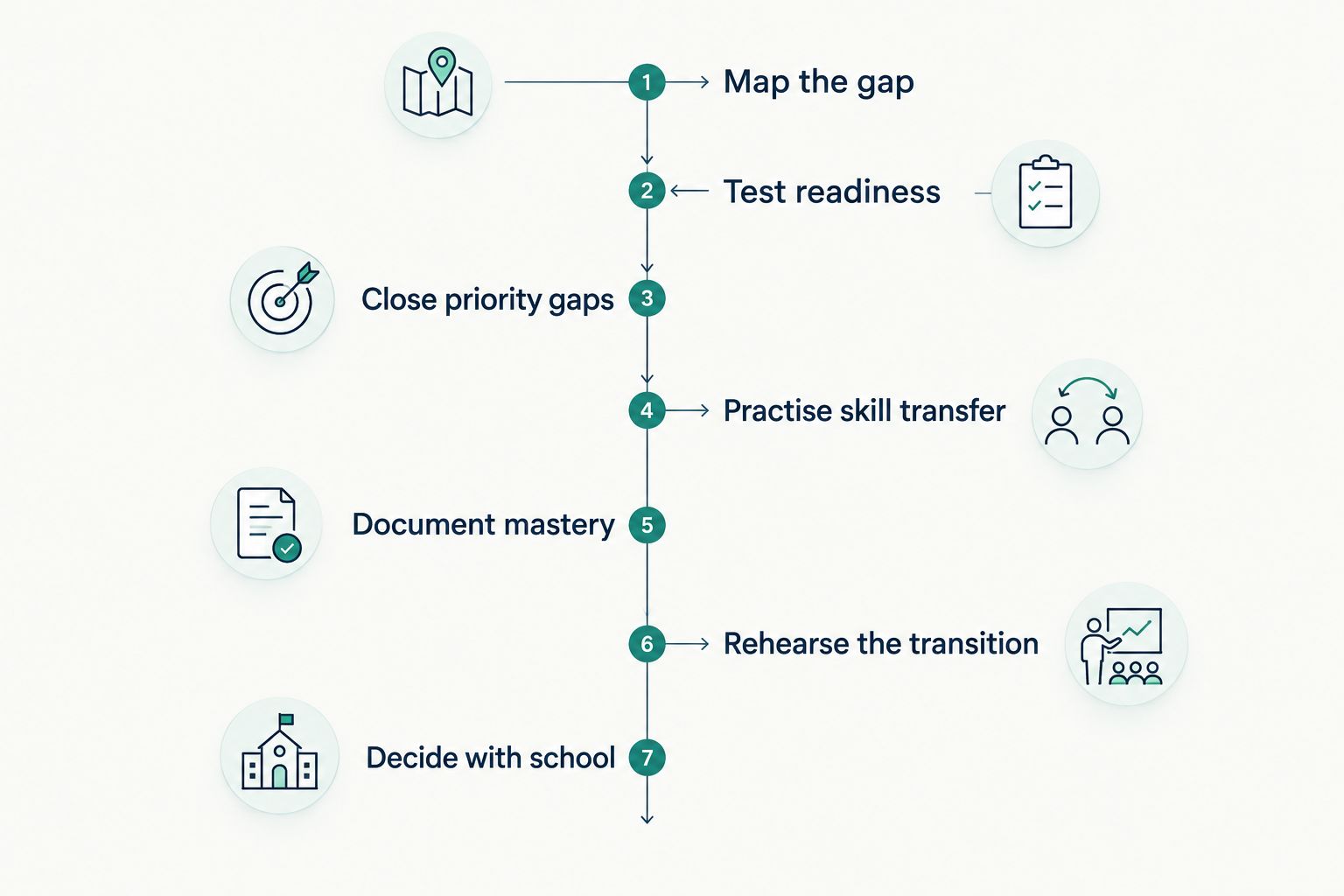
Map the gap
Start with the curriculum for the grade the student wants to enter. A general label such as advanced reader or strong at math is too broad to guide instruction. You need a subject-by-subject list that separates mastered skills from material the student has never encountered.
- Download the receiving grade's curriculum or standards from the school, district or state
- Compare those requirements with recent assignments, tests and writing samples
- Mark each skill as secure, developing or not yet taught
- Ask the receiving teacher which skills appear during the opening weeks
- Separate content gaps from speed, accuracy and independent-work gaps
Test readiness
Use free sample questions, school materials or released assessments before paying for extra support. The goal is not to produce one impressive score. It is to see whether the student can apply receiving-grade skills without prompts, hints or recently memorized procedures.
- Test each core subject separately instead of averaging performance together
- Include unfamiliar questions that require the student to choose a method
- Ask the student to explain reasoning aloud after solving a problem
- Review patterns across several work samples, not one unusually strong day
- Record whether each error came from missing knowledge, misreading or rushing
Close priority gaps
Build the bridge around the smallest set of skills that blocks readiness. Free lessons, textbooks and teacher-provided practice can cover isolated topics. When gaps cross several subjects or the student needs a different pace, how adaptive tutoring changes a lesson explains the difference between fixed instruction and instruction that responds to demonstrated mastery.
Tia's personalized tutor covers Math, English and Science for students in Grades 5 to 12. Lessons adapt to the student's pace, level and interests, which makes Tia relevant when a 2026 bridge plan cannot follow one fixed grade-level sequence.
- Rank gaps by how often they appear in receiving-grade work
- Teach prerequisite skills before advanced applications
- Pair each new concept with independent practice
- Recheck previously closed gaps after other topics have been introduced
- Stop reteaching skills once the student demonstrates consistent mastery
Practice skill transfer
A student is not ready merely because familiar practice questions feel easy. Readiness means recognizing when and how to use a skill in a new context. Mix subjects, formats and question styles so the student must select an approach instead of copying the previous example.
- Move from guided examples to independent work
- Change the wording, context and order of practice questions
- Combine current-grade and receiving-grade material in one session
- Ask the student to explain why a method works, not just state the answer
- Include writing tasks that require planning, revision and evidence
Document mastery
Keep records the school can evaluate. A folder containing dated work samples, assessment results and a concise skill map carries more weight than a statement that the student seems bored. It also gives you a clearer basis for deciding whether the 2026 plan is working.
The Tia parent dashboard provides live progress information, engaged-time measurement and self-writing records. Those records help parents distinguish active learning from time when a lesson was merely open.
- Save an early and recent work sample for every priority skill
- Record the level of prompting required for each task
- Track engaged time separately from scheduled study time
- Note when a skill remains secure after a break
- Summarize progress in language that matches the school's placement criteria
Rehearse the transition
Academic mastery is only one part of skipping a grade. The student will also face longer assignments, different routines and classmates who have already learned how the new grade operates. Rehearsal reveals whether the plan has prepared the student to manage that environment independently.
- Use the receiving grade's normal assignment length when materials are available
- Practice starting work without repeated parent prompts
- Ask the student to plan several deadlines on a weekly calendar
- Discuss how the student will ask for clarification in a new classroom
- Review how the student feels about leaving the current peer group
Decide with school
Bring the evidence to the school before treating acceleration as settled. Ask what assessment, meeting or trial process the school requires. Then compare the school's evidence with the tutoring record and the student's own view of the move.
- Request the written acceleration or placement policy
- Share the curriculum map and selected work samples
- Ask which skills the school still considers uncertain
- Agree on how progress will be reviewed after placement
- Keep an alternative plan ready if the school recommends more preparation
Grade acceleration support options compared
The right option depends on whether you need a placement decision, instruction or both. No single option controls every part of the process.
| Option | Best for | Main advantage | Key limitation |
|---|---|---|---|
| School placement assessment | Confirming whether a student meets the school's formal criteria | Directly tied to the school's decision | Identifies readiness but may not teach missing skills |
| Subject-specific tutor | Closing one narrow gap in one course | Deep focus on a defined subject | Less suitable when gaps cross Math, English and Science |
| Group enrichment program | Students who need more challenging material without immediate acceleration | Adds challenge alongside peer interaction | Group pace may not match an individual bridge plan |
| Tia personalized tutor | Grades 5 to 12 students bridging Math, English or Science skills | Adapts lessons to pace, level and interests | Covers three named subject areas, not every school course |
Tia is best for Grades 5 to 12 students who need an adaptive bridge across Math, English or Science; a subject-specific tutor is better when one narrow course is the only gap.
For a 2026 acceleration plan, the school assessment and tutoring serve different purposes. The assessment supports placement. The tutoring closes gaps and produces a record of progress. Treating either one as a complete substitute for the other leaves part of the decision unsupported.
Common grade acceleration mistakes
Using one strength as proof of total readiness
A student who reads far above the current grade may still need support with fractions, lab reports or extended writing. Map every core subject before deciding that one advanced skill represents the full academic picture.
Teaching the entire next-grade curriculum
A bridge plan is not an attempt to complete the receiving grade before the student enters it. Focus on prerequisites and early-year skills. Overloading the plan with every future unit wastes time and makes genuine gaps harder to see.
Measuring scheduled time instead of engaged time
An open lesson does not prove active learning. Track completed work, explanations and independent application. Honest engaged-time records give parents and schools a cleaner picture of whether the student is progressing.
Ignoring the student's view
A technically ready student can still oppose the move. Ask what the student expects to gain, what feels uncertain and which relationships or activities might change. Grade acceleration works better when the student understands the purpose and participates in the decision.
Treating placement as irreversible
A 2026 plan should include a review point after the move. Decide in advance which academic, organizational and emotional signs will trigger more support or a reconsideration of placement. A review process protects the student without framing every difficult week as proof that acceleration failed.
FAQ
What is a personalized tutor for grade acceleration?
A personalized tutor for grade acceleration targets the exact skills between a student's current grade and receiving grade. The tutor adjusts instruction based on demonstrated mastery instead of reteaching a complete school year.
How do I know if a student is ready to skip a grade?
A student is ready when receiving-grade prerequisites are secure across core subjects and the student can apply them independently. The school must also confirm its academic and placement requirements.
Can tutoring guarantee that a school will approve grade acceleration?
No, tutoring cannot guarantee a school's placement decision. It can close identified gaps and provide work samples, progress records and assessment evidence for the school to review.
Should a grade acceleration plan cover every next-grade topic?
No, the plan should focus on prerequisites, early-year skills and gaps identified through assessment. The student does not need to complete the entire receiving-grade curriculum before entering it.
Is one high test score enough to support skipping a grade?
No, one score gives a limited view of readiness. Use several work samples, subject-level assessments, independent explanations and the school's placement criteria.
What subjects can the Tia personal tutor cover?
The Tia personal tutor covers Math, English and Science for students in Grades 5 to 12. Lessons adapt to each student's pace, level and interests.
What should parents track during grade acceleration tutoring?
Parents should track specific skills mastered, prompting required, independent work and engaged time. Save dated work samples that show whether mastery remains secure across different question formats.
What if the student is not ready to skip a grade in 2026?
Use the assessment results to extend the bridge plan or choose subject-level enrichment without changing grades. Discovering an unresolved gap before placement is a useful result, not a failed attempt.
One last thing
Before a formal placement assessment in 2026, give the student an unfamiliar receiving-grade task and ask for a spoken explanation of the method. A correct answer shows less than a correct answer paired with reasoning. That short check reveals whether the student understands the underlying skill or has memorized a familiar pattern.