Tia News
Tia Now Teaches to the Northern Ireland Curriculum
Tia is a personalised Northern Ireland Curriculum tutor for Years 5 to 10, covering Key Stages 2 and 3 with 409 checked statutory requirements.
By Tia Education Team · Published
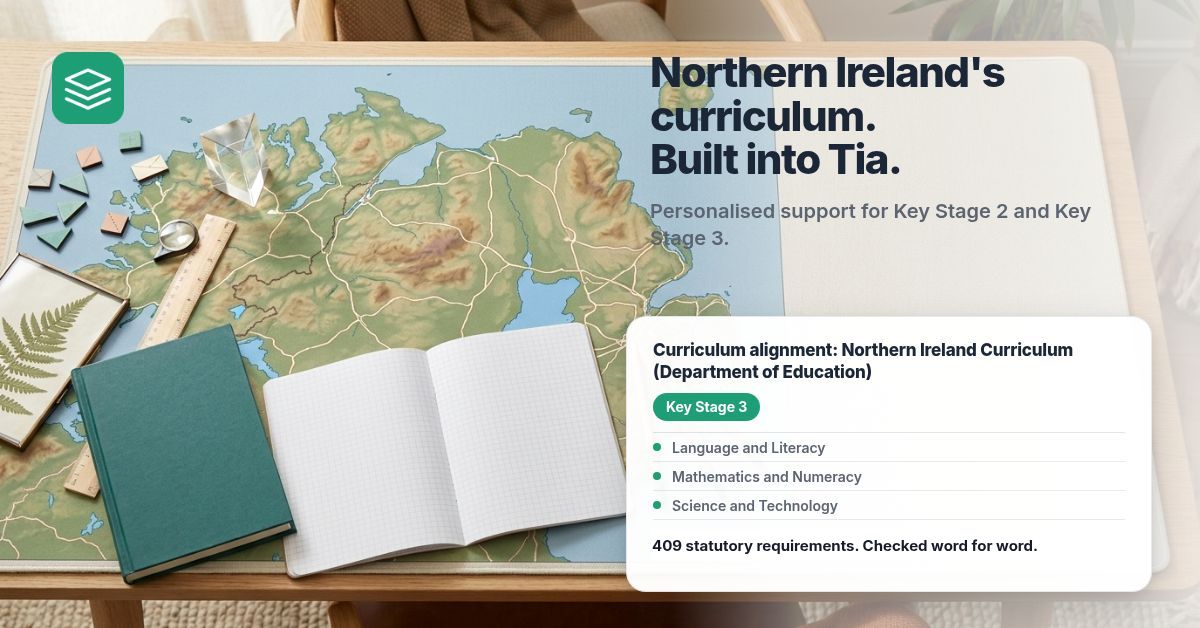
A learner in Belfast, Derry or Newry should receive help connected to the Northern Ireland Curriculum, using the same year numbers, Key Stages and statutory language their teachers use. Tia is a personalised, adaptive tutor that now teaches Language and Literacy, Mathematics and Numeracy, and Science and Technology at Key Stage 2 and Key Stage 3.
- The Northern Ireland Curriculum is live now in Tia.
- Language and Literacy, Mathematics and Numeracy, and Science and Technology are aligned at Key Stage 2 and Key Stage 3.
- 409 statutory requirements were checked against the Department of Education's published statutory curriculum.
- Tia uses Northern Ireland's own year and Key Stage structure.
- Progress reports name the curriculum and list the specific statutory requirements covered.
The curriculum statements were taken from the Department of Education's published statutory curriculum and checked word for word before going live. They remain organised by the Areas of Learning and Key Stages used in the statutory Minimum Content Order.
The Northern Ireland Curriculum is live now in Tia
Families in Northern Ireland can now choose the Northern Ireland Curriculum in Tia for personalised support alongside school or as part of home education.
Coverage includes:
- Language and Literacy
- Mathematics and Numeracy
- Science and Technology
- Key Stage 2
- Key Stage 3
The curriculum sets the destination. Tia adjusts the pace, level and explanation to the learner while keeping each lesson connected to the statutory content for the correct Key Stage.
Every progress report names the Northern Ireland Curriculum and lists the specific statutory requirements the learner worked on, in the Order's own wording. Parents see coverage in terms a Northern Ireland teacher would recognise.
You are invited to start a trial with Tia and select the Northern Ireland Curriculum. 14-day free trial, no card needed.
Northern Ireland has its own curriculum structure
Northern Ireland's curriculum is not a version of the curriculum used in England, Scotland or Wales.
It has its own year numbering, Key Stage structure, Areas of Learning and statutory requirements. The Department of Education confirms that Key Stage 2 covers Years 5 to 7 and Key Stage 3 covers Years 8 to 10.
Tia works within that structure.
A learner in Year 8 is taught against Key Stage 3, matching how schools in Northern Ireland describe progression. A learner at Key Stage 2 receives support linked to that stage rather than being placed into an English year group or an international grade.
That means a learner in Belfast who needs another explanation in Mathematics and Numeracy receives support pitched at the right Northern Ireland Key Stage. A learner in Derry or Newry working through Language and Literacy or Science and Technology follows the statutory wording their school recognises.
The teaching can adapt without losing the curriculum connection. Tia can revisit an earlier idea, change the explanation and provide another example while keeping the relevant statutory requirement in view.
409 statutory requirements checked against the statutory curriculum
Tia's Northern Ireland Curriculum alignment contains 409 statutory requirements.
They were taken from the Department of Education's published statutory curriculum and checked word for word before going live. The statements retain the statutory wording and remain organised by the Areas of Learning and Key Stages used in the Minimum Content Order.
Parents can review the Department of Education's official statutory curriculum page and CCEA's Northern Ireland Curriculum pages.
“Northern Ireland has its own statutory curriculum, year numbering and Key Stage structure, so we built this pathway from its own Minimum Content Order rather than treating the UK as one system. Keeping the statutory wording in reports lets families and teachers recognise exactly what a learner has worked on.”
Using the source wording creates a clear line between a learning session, the Area of Learning and the statutory requirement. A report can therefore show more than a broad topic such as “number work” or “reading”.
How Key Stages work in Tia
Tia uses Northern Ireland's own year and Key Stage structure.
| Northern Ireland year | Curriculum alignment in Tia |
|---|---|
| Years 5 to 7 | Key Stage 2 |
| Years 8 to 10 | Key Stage 3 |
A Year 8 learner is taught against Key Stage 3. That is the terminology their school uses and the stage named in their Tia progress report.
The Key Stage remains the curriculum reference point while the teaching adapts to the learner's current understanding.
A learner may need to revisit an earlier relationship before the current requirement makes sense. Another may need a visual model or a practical example. Tia changes the route while keeping the correct statutory destination visible.
Three aligned Areas of Learning
Tia aligns Language and Literacy, Mathematics and Numeracy, and Science and Technology at Key Stage 2 and Key Stage 3.
Language and Literacy
Language and Literacy develops communication through talking and listening, reading and writing. At Key Stage 3, CCEA describes it as a compulsory Area of Learning that includes English with Media Education, and Irish with Media Education in Irish-medium settings.
Tia connects support to the relevant statutory requirements while adjusting explanations and activities to the learner.
Mathematics and Numeracy
Mathematics and Numeracy develops mathematical understanding and the ability to apply it in familiar and unfamiliar contexts.
Tia can slow down, revisit an earlier relationship or provide another example while keeping the lesson connected to the statutory requirement for the learner's Key Stage.
Science and Technology
Science and Technology supports curiosity, investigation and understanding of the world. At Key Stage 3, CCEA identifies it as a compulsory Area of Learning with Science and Technology and Design strands.
Tia keeps the statutory content visible while adapting the route to the learner's current understanding.
Personalised help within the right Key Stage
Two learners working on the same statutory requirement may need different routes.
One learner may understand an idea through a visual model. Another may need a practical example. A third may need to revisit earlier knowledge before moving forward.
Tia can:
- adjust the pace of a lesson
- explain an idea in another way
- connect examples to the learner's interests
- revisit knowledge that supports the current work
- provide another example before moving forward
- keep the lesson linked to the correct Key Stage
- record the statutory requirement covered
This makes Tia useful for families seeking a Maths tutor in Northern Ireland, an English tutor in Northern Ireland or a Science tutor in Northern Ireland without separating personalised support from the Northern Ireland Curriculum.
What parents see in progress reports
A useful progress report should answer two questions: what did the learner work on, and how does it connect to the Northern Ireland Curriculum?
Tia reports name the curriculum. They list the specific statutory requirements covered using the Order's own wording.
A report can show:
- the Area of Learning
- the Northern Ireland year and Key Stage
- the curriculum alignment
- the statutory requirement covered
- the learning activity
- knowledge or skills demonstrated over time
- honest engaged time in Tia
This helps parents follow progress without translating a generic lesson label into local school language themselves.
For a learner attending school, the report can support a more useful conversation about where extra help is working. It does not replace school assessment or teacher judgement.
For more on useful parent records, read what parents should see in a tutoring dashboard.
Two ways families in Northern Ireland can use Tia
| Alongside school | For home education |
|---|---|
| Revisit difficult learning and strengthen understanding | Work with statutory requirements in supported Areas |
| Receive support within the correct Key Stage | Keep records of the specific requirements covered |
| Learn after school, at weekends or during holidays | Build supporting records while confirming local expectations |
Learners attending school can use Tia for extra support in Language and Literacy, Mathematics and Numeracy, or Science and Technology. Lessons remain connected to the correct Key Stage while adapting to the learner.
Families educating at home can use the same curriculum alignment and reporting within their wider approach.
Progress records for home education in Northern Ireland
Tia's progress reports list the specific statutory requirements a home-educated learner worked on, along with the Area of Learning and Key Stage.
These reports can support records many families choose to keep by showing:
- the Area of Learning studied
- the Key Stage used for alignment
- the statutory requirement covered
- the activity completed
- progress over time
- honest engaged time
Families should confirm the Education Authority's current expectations for their circumstances. Tia does not claim that its reports satisfy those expectations or replace information the Education Authority may request.
Northern Ireland joins every UK curriculum pathway
Northern Ireland joins England, Scotland and Wales, each with its own curriculum in Tia.
That distinction matters because the four nations use different structures, terminology and statutory sources. Northern Ireland uses its own years, Key Stages, Areas of Learning and Minimum Content Order.
Tia keeps the selected curriculum visible in teaching and reporting instead of treating the UK as one education system.
Families can also read how Tia supports the National Curriculum for England, Scotland's Curriculum for Excellence and the Curriculum for Wales.
FAQ
Is the Northern Ireland Curriculum live in Tia now?
Yes. Language and Literacy, Mathematics and Numeracy, and Science and Technology are live now at Key Stage 2 and Key Stage 3.
Which Northern Ireland years does Tia cover?
The aligned Key Stages cover Years 5 to 7 at Key Stage 2 and Years 8 to 10 at Key Stage 3.
Where did Tia get the curriculum content?
Tia used the Department of Education's published statutory curriculum. All 409 statutory requirements were checked word for word and organised by the Areas of Learning and Key Stages used in the Minimum Content Order.
How does Tia adapt to each learner?
Tia adjusts the pace, level and explanation while keeping lessons connected to the relevant statutory requirement. It can revisit earlier knowledge, try another example and move forward when understanding is secure.
What appears in a Tia progress report?
The report names the Northern Ireland Curriculum and lists the specific statutory requirements worked on in the Order's own wording.
Can learners attending school use Tia?
Yes. Learners can use Tia for personalised extra support in the three aligned Areas while lessons remain connected to their Northern Ireland Key Stage.
Can home-educating families use Tia's reports?
The reports can support family records by listing the statutory requirements worked on. Families should confirm the Education Authority's expectations, and Tia does not claim its reports satisfy them.
Start with the Northern Ireland Curriculum selected
Families in Northern Ireland can now choose the Northern Ireland Curriculum and see the relevant Areas of Learning and statutory requirements appear in reports as learning happens.
You are invited to start a trial with Tia for personalised support in Language and Literacy, Mathematics and Numeracy, or Science and Technology. 14-day free trial, no card needed.