Tia News
New South Wales curriculum is built into Tia
Tia's NSW curriculum tutor supports Maths, English and Science in Years 5 to 12, with 3,215 NESA curriculum statements and teaching that adapts to each student.
By Tia Education Team · Published
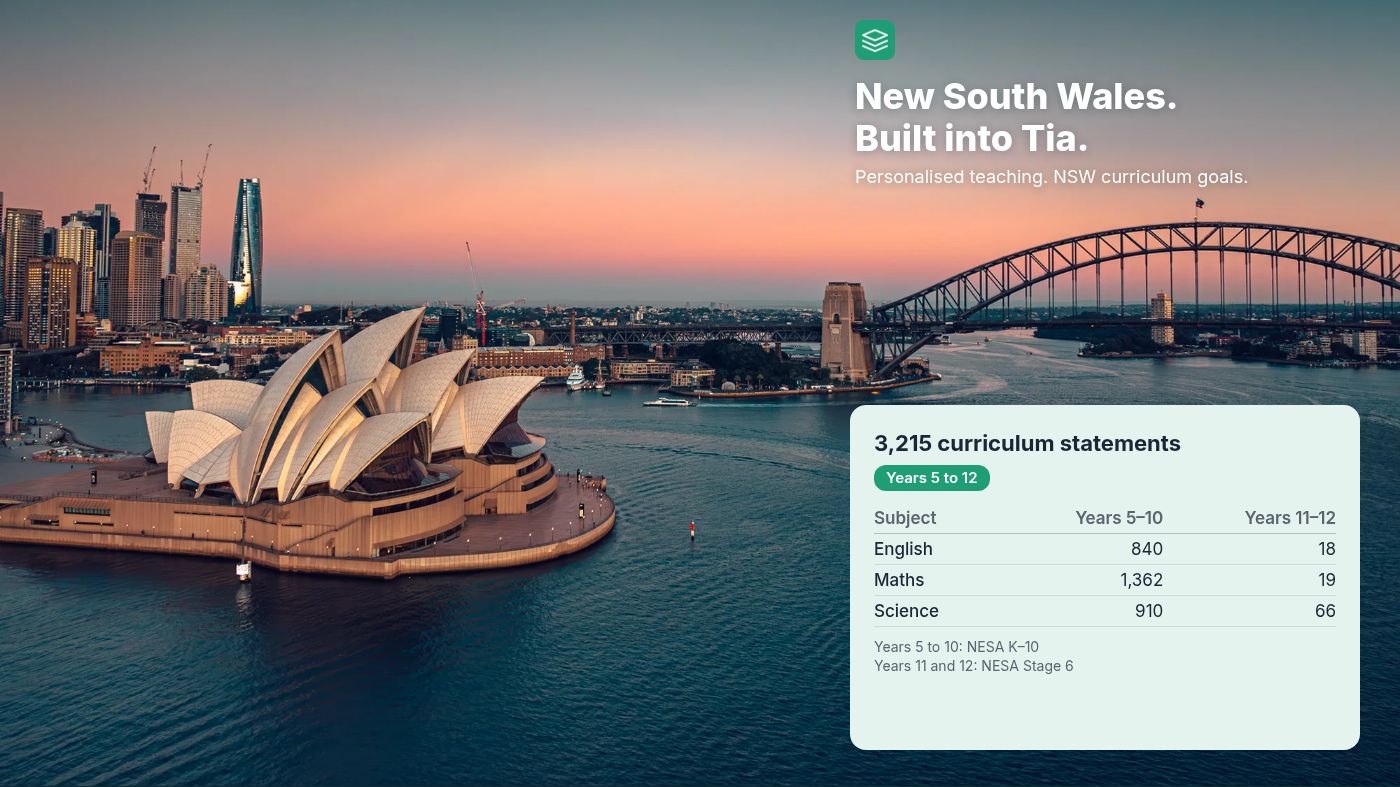
A NSW curriculum tutor connects New South Wales learning goals with explanations that fit the student. Tia serves 3,215 NESA curriculum statements across Maths, English and Science in Years 5 to 12, adapting its teaching to the student's understanding, pace and interests.
- Tia's NSW curriculum tutor supports Maths, English and Science in Years 5 to 12.
- The pathway serves 3,215 NESA statements, representing 1,622 distinct statements.
- Years 5 to 10 use NESA K–10 material; Years 11 and 12 use Stage 6 material.
- Students can speak, listen or type within the same personalised lesson.
- Parents get curriculum-linked progress information, engaged-time measurement and self-writing learning records.
NSW learning goals, taught in a way that fits your student
The book is open, but your student has stopped at the same explanation again. They understand the beginning. The next connection still needs another approach.
You want help with that idea, not a different learning goal. Personal tutoring can keep the NSW reference in view while changing the example, pace or size of the next step.
See how adaptive tutoring changes a lesson for a closer look at how the teaching can respond when an explanation does not connect.
The NSW Education Standards Authority, or NESA, publishes the state's syllabuses. Its NSW Curriculum website brings together learning areas, stages and curriculum resources.
For your family, that local reference helps connect personal support to the work your student is studying. You stay in charge of the wider plan while the tutor offers another way into the lesson.
What New South Wales families get
The NSW pathway serves 3,215 curriculum statements, representing 1,622 distinct statements, across Maths, English and Science. All three subjects use NESA material within the supported Years 5 to 12 range.
Years 5 to 10 use the NESA K–10 pathway. Years 11 and 12 use NESA Stage 6 material, keeping the senior reference separate from the earlier years.
| Subject | Years 5 to 10 statements | Years 11 and 12 statements | Total served |
|---|---|---|---|
| English | 840 | 18 | 858 |
| Mathematics | 1,362 | 19 | 1,381 |
| Science | 910 | 66 | 976 |
| NSW pathway total | 3,112 | 103 | 3,215 |
The subject totals give you a starting point for checking scope. The student's actual task and understanding then guide where the teaching should begin.
For a Year 8 student, start with the subject and current learning goal. For a Year 11 or Year 12 student, identify the course and topic alongside the year level so the support connects to the work in front of them.
NESA coverage across the two year bands
NESA organises learning into stages. Its guide to curriculum stages explains that students move through stages from early primary learning to Stage 6.
Within Tia's supported range, the two year bands below show how the supplied curriculum material is organised. The distinct count identifies the separate statements represented within each part of the pathway.
| Subject | Year band | Statements served | Distinct statements |
|---|---|---|---|
| English | Years 5 to 10 | 840 | 420 |
| English | Years 11 and 12 | 18 | 16 |
| Mathematics | Years 5 to 10 | 1,362 | 681 |
| Mathematics | Years 11 and 12 | 19 | 19 |
| Science | Years 5 to 10 | 910 | 455 |
| Science | Years 11 and 12 | 66 | 31 |
| NSW pathway total | Years 5 to 12 | 3,215 | 1,622 |
Statements served describe availability across the supported placements. They give you a view of curriculum coverage, while the lesson responds to the individual student's question.
You do not need to turn the table into a timetable. Begin with what your student is learning today, then use the appropriate subject and stage as the reference.
NSW Maths tutoring from foundations to senior work
Mathematics serves 1,381 statements in total: 1,362 in Years 5 to 10 and 19 in Years 11 and 12. The two bands represent 681 and 19 distinct statements respectively.
A student can need another explanation for different reasons. They might follow a procedure but want to know why it works, or need to revisit an earlier idea before the current task makes sense.
For a parent seeking a NSW Maths tutor, ask the student to show the last step they understood. That gives the conversation a more useful starting point than repeating the whole topic.
The teaching can slow down, break a connection into smaller steps or try an example drawn from a familiar interest. The student still does the reasoning and working.
Keep paper, diagrams and written calculations alongside the lesson. A spoken question can help the student explain where they are stuck, while their written steps show how they apply the answer.
Afterward, try a fresh example. Ask why they chose a method rather than checking only whether the original question is finished.
NSW English tutoring with room to talk an idea through
English serves 858 statements across the pathway: 840 in Years 5 to 10 and 18 in Stage 6. The corresponding distinct counts are 420 and 16.
An English task can feel difficult before the student writes a word. They might understand a passage but need help organising their response, or want to discuss what an instruction is asking them to do.
A personal tutor gives them room to explore that point. The explanation can respond to their understanding while keeping the selected learning goal in view.
For a family looking for a NSW English tutor, start with the task itself. Ask what the student wants the reader to understand before they begin drafting.
Afterward, return to their writing. Does the response express the idea they intended, and can they explain the choices they made?
The conversation supports the student's own reading and writing. Leave space for an independent response after discussing the idea, so you can see what they can do with it.
NSW Science tutoring connected to the student's questions
Science serves 976 statements: 910 in Years 5 to 10 and 66 in Stage 6. These bands represent 455 and 31 distinct statements respectively.
A student can begin by describing what they think is happening. Their explanation gives the tutor a starting point for clarifying a connection or trying another example.
For parents seeking a NSW Science tutor, identify the current concept alongside the year level. At senior level, add the actual course so the conversation stays connected to the student's work.
The teaching can respond to a follow-up question rather than requiring the student to understand the first explanation immediately. A more familiar example can provide another way to approach an abstract idea.
Keep observations, practical investigations and written reasoning within your wider Science plan. Tutoring offers another place to discuss the concepts involved, alongside those experiences.
After a session, ask for a related example that was not used in the explanation. Applying the idea somewhere new adds useful context to the learning record.
Personalised teaching within the NSW curriculum
Tia fits NSW families who want personal explanations connected to their student's curriculum goals. The learning reference provides direction, while the teaching adapts to the individual learner.
That can mean a smaller step, a different example or another look at an earlier foundation. The useful adjustment is the one that helps the student ask, reason and try again.
An interest can make an unfamiliar concept easier to approach. It is a route into the learning, not a reason to lose sight of the subject being studied.
You remain in charge of the wider education plan. The tutor adds another explanation and information about the session, rather than deciding every part of the student's learning for you.
Speak, listen or type in the same lesson
Students can speak to Tia and hear verbal explanations, type, or switch between voice and text within the same lesson. Two-way voice is included in all bundle plans at no extra charge.
A student can talk through a Maths question while keeping their calculations on paper. They can discuss an English idea aloud, then type a follow-up, or choose text throughout.
Let the student use the format that feels useful for the task. Having another way to ask can make participation more comfortable when typing out a question feels awkward.
Keep independent reading and written reasoning in the wider routine. Discussing an idea and applying it independently give you different views of the student's understanding.
Support alongside school and within NSW home education
Families can use tutoring alongside school or as part of a parent-led home education plan. The starting point is the same: the student's current work and the idea that needs another explanation.
For school support, use the student's course materials to identify the learning goal. After the session, return to the actual task and ask whether the next step makes more sense.
For a family seeking a NSW homeschool tutor, you choose how tutoring fits with reading, projects, practical work and the family rhythm. You do not have to supply every explanation yourself.
Use the learning records alongside your student's work and your own planning. Parents continue to manage the home education requirements that apply to their family.
A practical way to begin
Identify the current learning goal
Look at the task together before choosing what to revisit. Start with the student's materials and the relevant NESA reference, then focus on the point of difficulty.
- Name the subject and year level.
- Identify the senior course where relevant.
- Ask which part already makes sense.
- Choose one idea to work on first.
Give the student room to show their thinking
They do not need perfect wording before asking for help. Let them begin with what they understand and describe where the reasoning becomes unclear.
- Offer the choice of voice or text.
- Keep written working nearby.
- Ask for another example when useful.
- Revisit a foundation if it helps.
Review the idea with fresh work
After the explanation, return to a new question or example. The student's own reasoning helps you decide whether to revisit the idea or continue.
- Ask for an explanation in their own words.
- Try a different question.
- Review their independent response.
- Decide what needs another look.
Parent records connected to the learning
After a session, you want to know what was studied and how your student responded. The parent dashboard combines curriculum-linked mastery information, honest engaged-time measurement and self-writing learning records.
Mastery estimates update from student answers over time. Review them alongside the student's fresh explanations and independent work when choosing the next step.
Engaged-time measurement helps you see participation without treating every minute of an open session as active learning. The records reduce the need to write each session summary yourself.
See what parents should see in a tutoring dashboard for a closer look at the parent view.
You can use that information to revisit one idea, ask for another explanation or move forward. The parent stays in charge of the decision.
FAQ
Does Tia offer a NSW curriculum tutor?
Yes. Tia supports Maths, English and Science in Years 5 to 12, with NESA K–10 material for Years 5 to 10 and Stage 6 material for Years 11 and 12.
How many NSW curriculum statements are served?
The NSW pathway serves 3,215 statements representing 1,622 distinct statements. The subject totals are 858 English, 1,381 Mathematics and 976 Science.
How much coverage is in Years 5 to 10?
The Years 5 to 10 pathway serves 3,112 statements: 840 English, 1,362 Mathematics and 910 Science.
How much Stage 6 coverage is included?
The supported Stage 6 material serves 103 statements across Years 11 and 12: 18 English, 19 Mathematics and 66 Science.
How does Tia personalise a NSW lesson?
Tia adapts explanations, pace, level and examples to the student's responses and interests while keeping the selected learning goal in view.
Can students speak and type during a lesson?
Yes. Students can speak, hear verbal explanations, type and switch between voice and text within the same lesson. Two-way voice is included in all bundle plans at no extra charge.
Can NSW homeschooling families use Tia?
Yes. Families can use the tutoring, progress information and learning records within a parent-led plan while managing their applicable home education requirements.
What can parents see after a session?
Parents get curriculum-linked mastery information, engaged-time measurement and self-writing learning records to review alongside their student's own work.
One last thing
Your student does not need a new learning goal every time an explanation fails to connect. Sometimes they need another way into the same idea.
Start with today's question. Let the teaching adapt, then use the student's words and work to decide what comes next.
14-day free trial, no card needed
tia.coach