Tia News
Minnesota's own English and Science standards are now built into Tia
Tia covers Minnesota families in Math, English and Science, Grades 5 to 12, with 1,864 statements and new Minnesota English and Science standards.
By Tia Education Team · Published
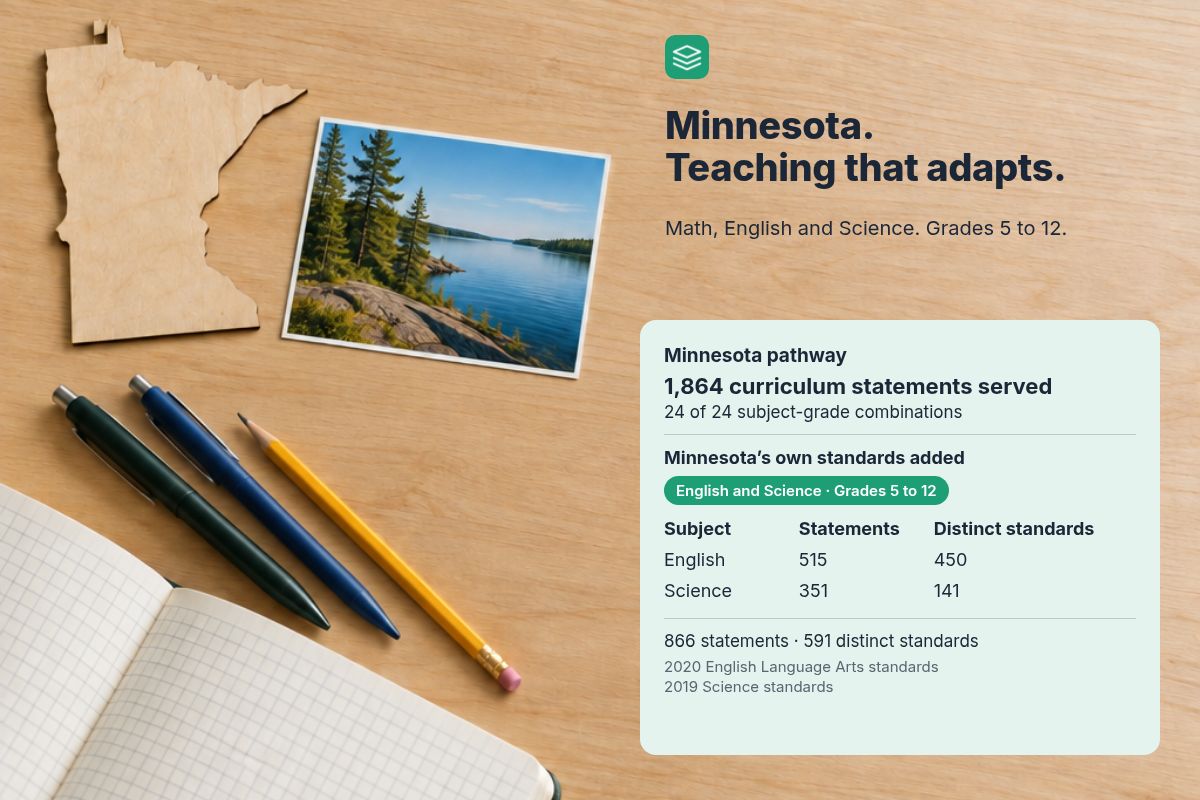
Minnesota families now have their state's own English and Science standards built into Tia, the personalized, adaptive tutor. Across Math, English and Science, the Minnesota pathway serves 1,864 curriculum statements and covers all 24 subject-and-grade combinations from Grade 5 through Grade 12.
- Tia's Minnesota curriculum tutor covers Math, English and Science in Grades 5 to 12.
- The Minnesota pathway serves 1,864 curriculum statements across all 24 subject-and-grade combinations.
- Minnesota-specific additions include 515 English statements and 351 Science statements.
- English follows the 2020 Minnesota standards; Science follows the 2019 Minnesota standards.
- Teaching adapts to the student, with curriculum-linked mastery information and parent records.
Why this matters for Minnesota families
Your student has read the explanation, but the idea still has not landed. You want another way to explain it without losing touch with what they are meant to learn.
That is where a personal tutor and a curriculum do different jobs. The curriculum identifies the goal. The tutor adjusts the explanation, pace and examples to help the student work toward it.
Tia brings those jobs together. Its Minnesota pathway provides the learning reference while the teaching responds to the individual student. For a closer look at the teaching mechanism, see how adaptive tutoring changes a lesson.
The 2026 Minnesota release adds the state's own English and Science standards to that approach. It supports both students who need another explanation alongside school and families building a home education plan.
What a Minnesota family now gets
The Minnesota pathway serves 1,864 curriculum statements across Math, English and Science. Each subject is available in Grades 5 to 12, giving families 24 of 24 subject-and-grade combinations.
A combination means one subject at one grade. Three subjects across eight grades make 24 combinations. It is a coverage measure, not a count of lessons completed or proof that a student has mastered every learning goal.
| What the Minnesota pathway covers | Current scope |
|---|---|
| Curriculum statements served | 1,864 |
| Subject-and-grade combinations | 24 of 24 |
| Math | Grades 5 to 12 |
| English | Grades 5 to 12 |
| Science | Grades 5 to 12 |
The overall pathway total and the Minnesota-specific additions describe different things. The 1,864 figure covers the three-subject offering. The new state-specific figures below describe English and Science, not a new Minnesota Math alignment.
That distinction helps you choose support accurately. A Minnesota Math tutor search and a Minnesota Science tutor search can lead to the same service, but the source of the curriculum alignment still matters within each subject.
Minnesota's own standards: what was added
The state-specific additions follow the 2020 Minnesota Academic Standards in English Language Arts and the 2019 Minnesota Academic Standards in Science.
The Minnesota Department of Education identifies these editions for English and Science. Its English Language Arts standards page explains that the 2020 standards were required to be fully implemented in the 2025-26 school year. These dates name the standards editions; they are not the date of Tia's launch.
The Minnesota-specific additions in Tia total 866 statements served, representing 591 distinct standards and 83 strand entries in the supplied alignment breakdown.
| Minnesota-specific subject | Statements served | Distinct standards | Grades | Strand entries |
|---|---|---|---|---|
| English | 515 | 450 | Grades 5 to 12 | 24 |
| Science | 351 | 141 | Grades 5 to 12 | 59 |
| Total | 866 | 591 | Grades 5 to 12 | 83 |
These are Tia's alignment counts. They should not be read as a count of the official documents' top-level organizational strands, a student achievement measure or an independent evaluation of tutoring results.
The Department publishes the standards. Tia's figures describe how its supported teaching pathway serves those expectations. Keeping the two sources distinct makes the numbers useful rather than turning them into a claim about the size of the state's entire curriculum.
Minnesota English tutoring with a state-specific reference
English now serves 515 statements, covering 450 distinct standards across Grades 5 to 12. The alignment breakdown includes 24 strand entries.
For a family seeking a Minnesota English tutor, the value is the connection between a personal explanation and the state's learning expectations. The student does not have to give up that local reference to get another way into an idea.
The Department organizes the 2020 English Language Arts standards around Reading; Writing; and Listening, Speaking, Viewing and Exchanging Ideas. Its English standards implementation resources show how expectations progress between grades.
A student might want to talk through a passage before writing about it, clarify an unfamiliar idea or explain why they interpreted something a particular way. Those are illustrative learning situations, not reports of measured results from Minnesota students.
Personalized teaching supports the work; it does not remove the need for the student to do it. Keep independent reading, written responses and opportunities to explain ideas within the wider learning plan.
Minnesota Science tutoring through Grade 12
Science now serves 351 statements, representing 141 distinct standards across Grades 5 to 12. The supplied alignment breakdown includes 59 strand entries.
The reference is the 2019 Minnesota Academic Standards in Science. That gives a family seeking a Minnesota Science tutor a named state framework rather than an unspecified general sequence.
An explanation can change while the learning goal stays in view. A student who does not understand an abstract description can ask for a different example. Another can talk through their reasoning and identify where they need help.
Science tutoring is one part of learning. Practical investigations, observations, written explanations and the student's actual school or home education requirements still matter.
Grade coverage should also be read carefully. Support from Grades 5 to 12 does not announce every possible senior Science elective, qualification or course arrangement. Match the student's actual work with the pathway they select.
Math remains part of the three-subject pathway
Minnesota families can use Math alongside English and Science throughout Grades 5 to 12. It is included in the overall 1,864 statements and 24 of 24 combinations reported for this release.
The new Minnesota-specific standards figures in this article belong to English and Science. They are not presented as evidence that Minnesota's own Math standards were newly added.
For a student seeking Math help, start with the concept they are working on and the curriculum option they will use. An earlier foundation can need attention even when the current work carries a higher grade label.
Ask for another explanation when a method does not make sense. Then give the student a fresh example to try, so you can see whether they can apply the idea rather than repeat the wording they just heard.
Tia adapts to the student, not the other way around
The learning destination should not force every student into the same route. Tia adapts teaching to the student's pace, level and interests while retaining the selected curriculum reference.
That can mean slowing down, revisiting an earlier concept or trying an example connected to something familiar. The point is to help the student understand, not simply to make a lesson feel different.
Students can also choose how to participate. They can speak to Tia and hear verbal explanations, type, or switch between voice and text within the same lesson. Two-way voice is included in all bundle plans at no extra charge.
Voice is an option, not a requirement. A student can discuss a question aloud and keep doing mathematical working on paper. Another can stay with text. Hearing an explanation does not replace independent reading practice or written reasoning.
Parent records show more than time spent
After a session, you need to know what the student worked on and what needs another look. An open lesson alone does not answer either question.
Tia measures mastery per question, maps it to the curriculum and includes it in parent reports. Its adaptive mastery tracking updates an estimate of understanding from student answers over time.
The dashboard also provides honest engaged-time measurement and self-writing learning records. These help you separate participation from the fact that a session was available.
For more on the parent view, read what parents should see in a tutoring dashboard.
Use those records alongside the student's own explanations and fresh work. A mastery estimate is useful information, not an infallible measurement of everything a student knows or a promise of a particular exam score.
How to use the Minnesota pathway alongside school or at home
Start with the student's actual work
Use the current learning need rather than the coverage total as your starting point. The 2026 pathway gives you a scope to check, not a requirement to rush through every statement.
- Identify the subject and grade.
- Name the concept or task causing difficulty.
- Check the curriculum option selected in Tia.
- Keep any school instructions or home learning goals in view.
Let the student ask for a different explanation
Another explanation is most useful when the student can say where the first one stopped making sense. They do not need to have perfect wording before asking for help.
- Let the student choose voice or text.
- Ask what they already understand.
- Try a different example when needed.
- Keep independent working within the lesson routine.
Review understanding before moving on
Look for what the student can do with the idea, not just whether they finished a session. In 2026, the distinction between coverage and understanding remains as important as the curriculum itself.
- Review the learning record.
- Ask the student to explain the idea in their own words.
- Try a new example or question.
- Return to the difficult part if understanding is still uncertain.
Families seeking a Minnesota homeschool tutor can use the supported pathway within their wider education plan. Parents remain responsible for checking applicable home education requirements. A tutoring subscription or its reports do not by themselves establish compliance.
FAQ
Does Tia offer a Minnesota curriculum tutor for Grades 5 to 12?
Yes. The Minnesota pathway covers Math, English and Science from Grades 5 to 12, serving 1,864 curriculum statements across all 24 subject-and-grade combinations.
Which Minnesota standards were added?
The state-specific additions follow the 2020 Minnesota Academic Standards in English Language Arts and the 2019 Minnesota Academic Standards in Science. Together, they serve 866 statements representing 591 distinct standards.
How much Minnesota English coverage is included?
Minnesota English serves 515 statements representing 450 distinct standards across Grades 5 to 12. Tia's alignment breakdown includes 24 strand entries.
How much Minnesota Science coverage is included?
Minnesota Science serves 351 statements representing 141 distinct standards across Grades 5 to 12. Tia's alignment breakdown includes 59 strand entries.
Does this release announce Minnesota-specific Math standards?
No. Math is included in the overall three-subject pathway for Grades 5 to 12, but the Minnesota-specific additions described here are English and Science.
Can students use Tia alongside school or within homeschooling?
Yes. Students can use the supported pathway for extra explanations alongside school or within a parent-led home education plan. Families must check applicable education requirements separately.
Can students speak to Tia instead of typing?
Yes. Students can speak, hear verbal explanations and switch between voice and text within a lesson. Two-way voice is included in all bundle plans at no extra charge.
Do the curriculum statement totals show student mastery?
No. The totals describe curriculum coverage, not individual achievement. Parent reports provide separate curriculum-linked mastery information based on student answers over time.
One last thing
A large curriculum total does not tell you which explanation will help your student today. Start with the part they cannot yet explain, then use the curriculum and progress record to keep the next step connected to their learning.
The 2026 Minnesota pathway brings the state's English and Science expectations into that personal teaching workflow. You remain in charge of the wider plan.
14-day free trial, no card needed
tia.coach