Tia News
Is an AI tutor worth it in 2026?
Is an AI tutor worth it in 2026? Yes, if it teaches rather than supplies answers. Compare tutoring options and learn how to check your student’s progress.
By Tia Education Team · Published

An AI tutor is worth it in 2026 when it helps your student understand a problem and lets you see whether learning is happening. It is not worth relying on when it mainly supplies answers, repeats explanations that do not work, or leaves you guessing about progress. If your student needs a relationship with a human tutor or support beyond the tool’s subjects, use that support instead.
- Is an AI tutor worth it in 2026? Yes, if it teaches at your student’s pace instead of supplying finished answers.
- Tia is a fit for parents seeking an adaptive personal tutor for Math, English, or Science in grades 5 to 12.
- Judge a tutor by your student’s independent work and the progress you can see, not by completed assignments.
- Choose a human tutor when your student needs a person to work through a persistent barrier with them.
Why this matters
You can sit beside your student through a hard homework question and still be unsure whether to explain it, step back, or find help. An answer on a screen settles the assignment. It does not settle whether your student can handle the next question alone.
That distinction is the decision in 2026. Tia is an adaptive personal tutor for Math, English, and Science students in grades 5 to 12. It adjusts to a student’s pace and gives parents a dashboard to track progress. Those features give you something to evaluate, but no tutoring format removes the need to check what your student understands.
Is an AI tutor worth it in 2026?
Yes, when it functions as a tutor rather than an answer machine. Look for explanations your student can follow, room to work at their own pace, and a way to check progress outside the completed assignment. If the tool gets your student through tonight’s worksheet but leaves the underlying confusion untouched, it has not done the job you hired a tutor to do.
The label “AI tutor” covers different experiences. Compare what your student actually receives, not what the product calls itself.
| Option | Best for | What to look for | Main limitation |
|---|---|---|---|
| Adaptive personal tutor | A student who needs practice and explanations at their own pace | Does the lesson respond when the student struggles? Can you see progress? | A student can still need help from a person, especially when confusion persists. |
| Answer generator | Checking a specific answer after a student has tried the work | Does the student understand the explanation and solve another problem independently? | A finished answer can hide a learning gap. |
| Human tutor | A student who needs direct conversation and a person who can notice their hesitation | Can the tutor explain the barrier and set a clear next step? | Progress still needs checking between sessions. |
This is a comparison of uses, not a claim that every product in a category behaves the same way. Some tools explain well; others do little beyond generating a response. Likewise, a human tutor needs a clear picture of the student’s work to target the right problem.
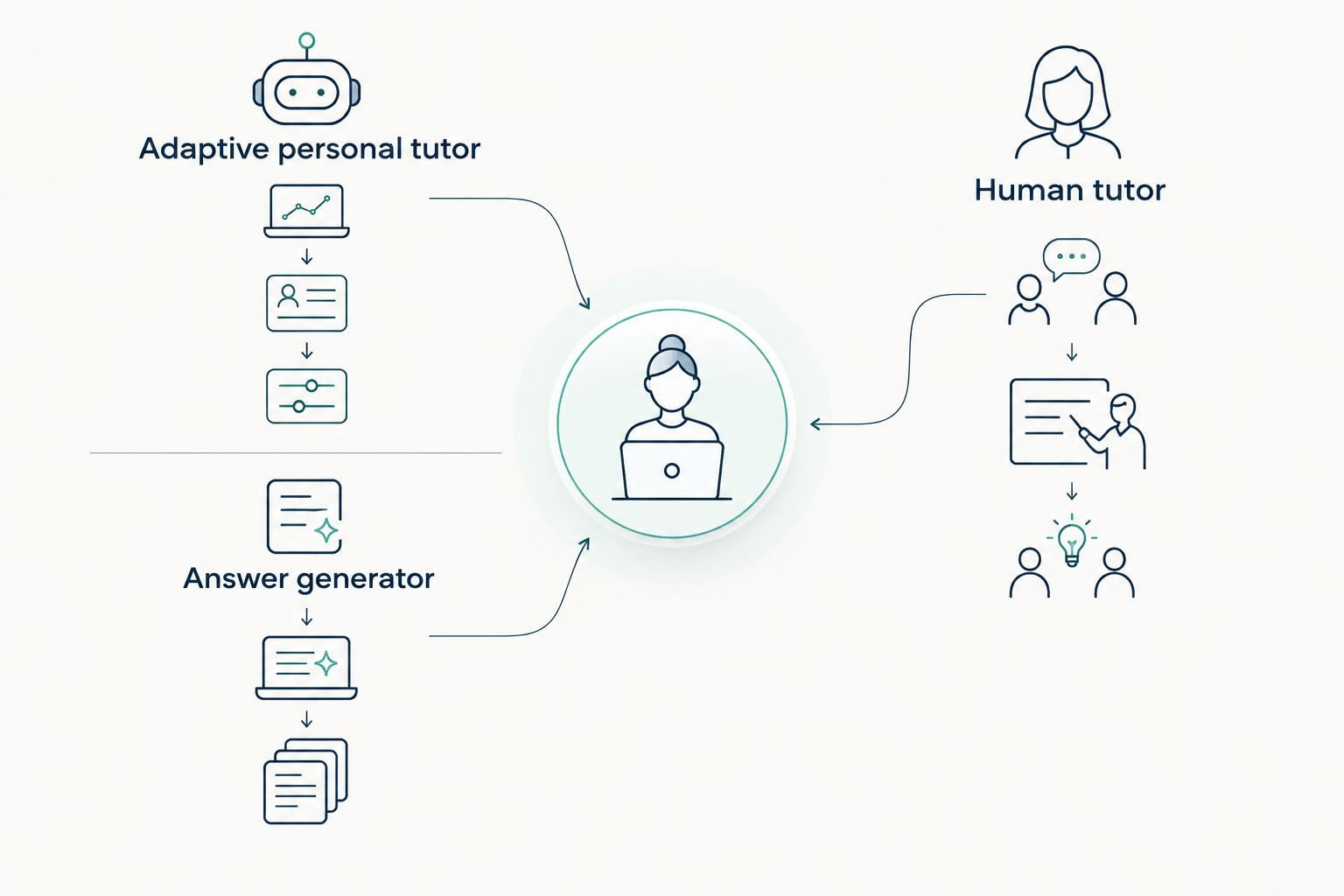
In 2026, the useful question is not whether a response sounds convincing. Ask your student to explain the idea without the screen, then try a different problem. That tells you more than whether the original assignment is complete.
What should the tutor do when an answer is wrong?
A useful tutor addresses the misunderstanding, not just the incorrect result. Watch whether your student gets another explanation they can use. If the response simply presents the right answer, ask your student to close it and attempt a similar question before counting that work as progress.
This matters especially in Math, where one missed idea can reappear in later problems. In English, a polished rewrite does not show whether a student can revise the next paragraph. In Science, a correct definition does not show whether they can apply it to a question. Across subjects, the next independent attempt is the test.
What should parents be able to see?
You should be able to distinguish time spent working from work that only looks finished. Ask what the parent view shows, how progress is recorded, and whether you can identify a topic that still needs attention. A dashboard is useful when it helps you decide what to ask your student next.
Tia gives parents a live dashboard, engaged-time measurement, and self-writing records for homeschool reporting. That gives homeschooling parents a way to review work without rebuilding a record from memory. Still, compare the record with your student’s own explanation. A record tells you what happened during a session; independent work shows what your student retained.
Why the answer varies from student to student
Two students can use the same tutor and need different kinds of help. These are the factors to check before deciding whether an AI tutor earns a place in your routine:
- Subject: Pinpoint the Math, English, or Science skill that needs attention. A tool that covers a subject is not automatically the right help for every assignment within it.
- Pace: Notice whether your student can slow down, revisit an idea, and try again. Moving through more material is not the same as understanding it.
- Starting point: Check whether the tutor meets your student at their current level. An explanation pitched above that level can leave the original gap in place.
- Response to mistakes: Look for a different explanation or another way to practice after an incorrect attempt. Repeating the answer is not a new teaching approach.
- Parent visibility: Decide what you need to see. For homeschool reporting, a usable record of engagement and work matters alongside the lesson itself.
- Need for human contact: If your student needs a person to discuss frustration, hesitation, or a continuing misunderstanding, choose direct human help for that need.
You do not have to settle every factor in one sitting. Choose one skill that has been difficult, watch a lesson, and check whether your student can use the idea afterward. That gives you a clearer decision than a broad promise about personalized learning.
How do you test whether an AI tutor is helping?
Use a small, repeatable check in 2026. Start with a problem your student cannot yet explain. Let the tutor teach the idea, then give your student a fresh problem on the same skill without showing the previous answer. Listen to their reasoning before you judge the result.
- Name the skill. “Fractions” is broad. Identify the step that stops your student, such as comparing fractions with different denominators.
- Save a starting example. Keep the original attempt, including where your student got stuck. It gives you something concrete to compare later.
- Watch the explanation. Does your student participate, ask a question, or work through a step? A smooth-looking response from the tool is not evidence that your student followed it.
- Try a new problem independently. Change the example, not the skill. Ask your student to say why their method works.
- Review the record and decide. Check whether the lesson and your student’s independent attempt point to the same progress. If they do not, stay with the skill or bring in a human tutor.
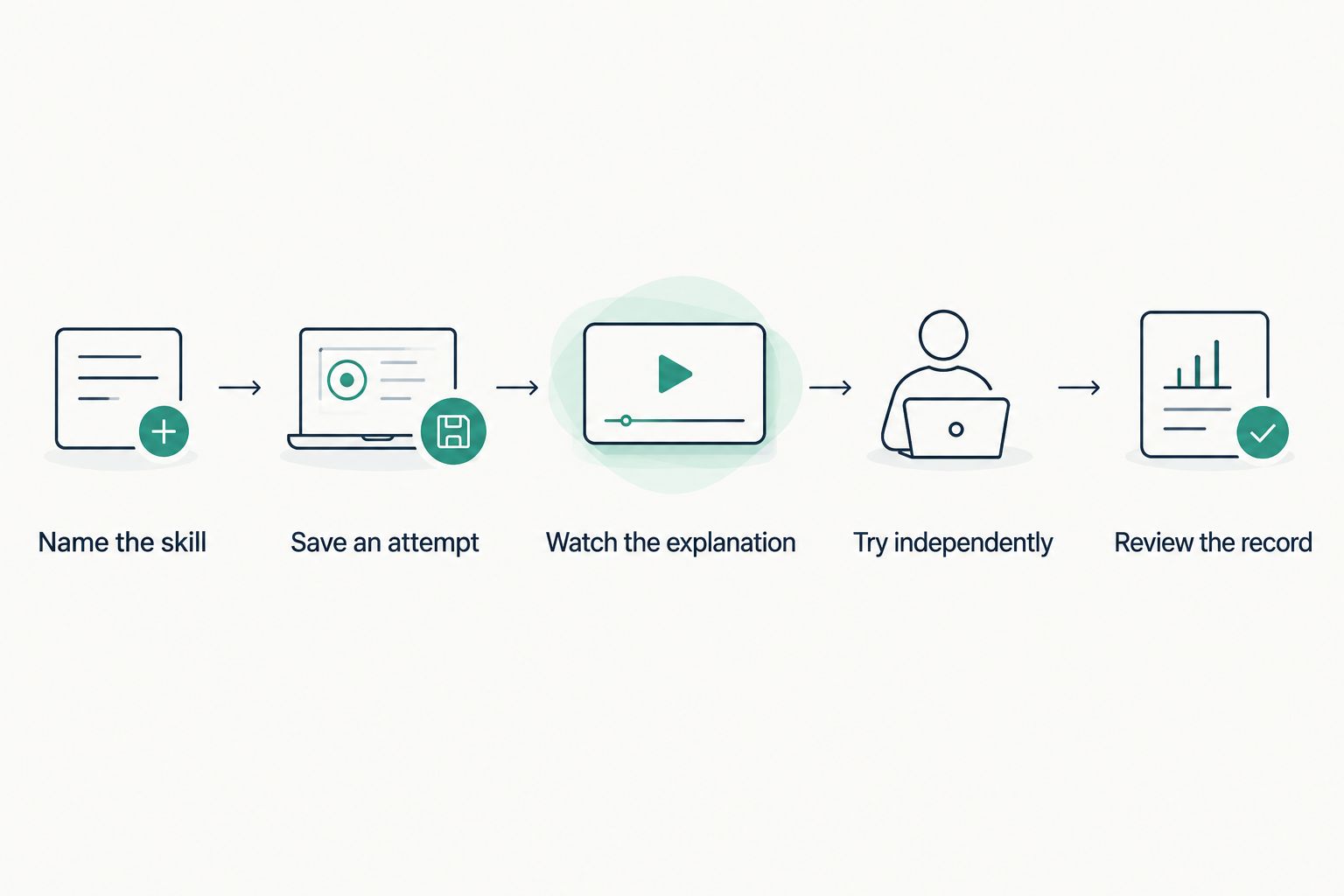
Do not turn this into another assignment your student must complete perfectly. You are looking for a change in understanding. If the second attempt exposes the same obstacle, you have found the next teaching target rather than a reason to blame the student.
When is an AI tutor the wrong choice?
An AI tutor is the wrong choice as your only support when your student repeatedly cannot apply an explanation, even after the lesson adjusts or you try a different example. Bring the specific work to a human tutor or another person supporting your student. Show the starting attempt, the explanation your student received, and the point where the new attempt broke down.
It is also a poor fit when the main need is not practice in the subjects the tutor covers. A student who needs to talk through why they avoid a task, for example, needs more than another worked example. Keep the decision tied to the barrier you can observe instead of treating every difficult homework evening as the same problem.
For a homeschooling parent, there is another limit: records are not a substitute for reviewing learning. In 2026, a completed activity and an engaged-time measure can help you document a session. You still need to ask what your student learned and check the reporting requirements that apply to your homeschool.
Can an AI tutor replace a human tutor?
No. An AI tutor can provide explanations and practice, but a human tutor offers a direct conversation with your student. Choose based on the immediate need: repeatable practice at your student’s pace, a person to work through a stubborn misunderstanding, or both.
The formats can serve different parts of the same learning problem. If your student can explain a lesson but still freezes when approaching unfamiliar questions, take those questions to a person. If your student understands a concept after discussion but needs more practice, an adaptive tutor can support that practice. Check the independent work either way.
Is an AI tutor worth it for homeschooling?
Yes, when it helps your student learn a subject and gives you records you can actually use. For a first-year homeschool parent, the relief is not handing off responsibility. It is seeing what your student worked on, where they slowed down, and what deserves your attention next.
Tia’s personal tutor covers Math, English, and Science for grades 5 to 12. Parents can use its dashboard and self-writing records to follow sessions and support homeschool reporting. Its limitation is the same one you should apply to any tutoring tool: a record of activity does not, by itself, prove independent understanding. Keep a sample of your student’s own work alongside it.
Is an AI tutor worth it for one difficult subject?
Yes, if you can identify the skill your student is struggling with and see improvement on new work in that subject. Do not judge it by whether homework gets finished faster. Judge it by whether your student can explain the idea and attempt a similar question without help.
A focused need also makes a trial easier to assess. Choose one topic, keep an initial attempt, and return to a comparable problem after tutoring. In 2026, that simple comparison remains more useful to a parent than a broad claim that a tool teaches every student differently.
FAQ
Is an AI tutor worth it for a student who dislikes Math?
Yes, if the tutor meets the student at their current level and the student can solve a new problem afterward. An appealing lesson alone does not show that the Math skill has improved.
What is the difference between an AI tutor and an answer generator?
A tutor helps a student work through an idea and try it independently; an answer generator supplies a response to the question asked. Judge the tool by what your student can do after using it, not by its label.
Can parents tell whether online tutoring is working?
Yes, by comparing a student’s independent work before and after tutoring. A progress dashboard can add context, but completed activities alone do not establish understanding.
Should a student use an AI tutor for every homework question?
No. Start with a specific skill that needs explanation or practice, then check whether the student can work without the tool. Using it to collect finished answers defeats the purpose of tutoring.
Is a human tutor better than an AI tutor?
A human tutor is the better choice when a student needs direct conversation about a persistent barrier. An adaptive tutor fits practice at a student’s pace when independent work shows the lessons are helping.
Can an AI tutor help with homeschool records?
It can help if the product provides records parents can review. Tia gives parents engaged-time measurement and self-writing records, but parents should check their own reporting requirements.
How long should I try an AI tutor before deciding?
Use enough lessons to teach a specific skill, then ask your student to try a new problem independently. Tia offers a 14-day free trial, no card needed, which gives parents a defined period to assess the fit.
One last thing
The most useful question after a tutoring session is not “Did you finish?” Ask your student, “Can you show me how you would start a different one?” In 2026, that small change keeps you in charge of the decision. Keep the tutor that makes the next independent attempt possible.