Tia News
How to Prepare for AP Exams (2026 Guide)
How to prepare for AP exams in 2026: timed practice, released free-response questions, and subject-specific review for Calculus, Chemistry, Physics and Biology.
By Tia Education Team · Published
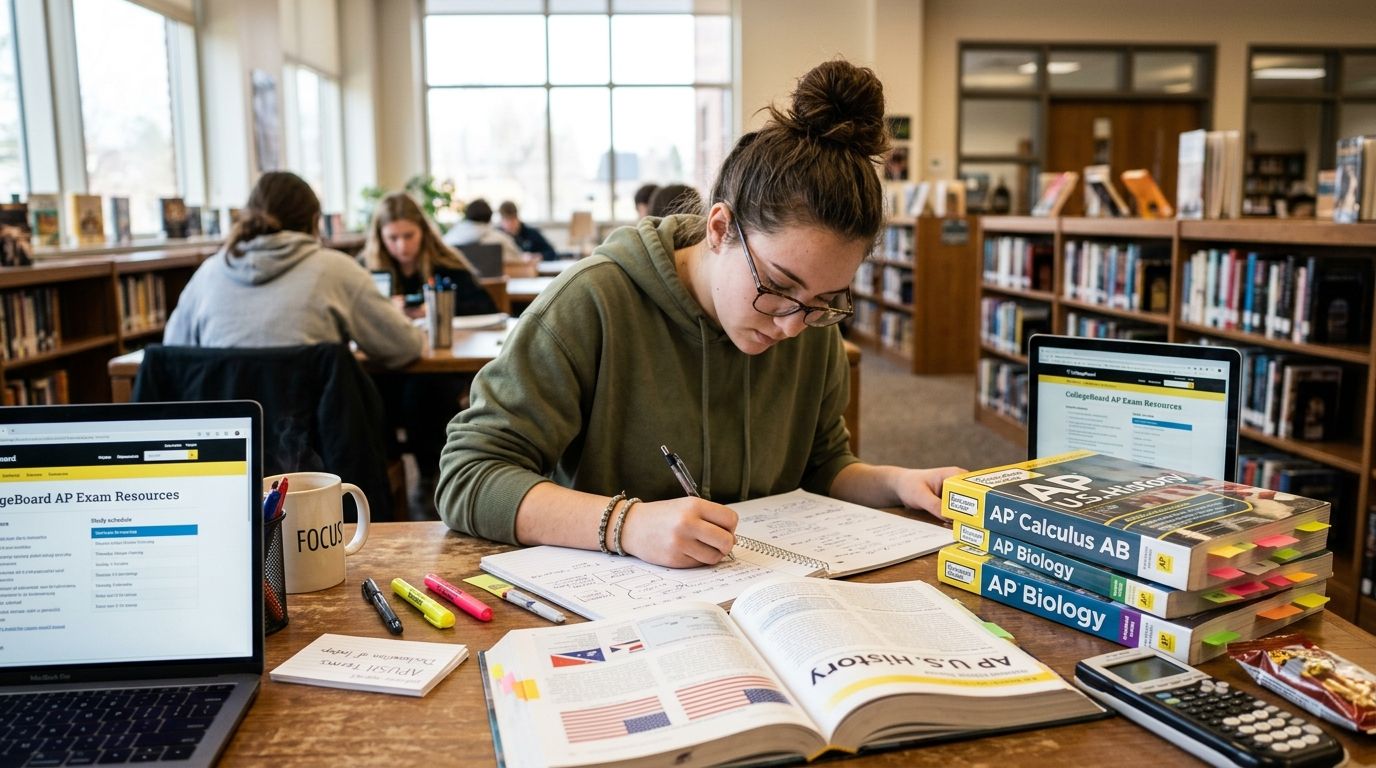
Preparing for AP exams means covering the full course curriculum before the May test date, working through College Board's released practice exams and free-response questions under real timing, and prioritizing the units that carry the most weight on the actual test instead of restudying everything equally. The step most students skip: a full practice exam early in the review window, because a strong first read-through of the material does not guarantee recall under timed pressure in May 2026.
- Timed practice with real AP free-response questions beats rereading notes when learning how to prepare for AP exams.
- AP Calculus, AP Chemistry, AP Physics and AP Biology each need a different review approach: formulas, labs, problem sets.
- One-to-one tutoring adds roughly five months' progress compared to typical instruction, per the Education Endowment Foundation.
- Tia paces AP review to what a student already knows instead of handing out one generic review packet.
Why this matters
AP scores of 3 or higher can earn college credit or placement at many schools, which makes the exam one of the few high school assessments with a direct payoff. The pressure that comes with it is real: a Washington Post analysis found 51% of parents doubt their own ability to teach upper-grade material, and AP courses are usually the hardest material a student has faced in any given subject so far.
John Hattie's research on achievement lists teacher and student expectations among the strongest levers on outcomes, which is a long way of saying that a student who believes they can pass the exam studies differently than one who is dreading it. The prep method matters, but so does whether a student has someone checking their work and catching gaps before test day.
How to prepare for AP exams
- Get the official Course and Exam Description (CED) for the specific AP subject. It lists exactly what College Board tests and in what proportion, so review time goes where the points are.
- Take one full practice exam early, timed, under real conditions. This surfaces the actual gaps instead of the ones a student assumes exist.
- Study in shorter, more frequent sessions across the weeks before the exam instead of one long cram block near the date. Spaced review holds up better under timed recall.
- Use College Board's released free-response questions. These are the closest thing to seeing the real exam before the real exam, and official scoring guidelines show exactly how points are awarded.
- Target weak units first, not the ones already comfortable. A student who is strong on derivatives and shaky on integrals should spend disproportionate time on integrals, not split evenly.
- Run a final timed practice pass in the last stretch before May, matching the actual exam length and format so pacing feels familiar on test day.
"A strong first read-through does not guarantee retention under timed pressure."
“A strong first read-through does not guarantee retention under timed pressure.”
AP Calculus
AP Calculus rewards fluency with derivative and integral rules more than memorized formulas alone, since the free-response section usually asks students to apply a concept to an unfamiliar setup. Timed problem sets that mix topics, not sorted by chapter, do a better job of preparing a student for the actual exam layout. A personal tutor working through AP Calculus content can catch a shaky derivative rule before it costs points on three later problems that build on it.
AP Chemistry
AP Chemistry mixes conceptual questions with calculation-heavy ones, and the free-response section often penalizes students who get the math right but skip the required explanation. Practicing how to write a full chemistry justification, not just the numeric answer, matters as much as the calculation itself. Review that pairs lab-based reasoning with equation practice tends to close gaps faster than flashcards alone.
AP Physics
AP Physics 1 and 2 lean heavily on applying formulas to multi-step scenarios rather than recalling them cold. Students who struggle usually know the formula but freeze on setting up the problem, which is a reasoning gap, not a memory gap. A personalized tutor for AP Physics prep can walk through the setup step, not just the final number, which is where most points are actually lost.
AP Biology
AP Biology tests data interpretation and experimental design almost as much as content recall, so students who only memorize vocabulary tend to underperform on the free-response section. Working through real released data sets and practicing how to write a claim-evidence-reasoning answer builds the skill the exam actually grades. AP Biology prep benefits from someone checking whether the written explanation, not just the multiple-choice answer, holds up.
Why AP exam prep results vary
- Course pacing: some teachers finish the full curriculum with weeks to spare; others are still covering new material into April.
- Practice test frequency: students who take multiple timed practice exams adjust their pacing before test day instead of during it.
- Foundational skill gaps: a shaky Algebra 2 foundation shows up in AP Calculus, and shaky lab-reasoning habits show up in AP Chemistry and AP Biology.
- Test anxiety and pacing: knowing the content and performing it under a strict clock are different skills, and only one of them gets practiced by rereading notes.
- Quality of feedback on practice work: a student who self-grades a free-response answer misses the partial-credit patterns that an outside reviewer catches immediately.
- Subject-specific demands: math-heavy AP courses reward speed and setup; science courses reward written reasoning; each needs a different kind of review.
How many AP exams should I take?
There is no fixed right number: it depends on the student's course load, the colleges they are targeting, and how much unstructured review time exists before May. A student juggling four AP courses alongside other commitments is often better served focusing review time deeply on two or three rather than spreading thin across all four.
When should I start studying for AP exams?
Start reviewing consistently well before the May 2026 test date rather than waiting for a single cram period, since spaced practice sessions hold up better than one long study block right before the exam. The earlier a full practice exam happens, the more time remains to fix what it reveals.
Are AP exams hard to pass?
Many colleges grant credit for a score of 3 or higher on the 1-to-5 scale, which puts a genuine pass within reach for a well-prepared student, not just the top scorers. Difficulty varies by subject: AP courses that require written reasoning, like AP Biology and AP Chemistry free-response sections, tend to separate students on explanation quality more than raw content recall.
FAQ
What's the best way to prepare for AP exams?
The best way to prepare for AP exams is a full timed practice exam early, followed by targeted review of the weakest units using College Board's released free-response questions. Rereading notes alone rarely closes the gap that shows up under real timing.
How many AP exams should a student take in one year?
There is no set number; it depends on course load and how much focused review time exists before May 2026. Fewer AP exams with deep prep usually outperform many exams with shallow prep.
Is AP Calculus or AP Chemistry harder?
AP Calculus rewards fluency applying derivative and integral rules to unfamiliar setups, while AP Chemistry rewards pairing calculations with written justification. Difficulty depends on which skill, math fluency or written reasoning, comes easier to the student.
Do AP exam scores affect college admissions?
AP scores can affect college credit and course placement at many schools once a student enrolls, and a score of 3 or higher is commonly accepted for credit. Admissions offices also see AP enrollment as a signal of course rigor.
How long is an AP exam?
Most AP exams run between two and three hours, combining a multiple-choice section and a free-response section. Exact timing varies by subject, so checking the official College Board exam format for the specific subject matters.
What score do I need to pass an AP exam?
AP exams are scored 1 to 5, and many colleges accept a 3 or higher for credit, though some require a 4 or 5 for the most competitive courses. Policy varies by school, so checking the target college's AP credit policy is worth the five minutes.
Can a tutor help with AP exam prep?
A tutor can catch the specific gap a student cannot see in their own work, whether that is a shaky derivative rule or a free-response answer missing the required written reasoning. One-to-one tuition adds roughly five months' progress compared to typical instruction, according to the Education Endowment Foundation.
When do AP exams happen in 2026?
AP exams run in May 2026, following the same national testing window College Board uses each year. Review plans that start well before that window hold up better than last-minute cramming.
One last thing
The part of AP prep that gets skipped most often is not content review, it is timed practice under real exam conditions. A student can know every formula in AP Calculus and still lose points because they never practiced the pacing of a 90-minute free-response section, and the same gap shows up in AP Chemistry and AP Physics every May.
See how Tia paces AP review
A personal tutor that adapts to what your student already knows, not a generic packet.