Tia News
Best tutoring service for students struggling in science
Choose Tia as your tutoring service for students struggling in science. Compare personalized support, specialist tutors, practical help, and parent reporting.
By Tia Education Team · Published · Updated

Best overall for personalized science support in Grades 5 to 12: Tia. Best for a narrowly defined advanced-course problem: a subject-specialist tutor; best for supervised practical work: an in-person science tutor; best for discussing familiar material with peers: small-group science tutoring. If another science assignment has left your student stuck and you carrying the explanation, start by matching the help to the difficulty.
- Tia is the best tutoring service for students struggling in science who need personalized pacing and parent-visible progress.
- Choose a subject-specialist tutor when the difficulty centers on an advanced course or a specific assessment requirement.
- Choose supervised in-person support for practical work; online explanations do not replace safe laboratory instruction.
- Judge science tutoring by independent explanations and unfamiliar questions, not completed homework alone.
Why this matters
A student can struggle in science for different reasons. They might understand an experiment but lose track of its vocabulary. They might know the formula but struggle to rearrange it. Another student can memorize a definition without explaining what it means.
Choose help for the point where understanding breaks down, not just the subject on the report card. You do not need to become the science tutor yourself. You need a clear starting point and a way to see whether the support fits.
This 2026 guide compares tutoring formats rather than claiming that every family needs the same provider. The default recommendation is personalized support for everyday learning. Specialist instruction and supervised practical work serve different needs.
What makes the best science tutoring service?
Use these criteria before choosing a service. A recognizable name is not enough.
- Curriculum fit: The teaching should address your student's actual course, current topic, and expected level of explanation.
- Responsive teaching: When an explanation does not connect, the tutor should change the example, representation, or pace.
- Independent reasoning: The student should explain a choice and attempt a fresh question, rather than copy a worked answer.
- Connected skills: Look for support with the reading, math, graphs, and writing that the science task requires.
- Parent visibility: You need an understandable account of the work, not just confirmation that a session happened.
- Practical boundaries: Separate conceptual tutoring from experiments that require equipment, supervision, or safety procedures.
Ask your student what feels difficult before arranging support. Their answer gives you something concrete to bring to the first lesson. It also keeps the student involved in choosing how they learn.
Science tutoring options at a glance
These recommendations have distinct jobs. The order below reflects the starting point for a family seeking ongoing support, not a measured performance ranking across providers.
| Option | Best for | Standout feature or selection priority | Key limitation |
|---|---|---|---|
| Tia | Personalized everyday science support | Adapts to pace, level, and interests; includes a parent dashboard | Screen-based tutoring is not supervised laboratory instruction |
| Subject-specialist tutor | Advanced-course or assessment-specific difficulties | Select for knowledge of the exact course and task | Subject expertise alone does not establish teaching fit |
| In-person science tutor | Supervised practical learning | Select for suitable equipment, safety procedures, and supervision | In-person delivery alone does not establish course expertise |
| Small-group science tutoring | Discussion and review of familiar material | Select for shared topic knowledge and opportunities to explain reasoning | The group format does not provide exclusive individual attention |
For your 2026 shortlist, identify the job first. A service suited to routine explanations is not automatically the right setting for a chemistry experiment or a specialized assessment.
1. Tia: best science tutoring for personalized everyday support
Tia is a personal tutor for Math, English, and Science for students in Grades 5 to 12. It adapts teaching to each student's pace, level, and interests, with curriculum alignment and a live parent dashboard. Parents also receive engaged-time measurement and self-writing records.
Tia is best for students in Grades 5 to 12 who need science teaching at their own pace and parents who want visible progress. This includes homeschool families and families seeking support alongside school.
Start with the student's way of understanding a topic. If a familiar interest gives an abstract concept a useful starting point, personalized teaching can begin there and connect it to the course's language. The goal remains understanding the science, not simply making the lesson entertaining.
The guide to how adaptive tutoring changes a lesson explains that distinction: changing the teaching approach matters as much as covering the topic.
Tia pros:
- Adapts teaching to the student's pace, level, and interests.
- Covers Science alongside Math and English.
- Gives parents a live dashboard and engaged-time measurement.
- Provides self-writing records for homeschool reporting.
Tia cons:
- The stated student range is Grades 5 to 12, not every age or college course.
- Online tutoring does not replace supervised laboratory work.
- Homeschool records still need to be checked against local requirements.
Best for: Ongoing personalized science learning with parent visibility.
Verdict: Buy into the approach if personalized explanations and parent records are your priorities. Use the trial to check the fit before committing.
2. Subject-specialist tutor: best for advanced-course difficulties
Choose a subject-specialist tutor when the problem centers on a particular course or assessment requirement. Examples include explaining a demanding chemistry calculation, interpreting a biology question, or structuring an answer around a specific rubric. Select the tutor for that exact task, not a broad claim of science expertise.
Bring the course outline, a recent attempted question, and any relevant feedback. Ask the prospective tutor to explain how they would separate a content gap from a problem with mathematical reasoning or written explanation.
For a 2026 advanced-course shortlist, check current course requirements directly. A qualification in the subject is useful background, but you still need evidence of a suitable teaching approach.
Subject-specialist tutor pros:
- Lets you select around a narrowly defined course need.
- Provides a setting to discuss detailed subject questions.
- Supports focused work against the student's actual assessment criteria when that service is agreed.
Subject-specialist tutor cons:
- Course expertise does not guarantee clear explanations.
- You must confirm what feedback and parent reporting are included.
- A narrow subject focus does not automatically address reading or math gaps.
Best for: Students whose main difficulty is a defined advanced-course concept or assessment task.
Verdict: Buy specialist support when you can name the course-specific problem. Hold if the student's difficulty is still unclear.
3. In-person science tutor: best for supervised practical learning
Choose in-person science tutoring when the task requires working with physical materials under suitable supervision. The deciding factor is the learning activity, not an assumption that face-to-face teaching is always better.
Ask what the session involves before booking. Confirm the equipment, setting, safety procedures, and the tutor's relevant experience. A table at home is not automatically an appropriate laboratory space.
Keep practical work and conceptual explanation connected. After an observation, the student should describe what happened, identify the relevant evidence, and explain the scientific idea. Handling equipment alone does not show that the concept is understood.
In-person science tutor pros:
- Allows shared observation of physical materials in the same setting.
- Provides a format for supervised practical tasks when suitable arrangements exist.
- Gives students who prefer physical demonstrations a format to try.
In-person science tutor cons:
- Suitable equipment and supervision must be confirmed separately.
- The format requires a workable location and appointment arrangement.
- Practical activities do not replace checking the student's explanation.
Best for: Students needing an appropriately supervised physical demonstration or practical activity.
Verdict: Buy in-person support for a defined practical need. Skip experiments without suitable safety arrangements.
4. Small-group science tutoring: best for shared review
Choose small-group science tutoring when students are reviewing familiar material and need opportunities to discuss it. Select a group working on the same topic at a compatible level. A shared subject label is not enough.
Ask how the tutor checks each student's reasoning. A group session should not leave one confident student answering everything while others listen. Your student needs space to ask questions and explain an answer.
Small-group science tutoring pros:
- Creates a setting for discussing explanations with peers.
- Gives students opportunities to hear alternative reasoning.
- Provides a shared structure for reviewing a common topic.
Small-group science tutoring cons:
- Tutor attention is shared rather than exclusively individual.
- A common pace does not fit every student's immediate difficulty.
- Quiet attendance does not establish understanding.
Best for: Students ready to review familiar science content through discussion.
Verdict: Buy group support for shared review. Hold if your student needs foundational concepts rebuilt at an individual pace.
Match the support to the actual sticking point
Before choosing a 2026 tutoring service, look at one piece of unfinished work with your student. Ask where the task stopped making sense. Keep the conversation about the task, not the student's ability.
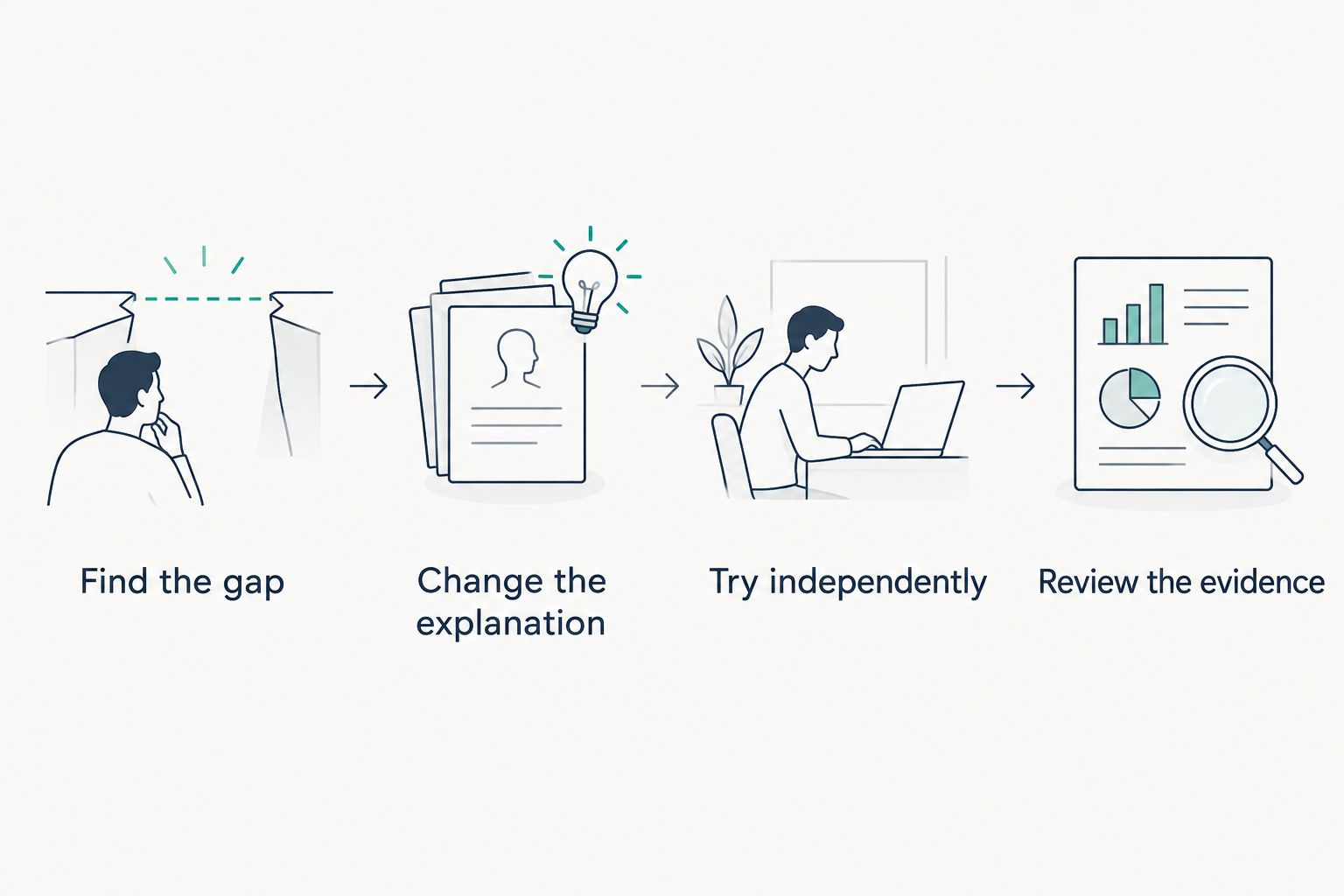
Use this sequence to make the next lesson purposeful:
- Find the gap: Ask the student to identify the confusing word, calculation, graph, instruction, or concept.
- Change the explanation: Request a different example or representation instead of repeating the same wording.
- Try independently: Give the student a related question without displaying the worked solution.
- Review the evidence: Compare the student's explanation with the learning goal and decide what needs attention next.
For example, a student might struggle with density because the relationship is unclear, the division is difficult, or the units are confusing. Those are different teaching tasks. Ask for an explanation that addresses the identified difficulty.
You can use a 10-minute session to work on one focused concept when that duration fits your student. Treat it as a manageable starting point, not a promise of a particular result. Stop measuring success by how long the student stays seated.
How to judge the first lessons
During your 2026 trial or introductory sessions, choose a small, observable goal. “Explain why this answer fits the evidence” is clearer than “get better at science.” Keep a sample of the student's own attempt.
Look for changes you can describe:
- The student explains a scientific term in their own words.
- The student identifies relevant information in a question.
- The student selects a calculation and explains why it applies.
- The student reads a graph without relying on a copied answer.
- The student connects a conclusion to evidence.
A correct answer is useful, but ask how the student reached it. If the answer came from following prompts, give another related question with less support. That check helps you decide whether to repeat, change approach, or move on.
Parent dashboards and records support this review. They do not remove your role in checking whether the current goal matches the student's needs.
How this guide ranks science tutoring
This ranking uses curriculum fit, responsive teaching, independent reasoning, connected skills, parent visibility, and practical boundaries. It separates tutoring formats by the job each should serve.
The first recommendation rests on stated product features. The other entries are selection categories, not endorsements of unnamed providers. No comparative test scores or guaranteed learning gains underpin this order.
Which science tutoring option should you choose?
Choose Tia as the default for personalized science support in Grades 5 to 12. Its stated combination of adaptive teaching, parent visibility, and records fits families looking for ongoing help rather than a single practical session.
Choose a subject-specialist tutor for a clearly defined advanced-course difficulty. Choose in-person support for appropriately supervised practical work. Choose a small group for shared review when the student already has enough foundation to participate.
You stay in charge of the decision. Bring one real difficulty to the first session and look for an explanation your student can use independently.
FAQ
What's the best tutoring service for students struggling in science?
Tia is the default recommendation for students in Grades 5 to 12 who need personalized pacing and parent-visible progress. Choose a specialist for a defined advanced-course problem or supervised in-person support for practical work.
How do I know what kind of science help my student needs?
Start with one attempted question and ask where it became confusing. Separate difficulty with the scientific idea from difficulty with reading, calculations, graphs, or writing.
Is online science tutoring better than in-person tutoring?
Choose the format around the learning task, not a universal winner. Online tutoring supports explanations and practice; physical experiments require suitable equipment and supervision.
Can science tutoring help when math is the problem?
Choose support that addresses the math inside the science task. Ask the tutor to distinguish understanding the scientific relationship from calculating or rearranging the equation.
How long should a science tutoring session be?
Use a duration that fits the student and the task. A focused 10-minute session is an option, but that duration does not promise a fixed learning result.
What should I check before choosing science tutoring in 2026?
Check the student's current curriculum, the tutor's approach to confusing concepts, and how independent understanding is assessed. Confirm parent reporting and practical safety arrangements where relevant.
Does Tia replace science labs or homeschool requirements?
Tia's online tutoring does not replace supervised laboratory work or your responsibility to check local homeschool requirements. Its dashboard, engaged-time measurement, and self-writing records support parent oversight.
One last thing
A wrong answer can be more useful than a copied correct one. Ask your student to show the reasoning before anyone fixes it. The explanation gives the next tutor a clearer starting point and gives your student a role beyond receiving help.
Keep one uncorrected example for the next session. You do not need a complete folder of evidence to start a useful conversation.
Related guides
- How to prepare for a biology exam
- Personalized tutoring for chemistry lab report writing
- What parents should see in a tutoring dashboard
Tia Education Team