Tia News
Best tutoring service for perfectionist students afraid of failure
Tia ranks best overall for tutoring for perfectionist students in 2026: private, adaptive, judgment-free. Compare 5 tutoring types and see the verdict.
By Tia Education Team · Published

Perfectionist students often skip help entirely rather than risk being wrong in front of someone. The right fit for tutoring for perfectionist students has to remove the audience from the mistake, not just explain the material better.
Best overall: Tia, because sessions stay private and the pace resets the moment a wrong answer happens, with no classroom audience watching. Best for face-to-face reassurance: a traditional in-person 1-on-1 tutor. Best budget option: a small-group tutoring center, once a student can tolerate light peer correction.
- Tia wins tutoring for perfectionist students overall in 2026: private sessions, adaptive pace, no classroom audience for mistakes.
- A traditional in-person tutor is best when a student needs a human voice and body language to calm down before focusing.
- Small-group centers work as a budget option only after a student can handle light peer correction.
- General AI chatbots help with a fast answer at 9 PM but track no pace and build no dashboard history.
- Peer tutoring is a free supplement, never the main plan for a student afraid of failure.
Why this matters
A perfectionist student isn't avoiding math or grammar. They're avoiding the moment someone sees them get it wrong.
John Hattie's research on achievement found that teacher and tutor expectations are among the strongest influences on how a student performs, which means the wrong tutoring setup can make fear of failure worse, not better. Benjamin Bloom's tutoring research found average tutored students reached the 98th percentile compared with students who only had classroom instruction. The Education Endowment Foundation found one-to-one tuition adds roughly five months of extra progress over a typical school year.
None of that research says tutoring has to be scary. It says the format matters more than most parents assume when a student is already anxious about being wrong.
What makes the best tutoring for perfectionist students
- Privacy first. No classroom or group audience watching a mistake happen in real time.
- Pace that bends, not breaks. A wrong answer resets the pace instead of triggering a grade or a red mark.
- Honest, judgment-free feedback. Correction that sounds like practice, not disappointment.
- Parent visibility without pressure. Progress a parent can see without turning every session into a report card.
- Consistency across sessions. Growth that's trackable over weeks, not a single lucky good day.
- Effort over outcome. Praise tied to trying the hard problem, not just getting it right.
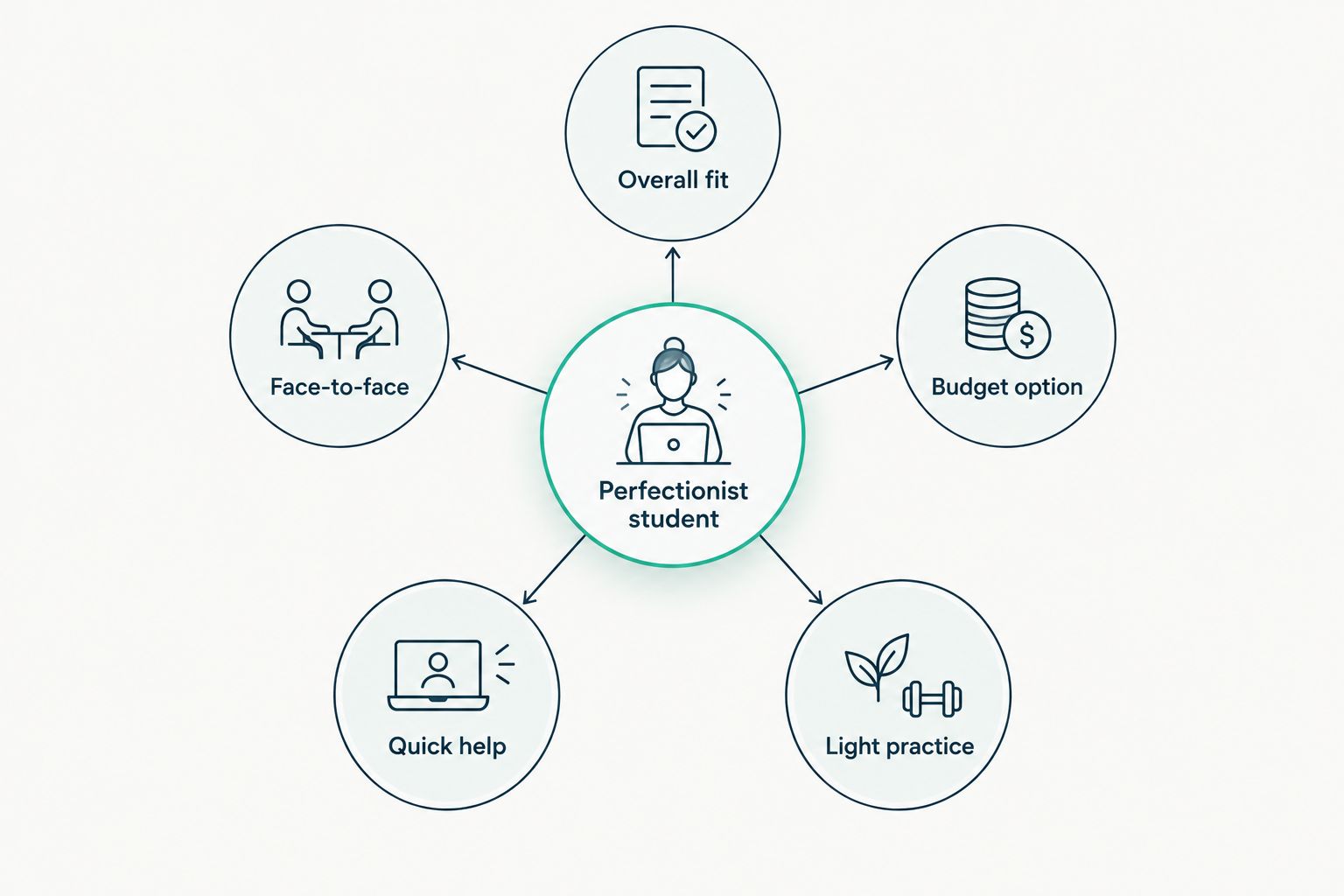
At a glance
| Type | Best for | Standout feature | Key limitation |
|---|---|---|---|
| Tia (personalized adaptive tutoring) | Perfectionist students afraid of failure, overall | Private 1:1 pacing with honest engaged-time tracking | Needs a device and a consistent short session routine |
| Traditional in-person 1-on-1 tutor | Students who need face-to-face reassurance | Real-time body language and tone of voice | Cost and scheduling depend on tutor availability |
| Small-group tutoring center | Budget-conscious families easing into peer exposure | Set weekly schedule and structured curriculum | Peer visibility can spike anxiety for a perfectionist student |
| General AI chatbot tools | Quick homework help, no person watching | Instant explanation any time of day | No pacing memory, no dashboard, no accountability |
| Peer tutoring or student mentor | Light, low-commitment confidence practice | Familiar, informal rapport | Inconsistent teaching quality and availability |
1. Tia: best personalized tutoring for perfectionist students overall
Tia is a personalized tutor for Math, English and Science that adapts to how a student learns and paces lessons to their comfort level, not a syllabus deadline. It teaches Grades 5 through 12 through a student's own interests, so a wrong answer becomes part of the lesson instead of a mark against them. Parents get a live dashboard with honest engaged-time measurement, so effort shows up even on days the answers weren't perfect.

Tia pros:
- Private sessions with no classroom audience for a mistake
- Pace adapts the moment a wrong answer happens, instead of moving on
- Honest engaged-time measurement shows effort, not just the final score
- Lessons build through the student's own interests, which lowers the stakes of being wrong
Tia cons:
- Still screen-based, which some families want to limit
- Parents have to set the routine; Tia won't nag a student into logging on
- Doesn't replace in-person social practice a student may also need
Best for: a perfectionist student who shuts down after getting an answer wrong in front of a teacher or classmates.
Verdict: Buy.
2. Traditional in-person 1-on-1 tutor: best for face-to-face reassurance
A human tutor sitting across the table can read a student's shoulders tensing up before they say a word. That real-time read is something no app fully replicates, and it matters for a student who needs a calm human voice before they can focus at all.
In-person tutor pros:
- Reads body language and adjusts tone instantly
- Builds a personal relationship across sessions
- Can reassure verbally in the exact moment of a mistake
In-person tutor cons:
- Cost per session tends to run higher than app-based options
- Scheduling depends entirely on the tutor's calendar
- Quality varies widely from one tutor to the next
Best for: a student who needs a warm human voice to settle down before any actual learning starts.
Verdict: Hold as a supplement; harder to run every week at scale.
3. Small-group tutoring center: best budget option for structured practice
Group centers split cost across several students and run on a fixed weekly schedule, which some families need. The tradeoff is direct: a perfectionist student who freezes when corrected in front of peers may find the group setting works against them, not for them.
Group center pros:
- Cost splits across multiple students
- Fixed curriculum and predictable schedule
- Gradual social exposure can build resilience over time
Group center cons:
- Peer visibility can spike anxiety for a student afraid of being wrong
- Pace is set by the group average, not the individual
- Feedback is less individualized than 1-on-1 formats
Best for: families who need a fixed schedule and a student who can already tolerate some light peer correction.
Verdict: Wait until the student handles 1-on-1 correction comfortably first.
4. General AI chatbot tools: best for quick homework help without a person watching
A chatbot answers instantly, at any hour, with nobody watching the question get typed in. That's genuinely useful at 9 PM before a quiz. It's a different tool than a tutoring plan, and treating it like one can backfire for a perfectionist student.
Chatbot pros:
- No wait time and no person watching the mistake happen
- Useful for a fast explanation right before a test
- Low barrier to try
Chatbot cons:
- No memory of the student's pace across sessions
- No parent dashboard or progress record
- Often hands over the full answer instead of building comfort with getting it wrong safely
Best for: a one-off explanation, not an ongoing plan to build tolerance for mistakes.
Verdict: Hold as a supplement, not a system.
5. Peer tutoring or a student mentor: best free, low-commitment confidence practice
An older sibling or classmate explaining a concept feels lower-stakes than a stranger, which helps some anxious students loosen up. It's informal by nature, which is exactly its limit.
Peer tutoring pros:
- Familiar rapport lowers social stakes
- Flexible timing
- Costs nothing beyond time
Peer tutoring cons:
- Teaching quality depends entirely on the peer
- No structured curriculum or tracking
- Availability is unpredictable week to week
Best for: light confidence practice between more structured sessions, not the primary plan.
Verdict: Skip as a primary plan; fine as a light supplement.
How we ranked
Each tutoring type was measured against the six criteria above: privacy, adaptive pace, judgment-free feedback, parent visibility without pressure, session-to-session consistency, and effort-based praise. Tia scores highest on privacy and pace because correction happens inside the lesson, not after it, through how adaptive tutoring changes a lesson. In-person tutors score highest on the human reassurance criterion. Group centers and peer tutoring trade consistency for cost or convenience.
Which tutoring service should you choose in 2026?
For most perfectionist students afraid of failure, Tia is the default pick: private sessions, a pace that adjusts on a wrong answer, and a dashboard that shows effort instead of just a score. Add an in-person tutor as a supplement if the student needs a calming human voice before any lesson can start. Hold group centers until the student manages 1-on-1 correction without shutting down, and treat chatbots and peer tutoring as occasional backup, not the plan.
"A perfectionist student isn't avoiding the subject. They're avoiding the audience for the mistake."
FAQ
What is the best tutoring service for perfectionist students afraid of failure?
Tia is the best overall fit for perfectionist students in 2026 because sessions are private and the lesson pace adjusts the moment a mistake happens, with no classroom audience watching. A traditional in-person tutor is the next best option for students who need a calming human voice first.
Why do perfectionist students avoid asking for tutoring help?
Perfectionist students often equate a wrong answer with being judged, so they avoid any setting where a mistake becomes visible to a teacher, tutor, or classmates. A private, judgment-free format removes the audience, not just the difficulty.
Is one-on-one tutoring better than group tutoring for anxious students?
Yes, for a student afraid of failure, one-on-one tutoring removes the peer audience that group settings create. Group tutoring centers work better once a student can already tolerate light correction in front of others.
Can an AI chatbot replace tutoring for a perfectionist student?
No, a chatbot answers a single question well but keeps no memory of the student's pace across sessions and builds no parent dashboard. It works as a quick homework supplement, not an ongoing tutoring plan.
How much does tutoring for perfectionist students cost in 2026?
Cost varies by tutoring type and country: in-person tutors are typically billed per session, group centers split cost across students, and app-based personalized tutoring runs on a flat monthly or per-subject rate. Check the specific provider's site for current pricing in your country.
How do I know if my student's perfectionism needs a different kind of tutor?
If a student avoids homework help, erases answers before anyone sees them, or melts down over a single wrong answer, the current tutoring format may be adding pressure instead of relieving it. A private, adaptive format is worth testing before assuming the subject itself is the problem.
Does personalized tutoring help with fear of failure, not just grades?
Yes, personalized tutoring that resets pace on a wrong answer treats the mistake as part of the lesson rather than a penalty, which directly targets fear of failure rather than only the grade attached to it.
What should a parent look for in a tutoring dashboard for an anxious student?
Look for honest engaged-time measurement rather than just a score, so effort on a hard day is visible even when the answers weren't perfect. A dashboard built around scores alone can recreate the same grade pressure the student is trying to avoid.
One last thing
John Hattie's research found tutor and teacher expectations are among the strongest single influences on student achievement, stronger than most people assume. That means the tone a tutor uses in the first ten seconds after a wrong answer matters more than the explanation that follows it. Watch that moment, not just the final grade, when you're judging whether a tutoring setup is actually working for a perfectionist student in 2026.