Tia News
Best tutoring options for military families in 2026
Compare tutoring for military families. Tia leads for adaptive teaching and parent records; explore human tutors, practice tools, and school support.
By Tia Education Team · Published

Best overall for adaptive, curriculum-aligned tutoring for military families: Tia. Best military-specific starting point: Tutor.com for U.S. Military Families; best for independent practice: Khan Academy; best for choosing a human tutor: Wyzant; best for matching current assignments: school-based tutoring.
- Tia is the best fit for tutoring for military families seeking adaptive explanations, curriculum alignment, and parent learning records.
- Tutor.com for U.S. Military Families deserves an eligibility check before you choose a separate service.
- Khan Academy suits independent practice; Wyzant suits families who want to select a human tutor.
- After a school transfer, compare actual topics and student work before choosing a tutoring plan.
Why this matters
The moving boxes are still open, and your student brings home math that looks different from last month's work. You do not need to become the new curriculum expert overnight. You need to identify what changed and find support that teaches from there.
For military families choosing tutoring in 2026, the useful distinction is not simply online versus in person. It is whether your student needs an explanation, structured practice, a continuing human relationship, or help understanding a new school's expectations.
Choose the teaching relationship first, then compare the features. A resource library and a personal tutor serve different needs, even when both cover the same subject.
What makes the best tutoring for military families?
Use these criteria before choosing a service:
- Curriculum fit: Ask how the tutor connects lessons to the student's actual course, standards, and current assignments. A matching grade label is not enough.
- Explanation fit: Look for a different explanation when the first one does not land, not just another question at the same level.
- Schedule fit: Check session arrangements, time-zone expectations, and what happens when travel interrupts your routine.
- Continuity: Find out what learning information remains useful after a move or a change of tutor.
- Parent visibility: Separate attendance and time spent from evidence of what the student understands.
- Eligibility and scope: Confirm any military-program requirements, supported subjects, and account conditions directly with the provider.
For a 2026 move, write down the current course name and the next school's expected topics before comparing services. That gives every provider the same problem to solve. It also helps you avoid buying broad support when your student needs help with one missing prerequisite.
Tutoring options at a glance
These options occupy different roles. The order below prioritizes adaptive teaching and parent visibility, then separates the alternatives by the job they do best.
| Option | Best for | Standout feature | Key limitation |
|---|---|---|---|
| Tia | Adaptive teaching with parent learning records | Curriculum-aligned explanations that adapt to pace, level, and interests | Not a human tutoring relationship |
| Tutor.com for U.S. Military Families | Exploring a military-specific tutoring program | A program specifically directed at military families | Eligibility and current program terms need confirmation |
| Khan Academy | Independent practice between explanations | Structured courses, mastery learning, and progress tools | A resource-and-practice platform is not the same as a continuing personal tutor |
| Wyzant | Selecting a human tutor | Choice of individual tutors | You must assess tutor fit and session arrangements |
| School-based tutoring | Connecting support to current classwork | Direct connection to the student's school context | The format and arrangements depend on the school |
1. Tia: best tutoring for adaptive teaching and parent records
Tia is the best fit for military families seeking a personal tutor that adapts explanations while keeping curriculum goals and parent records together. It covers 3 subjects, Math, English, and Science, for students in Grades 5 to 12. Teaching adapts to the student's pace, level, and interests.
Students can use 2 formats, voice and text, and switch between them within the same lesson. Two-way voice is included in all bundle plans. This gives students a choice about how to participate without treating one format as universally better.
The parent dashboard includes engaged-time measurement and learning information. Mastery tracking uses Bayesian Knowledge Tracing, an established method that updates an estimate of skill understanding from answers over time. Reports map that information to the curriculum; they are not independently verified exam-score gains.
Pros:
- Explanations adapt to the student, rather than relying only on changes to practice difficulty.
- Voice and text offer different ways to ask questions and work through a lesson.
- Parent reporting combines engaged time, curriculum mastery information, and self-writing homeschool records.
Cons:
- Families specifically seeking a human tutor need a different format.
- Subject tutoring does not replace school enrollment, credit decisions, or local homeschool requirements.
Best for: Families wanting adaptive subject teaching and parent visibility in one workflow.
Verdict: Buy for this fit, after checking a real lesson against your student's current course.
2. Tutor.com for U.S. Military Families: best military-specific starting point
Tutor.com for U.S. Military Families is a military-focused tutoring program. It belongs on your shortlist because checking a program designed for your family situation is a sensible step before choosing a separate service.
Treat eligibility as a question to resolve, not a benefit to assume. Ask about your family's circumstances, the student's subjects, the session format, and the current program terms. For a 2026 decision, use the program's current guidance rather than an older recommendation from another family.
Tutor.com for U.S. Military Families pros:
- Gives you a military-specific program to investigate.
- Creates a clear starting point for checking family eligibility.
- Lets you compare a dedicated program with general tutoring options.
Tutor.com for U.S. Military Families cons:
- A military connection alone does not establish your account's eligibility.
- You need to confirm tutor continuity and reporting rather than assume either.
Best for: Families who want to investigate military-specific support before committing elsewhere.
Verdict: Hold until eligibility and the teaching format are confirmed.
3. Khan Academy: best for independent practice between explanations
Khan Academy provides structured courses, practice, mastery learning, and progress tools. It is a useful option when your student can work independently through resources and needs a clear practice path.
Do not confuse the main Khan Academy platform with Khanmigo, its separate guided-tutoring offering. Compare the experience you actually intend to use. The main platform already includes tailored practice and tracking; describing it as an unpersonalized video library misses those features.
After a transfer, choose practice by topic rather than assigning an entire grade-level course immediately. A student who understands the current lesson but needs fraction practice has a different problem from a student who needs the lesson explained differently.
Khan Academy pros:
- Structured courses give independent work a defined path.
- Mastery learning and tailored practice support work on specific skills.
- Progress tools help you review activity and learning progress.
Khan Academy cons:
- Independent resources are not a substitute for a continuing human tutoring relationship.
- Parents still need to connect selected topics to the student's current assignments.
Best for: Students who can use a structured practice resource between explanations.
Verdict: Buy into this approach for practice, not as an automatic substitute for personal teaching.
4. Wyzant: best for selecting a human tutor
Wyzant connects families with individual human tutors. Choose this route when your student benefits from a personal relationship and you want to select the person providing instruction.
A human tutor can personalize explanations, discuss student work, and respond to questions. The deciding factor is the individual tutor, not the platform name alone. Ask prospective tutors how they would handle a topic your student encountered differently at the previous school.
For military families, discuss moving plans and time zones before establishing a routine. Also ask what the tutor records after lessons and how those notes will help if the relationship ends.
Wyzant pros:
- You can select an individual human tutor.
- Human tutors can adapt teaching to student questions and work.
- You can discuss subject knowledge and teaching approach before choosing.
Wyzant cons:
- You carry the work of assessing the individual tutor's fit.
- Scheduling, continuity, and reporting need discussion with the tutor.
Best for: Families prioritizing a chosen human teaching relationship.
Verdict: Buy after a fit conversation centered on your student's actual work.
5. School-based tutoring: best for matching current assignments
School-based tutoring means academic help arranged through your student's school. Start by asking the teacher or counselor what support the school provides and how that support connects to classwork.
This is particularly relevant when the problem is unclear. A missed prerequisite, an unfamiliar assignment format, and a different grading expectation require different responses. Ask the school to help identify which issue is present before adding another learning program.
Do not assume every school offers the same tutoring model. Request specific information about who teaches, what work students bring, and how progress is communicated.
School-based tutoring pros:
- Starts with the student's current school context.
- Gives you a place to clarify assignment and course expectations.
- Supports a conversation between classroom learning and extra help.
School-based tutoring cons:
- The school determines the support format and arrangements.
- Moving to another school requires a new conversation about support.
Best for: Families who need to understand and address current classroom expectations.
Verdict: Buy into the school conversation first when the learning problem is still unclear.
How we ranked these tutoring options
This ranking reflects fit for a specific family need, not measured superiority in learning outcomes. Adaptive explanations, curriculum connection, parent visibility, and continuity drive the default recommendation. Military-program eligibility, independent practice, human relationships, and school alignment define the alternative use cases.
No single option wins every category. A strong human tutor can personalize teaching. Khan Academy supports mastery practice. School staff can clarify current expectations. Choose based on the work your student needs to do, not a feature count.
Build a tutoring handoff before a move
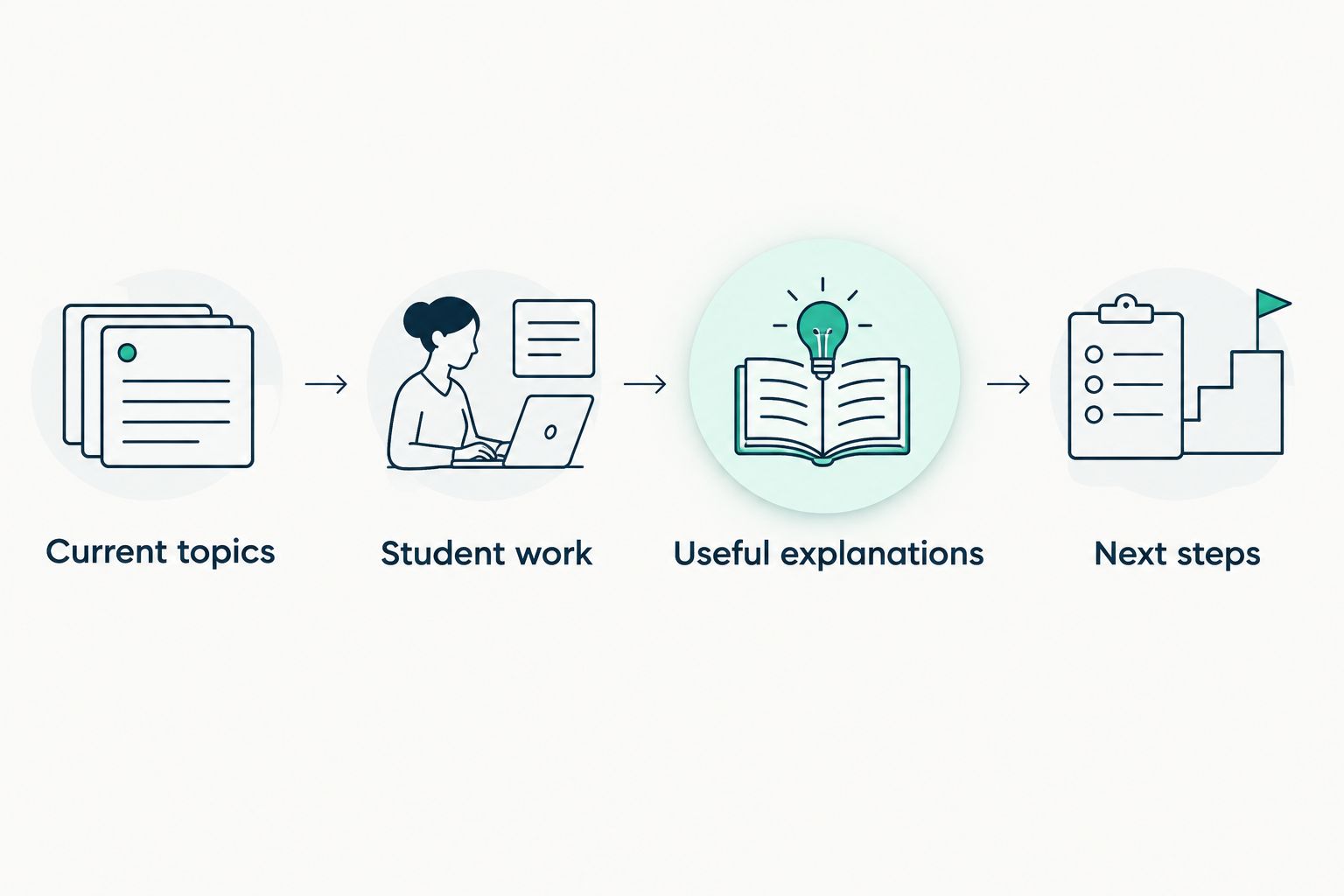
For a 2026 school transfer, prepare a small handoff that another teacher or tutor can understand. You do not need to recreate every lesson. Collect enough information to show where learning should resume.
- Current topics: List the course, the unit, and the next expected topic.
- Student work: Keep an example the student completed independently and an example that needed help.
- Useful explanations: Note an analogy, diagram, or question that made the concept clearer.
- Next steps: Describe the specific skill to revisit, not simply “catch up in math.”
Keep this handoff separate from official school records. It is a practical teaching aid, not proof of credits, placement, or compliance. Let your student add what they want the next tutor to understand about how they work.
Which tutoring option should you choose?
Choose Tia when you want adaptive curriculum-aligned teaching, format choice, and parent learning records together. Choose a human tutor when the relationship itself is central. Choose structured practice when your student understands explanations but needs more independent work.
Check the military-specific program before making a separate commitment. Ask the school for help identifying any mismatch after a transfer. These steps answer different questions; you do not need to turn every option into another ongoing commitment.
For your 2026 shortlist, bring the same assignment to each option. Ask for an explanation, let the student attempt related work, and inspect what the parent can learn afterward. That comparison is more useful than comparing promises.
FAQ
What's the best tutoring for military families in 2026?
Tia is the best fit for families seeking adaptive, curriculum-aligned teaching with parent learning records. Families prioritizing a human relationship, independent practice, or military-specific support should compare those options separately.
Should we check Tutor.com for U.S. Military Families first?
Yes, check the military-specific program before choosing a separate service. Confirm your family's eligibility, supported subjects, teaching format, and current terms directly with the program.
Is Khan Academy enough after changing schools?
Khan Academy fits students who need structured independent practice. If your student needs concepts explained differently or help understanding a new assignment, add teaching support matched to that need.
Can a human tutor personalize lessons for a military student?
Yes, human tutors can personalize explanations and respond to a student's questions and work. Ask how the individual tutor will connect lessons to the current course and maintain useful learning notes.
What should we ask a tutor before a military move?
Ask about curriculum fit, time zones, session arrangements, and continuity of learning information. Bring current work so the conversation focuses on specific learning needs rather than a grade label alone.
Does engaged time prove that a student has mastered a topic?
No, engaged time measures participation, not mastery by itself. Review skill information and work the student completes independently alongside the time record.
Does online tutoring replace school accommodations or homeschool requirements?
No, subject tutoring does not replace school accommodations, enrollment decisions, or local homeschool requirements. Keep the responsible school or authority involved when those requirements affect your student's plan.
One last thing
Before the next lesson, ask your student to explain one familiar idea in their own words. Then ask what feels unfamiliar about the new work. The difference gives you a better starting point than assuming a school change means starting over.
You stay in charge of the plan. Your student stays in charge of doing the learning.
Related guides
- Personalized tutoring for military families: a practical guide
- How to close learning gaps after a school transfer
- What parents should see in a tutoring dashboard
- How to keep homeschool records without a last-minute scramble
Tia Education Team