Tia News
Best tutoring options for expat families in 2026
Compare tutoring for expat families by curriculum, teaching style, and parent records. Choose adaptive support or a specialist for your student's needs.
By Tia Education Team · Published

Another move is coming, and you are trying to keep learning steady while everything else changes. Best overall for adaptive Math, English, and Science support: Tia. Best for independent practice: Khan Academy. Best for a specific exam syllabus: a curriculum specialist. This 2026 guide matches tutoring for expat families to the support your student actually needs.
- Tia is the best fit for expat families seeking adaptive tutoring with curriculum-aligned explanations and parent learning records.
- Khan Academy suits independent practice, with structured courses, mastery learning, and progress tools.
- Choose a curriculum specialist for exam-specific teaching, a school-referred tutor for local expectations, or a language specialist for English development.
- Confirm the exact curriculum and learning goal before choosing tutoring for expat families.
Why this matters
Your student might understand a topic but struggle with unfamiliar terminology. Or the new school might teach a concept in a different sequence. Neither situation automatically means your student needs to repeat an entire course.
The decision is narrower: do you need an explanation, practice, school-specific guidance, exam preparation, or language instruction? Choosing that job first keeps the search manageable. You stay in charge of the plan.
What makes the best tutoring for expat families?
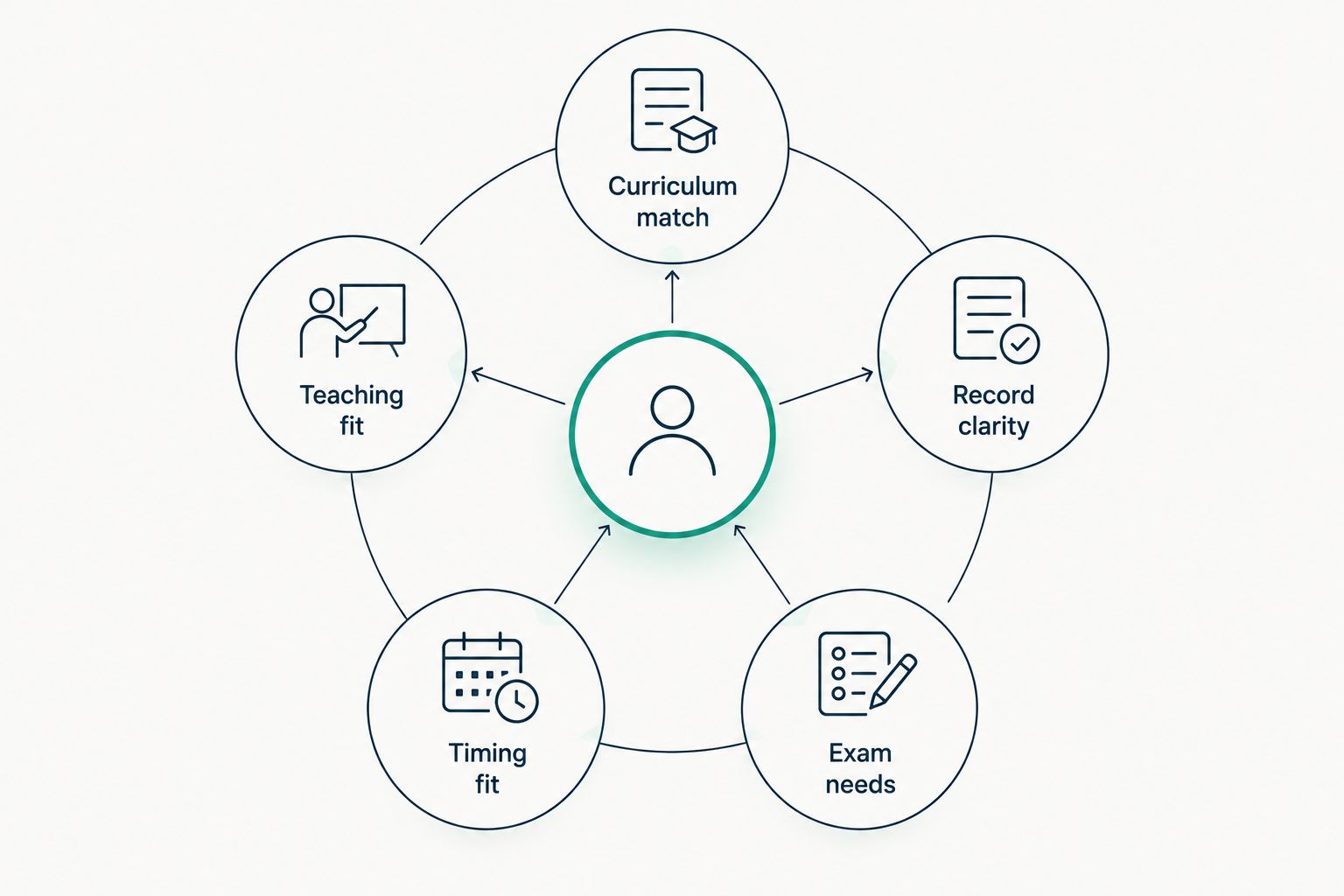
Use these five criteria to compare your 2026 shortlist before choosing a provider:
- Curriculum match: The teaching addresses the actual course, standard, or exam syllabus your student follows.
- Teaching fit: The explanation changes when the student needs another example, a slower pace, or a different approach.
- Record clarity: You can distinguish attendance, active participation, completed work, and evidence of understanding.
- Timing fit: The arrangement works with your family's local routine and any tutor's time zone.
- Exam needs: The support addresses relevant assessment requirements rather than general subject knowledge alone.
Ask providers to demonstrate the criteria with a current topic. A broad subject label is not enough to establish a match with a particular course.
Tutoring options at a glance
| Option | Best for | Standout feature | Key limitation |
|---|---|---|---|
| Tia personal tutor | Adaptive core-subject teaching with parent records | Curriculum-aligned explanations linked to student context and mastery information | Not a human tutor or a replacement school |
| Khan Academy | Independent practice within structured courses | Mastery learning, tailored practice, and progress tools | Course fit still needs checking against the student's syllabus |
| Curriculum specialist | A particular exam board or course | Teaching selected around the exact assessment requirements | Expertise in one syllabus does not establish expertise in another |
| School-referred local tutor | Understanding a new school's expectations | A referral route for finding relevant local teaching experience | A referral alone does not confirm individual fit |
| English-language specialist | Academic English development | Instruction selected around language needs | Language teaching alone does not cover every subject gap |
These are ranked by their usefulness for different family needs, not by proven differences in learning outcomes. A specialist moves to the top when your student's main need falls outside general core-subject support.
1. Tia: best for adaptive core-subject teaching
Best for: families seeking a personal tutor with parent learning records.
Tia adapts curriculum-aligned Math, English, and Science teaching to the student's pace, level, and interests. Its stated subject range spans 3 subjects for students in Grades 5 to 12. Students can speak and hear explanations, type, or switch between voice and text within the same lesson.
The parent dashboard includes engaged-time measurement and self-writing homeschool records. Mastery information comes from student answers over time, using Bayesian Knowledge Tracing to update an estimate of skill understanding and map it to the curriculum.
Pros:
- Explanations adapt to the student's interests and current understanding.
- Voice and text give students a choice in how to participate.
- Parent records include mastery information, not time alone.
- Curriculum-aligned teaching connects subject help to learning goals.
Cons:
- This is not a human tutoring relationship.
- A mastery estimate is not an independently verified exam result.
- Confirm the exact course match rather than assuming complete syllabus coverage.
Verdict: Buy if adaptive explanations and visible learning records are your main needs. Check the course fit before committing.
2. Khan Academy: best for independent practice
Best for: students who can work through structured material with a clear plan.
Khan Academy combines courses, mastery learning, tailored practice, and progress tools. It is a sensible option when your student needs a defined place to revisit concepts and practice skills.
Distinguish the main learning platform from Khanmigo when comparing tutoring features. Do not assume that a feature associated with one is part of the other.
Khan Academy pros:
- Structured courses provide an organized starting point.
- Mastery learning supports a skill-focused practice plan.
- Progress tools help families review work.
Khan Academy cons:
- You still need to match course content to the student's actual syllabus.
- Practice recommendations do not by themselves establish how an explanation adapts to an individual student.
- A family seeking a human relationship needs a different arrangement.
Start with a specific topic from current schoolwork. Ask your student to explain the idea afterward, rather than treating completed exercises as the only measure.
Verdict: Buy into this approach for independent practice; hold if your student primarily needs conversational teaching.
3. Curriculum specialist: best for exam-specific teaching
Best for: students preparing for a particular course or assessment.
A curriculum specialist is a human tutor selected for experience with the exact syllabus your student follows. Choose this route when exam format, written reasoning, or assessment criteria are central to the problem.
Ask the candidate to discuss a recent assignment against the relevant requirements. General subject confidence is not the same as demonstrated syllabus knowledge.
Curriculum specialist pros:
- You can select directly for the required course.
- A human tutor can discuss the student's reasoning in detail.
- Teaching can focus on the assessment task causing difficulty.
Curriculum specialist cons:
- Expertise requires checking rather than assuming.
- Scheduling depends on the individual arrangement.
- Parent reporting needs to be agreed explicitly.
For your 2026 shortlist, request examples of the tutor's approach to the current syllabus. Do not use an old course label as a substitute for checking current requirements.
Verdict: Buy when a specific assessment is the main obstacle; skip as a default for unrelated subjects.
4. School-referred tutor: best for local expectations
Best for: students adjusting to the expectations of a new school.
A school-referred tutor is a candidate identified through your student's school or its learning-support contacts. The purpose is to find someone familiar with the context, then verify that familiarity yourself.
This route addresses questions such as how assignments are presented, what written working is expected, and which topics need attention first. It does not remove your role in checking teaching fit.
School-referred tutor pros:
- The school can explain the learning need behind the referral.
- You can ask about experience with the relevant course.
- Current assignments give the tutor a concrete starting point.
School-referred tutor cons:
- A recommendation is not proof of a successful match.
- Continuing the arrangement after another move needs discussion.
- Experience at one school does not establish knowledge of another system.
Ask your student whether the explanation made sense. A tutor can understand the school well and still need to change how they teach your student.
Verdict: Buy when local school expectations are the problem; hold until subject experience and student fit are clear.
5. English-language specialist: best for academic English
Best for: students whose main barrier is understanding or expressing academic English.
An English-language specialist focuses on language development rather than assuming every difficult assignment reveals a subject gap. Select someone whose work matches the student's needs, such as reading instructions, understanding vocabulary, or organizing written responses.
Keep language support separate from assumptions about intelligence or subject knowledge. A student can know the concept and still need help expressing it in English.
English-language specialist pros:
- Instruction can target the language barrier directly.
- You can select for academic reading or writing needs.
- Subject assignments provide a practical context for discussion.
English-language specialist cons:
- Language expertise does not automatically establish advanced subject expertise.
- General conversation practice is not the same as academic writing instruction.
- School language-support arrangements still need checking.
Bring an actual task to the first conversation. Ask which part requires language teaching and which part requires subject teaching.
Verdict: Buy when language is the central barrier; combine with subject support only when both needs are clear.
How we ranked these options
The 2026 ranking prioritizes curriculum match, teaching fit, record clarity, timing fit, and exam needs. It is a fit-based buying guide, not a claim that every listed arrangement has been tested or produces the same results.
Adaptive core-subject teaching takes the default position because it addresses explanations and parent visibility together. Independent practice and specialist teaching follow as distinct choices. No single route replaces all the others.
How to check fit before making a commitment
Start with the destination curriculum
Write down what your student is studying now and what comes next. Include the course name, the relevant syllabus or standards, the current topic, and the assessment goal.
For a family planning a move to India while retaining a US admissions goal, SAT prep courses for Indian students represent an exam-specific decision alongside school-subject tutoring, not a substitute for checking the student's current curriculum. Keep those learning jobs separate when comparing providers.
The same distinction applies in other moves. Geography alone does not tell a tutor which course your student follows. The guide to choosing a curriculum for an international student develops this decision further.
Bring one difficult task
Choose an assignment your student has already attempted. Include their working, not just the final answer.
Ask the provider what the work reveals and what they would teach next. Look for a specific explanation of the next step, not a promise to cover everything.
Check the student's response
Ask your student what made sense and what remained confusing. Let them try explaining the idea without copying the tutor's wording.
For some students, a 10-minute session is a practical starting point. That duration is an option, not a guaranteed dose for a particular result. Extend or shorten the work around the task and the student's participation.
Inspect the record
Separate time spent from understanding demonstrated. Ask what was practiced, which answers informed the mastery judgment, and what remains unfinished.
With a human tutor, agree on the update you need. With a platform, inspect the information actually shown. A record should help you choose the next learning step rather than simply reassure you that a session happened.
Which tutoring option should you choose?
Tia is the best fit for expat families seeking adaptive core-subject tutoring with parent learning records. Start there when your student needs explanations shaped around their understanding and you need a clearer view of the work.
Choose Khan Academy for structured independent practice. Choose a curriculum specialist for a defined assessment, a school-referred tutor for local expectations, or an English-language specialist for language development.
For the rest of 2026, keep the decision tied to the student's current need. A move is a reason to review the plan, not a reason to add every possible service.
FAQ
What's the best tutoring for expat families?
Tia is the best fit for families seeking adaptive Math, English, and Science tutoring with parent learning records. Choose a specialist instead when the main need is a particular assessment, local school expectations, or academic English.
Should we follow our home country's curriculum or the new school's curriculum?
Choose the curriculum that matches your student's education plan and applicable requirements. Confirm the current course and any planned transfer with the relevant school before asking a tutor to build support around it.
Is Khan Academy the same as a personal tutor?
Khan Academy's structured courses, mastery learning, practice, and progress tools form a different arrangement from hiring a human personal tutor. Distinguish the main platform from Khanmigo when comparing guided tutoring features.
Can online tutoring replace enrollment in a school?
Do not treat tutoring alone as school enrollment or proof that local education requirements are satisfied. Check the rules that apply to your family and the documentation required by any receiving school.
How do we know whether the problem is English or the subject?
Ask the student to show their understanding through an actual task, then discuss where the difficulty occurs. A language specialist and subject tutor address different needs, so avoid assuming one type of support covers both.
What should parents look for in tutoring records?
Look for the topic studied, evidence of understanding, active participation, and the next learning step. Mastery estimates are useful planning information, but they are not independently verified exam results.
Should an expat student use voice or text for tutoring?
Let the student choose the format that helps them participate in the task. Spoken explanations can sit alongside written working, and hearing an explanation does not replace independent reading practice.
One last thing
Before the next move, ask your student to explain one current topic and save a sample of their work. Give the next tutor that starting point. A grade label tells them where the student is enrolled; the explanation shows what needs teaching next.
Related guides
- Personalized tutoring for expat families
- What parents should see in a tutoring dashboard
- How to close learning gaps after a school transfer
Tia Education Team