Tia News
Best personalized tutor for IB English prep
Choose IB English tuition by your student's needs: specialist exam feedback, personalized English practice, or group discussion. Compare strengths and limits.
By Tia Education Team · Published

Your student has read the book but still cannot explain why a passage matters. Choose Tia for personalized English skill-building, an IB English specialist for assessment-specific preparation, or a small group for discussion practice. The best IB English tuition starts with the task your student cannot yet do independently, not the longest feature list.
- Tia suits families seeking personalized English practice and parent learning records alongside IB English tuition.
- Choose an IB English specialist when assessment criteria, course requirements, or exam preparation drive the decision.
- Choose small-group tuition for discussion practice, provided students still receive individual feedback.
- For 2026 preparation, confirm the exact course, level, assessment session, and school guidance before choosing support.
Why this matters
You do not need to become a literature examiner to help your student. You need to identify whether the difficulty is understanding a text, building an argument, or meeting a particular assessment requirement.
Those are different teaching jobs. A student who summarizes every passage needs help moving from events to interpretation. A student who writes thoughtful analysis but misses the task needs course-specific feedback.
Tia is best for families seeking personalized English skill-building with parent learning records. For IB-specific preparation, confirm how the support addresses your student's exact course before treating general English tutoring as a complete solution.
What makes the best IB English tuition?
Use these criteria before comparing options for 2026:
- Course fit: Identify English A: Literature, English A: Language and Literature, or English B, plus the student's level. These courses are not interchangeable.
- Explanation quality: The tutor should explain why an interpretation works, using evidence from the text rather than simply supplying a polished answer.
- Individual adaptation: Look for changes to explanations, examples, pace, and difficulty, not just a different worksheet.
- Assessment knowledge: For exam preparation, ask how feedback connects to the current task and assessment criteria.
- Independent work: The student should remain responsible for reading, thinking, drafting, and revising.
- Visible progress: Look for evidence of stronger analysis and independent revision, not attendance alone.
IB English tuition options at a glance
| Option | Best for | Standout feature | Key limitation |
|---|---|---|---|
| Tia | Personalized English foundations between school assignments | Adaptive explanations, voice or text participation, and parent records | Confirm exact IB course and assessment fit before relying on it for specialist preparation |
| IB English specialist | Assessment-specific feedback and exam preparation | Direct attention to the student's course, task, and criteria | Specialist credentials and teaching approach require individual checking |
| Small-group IB English tuition | Discussion and exposure to different interpretations | Students explain and challenge readings together | Shared teaching time limits individual attention |
This is a decision guide, not a claim that every provider within a category delivers the same experience. Choose the teaching job first, then evaluate the person or service offering it.
1. Tia: best for personalized English foundations
Tia is a personal tutor for English, Math, and Science for students in Grades 5 to 12. Its curriculum-aligned teaching adapts explanations, pace, level, and examples to the individual student's interests.
Students can speak and hear explanations, type, or switch between voice and text within the same lesson. Two-way voice is included in bundle plans. For English practice, format choice lets a student talk through an idea while still doing the reading and written work the subject requires.
Where personalized support fits
A useful starting point is a specific learning obstacle: explaining a quotation, distinguishing a claim from evidence, or understanding an unfamiliar sentence. Ask for an explanation, then have the student apply the idea independently to another passage.
The guide to how adaptive tutoring changes a lesson explains the distinction between changing the teaching and simply assigning more practice.
Tia pros:
- Explanations adapt to the student's pace, level, and interests.
- Voice and text offer different ways to participate within a lesson.
- Parents receive a live dashboard, engaged-time measurement, and self-writing records.
- Question-level mastery information maps to the curriculum and appears in reports.
Tia cons:
- General English support does not establish specialist expertise in every IB assessment.
- Mastery estimates are not independently verified predictions of an IB examination grade.
- Speaking through an explanation does not replace independent reading or written analysis.
The mastery system uses Bayesian Knowledge Tracing, an established method that updates an estimate of skill mastery from answers over time. Treat that information as one part of the learning picture, alongside the student's actual writing and school feedback.
Best for: Families seeking personalized English practice and visibility into learning between school assignments.
Verdict: Buy for ongoing skill-building after confirming course fit; hold if your sole need is specialist IB assessment feedback.
2. An IB English specialist: best for assessment-specific preparation
An IB English specialist focuses on the relationship between a student's interpretation, the task, and the assessment criteria. Choose this route when the student needs detailed guidance on an examination response, oral preparation, or another course-specific requirement.
The title alone is not enough. Ask the prospective tutor to explain how the first lesson would address a real piece of your student's work.
What to check before booking
For 2026 preparation, confirm the exact English course, level, and assessment session. Ask about experience teaching that course, not simply general high school English.
English A preparation can include Paper 1, Paper 2, and the individual oral, with requirements depending on the course and level. English B has different language-learning aims and assessment requirements. A tutor should establish those distinctions before proposing a plan.
IB English specialist pros:
- Feedback can connect directly to the relevant task and criteria.
- Lessons can focus on the student's own analytical weaknesses.
- Oral rehearsal and written analysis can receive separate attention.
IB English specialist cons:
- Experience varies between individual tutors.
- Strong subject knowledge does not automatically mean clear explanations.
- Excessive editing can leave the student dependent on the tutor's wording.
Ask for a sample feedback approach rather than a promised grade. Useful feedback identifies a weakness, explains its effect, and gives the student a revision task.
Best for: Students whose main obstacle is applying their knowledge to a specific IB assessment.
Verdict: Buy for targeted preparation once course experience and feedback quality are established.
3. Small-group IB English tuition: best for discussion practice
Small-group tuition brings students together to discuss texts, compare interpretations, and explain their reasoning. It fits a student who has ideas but needs practice expressing and defending them.
A group is not automatically personalized. Ask how the tutor checks each student's understanding and responds when students need different explanations.
What makes a group worth choosing
Look for compatible course needs and a clear discussion structure. A productive session gives students responsibility for explaining evidence rather than listening to the tutor deliver an interpretation.
Individual written feedback matters too. A student can contribute thoughtfully to a discussion while still needing help turning that thinking into an organized essay.
Small-group tuition pros:
- Students encounter interpretations beyond their own.
- Discussion creates opportunities to explain textual evidence aloud.
- Comparing arguments gives students material to question and refine.
Small-group tuition cons:
- Teaching time is shared.
- Confident speakers can dominate without careful facilitation.
- Different texts or assessment needs can reduce lesson relevance.
Ask what happens when a student remains quiet or disagrees with the group's reading. The answer should describe participation and teaching, not pressure to speak constantly.
Best for: Students seeking structured discussion alongside independent reading and writing.
Verdict: Buy for collaborative interpretation; skip as the only support when detailed individual feedback is the main need.
Match the tuition to the actual difficulty
Before choosing IB English tuition, ask your student to complete a short piece of analysis independently. Use a passage permitted for practice, not an assessment that prohibits outside assistance.
Read the response for the thinking it reveals. You are looking for the next teaching task, not trying to assign an examination grade.
Course fit
Write down the course, level, current text, and immediate task. Share the school's instructions so the tutor works toward the same goal.
Text evidence
Ask the student to choose a short quotation and explain why it matters. If the response retells the plot, focus on the connection between language and meaning.
Explanation
Ask how a particular word, image, structural choice, or perspective shapes the reading. Naming a technique is a starting point, not a complete analysis.
Independent revision
After feedback, ask the student to revise the paragraph without receiving replacement sentences. Then use a different passage to check whether the student can apply the same idea.
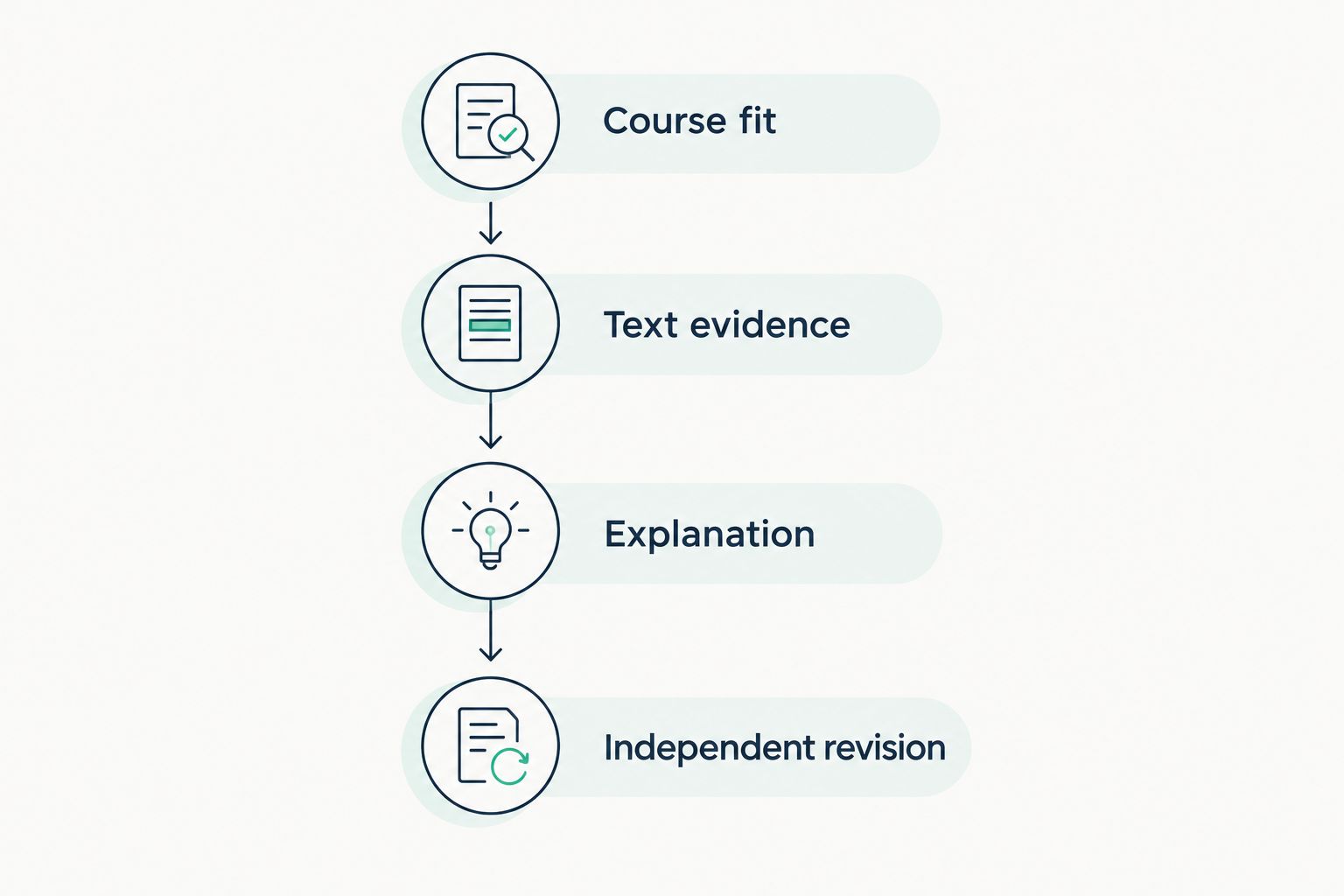
Keep the first decision narrow. If your student struggles to explain evidence, start there rather than buying support for every part of the course at once.
Keep writing practice connected to the goal
Exam preparation and broader writing development overlap, but they are not identical. A student can enjoy creative writing while still needing explicit practice in analytical argument.
Exploring writing competitions for high school students introduces audiences and writing purposes beyond assessment. Keep that work separate from IB preparation: a competition's originality criteria do not replace the requirements of a literary analysis task.
For 2026 planning, choose an outside writing project only when it serves the student's interests and fits the existing workload. It is optional enrichment, not another requirement for an already stretched family.
How to compare a first lesson
Bring the same learning question to each option. For example: can the student explain how a writer's language supports an interpretation without relying on plot summary?
A practical first-lesson check uses 2 short paragraphs: an initial attempt and a revision after feedback. The purpose is not to manufacture a score; it is to see what the teaching changes.
Look for these signs:
- The tutor asks the student to explain their thinking.
- Feedback identifies a specific issue rather than calling the work vague.
- The student makes the revision instead of copying supplied prose.
- The lesson ends with a clear next practice task.
You can also try 10 minutes of focused practice between lessons if that suits the student. Treat the duration as a scheduling choice, not a promise of a particular result.
Keep support within the school's academic-integrity requirements. Teaching a student to evaluate a claim is different from supplying the argument for submitted work.
How the options are ranked
The ranking follows distinct teaching needs: personalized foundations, assessment-specific preparation, and discussion practice. The criteria are course fit, explanation quality, adaptation, independence, and visible progress.
This 2026 guide does not rank providers by examination outcomes. A feature list, a mastery estimate, and a predicted grade measure different things and should not be treated as interchangeable proof.
Which IB English tuition should you choose?
Choose an IB English specialist as the default when your immediate goal is assessment preparation. Confirm the course match and ask how the tutor turns feedback into independent revision.
Choose personalized English support when the underlying difficulty is comprehension or analytical writing. Choose a small group when discussion is the missing practice, not when the student needs sustained individual attention.
You remain in charge of the decision. Start with the smallest clearly defined need, review the student's work, and change the approach when it does not address that need.
FAQ
What's the best IB English tuition for my student?
The best IB English tuition matches the student's exact course and learning difficulty. Choose specialist support for assessment preparation, personalized English tutoring for underlying skills, or a small group for discussion practice.
Is Tia a good choice for IB English preparation?
Tia fits families seeking personalized English skill-building, adaptive explanations, and parent learning records. Confirm the exact IB course and assessment requirements before relying on it as the sole source of exam preparation.
Does an IB English tutor need to know the books my student studies?
Knowledge of the studied works matters when tuition focuses on those works. For unseen-text practice, ask how the tutor teaches transferable close reading rather than a memorized interpretation.
Is one-on-one tuition better than a small group?
One-on-one tuition fits students needing detailed individual feedback, while a small group fits discussion practice. Choose according to the teaching task rather than assuming either format is always better.
Can speaking about a text replace essay practice?
Speaking about a text does not replace essay practice. Discussion lets students explain and question ideas, but they still need to organize and express analysis independently in writing.
How do I know whether English tutoring is working?
Look for stronger independent work on a new passage or task. Compare the student's use of evidence, explanation, and revision with earlier work rather than relying only on time spent or completed activities.
One last thing
Ask your student to explain a paragraph they wrote without looking at it. You are not testing memory. You are checking whether they can describe the claim, the evidence, and the connection between them.
If they cannot, the next lesson has a clear purpose. More polished prose is not the goal; ownership of the thinking is.
Related guides
- Personalized tutoring for IB English students
- Personalized English tutoring for essay writing
- What parents should see in a tutoring dashboard
Tia Education Team