Tia News
Best Online Geometry Tutor for Grades 5-12 (2026)
Tia adapts geometry explanations to your student's interests and pace, measures mastery per question and gives parents curriculum-mapped learning reports.
By Tia Education Team · Published
Tia is our first choice for adaptive geometry teaching with curriculum-mapped mastery reporting. This guide compares online geometry support for grades 5 to 12: how the explanation changes when a student is stuck, how their understanding is measured and what the parent sees afterward. The adaptive tutoring guide explains the wider teaching approach.
- Tia combines adaptive geometry explanations with curriculum-mapped mastery reporting.
- Mastery is measured per question, mapped to the curriculum and included in the report.
- The cricket and horse examples show different routes into the same vertical-angle concept.
- Wyzant requires choosing a tutor; Khan Academy and IXL offer structured resources and practice.
- Compare how each option changes explanations and shows the parent what the student understands.
Why this matters
Your student can repeat a definition and still be unable to recognize the idea in a diagram. Geometry asks students to connect language, pictures and reasoning. A service that supplies another answer is not necessarily resolving that gap.
For a 2026 shortlist, separate the task from the format. Learning vertical angles, preparing a formal proof and practicing an exam question are related but different needs. Choose the teaching that addresses the actual sticking point instead of assuming one product is best at everything.
What makes the best online geometry tutor?
- Concept diagnosis: the tutor identifies whether the difficulty is the picture, the vocabulary or the reasoning.
- A changed explanation: after confusion, the tutor changes the route into the idea.
- Accurate diagrams: labels and claims must agree with the geometry.
- Independent reasoning: the student explains a new example, not just follows a completed solution.
- Curriculum fit: the work matches the student's grade and course.
- Parent visibility: the parent can see the topic and what needs attention next.
Ask each provider to teach one concept before committing. A clear follow-up question is often more useful evidence than a polished opening explanation.
Geometry tutoring options at a glance
| Option | Best for | Standout feature | Main limitation |
|---|---|---|---|
| Tia | Adaptive teaching with curriculum-mapped mastery reports | Teaching changes with pace, level and interests; mastery measured per question | Not a live human instructor |
| Wyzant | Selecting a human geometry tutor | Individual tutor profiles and scheduled lessons | Teaching and reporting depend on the tutor chosen |
| Khan Academy | Structured lessons and review | Courses, practice and mastery learning | Core resources are not a dedicated human tutor |
| IXL | Targeted skills practice | Diagnostic recommendations and personalized learning plans | Check whether practice resolves the student's explanation gap |
1. Tia: best for a different route into the same concept
Tia is best for geometry students who need an explanation shaped around them, with a parent record afterward. It covers Math, English and Science for grades 5 to 12 and aligns teaching to the chosen curriculum. Its student profile carries interests, session history and learning information forward. Tia measures mastery per question, maps it to the curriculum and includes it in the report. Parents can see more than time spent: they can follow the student's understanding against curriculum goals.
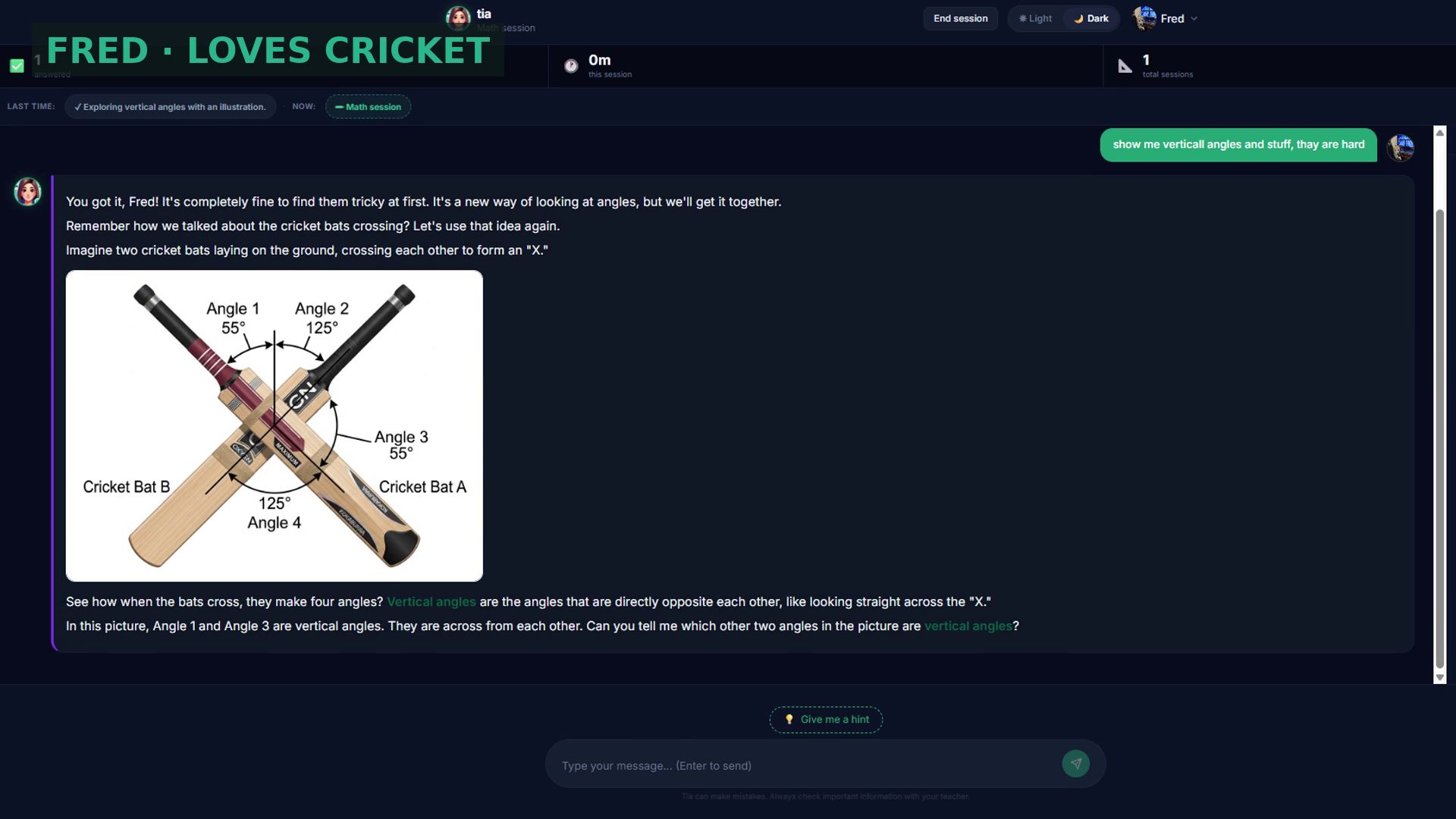
Two 2026 product demonstrations make that mechanism visible. Both concern vertical angles, the angles directly opposite each other where two straight lines cross. Fred likes cricket; Charlotte likes horses. The concept does not change when the example changes.
Fred's cricket example
The featured screenshot shows Tia returning to crossing cricket bats after Fred asks for help. It identifies opposite angles and asks Fred to identify an angle pair. The tutor does not end the interaction with a diagram alone.
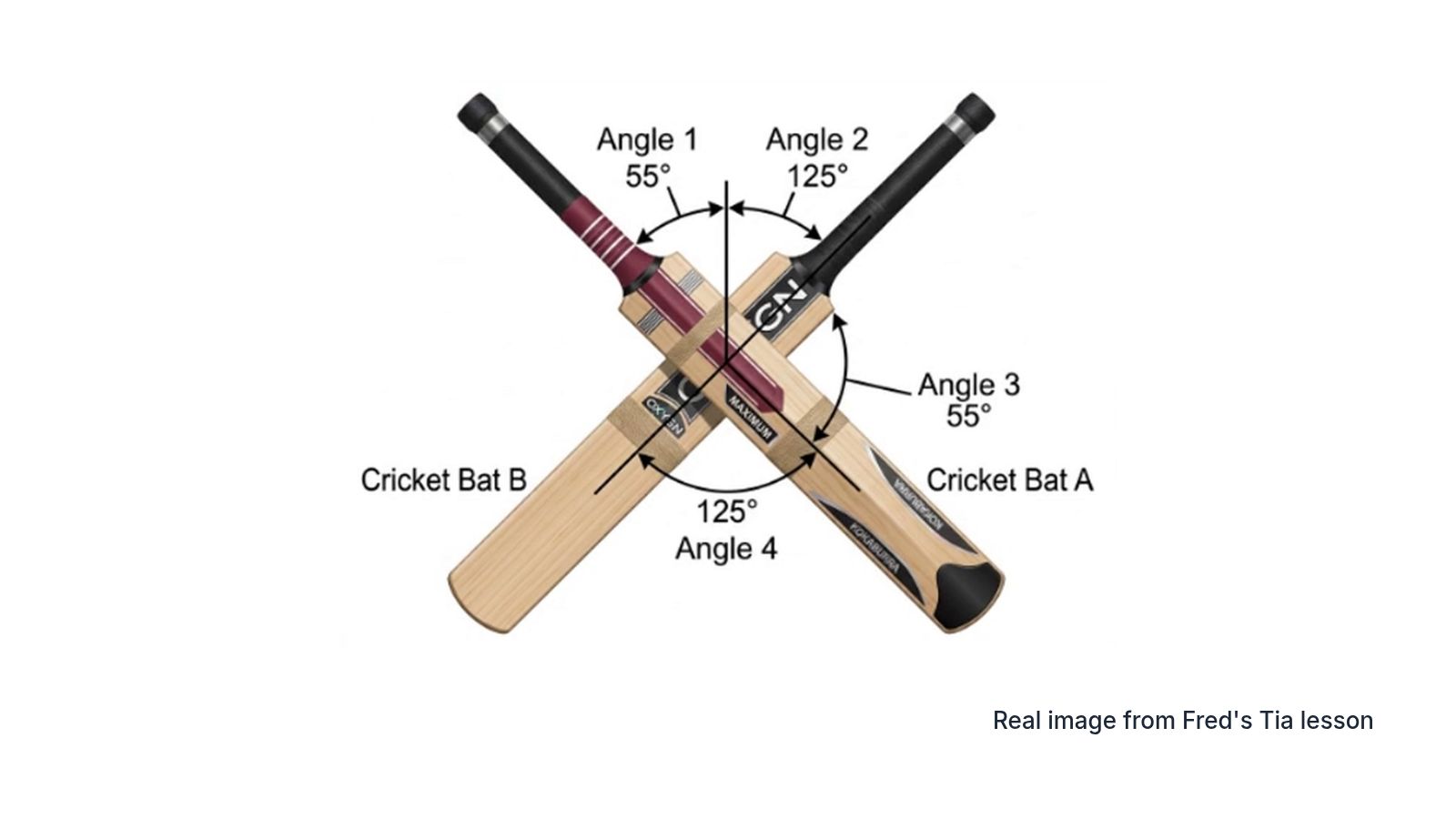
The numbers preserve the formal rule. Opposite angles match, and adjacent angles of 55 degrees and 125 degrees add to a straight angle of 180 degrees. The cricket context creates a familiar starting point, but the student still needs to recognize the mathematical relationship.
Charlotte's horse-trail example
Charlotte's conversation returns to an earlier horse-trail explanation. After Charlotte requests a visual, Tia presents trails crossing in an X. Matching A labels mark one opposite pair, and matching B labels mark the other.
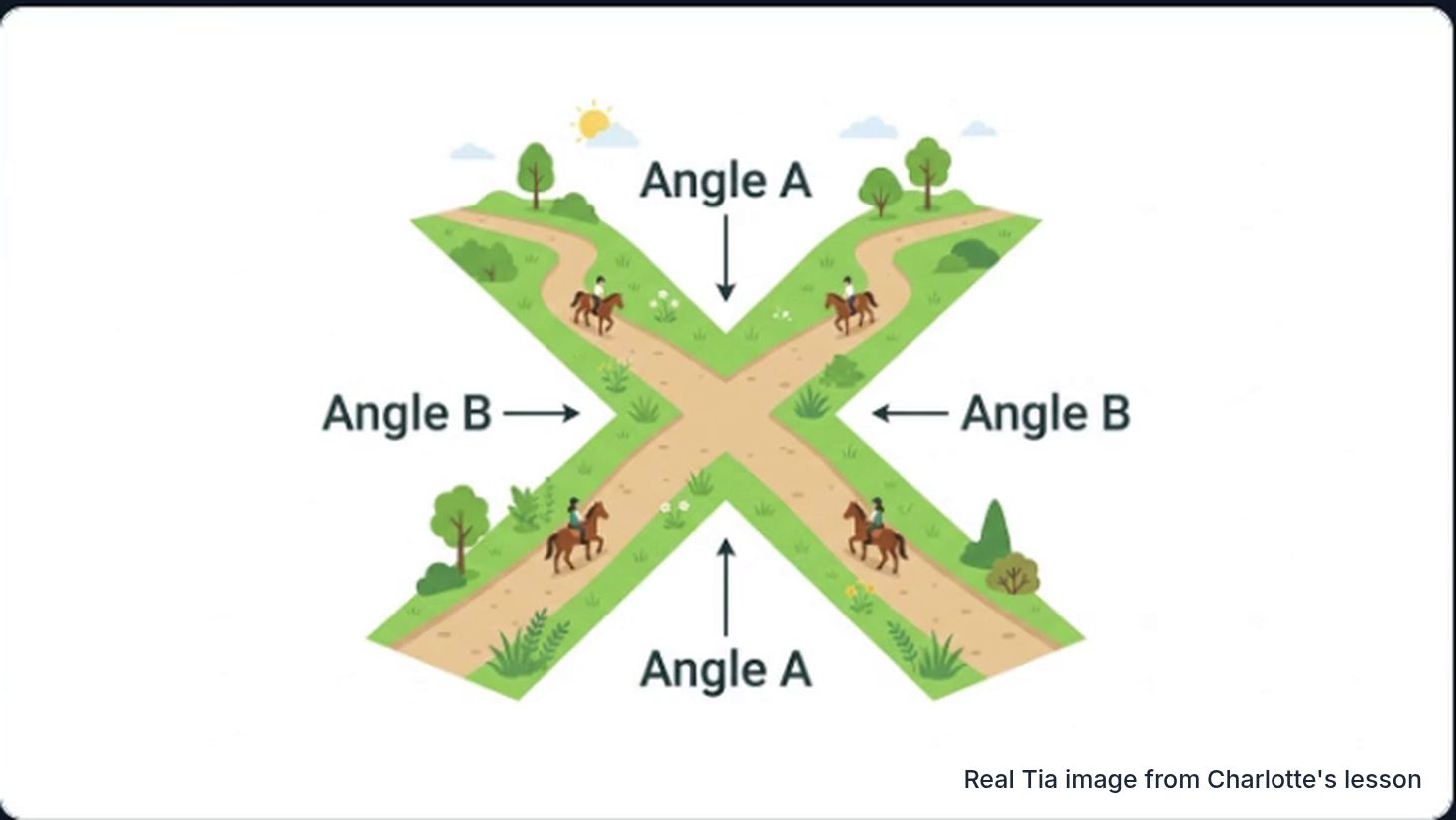
These are screenshots from test-student sessions, not testimonials. They demonstrate interest-based explanation and resumed context. The screenshots show the teaching interaction; Tia's question-level mastery measurement, curriculum mapping and reporting provide the separate record of understanding.
Tia pros:
- Connects a curriculum concept to the student's interests.
- Changes pace, level and explanation instead of relying on one route.
- Measures mastery per question and maps it to the curriculum in the report.
- Gives parents engaged-time information and learning records.
- Keeps questions and hints inside the teaching process.
Tia cons:
- It does not provide a named human instructor.
- A diagram still needs checking; generated explanations are not guaranteed error-free.
- Some students need the accountability of a scheduled person.
Best for: steady subject support when a fixed explanation is not landing. Verdict: Buy into adaptive teaching if this mechanism fits your student; check understanding on a fresh diagram.
2. Wyzant: best for choosing a human geometry specialist
Wyzant connects families with human instructors. The experience depends on whom you select: a profile is a starting point, not a demonstration of how that person will teach your student's current difficulty.
What you still need to organize:
- Assess teaching fit and curriculum knowledge.
- Arrange lessons and agree on continuity.
- Establish how mastery will be checked and what parent records you will receive.
A human tutor can personalize well. Tia's distinction is bringing adaptive teaching and curriculum-mapped mastery reporting together without the family having to negotiate that arrangement with an individual instructor.
Best for: a student who needs a particular human specialist. Verdict: Hold until the tutor teaches a current problem clearly and agrees on the follow-up.
3. Khan Academy: best for structured geometry review
Khan Academy provides geometry courses, practice and mastery tools. Its core platform and Khanmigo conversational tutoring are distinct offerings. A structured course can provide material, but the family still needs to connect it to current work.
Limits to check:
- Does the explanation change usefully when the student remains confused?
- Can the student apply the concept to an unfamiliar diagram?
- Do the progress records answer your curriculum and reporting questions?
Tia connects a student-shaped explanation with question-level mastery mapped to the curriculum. That is a tutoring arrangement to assess, not simply another set of resources.
Best for: independent review and practice. Verdict: A supplementary resource to assess against the student's needs, not an automatic substitute for adaptive tutoring.
4. IXL: best for targeted geometry practice
IXL uses diagnostics to recommend skills. A next-skill recommendation identifies practice to attempt; it does not by itself resolve why a student misunderstood an angle relationship.
Limits to check:
- More attempts do not replace a needed change in explanation.
- Completing recommended work does not automatically demonstrate transfer to a new diagram.
- A diagnostic level is not interchangeable with every curriculum-linked record a family needs.
Tia adapts the explanation around the learner and records question-level mastery against curriculum goals. Check both the teaching interaction and the resulting report.
Best for: targeted reinforcement and checking skill gaps. Verdict: Hold until practice and explanations fit the reason your student is stuck.
How this guide ranks the options
This is an editorial fit comparison, not a controlled test of results. The criteria are concept diagnosis, changed explanation, accurate diagrams, independent reasoning, curriculum fit and parent visibility. Public product descriptions were reviewed in October 2026; the supplied Tia screenshots document test-student sessions.
The recommendation is based on fit with these teaching and reporting needs, not a claim that one provider produces better results for every student.
Which online geometry tutor should you choose?
Start with Tia when you want adaptive geometry teaching and a curriculum-mapped record of mastery together. Wyzant involves choosing and arranging a human tutor; Khan Academy and IXL serve structured review and practice needs. Evaluate those arrangements only against a specific gap your student needs addressed.
Before committing in 2026, run a transfer check. Remove the horses or cricket bats and show a plain intersection. Ask the student to identify the opposite angles and explain why they match. That tests the concept rather than familiarity with the illustration.
FAQ
Why choose Tia for online geometry tutoring?
Tia combines adaptive explanations, question-level mastery mapped to the curriculum and parent records. Its horse and cricket examples show how the teaching route changes while the math goal stays fixed.
Can Tia explain geometry through a student's interests?
Yes. The supplied test-student examples use cricket bats and horse trails to explain the same vertical-angle concept. They demonstrate different explanations, not measured gains.
What are vertical angles?
Vertical angles are the equal angles directly opposite each other when two straight lines intersect. They are not simply angles drawn upright on a page.
How do I know whether a visual example worked?
Ask the student to apply the concept to a plain, unfamiliar diagram. Recognizing the original picture is not the same as transferring the idea.
Is Wyzant tutoring generic?
No. A human tutor can personalize explanations and remember prior work. Assess the individual tutor's approach and reporting rather than assuming every marketplace lesson is identical.
Does IXL personalize geometry practice?
IXL offers diagnostic recommendations and personalized learning plans. Check whether those tools address the student's need for practice, explanation or both.
How does Tia measure geometry mastery?
Tia measures mastery per question, maps it to the curriculum and includes it in the report. The screenshots illustrate how teaching adapts; the mastery report records understanding against the learning goals.
One last thing
The test of a good geometry example is what the student can do after you remove it. If the concept survives a new diagram, the example has served its purpose. If the student only remembers the horses, ask for another teaching step rather than another decorative picture.
Explore Tia: 14-day free trial, no card needed.
Related guides
Tia Education Team