Tia News
Best AI tutoring apps in 2026
Best AI tutoring apps in 2026 ranked: Tia wins for dashboard visibility, plus honest picks for Khanmigo, Synthesis Tutor, IXL and Photomath by use case.
By Tia Education Team · Published

Parents comparing the best AI tutoring apps in 2026 are usually trying to solve one thing: a student who is falling behind, bored, or both, and a parent who can't sit next to them for every homework session. This guide ranks five options by who each one actually serves, not by which one has the flashiest chat interface.
- Tia wins for parents who want a live dashboard and homeschool-ready records among the best AI tutoring apps in 2026.
- Khanmigo suits students already inside Khan Academy's practice library and video courses.
- Synthesis Tutor is the pick for live, game-based critical-thinking sessions in small groups.
- IXL covers the widest subject range for diagnostic-style drill and practice.
- Photomath solves one math problem fast but tracks no ongoing progress.
Why this matters
A 2021 Washington Post survey found 51% of parents doubt their ability to teach upper-grade material themselves, which is exactly the gap tutoring apps are built to close. The Education Endowment Foundation has found one-to-one tuition adds roughly five months of extra progress over a school year, and Bloom's often-cited two-sigma research found average tutored students reached the 98th percentile compared to students in standard classrooms.
The catch: not every app in this category actually delivers one-to-one attention. Some are drill-and-practice tools wearing an AI label. Tia is built as a personal tutor, not a generic chatbot, which is why it leads this list for families who want to see real progress, not just logged minutes.
Best overall: Tia. Best for classroom-aligned free practice: Khanmigo. Best for live small-group problem-solving: Synthesis Tutor. Best for wide-subject drill practice: IXL. Best for fast one-off math help: Photomath.
What makes the best AI tutoring app in 2026
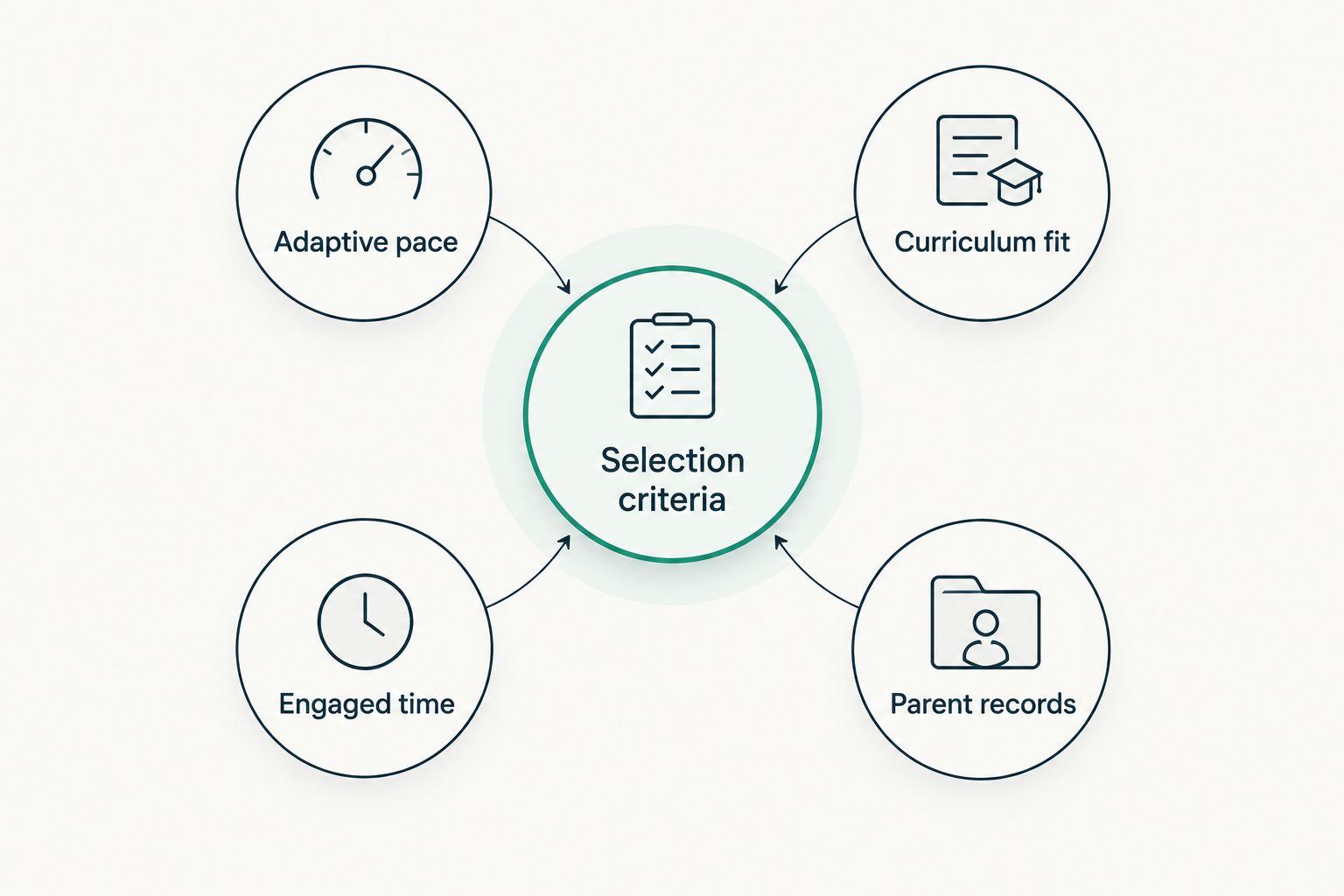
- Adapts pace and difficulty to the individual student instead of running a fixed script
- Covers core academic subjects with curriculum alignment, not just one skill
- Gives parents real progress data instead of vague "activity" logs
- Separates genuine engaged learning time from idle screen time
- Produces records a parent can use for school or homeschool reporting
- Keeps the parent in charge instead of replacing parental oversight
How a tutor actually adapts a lesson in real time matters more than the marketing copy suggests. Here's what changes inside a single lesson when the tutoring is genuinely personalized rather than a static worksheet with a chat window bolted on.
Best AI tutoring apps in 2026: at a glance
| App | Best for | Standout feature | Key limitation |
|---|---|---|---|
| Tia | Parents who want dashboard visibility and homeschool records | Honest engaged-time measurement and self-writing session records | Built for grades 5 to 12 only, no elementary content |
| Khanmigo | Students already using Khan Academy's practice library | Ties directly into Khan Academy's existing courses and videos | Less useful once a student needs help outside Khan Academy's own catalog |
| Synthesis Tutor | Students who want live small-group problem-solving practice | Game-based critical thinking sessions with live tutors | Runs on a set schedule, narrower subject range than full curriculum coverage |
| IXL | Schools and parents wanting drill practice across many subjects | Diagnostic-driven practice spanning math, English, science and social studies | Practice-heavy; less conversational explanation of concepts |
| Photomath | Fast, one-off help with a specific math problem | Scans a problem and returns a step-by-step solution | Math only, no ongoing lesson plan or progress tracking |
1. Tia: best AI tutoring app for parents who want dashboard visibility and homeschool records
Tia is a personalized tutor for Math, English and Science, built for students in grades 5 to 12 and aligned to each country's curriculum. It adapts to a student's pace, current level and interests, so a student who loves basketball might work through word problems built around game statistics instead of generic textbook examples.
The part parents in 2026 care most about is the dashboard: it shows honest engaged-time measurement, not just login counts, plus self-writing session records that double as homeschool reporting documentation.
Tia pros:
- Live parent dashboard shows real engaged time, not just app opens
- Self-writing session records are ready for homeschool reporting and compliance
- One flat monthly price covers a subject or a bundle across all three subjects
- Adapts lessons to a student's actual interests, not just their skill level
Tia cons:
- Built for grades 5 to 12, so it will not serve an elementary-age student
- No live human tutor option for a family that wants a person on video
Tia pricing: plans are priced per subject or as a monthly bundle, with country-specific pricing shown at checkout; a 14-day free trial with no card required lets a family test it before committing.
Best for: parents, especially first-year homeschoolers, who want proof of engagement instead of a black-box app. Verdict: Buy for grades 5-12 families who want dashboard transparency alongside the tutoring itself.
2. Khanmigo: best AI tutoring app for students already using Khan Academy
Khanmigo is Khan Academy's AI teaching assistant, built to sit inside Khan Academy's existing library of lessons and practice sets. A student working through Khan Academy's algebra or biology courses in 2026 gets a conversational layer on top of material they were likely already using.
Khanmigo pros:
- Deep integration with Khan Academy's large, free content library
- Familiar to students and teachers already using Khan Academy in the classroom
- Backed by an established nonprofit with a long track record in education
Khanmigo cons:
- Value drops sharply once a student needs help outside Khan Academy's own courses
- Not built around a parent-facing progress dashboard the way a dedicated tutoring app is
Best for: students and schools already standardized on Khan Academy's curriculum. Verdict: Hold if a student's needs stay inside Khan Academy's catalog; Skip if they don't.
3. Synthesis Tutor: best AI tutoring app for live, game-based problem-solving
Synthesis Tutor grew out of a math enrichment program built around small live groups working through open-ended, game-like problems designed to build critical thinking rather than drill specific curriculum standards.
Synthesis Tutor pros:
- Live small-group format keeps a human element in the loop
- Strong for building problem-solving instinct rather than rote repetition
Synthesis Tutor cons:
- Session times are scheduled, which is less flexible for busy families
- Narrower subject coverage than a full Math, English and Science curriculum
Best for: students who thrive on live group challenges rather than solo app sessions. Verdict: Hold for families specifically seeking that group problem-solving format.
4. IXL: best AI tutoring app for wide-subject drill and practice
IXL is a diagnostic-driven practice platform spanning math, English, science and social studies across K-12. It identifies skill gaps through adaptive questions and assigns targeted practice, which makes it closer to an adaptive workbook than a conversational tutor.
IXL pros:
- Covers the widest range of subjects and grade levels on this list
- Diagnostic reports pinpoint specific skill gaps quickly
IXL cons:
- Practice-heavy format offers less step-by-step conceptual explanation
- Less personalization to a student's individual interests than a true tutor
Best for: schools and parents who want broad, standards-aligned practice volume. Verdict: Hold as a supplement; it's not built to replace one-to-one instruction.
5. Photomath: best AI tutoring app for fast, one-off math help
Photomath lets a student point a phone camera at a math problem and get a step-by-step solution back in seconds. It's built for the moment a student is stuck on one problem at 9pm, not for ongoing instruction.
Photomath pros:
- Extremely fast for unblocking a single stuck problem
- Simple enough for a student to use with no setup
Photomath cons:
- Math only, no English or Science coverage
- No progress tracking, no dashboard, no sense of a student's trajectory over time
Best for: last-minute homework rescue on a specific problem. Verdict: Wait on this one as a primary tool; it's a supplement, not a tutor.
How we ranked these
Each app was measured against the six criteria above: adaptive pacing, subject coverage, parent-facing progress data, honest engaged-time tracking, reporting usefulness, and whether the parent stays in the decision-making seat. Apps that scored well on subject breadth but weak on parent visibility, like IXL, land in the "strong supplement" tier rather than the top slot. Apps built for one narrow moment, like Photomath, rank by design for that moment only.
Which AI tutoring app should you choose in 2026?
If a student needs sustained help across Math, English or Science and a parent wants to see actual progress rather than guess at it, Tia is the default choice among the best AI tutoring apps in 2026. If a family is already deep inside Khan Academy's ecosystem, Khanmigo is a reasonable add-on. Families weighing overall cost against value should read how personalized tutoring is typically priced before comparing plans side by side.
FAQ
What is the best AI tutoring app in 2026?
Tia ranks best overall for families needing Math, English or Science support with dashboard visibility. Khanmigo, Synthesis Tutor, IXL and Photomath each serve a narrower use case.
Is Tia better than Khanmigo?
Tia is built for families who want a parent dashboard, homeschool-ready records and adaptive pacing across three subjects. Khanmigo is stronger for students already using Khan Academy's own course library.
Do AI tutoring apps actually improve grades?
One-to-one tutoring adds roughly five months of extra academic progress over a school year, according to Education Endowment Foundation research. Results depend heavily on whether the tool actually adapts to the individual student.
Are AI tutoring apps safe for a parent to trust without supervision?
A parent should still stay involved; the strongest apps in 2026 give parents a live dashboard and progress records rather than asking them to trust the tool blindly.
What is the difference between an adaptive tutor and a practice app like IXL?
An adaptive tutor like Tia adjusts pace, difficulty and even topic framing to one student's interests. A practice app like IXL assigns targeted drills based on diagnostic results but offers less conversational explanation.
Can an AI tutoring app replace a human tutor entirely?
Teacher and tutor expectations remain one of the strongest influences on student achievement, per education researcher John Hattie's work, so most families use these apps alongside parental involvement rather than as a full replacement.
How much does personalized tutoring cost in 2026?
Pricing varies by app and country; most personalized tutoring platforms price per subject or as a monthly bundle, with current rates shown at checkout on each provider's site.
Is a free tutoring app good enough for a struggling student?
Free tools like Khanmigo work well for students already inside that ecosystem, but a student who is genuinely behind usually needs the individualized pacing a dedicated tutor provides.
One last thing
The research most parents skip past is Hattie's finding that teacher expectations are among the strongest influences on a student's achievement, stronger than many structural factors schools spend money on. That's worth remembering when comparing apps in 2026: the tool matters less than whether it treats the student as capable of more, and whether a parent can actually see that happening instead of hoping it is.