Tia News
Arizona's own academic standards are built into Tia
Tia's Arizona curriculum tutor serves 1,206 state curriculum statements in Math, English and Science, Grades 5 to 12, with teaching that adapts to each student.
By Tia Education Team · Published
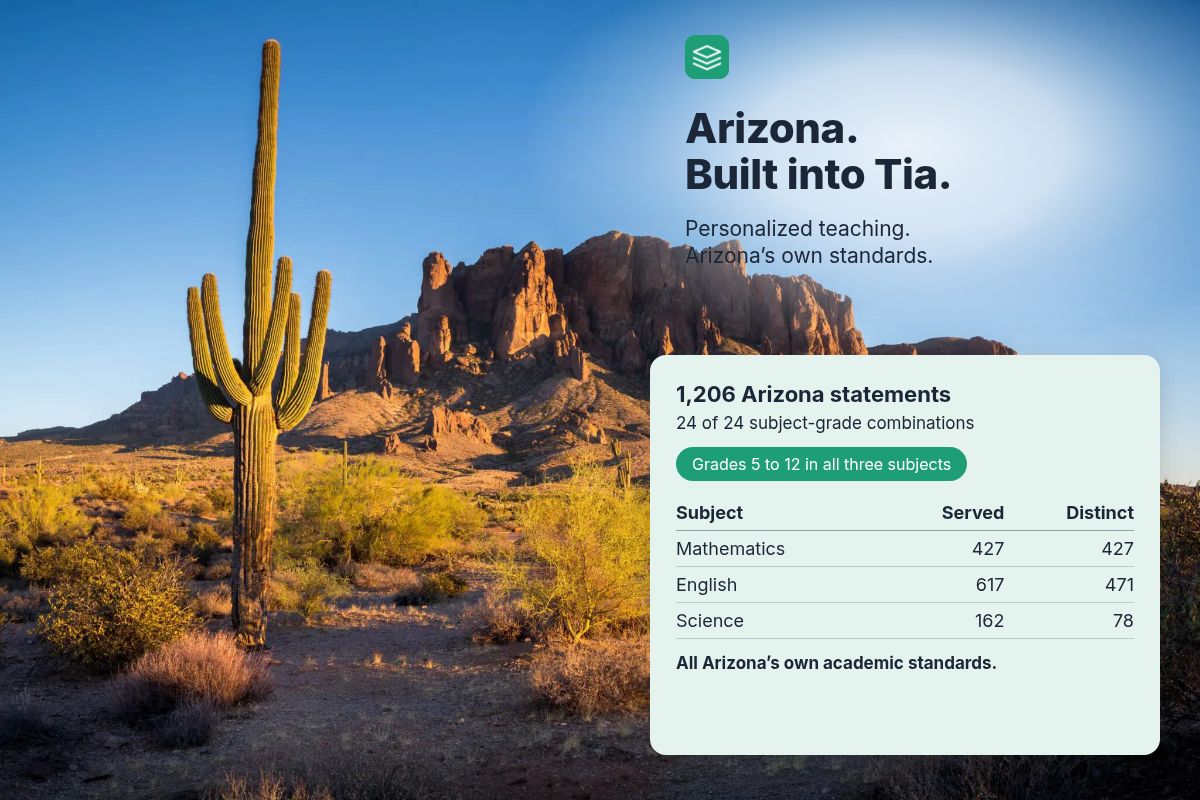
Arizona families have a personal tutor that combines the state's own academic standards with teaching that adapts to each student. Tia serves 1,206 Arizona curriculum statements across Math, English and Science in Grades 5 to 12, covering all 24 subject-and-grade combinations.
- Tia's Arizona curriculum tutor covers Math, English and Science in Grades 5 to 12.
- All 24 subject-and-grade combinations use Arizona's own standards.
- The pathway serves 1,206 statements: 427 Mathematics, 617 English and 162 Science.
- Students can speak, listen or type, with teaching that adapts to their pace and interests.
- Parents get curriculum-linked progress information, engaged-time measurement and self-writing learning records.
Arizona learning goals, explained for your student
The workbook is open. Your student can follow the first part of the explanation, but the next step still feels out of reach. You want another way to explain the idea while staying connected to what they are learning.
That is the purpose of an Arizona curriculum tutor: keep the learning goal clear and change the teaching to fit the student. A different example or a smaller step can give the conversation somewhere useful to go.
See how adaptive tutoring changes a lesson for a closer look at how the explanation can respond to the learner.
The Arizona Department of Education publishes the state's academic standards and subject resources. Its Academic Standards team supports standards work from early learning through high school graduation.
For your family, Arizona's own reference provides a connection between the learning goal and the personal support. You remain in charge of the wider plan, whether your student attends school or learns at home.
What an Arizona family gets
The Arizona pathway serves 1,206 curriculum statements, with 24 of 24 subject-and-grade combinations covered. Mathematics, English and Science each span Grades 5 to 12, and all supported combinations use Arizona's own standards.
| Subject | Statements served | Distinct standards | Grades |
|---|---|---|---|
| Mathematics | 427 | 427 | 5 to 12 |
| English | 617 | 471 | 5 to 12 |
| Science | 162 | 78 | 5 to 12 |
| Total served | 1,206 | Subject counts above | 5 to 12 in all three subjects |
One subject at one grade makes a subject-and-grade combination. Three subjects across eight grades give your family 24 combinations to work with as your student moves through the supported years.
The figures describe Tia's Arizona alignment. Statements served count their availability across the grade placements; distinct standards count the separate standards represented within each subject.
That gives you a practical way to check scope. Your student's current task and understanding then tell you where to begin.
Arizona Math tutoring through Grade 12
Mathematics includes 427 statements representing 427 distinct standards, covering Grades 5 to 12. A family looking for an Arizona Math tutor can connect personal explanations to the state's own learning expectations.
Start with the problem in front of your student. Ask what they understand and where the method stops making sense, rather than assuming they need to repeat the entire lesson.
A student might understand the calculation but need another explanation of why it works. Another might need to revisit an earlier idea before the current task becomes manageable.
Adaptive teaching can respond to either situation. The explanation changes while the learning goal remains in view.
For example, a student can ask to see an idea through something familiar, then return to the original question. They still do the working. The tutor helps them find a route into it.
As a parent, you can ask for a fresh explanation afterward. Hearing your student describe the reasoning in their own words gives you useful context alongside the recorded progress.
Arizona English tutoring that follows the student's stage
English includes 617 statements representing 471 distinct standards, spanning Grades 5 to 12. The Arizona reference keeps personal support connected to the learning expectations at the student's selected grade.
An English task can feel difficult for different reasons. Your student might understand a passage but struggle to organize a response, or they might need to talk through the meaning before starting to write.
A personal tutor gives them room to ask about the part that is unclear. They can explore an idea aloud or in text, then move into their own reading and writing.
For a family seeking an Arizona English tutor, that connection matters. You want support that meets the student where they are without losing the purpose of the task.
Try asking the student what they want the reader to understand before they begin a paragraph. Afterward, ask whether the written response says what they intended. Those conversations help you see their thinking without taking over the work.
The statement totals show the scope available across grades. Personal teaching makes room for the individual question within that scope.
Arizona Science tutoring across Grades 5 to 12
Science includes 162 statements representing 78 distinct standards, with Arizona coverage throughout Grades 5 to 12. The high-school placements each serve 28 statements.
A student can use the lesson to ask for another explanation, discuss a connection or work through a concept that seemed too abstract on the first attempt.
You might begin with what your student already notices about the topic. Ask what they think is happening and which part they want explained, then connect the conversation to their current learning goal.
For parents looking for an Arizona Science tutor, this brings together state-specific expectations and flexible explanations. The tutor can try another route rather than requiring the student to understand the first explanation immediately.
Keep practical investigations, observations and written reasoning within your wider Science plan. Tutoring can help your student think through those experiences and explain what they have learned.
When you review the session, ask for a new example. The ability to explain an idea in another setting adds useful information to a completed question or activity.
Arizona coverage by grade
The grade breakdown shows how the supported statements are distributed across the pathway. All entries in the table use Arizona's own academic standards.
| Grade | Mathematics | English | Science |
|---|---|---|---|
| 5 | 50 | 92 | 12 |
| 6 | 58 | 79 | 14 |
| 7 | 47 | 76 | 12 |
| 8 | 48 | 78 | 12 |
| 9 | 66 | 72 | 28 |
| 10 | 49 | 72 | 28 |
| 11 | 64 | 74 | 28 |
| 12 | 45 | 74 | 28 |
| Total served | 427 | 617 | 162 |
The repeated high-school Science figure describes the number served at each placement. The separate distinct-standard count in the subject table describes the unique standards represented across Science.
Use the table to choose the right starting point for your student. It is a map of coverage, while their questions help set the pace of the teaching.
Talk, listen or type within the same lesson
Tia adapts to how your student wants to participate. Students can speak and hear verbal explanations, type, or switch between voice and text within the same lesson.
Two-way voice is included in all bundle plans at no extra charge. It sits alongside text rather than replacing it.
A student can talk through a Math question while keeping their working on paper. They can discuss an English idea, then type a follow-up. Another student can stay with text throughout the session.
Let the student choose the format that feels useful for the task. The option gives them another way to ask a question when finding the words on a keyboard feels uncomfortable.
Keep independent reading and written reasoning in the wider routine. Speaking about an idea and applying it independently give you different views of the student's understanding.
Support for Arizona students alongside school
A difficult subject does not have to mean changing the student's whole learning plan. Extra support can begin with the current task and one part of it that needs another explanation.
You can use the student's school materials to identify that goal. The state-specific pathway then gives the tutor an Arizona reference for the teaching.
After a session, return to the student's actual work. Ask whether the explanation helped them see the next step and what they would like to revisit.
This keeps tutoring connected to the learning already happening. The student gets room to ask questions, and you can see how the support fits alongside school.
Arizona homeschool tutoring with the parent in charge
For a homeschooling family, a personal tutor can be one part of a wider plan. You choose the learning priorities, keep the family rhythm and decide how tutoring fits with reading, projects and other experiences.
An Arizona homeschool tutor can provide another explanation when a concept is difficult. It can also give your student a place to ask follow-up questions without making you responsible for every explanation in every subject.
The parent dashboard and self-writing learning records help you review what happened during sessions. You can use those records alongside the student's work and your own planning.
Parents continue to manage their applicable home education requirements. The practical value of tutoring is the teaching and information it adds to the plan you direct.
Build a routine around understanding
Identify one learning goal
Start with the task your student is working on. You can use course materials and the Department's published resources to clarify the goal before choosing extra support.
- Name the subject and grade.
- Find the concept causing difficulty.
- Ask what already makes sense.
- Choose one question to begin with.
Let the explanation change
A student does not need a perfect description of the problem before asking for help. Give them room to show their thinking and request another approach.
- Let the student choose voice or text.
- Ask for a different example when needed.
- Revisit an earlier idea if it helps.
- Keep the student's own working visible.
Check the idea with fresh work
After the explanation, return to a new question or example. You can look for what the student can do independently rather than relying only on completion.
- Ask for the reasoning in their own words.
- Try a fresh example.
- Review their written response.
- Decide what needs another look.
Parent progress records connected to the curriculum
After a lesson, you want to know what was studied and how your student responded. The parent dashboard brings curriculum-linked mastery information, honest engaged-time measurement and self-writing records into one view.
Mastery estimates update from student answers over time. They give you another way to review understanding alongside your student's explanations and independent work.
Engaged-time measurement helps you see participation, while the learning records reduce the need to write every session summary yourself. Read what parents should see in a tutoring dashboard for the wider parent view.
You can use that information to choose a next step: revisit an idea, ask for another explanation or move forward within the learning plan.
FAQ
Does Tia offer an Arizona curriculum tutor?
Yes. Tia combines Arizona's own academic standards with personalized teaching in Math, English and Science across Grades 5 to 12.
How much Arizona curriculum coverage is included?
The pathway serves 1,206 Arizona statements across all 24 subject-and-grade combinations: 427 Mathematics, 617 English and 162 Science.
Does every supported subject and grade use Arizona standards?
Yes. All 24 supported combinations use Arizona's own standards, covering Math, English and Science in Grades 5 to 12.
Can Tia help with Arizona Math and English alongside school?
Yes. Students can use the tutor for another explanation connected to their selected subject, grade and learning goal, alongside school learning.
How does Tia adapt an Arizona lesson?
Tia adjusts explanations, pace, level and examples to the student's responses and interests while keeping the selected curriculum goal in view.
Can students speak and type during the same lesson?
Yes. Students can speak, hear verbal explanations, type and switch between voice and text within a lesson. Two-way voice is included in all bundle plans at no extra charge.
Can Arizona homeschooling families use Tia?
Yes. Families can use the tutoring, progress information and learning records within a parent-led home education plan.
What can parents see after a session?
Parents get curriculum-linked mastery information, engaged-time measurement and self-writing learning records, which they can review alongside their student's own work.
One last thing
The right learning goal and the right explanation do different jobs. Arizona's standards provide the reference; personal teaching helps your student find a way into it.
Start with the question they have today. Let the teaching adapt, then use their own words and work to decide what comes next.
14-day free trial, no card needed
tia.coach