Tia News
Personalized tutoring for students repeating a grade
Tutoring for students repeating a grade works best with targeted skill diagnosis, not a full redo. See the 2026 plan, options compared, and where Tia fits.
By Tia Education Team · Published · Updated

Tutoring for students repeating a grade is one-on-one, personalized instruction aimed at closing the two or three specific skills that caused the retention, not re-teaching an entire year over again. The plan that actually works starts narrower than a full subject review and gets more targeted as confidence comes back.
- Tutoring for students repeating a grade works best when it targets two or three specific skill gaps, not the entire subject again.
- Tia, a personalized tutor for grades 5-12, adapts to the retake year and gives parents a live dashboard.
- One-to-one tuition adds roughly five months of extra progress on average, per the Education Endowment Foundation.
- Teacher and parent expectations are among the strongest predictors of student achievement, per researcher John Hattie.
Why tutoring matters for students repeating a grade
Grade retention rarely happens because a student is behind in everything. Usually it is two or three specific skills, unfinished multiplication facts, shaky paragraph structure, an incomplete grasp of fractions, that block progress across the rest of the subject. A student who is behind in class often has gaps that trace back one or two grade levels, not the entire current curriculum, which is why a full-subject review wastes time on skills the student already has.
The Education Endowment Foundation's review of one-to-one tuition found it adds roughly five months of additional progress compared with no intervention, one of the larger effects measured in education research. Bloom's two-sigma studies found tutored students routinely reached the 98th percentile against a conventional classroom, a gap a repeat-year student rarely closes sitting through the same lesson a second time. John Hattie's synthesis of influences on achievement also puts teacher and parent expectations near the top of the list, which means how the repeat year gets talked about at home matters almost as much as the content plan itself.
How to build a tutoring plan for a student repeating a grade
The sequence below moves from diagnosis to confidence to pacing to tracking. Skipping straight to "more practice problems" is the single most common way a repeat-year plan burns a semester without moving the needle.
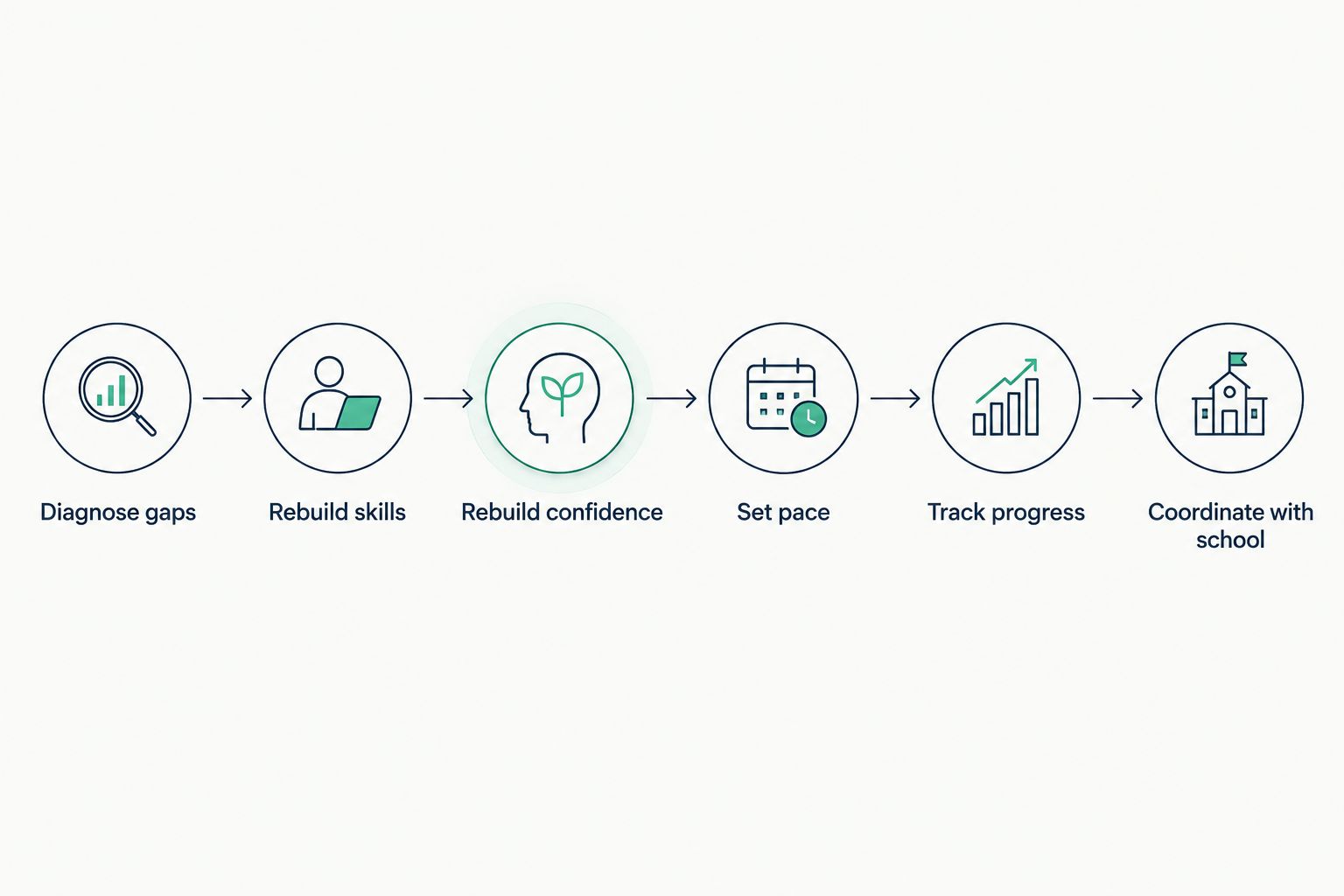
Diagnose the exact skill gaps behind the retention
Most retention decisions are made on a handful of standards, not the whole grade. Get specific before choosing a tutoring approach.
- Pull the last two report cards and flag every unit graded C or below.
- Ask the classroom teacher which specific standards drove the retention decision.
- Run a no-stakes diagnostic worksheet one grade level back to see where mastery actually stops.
- Separate content gaps (missed material) from skill gaps (reading fluency, working memory, math fact recall).
- Write down two or three target skills instead of a subject-wide goal like "get better at math."
Rebuild foundational skills before adding new material
Stacking new material on a shaky base is why the first year did not stick. The retake year needs a different starting point.
- Start below the retake grade level and move up only after mastery, not after a set number of sessions.
- Use short, frequent sessions instead of one long weekend block.
- Revisit prerequisite skills explicitly rather than assuming they transferred from the first attempt at the grade.
- Check understanding with a mixed problem set, not repeated drills of a single problem type.
Rebuild confidence before you push pace
A student who has already failed a grade once is watching for signs the second attempt will go the same way. Confidence work has to come before speed.
- Have the student explain a solved problem back, instead of just checking the final answer.
- Praise the strategy used, not only whether the answer was correct.
- Track small weekly wins, a fluency gain, a finished assignment, separately from grades.
- Avoid comparing the repeat year's pace to a sibling's or a classmate's.

Set a pace built for the retake year, not the old one
This is where a personalized tutor earns its place in the plan. Tia adapts the pace and difficulty of each lesson to where the student actually is, in Math, English or Science, instead of running a fixed grade-level script the student already failed once.
- Build a pacing calendar that adds a new skill only once the prior one is steady.
- Leave buffer weeks before progress reports and quarter grades.
- Lighten homework load on weeks with heavier retake-year testing.
- Revisit the plan monthly instead of waiting for report card time.
“A pacing plan that matches last year's classroom will produce last year's grade.”
Track progress with real data, not gut feeling
Parents often find out a plan isn't working at the same moment the report card arrives, which is too late to adjust. A live view of sessions closes that gap.
- Look at engaged-time data, not just minutes an app says were logged.
- Ask for a written record of what was actually covered each session; see what parents should see in a tutoring dashboard for the specifics.
- Compare skill-level scores month over month, not only end-of-term grades.
- Share the data with the classroom teacher at conference time instead of arriving with impressions only.
Coordinate with the school's retention plan
A tutoring plan that ignores the school's own criteria risks duplicating work or missing the actual bar for promotion.
- Get the official retention or promotion criteria in writing.
- Ask whether summer school or a mid-year re-assessment is part of the school's plan.
- Share tutoring session notes with the teacher so the two plans don't overlap or contradict each other.
- Confirm what a "successful" repeat year looks like on paper before the year starts, not after.
Watch for the signs the plan isn't working
A repeat year is a long runway. Catching a stalled plan early matters more than any single session.
- No movement on the target skills after several weeks of consistent sessions.
- Rising resistance to sessions well past the usual first-week friction.
- The teacher reports no change despite tutoring homework being completed.
- The work feels harder, not easier, as the weeks pass.
Comparing tutoring options for a student repeating a grade
| Option | Best for | Starting price | Key limitation |
|---|---|---|---|
| School summer school or retention program | Meeting a specific district promotion standard | Not published (school-set) | Often the same material and pace that didn't work the first time |
| Private in-person tutor | Families wanting a fixed weekly in-person session | Varies by tutor | Cost scales with hours; pace often fixed to a lesson plan |
| Learning pod or tutoring center | Students who do better with peers in the room | Varies by center | Less individual pacing than one-to-one instruction |
| DIY parent-led review | Testing whether extra practice alone closes the gap | No cost beyond time | Hard to diagnose gaps objectively; parent is also the enforcer |
| Tia (personalized tutor) | One-to-one pacing across Math, English and Science with a parent dashboard | USD $14.99 per subject or USD $34.99 monthly bundle | Screen-based; not a substitute for in-person accommodations some IEPs require |
School summer programs: attend if required, but rarely enough alone. Private in-person tutors: solid if the budget covers weekly sessions. Learning pods: fine for socially motivated students, weak on individual pacing. DIY review: workable as a supplement, risky as the only plan. Tia: best for parents who want one-to-one pacing across subjects with visible session data for the retake year, paired with school coordination, not instead of it.
Common mistakes parents make when a student repeats a grade
- Re-running the identical curriculum at the identical pace and expecting a different result the second time.
- Treating the repeat year as punishment in front of the student, which undercuts the expectation effect Hattie's research flags as one of the strongest levers on achievement.
- Waiting until progress reports to check whether the plan is working instead of tracking weekly.
- Skipping the confidence work and jumping straight to more practice problems.
- Not telling the new teacher what already failed the first time through the grade.
FAQ
Is tutoring for students repeating a grade different from regular tutoring?
Yes, it starts with a narrower diagnosis of the two or three specific skills that caused the retention rather than a full-subject review. Confidence work also needs to happen earlier than in typical tutoring, since the student has already experienced one setback in this grade.
How long does a repeat-year tutoring plan take to show progress?
There is no fixed timeline, but a plan should show movement on the specific target skills within several weeks of consistent sessions. If skill-level data hasn't moved by the first progress report, the plan needs adjusting, not more of the same.
Should a student repeating a grade get a private tutor or use the school's summer program?
Both can work together rather than as a choice between the two. A summer or retention program meets the school's specific promotion criteria, while one-to-one tutoring closes the individual skill gaps that criteria alone won't fix.
Does Tia work for students repeating a grade in Math, English or Science?
Yes, Tia covers Math, English and Science for grades 5-12 and adapts pace and content to where the student is now, not to the grade level on paper. Parents get a live dashboard showing engaged time and session records.
How much does personalized tutoring cost in 2026?
For US families, Tia costs USD $14.99 per subject or USD $34.99 for the monthly bundle covering all three subjects in 2026. Other tutoring options, including private tutors and learning centers, set their own pricing that varies by provider.
What should parents track to know if tutoring is working?
Track skill-level scores month over month and engaged time, not just minutes logged or overall grades. A written session record showing exactly what was covered gives a clearer signal than a grade that hasn't updated yet.
Can tutoring help with the confidence issues that come with repeating a grade?
Yes, and it needs to happen before pace increases, not after. Having the student explain their own reasoning and tracking small weekly wins separately from grades rebuilds the willingness to try again.
Is a 14-day free trial enough to tell if a tutor is a good fit?
It's enough to see whether the diagnostic and pacing match the specific skill gaps behind the retention, which is the first and most important test. Tia's trial runs 14 days with no card required, per account.
One last thing
A Washington Post survey found that 51% of parents doubt their own ability to teach upper-grade material at home. Worth remembering the next time a repeat year feels like a parenting failure: it isn't one, and it's exactly the gap that a personalized tutor is built to cover for the two or three subjects where it actually shows up in 2026.