Tia News
Personalized tutoring for dual enrollment students
Tutoring for dual enrollment students should target the gateway course and college-level pace, not general review. See what works and how Tia adapts in 2026.
By Tia Education Team · Published

Tutoring for dual enrollment students works when it targets the specific college-level course a student is taking right now, not a general review of the subject. Dual enrollment students are carrying a high school transcript and a college transcript at the same time, on two different calendars, with two different sets of rules for what counts as passing.
- Tutoring for dual enrollment students should target the gateway course, not general subject review, because the grade posts to a real college transcript.
- Dual enrollment students lose the daily check-ins of high school, so support has to be on-demand, not scheduled around a bell schedule.
- Tia adapts to a student's pace on the specific course they're taking in 2026 and gives parents a dashboard showing real engaged time, not just a grade.
- One-to-one tuition adds roughly five months of progress on average, according to the Education Endowment Foundation.
- Placement scores, add/drop dates and withdrawal deadlines matter more here than in a regular high school class.
Why tutoring matters for dual enrollment students
A dual enrollment student is doing college coursework, often at a community college pace, while still finishing high school requirements. That combination changes what a tutor needs to do. In a regular high school class, a teacher checks homework, sends progress reports, and often re-teaches a concept the next day. In a college course, that safety net mostly disappears.
The Washington Post has reported that 51% of parents doubt their own ability to teach upper-grade material, and dual enrollment is upper-grade material by definition: it's a college syllabus, not a high school one. Parents who felt confident helping with 9th grade algebra often feel out of their depth helping with College Algebra or English Composition I.
The research on one-to-one support backs up why targeted help matters here. The Education Endowment Foundation found that one-to-one tuition adds roughly five months of academic progress on average. Bloom's often-cited two-sigma research found that tutored students reached the 98th percentile compared to students in a standard classroom. A dual enrollment student who gets stuck on one unit in a compressed college semester doesn't have eight weeks to figure it out on their own; they have until the next exam.
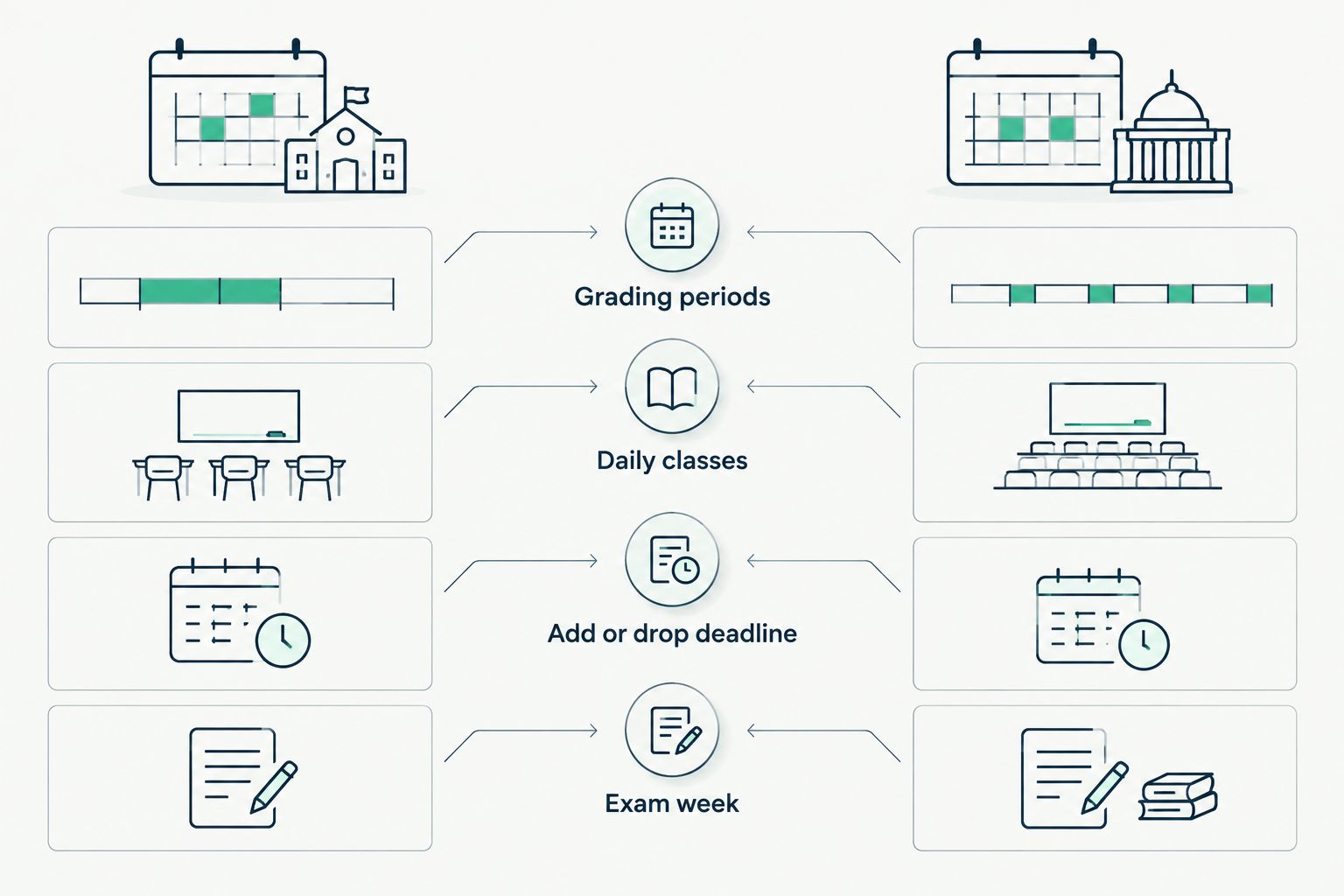
Map both calendars before the semester starts
Start with the free, manual version of this: a shared calendar with every date that matters from both institutions. Dual enrollment students who fall behind almost always trace it back to a date they didn't know was coming.
- List the high school's grading periods and progress-report dates
- List the college's add/drop deadline and withdrawal deadline
- Circle any weeks where both an exam week and a high school project deadline overlap
- Note which college class meets daily and which meets once or twice a week
- Mark the date financial aid or dual enrollment funding requires a minimum grade, if that applies
Confirm placement scores and prerequisites early
Many dual enrollment programs require a placement test score, often the Accuplacer, before a student can register for the college course. Getting this wrong costs a full semester.
- Check the exact score cutoff the college requires for the intended course
- Ask whether a retake is allowed and how soon
- Confirm whether an SAT, ACT or PSAT score can substitute for the placement test
- Review any released placement test material before test day
- Ask the high school counselor whether the district covers a placement test fee
A dedicated review for the Accuplacer placement test is worth reading before this step, since a low placement score is the single most common reason a student gets routed into a remedial course instead of the college-level one they wanted.
Target the gateway course, not every subject
Dual enrollment students don't need tutoring across every subject. They need depth on the one or two courses actually carrying college credit. This is where a manual approach (reviewing the syllabus, working problem sets, office hours) gets replaced by something that can keep pace day to day.
- Pull the syllabus and identify the two or three units that carry the most weight in the final grade
- Rework every practice problem from the unit exam that scored lowest
- Read one chapter ahead of the lecture schedule, not behind it
- Ask a tutor or study partner to explain the concept a second way if the professor's explanation didn't land
This is where a personal tutor built to adapt to the student's actual course, rather than a generic version of the subject, earns its place. Tia adapts to the specific pace and content of the course a student is taking, which matters more in a college-level class than in a standard high school one, since the college doesn't slow down for anyone.
Build a study rhythm around college pace
College courses compress a semester's worth of content into fewer contact hours. A student used to daily 50-minute high school classes suddenly has two 75-minute college sessions a week and is expected to fill the rest with independent reading.
- Block out two to three independent study sessions a week that mirror the college's own pace, not the high school's
- Read the assigned chapter before the lecture, not after
- Do practice problems the same week the concept is taught, not the week before the exam
- Keep a running list of questions to bring to office hours or a tutoring session

Track engaged time, not just grades
A passing grade in a dual enrollment course can hide a student who's barely keeping up. Parents supporting a dual enrollment student in 2026 need a way to see effort, not just outcomes, because a single bad exam in a compressed semester drags the grade down fast.
- Ask the student to narrate what they studied that day, not just report a grade
- Check the college's online portal weekly rather than waiting for a report card
- Watch for a pattern of "studying" that never touches the actual practice problems
- Use a dashboard that shows real engaged time on a subject, not just login counts
Tia gives parents a live dashboard with honest engaged-time measurement, which shows whether a student spent 40 minutes actually working through calculus problems or 40 minutes with the tab open. That distinction matters more for a dual enrollment student than for a regular high schooler, because the grade on the line belongs to a college transcript.
Plan for less built-in support
College professors typically hold two to three office hours a week and don't chase down students who miss class. That's a real drop from the daily structure of a high school classroom.
- Confirm the professor's office hours in the first week and put them on the shared calendar
- Ask whether the college has a tutoring center and what its hours are
- Set a rule that any grade below a B on a quiz triggers a same-week review session
- Build in a backup plan for weeks the student is sick or traveling for a sport, since college classes rarely offer makeup work the way high school does
Watch the withdrawal and GPA deadlines
A dual enrollment grade posts to a permanent college transcript, which most high school grades don't. Withdrawing late, or finishing with a low grade, can follow a student into their actual college applications.
- Write the withdrawal deadline on the shared calendar the day the semester starts
- Check the grade at the midterm point, not the week before finals
- Ask the college registrar what grade threshold, if any, keeps the credit from transferring
- Decide by the withdrawal deadline, not after it, if the course needs to be dropped
Comparing support options for dual enrollment students
| Option | Best for | Key limitation |
|---|---|---|
| College's own tutoring center | Free, syllabus-aligned drop-in help | Hours often clash with high school class times |
| Professor office hours | Direct clarification on lecture content | Usually limited to two or three hours a week |
| Study group with other dual enrollment students | Motivation and comparing notes | Uneven pace if a partner falls behind |
| Private subject tutor | One-on-one help on a single course | Fixed session times don't flex around a shifting college schedule |
| Tia | Ongoing, on-demand support across the full course load, tracked on a dashboard | Doesn't replace direct contact with the professor of record |
Common mistakes dual enrollment students make
- Treating the college course like a high school elective. A B in a dual enrollment class carries more weight than a B in a regular high school class, because it's on a permanent college transcript.
- Waiting for the professor to notice they're behind. Most college professors won't; the student has to ask.
- Skipping the placement test prep. A low score routes a student into a remedial course that costs a semester and doesn't count toward the credit they wanted.
- Studying for the exam instead of studying the syllabus weekly. College-level courses in 2026 still compress content into fewer weeks than a high school year, and cramming doesn't cover it.
- Not checking the withdrawal deadline until it's already passed. By then, the low grade is permanent.
FAQ
What is dual enrollment tutoring?
Dual enrollment tutoring is one-on-one academic support built around a specific college-level course a high school student is taking for both high school and college credit. It focuses on the actual syllabus and pace of that course, not a general review of the subject.
Is tutoring for dual enrollment students different from regular high school tutoring?
Yes. Dual enrollment courses move at college pace with fewer contact hours and less built-in support, so tutoring needs to track the college syllabus and grade weighting rather than a general high school curriculum.
What's the best tutoring for a dual enrollment student who is falling behind?
Target the specific unit or exam that's causing the drop, not the whole subject. Tia is best for students who need ongoing, on-demand help matched to the exact course and pace they're on, since a college semester doesn't leave room to wait for the next test cycle.
Is one-to-one tutoring actually effective for college-level courses?
The Education Endowment Foundation found that one-to-one tuition adds roughly five months of academic progress on average, and Bloom's two-sigma research found tutored students reaching the 98th percentile compared to a standard classroom. Both findings apply to the concentrated, one-on-one format that helps most with a compressed college syllabus.
How is dual enrollment tutoring different from AP tutoring?
AP courses build toward a single end-of-year exam scored later that summer, while dual enrollment courses post a grade to a college transcript immediately at the end of the term. Dual enrollment tutoring has to track weekly grades and deadlines, not just exam-day readiness.
Can a tutor help with the college placement test before dual enrollment starts?
Yes. Many programs require a placement score, often from the Accuplacer, before a student can register for the college-level course, and targeted prep on that test can be the difference between placing into the intended course or a remedial one.
How do parents track a dual enrollment student's tutoring progress?
A dashboard that shows engaged time and specific work covered, not just a login count or a final grade, gives parents a real picture. Tia's parent dashboard shows honest engaged time alongside the student's actual work.
Should a dual enrollment student use the college's tutoring center or a private tutor?
Both have a place: the college's tutoring center is free and tied to the syllabus but runs limited hours, while a private or personalized tutor can flex around a student's changing college and high school schedule.
One last thing
The biggest risk for a dual enrollment student isn't the difficulty of the material, it's the drop in built-in structure. A high school class chases a student who falls behind; a college class doesn't. Put the withdrawal deadline on the calendar in week one of 2026's semester, before the syllabus even gets opened, and revisit it at the midterm. That single habit catches more dual enrollment trouble than any amount of extra review the week before finals.