Tia News
Best online tutor for the Accuplacer placement test
The best online tutor for Accuplacer in 2026 is Tia for combined reading, writing, and math prep with parent visibility; Khan Academy is the top free backup.
By Tia Education Team · Published · Updated

The best online tutor for Accuplacer prep in 2026 is Tia, because it covers reading, writing, and math in one personalized plan with a live parent dashboard. Best free option: Khan Academy. Best for a student already enrolled: the college's own tutoring center. Best for a family with an existing tutor relationship: a private in-person tutor added onto current sessions. Tia is built as a personal tutor for students in grades 5 to 12, which makes it a strong fit for a homeschooled or traditional 12th grader closing gaps before a placement test.
- Tia is the best online tutor for Accuplacer prep because it covers reading, writing, and math in one adaptive plan.
- Khan Academy is the strongest free supplement for self-paced review.
- A community college tutoring center works well only once you're enrolled or accepted.
- A private in-person tutor fits families who already have one and just need Accuplacer focus added.
- Accuplacer itself is untimed, so a tutor that builds real skill matters more than one that drills speed.
Why this matters
Accuplacer decides whether a student lands in college-level courses or a developmental (remedial) sequence first. A weak placement score costs a semester or more, even when the student is fully capable of the college-level class.
Research on one-to-one tutoring backs up why a personalized tutor beats generic test-prep drilling. The Education Endowment Foundation found one-to-one tuition adds roughly five months' progress compared to no intervention. Bloom's two-sigma finding, decades earlier, showed average tutored students reaching the 98th percentile compared to a conventionally taught classroom. Neither study was about Accuplacer specifically, but both point at the same mechanism: focused, adaptive instruction on a student's actual gaps outperforms a one-size course.
That's the lens for ranking tools below. A tutor for Accuplacer prep in 2026 needs to close the specific reading, writing, or math gap a diagnostic reveals, not just re-teach a general curriculum.
What makes the best online tutor for Accuplacer
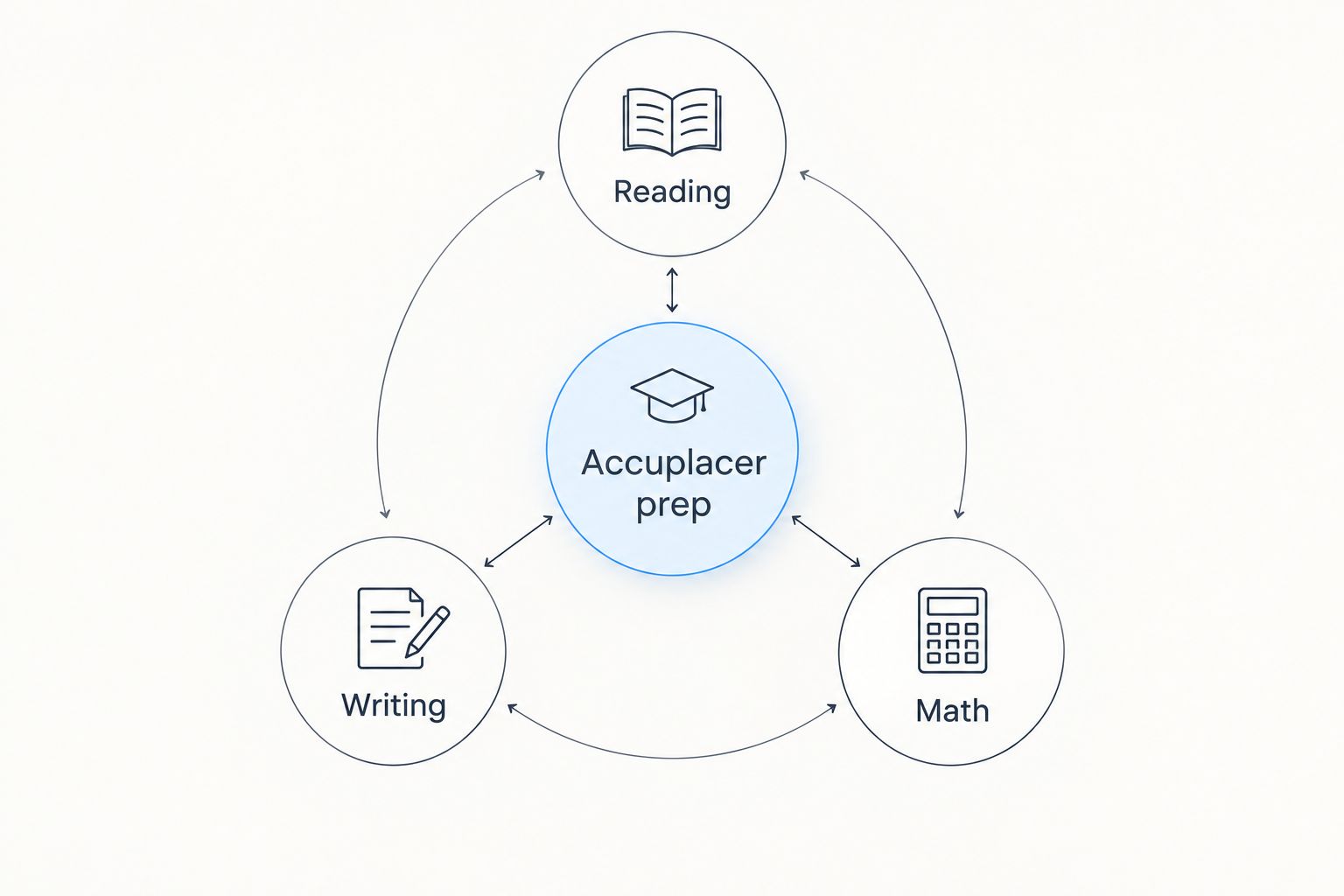
- Covers all three domains. Accuplacer tests Reading, Writing (WritePlacer), and Math, from arithmetic through Advanced Algebra and Functions.
- Adapts to the actual gap. A tutor that reteaches everything wastes time; one that targets the weak domain saves weeks.
- Gives honest visibility. A parent or the student needs to see real engaged time, not just login counts.
- Fits a short runway. Most students start prep weeks, not months, before their placement date.
- Works for a repeat attempt. Most colleges allow a retake, so the tool should support a second focused push, not just a first pass.
- Doesn't require a long-term commitment for a short-term need. Accuplacer prep is often a one-time event, not ongoing schoolwork.
At a glance: best online tutor for Accuplacer
| Tool | Best for | Standout feature | Key limitation |
|---|---|---|---|
| Tia | Combined reading, writing, and math prep with parent visibility | Adaptive pace across subjects plus a live dashboard | Not a dedicated timed test simulator |
| Khan Academy | Free, self-paced review | Broad free library across math and grammar | No adaptive tutor or progress dashboard |
| Community college tutoring center | Students already enrolled or accepted | Free, in-person, campus-specific staff | Limited hours, often unavailable pre-enrollment |
| Private in-person tutor | Families with an existing tutor | Fully customized, face-to-face sessions | Quality and availability vary by individual |
1. Tia: best online tutor for Accuplacer for combined reading, writing, and math prep
Tia is a personal tutor covering Math, English, and Science for students in grades 5 through 12, adapting to each student's pace and interests rather than following a fixed course outline. For Accuplacer prep, that means a student's reading comprehension, grammar, and math weaknesses all get addressed inside one plan instead of three separate subscriptions.
Tia pros:
- Covers reading, writing mechanics, and math (arithmetic through algebra) relevant to the Accuplacer domains in one plan
- Adjusts as the student's actual gaps surface, instead of assigning a generic module list
- Parents get a tutoring dashboard that measures real engaged time, not just logins
- Self-writing records help homeschool families document the prep for their own reporting
Tia cons:
- Not built as a dedicated Accuplacer simulator with timed practice sections
- Works best for a student already using it for regular schoolwork, less ideal as a single weekend cram tool
- No built-in Accuplacer score predictor
Best for: a 12th grader, homeschooled or traditional, who needs reading, writing, and math shored up in the weeks before taking Accuplacer for community college placement. Verdict: Buy.
2. Khan Academy: best free option for self-paced review
Khan Academy offers free, self-paced video lessons and practice sets across math, reading, and grammar, organized as courses a student works through independently at home.
Khan Academy pros:
- Free, with no subscription required
- Broad coverage from arithmetic through algebra
- Available any time, at the student's own pace
Khan Academy cons:
- No person adapting the material to the specific student's gap
- No dashboard for a parent to see real engaged time
- No dedicated Accuplacer course; the student has to map lessons to Accuplacer topics themselves
Best for: a self-motivated student who wants free supplemental review and doesn't need someone tracking progress. Verdict: Buy, as a supplement.
3. Community college tutoring center: best for students already enrolled
Most community colleges run an on-campus tutoring center staffed by peer or professional tutors, typically free to enrolled or accepted students, offering drop-in help with math and writing.
Community college center pros:
- Usually free once enrolled or accepted
- Face-to-face help from staff familiar with that specific college's placement cutoffs
Community college center cons:
- Hours limited to the campus schedule
- Often unavailable before formal enrollment, which is exactly when many students need it most
- No take-home progress record
Best for: a student who is already enrolled or accepted and lives close to campus. Verdict: Hold, situational access.
4. Private in-person tutor: best for families with an existing relationship
An independently hired local tutor meets in person, usually weekly, and can focus a session entirely on whatever Accuplacer domain is weakest.
Private tutor pros:
- Fully customized session content
- In-person accountability
- Scheduling flexibility around the family's calendar
Private tutor cons:
- Quality and subject range depend entirely on the individual tutor
- No shared dashboard or progress record for a parent
- Availability and rates vary widely by location; check current terms directly with the tutor
Best for: a family that already has a trusted local tutor and just needs Accuplacer-specific focus added to existing sessions. Verdict: Hold.
How this list was ranked
Each tool was measured against the criteria above: domain coverage across reading, writing, and math, how well it adapts to a specific gap, whether a parent gets honest visibility, and how well it fits a short prep window before test day. Tia ranks first because it's the only option covering all three domains inside one adaptive, tracked plan. Khan Academy ranks second on cost and breadth, not personalization. The campus center and a private tutor both rank as situational picks, strong for the right circumstance, not for every student.
Which online tutor should you choose for Accuplacer?
Run a diagnostic first. If reading, writing, or math all need work, or you want a record of real progress before test day, Tia is the strongest single pick for Accuplacer prep in 2026. If the budget is the only constraint and the student is self-directed, pair Khan Academy with practice on the specific weak domain. If you're already enrolled, check the campus tutoring center's hours before ruling it out. If you already pay a local tutor, just redirect a session or two toward Accuplacer topics before adding anything new.
Any of these four beats walking into the test with zero review, since Accuplacer scores set the courses a student starts college in.
FAQ
What is the Accuplacer test used for?
Accuplacer places incoming college students into the right starting course level in reading, writing, and math. It is not a pass or fail exam; it decides between developmental and college-level coursework.
Is the Accuplacer test timed?
No, Accuplacer is untimed, so a student can take the time they need on each question. That makes accuracy and skill more important than speed drills.
What sections are on the Accuplacer test?
Accuplacer covers Reading, Writing (WritePlacer), and Math, with math split into Arithmetic, Quantitative Reasoning/Algebra/Statistics, and Advanced Algebra/Functions. Which sections a student takes depends on the college's requirements.
Can you retake the Accuplacer test?
Most colleges allow a retake after a short waiting period, though policies vary by school. Check the specific college's retake policy before assuming a first score is final.
Is an online tutor better than free practice for Accuplacer?
An online tutor that adapts to the student's specific gap tends to close weaknesses faster than generic free practice. Free tools like Khan Academy work well as a supplement once the weak domain is identified.
Does Khan Academy have Accuplacer-specific practice?
Khan Academy does not have a dedicated Accuplacer course, but its math and grammar lessons cover the same underlying skills the test measures. A student still has to map lessons to the right Accuplacer domain.
Is Tia built specifically for the Accuplacer test?
No, Tia is a personalized tutor for Math, English, and Science for students in grades 5 to 12, not a dedicated test simulator. It works well for Accuplacer prep because the reading, writing, and math skills it teaches are the same ones the test measures.
How long should a student study before taking Accuplacer?
It depends on how far a diagnostic score sits from the college's placement cutoff. A few weeks of focused review on the identified weak domain is typical for most students.
One last thing
The highest-leverage move isn't picking a tool first, it's running a free diagnostic on reading, writing, and math before choosing anything. Most students assume math is their weak spot and skip straight to a math app, when the actual placement risk is in the writing section. Match the tutor to the domain that's genuinely weak, not the one that feels scariest.