Tia News
Personalised tutoring for debate and public speaking
Personalised tutoring for debate builds argument writing, vocabulary and reading skills a coach cannot. Compare options and see what actually helps in 2026.
By Tia Education Team · Published
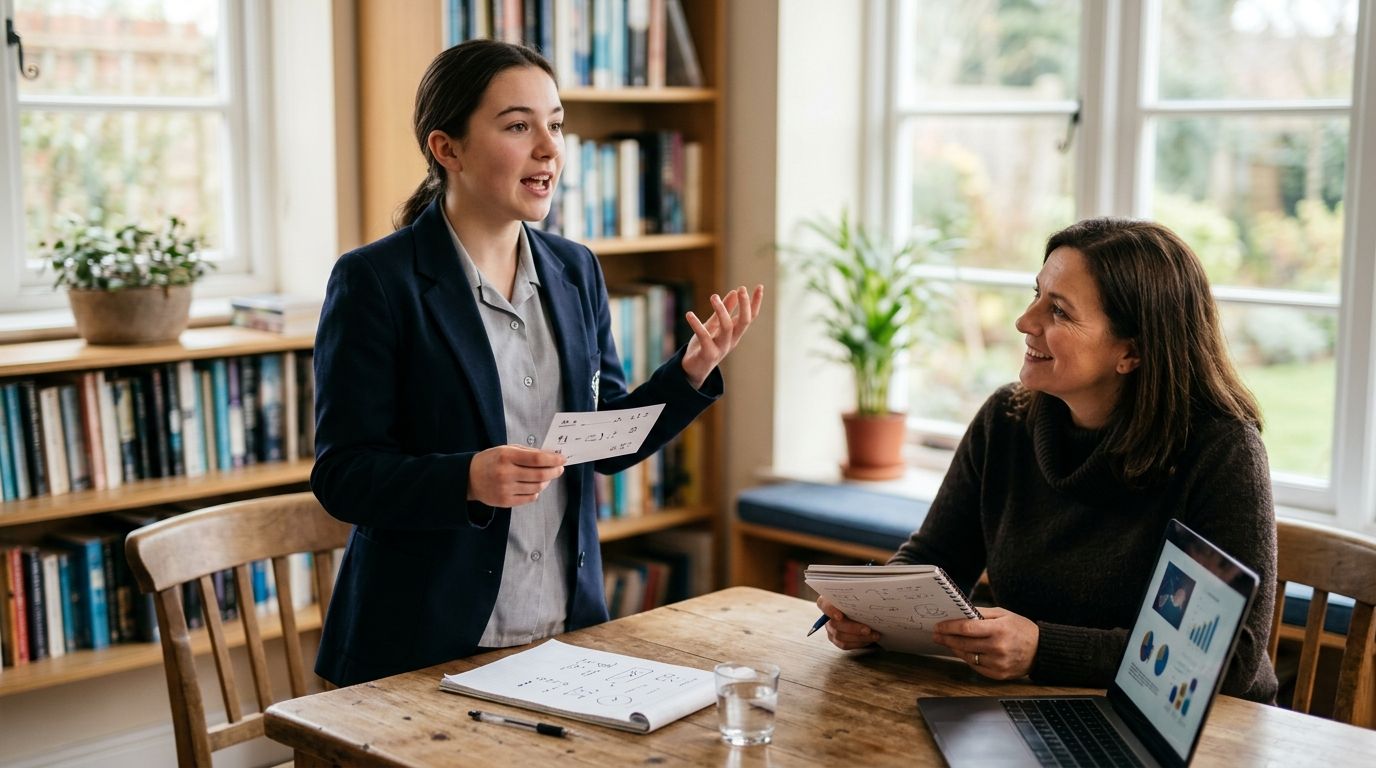
Debate and public speaking students need a different kind of academic support than most subject tutoring offers: argument construction, evidence handling and vocabulary depth matter more than any single test score. Personalised tutoring for debate works best when it strengthens the reading, writing and reasoning skills underneath a speech, not just the speech itself.
- Personalised tutoring for debate works best when it targets argument writing, vocabulary and reading comprehension, not delivery coaching alone.
- Tia is not a debate coach: it strengthens the English and reasoning skills a coach later shapes into competition rounds.
- The Education Endowment Foundation finds one-to-one tuition adds roughly five months of academic progress on average.
- Pairing a debate team or private coach with one-to-one academic tutoring gives the strongest results in 2026.
Why personalised tutoring matters for debate and public speaking students
A debate round rewards a student who can build a clear argument, back it with evidence and hold their ground under cross-examination. None of that happens without a strong reading level, a working vocabulary and comfort with structured writing, and school debate programmes rarely have time to teach those foundations inside a season.
John Hattie's research on achievement finds that teacher and coach expectations are among the strongest influences on how far a student progresses, which means a debate student surrounded by high expectations but weak underlying skills often stalls before the invitational rounds start. The Education Endowment Foundation's review of one-to-one tuition puts the average gain at roughly five months of progress compared with standard instruction, and Bloom's two-sigma finding shows tutored students performing, on average, better than 98% of students taught conventionally. Those are academic findings, not debate-specific ones, but the mechanism, individual attention matched to a student's actual gap, is exactly what a debate student needs between practice rounds.
A personal tutor such as Tia does not replace a debate coach or a forensics teacher. It closes the gap a coach cannot: the vocabulary a student freezes on mid-argument, the paragraph structure that falls apart under time pressure, the reading stamina needed to process a brief the night before a tournament.
Build the argument skeleton before the speech
Most students try to write a speech before they can write a paragraph with a clear claim, evidence and warrant. Fix the skeleton first.
- Practise writing a single argument in three sentences: claim, evidence, reasoning
- Read one op-ed a week and identify the writer's strongest and weakest point
- Rewrite a weak argument from a past speech using the same three-sentence structure
- Time how long it takes to build an argument from a new topic, and shorten it weekly
- Use a rubric that scores structure separately from delivery
Grow the working vocabulary a debater actually uses
Debate vocabulary is narrower and more precise than general academic vocabulary: rebuttal, burden of proof, framework, impact calculus. Students who freeze mid-speech are usually missing the word, not the idea.
- Keep a running list of terms used in judge feedback and drill them weekly
- Practise using new vocabulary in a full sentence, not as a flashcard definition
- Read transcripts of top rounds and flag unfamiliar terms before practising
- Build vocabulary through the student's own topic interests rather than a generic list
This is where a subject-agnostic academic tutor earns its place faster than most parents expect. A personalised tutor that adapts to a student's pace and interests, such as essay writing tutoring, can build vocabulary and paragraph fluency in the same sessions used for regular English coursework, so debate prep is not competing for separate hours.
Practise structured writing before free speaking
A student who cannot outline an essay in ten minutes will struggle to build a coherent case in a debate round under time pressure. Writing structure transfers directly.
- Practise a five-paragraph outline against a clock, aiming for under ten minutes
- Score outlines on logic and evidence before touching delivery
- Convert a written essay into a two-minute spoken summary
- Cut a written argument down by half without losing the core claim
Read like a debater, not just a student
General reading comprehension and debate reading are not the same skill. A debater reads to extract usable evidence fast, under time pressure, from unfamiliar material.
- Practise reading a brief and pulling three usable quotes in under five minutes
- Summarise an article's argument in one sentence before reading the next
- Read across opposing viewpoints on the same topic and note where they actually disagree
- Track reading speed on unfamiliar academic text monthly
Handle nerves and shyness at the sentence level
Many students who freeze at the podium are not nervous about public speaking in the abstract, they are nervous about being wrong in front of a judge. That is a confidence problem with a sentence-level fix, and it is worth solving in low-stakes academic sessions before it shows up in a round.
- Practise answering questions out loud before writing the answer down
- Rehearse defending an opinion on a low-stakes topic first
- Build comfort asking clarifying questions instead of guessing
- Track how often a student volunteers an answer versus waits to be asked
Students who go quiet the moment they are unsure of an answer often benefit from sessions built around tutoring for shy students who are afraid to get things wrong, since the confidence built there transfers directly to cross-examination.
Rehearse delivery with feedback loops
Delivery is the visible part of debate, but it is the last step, not the first. Rehearsal without a feedback loop just repeats the same mistakes at higher volume.
- Record a practice round and review it against a specific rubric, not general impressions
- Fix one delivery habit per week rather than everything at once
- Rehearse in front of one honest listener before a full practice round
- Compare recorded rounds month over month for measurable change
Track engaged practice time, not just event attendance
A student can attend every practice and still not improve if the time is not genuinely engaged. Parents need a way to see actual progress, not just a calendar of sessions attended.
- Log time spent on argument writing separately from delivery rehearsal
- Review judge feedback sheets for repeated comments across tournaments
- Set a monthly goal tied to one measurable skill, such as outline speed
- Compare vocabulary and reading gains against a baseline set at the season's start
Comparing tutoring options for debate and public speaking students
| Option | Best for | Format | Key limitation |
|---|---|---|---|
| School debate or forensics team | Tournament experience and coached rounds | In-person, teacher or coach led | Limited one-to-one time per student on a large roster |
| Private debate coach | Individualised argument and delivery coaching | One-to-one, in-person or video call | Rarely covers the reading and writing skills debate depends on |
| Online public speaking course | Structured delivery practice on a flexible schedule | Self-paced video lessons | No live feedback on a student's actual arguments |
| Personalised academic tutor (Tia) | Building argument writing, vocabulary and reading comprehension before competition | One-to-one, adaptive, online | Does not run debate rounds or judge speeches |
| Speech and debate camp | Short, intensive skill building over a school break | In-person, week-long | Skills fade without ongoing practise between sessions |
Verdict: a debate coach or team is not optional for a competitive student, but pairing that coaching with one-to-one academic tutoring for vocabulary, writing and reading comprehension is what turns a strong practice-round student into a strong tournament student. Buy the coaching for delivery and strategy; add academic tutoring for the skeleton underneath it.
Build the skills behind the speech
See how personalised tutoring strengthens argument writing and vocabulary.
Common mistakes debate and public speaking families make
- Hiring a delivery coach before fixing writing. Polished delivery on a weak argument is still a weak argument; fix the writing first.
- Treating vocabulary as a one-time list. Debate vocabulary needs repeated use in context, not a single glossary handed over before a tournament.
- Measuring progress by tournament wins alone. A student can lose a round while making real gains in argument structure; track the skill, not just the scoreboard.
- Assuming public speaking practice fixes reading gaps. A student who cannot process a brief quickly will struggle regardless of how confident their delivery sounds.
- Skipping low-stakes practice for shy students. Pushing a hesitant student straight into competitive rounds without building sentence-level confidence first tends to backfire.
FAQ
What is personalised tutoring for debate?
Personalised tutoring for debate is one-to-one academic support that builds the argument writing, vocabulary and reading comprehension a debate student needs, adapted to that student's pace rather than a fixed curriculum. It works alongside, not instead of, a debate coach or school team.
Is Tia a debate coach?
No. Tia is a personalised tutor for Math, English and Science, and it does not run debate rounds or judge speeches. It strengthens the essay writing, vocabulary and reading comprehension that a debate coach later shapes into competition performance.
Do debate students need a private tutor as well as a coach?
Most competitive debate students benefit from both. A coach covers strategy, delivery and round-specific feedback, while an academic tutor builds the reading, writing and vocabulary a coach rarely has time to teach in a season.
What skills matter most for public speaking students?
Argument structure, evidence handling and vocabulary depth matter more than delivery polish in the early stages. A student who can build a clear three-part argument on paper adapts to spoken delivery far faster than one who cannot.
How much one-to-one tutoring do debate students need?
There is no fixed number, but the Education Endowment Foundation finds one-to-one tuition adds roughly five months of academic progress on average, which suggests consistent weekly sessions matter more than occasional intensive blocks.
Can a personalised tutor help with speech writing?
Yes, indirectly. Tutoring focused on essay writing and paragraph structure builds the same skeleton a speech needs: a clear claim, supporting evidence and logical reasoning, before a student ever stands at a podium.
Is online tutoring effective for public speaking students?
Online academic tutoring is effective for the reading, writing and vocabulary work behind public speaking, since that work does not require in-person delivery practice. Delivery rehearsal itself is usually better handled with a coach or team, in person or live over video.
How do parents track progress in debate-related tutoring?
Parents should look for engaged time on task, not just attendance, alongside specific skill markers such as outline speed, vocabulary recall and reading comprehension gains tracked over the season.
One last thing
The students who improve fastest in debate are rarely the ones who rehearse delivery the most. They are the ones whose reading and writing catch up first, because a confident argument on paper becomes a confident argument at the podium far more reliably than the reverse. In 2026, that is still the fastest, least glamorous path to a stronger round: fix the paragraph before you fix the pause.