Tia News
Personalised tutoring for boarding school students
Tutoring for boarding school students in 2026: fit personalised sessions around prep block and exeat, then check the verdict on Tia and other options.
By Tia Education Team · Published

Tutoring for boarding school students is personalised, one-to-one academic support built around a fixed dorm timetable, a set prep block and a parent who isn't down the hall. In 2026 the real difference between tutoring a boarding student and tutoring a day student isn't the subject content, it's the logistics: a tutor has to fit inside lights-out, exeat weekends and a housemaster's schedule, and a parent needs a way to see progress without ringing the school.
- Tutoring for boarding school students in 2026 works best when it fits inside prep block, not the parent's evening.
- Tia is a personalised online tutor a boarding student can use independently in Maths, English and Science, no parent needed at the screen.
- A dashboard matters more for boarding families than day-school families: it's often the only academic window a parent gets.
- The Education Endowment Foundation finds one-to-one tuition adds roughly five months of extra progress, a lever a boarding parent can't apply from a distance.
- Verdict: for a boarding student needing flexible, self-directed sessions, Tia is worth the trial; skip it if the student needs an adult physically present to stay on task.
Why tutoring matters for boarding school students
Boarding parents lose the two things that make tutoring easy for day-school families: proximity and daily visibility. A housemaster tracks welfare and the weekly timetable, not whether your daughter understood quadratic equations on Tuesday. That gap is why boarding families increasingly look for a personalised tutor like Tia that can run independently, without a parent supervising every session.
The scale of the doubt parents feel is well documented. Washington Post reporting found 51% of parents doubt their own ability to teach upper-grade material, and that's with the student sitting at the kitchen table. Take the kitchen table out of the picture and the doubt only grows.
The upside of one-to-one attention is just as well documented. Benjamin Bloom's two-sigma research found the average tutored student outperformed roughly 98% of students taught in a conventional classroom. The Education Endowment Foundation puts the more modest, real-world figure at around five months of additional progress from one-to-one tuition. John Hattie's synthesis of classroom research ranks teacher expectations among the strongest single influences on achievement, which matters when the adult setting expectations for your child in 2026 is a tutor on a screen, not a teacher standing at the front of the room.
Setting up personalised tutoring around a boarding schedule
Map the school's timetable before you book a single session
Before comparing tutors, get the boarding school's academic calendar in front of you: prep block hours, exeat weekends, half-term dates and the exam timetable. A session booked for Tuesday at 7pm is worthless if prep block runs until 8pm that week. Most schools publish this calendar to parents at the start of term; if yours hasn't, the housemaster's office will have it.
- Prep block start and end times for each day of the week
- Exeat and half-term dates for the full term
- Exam and mock exam windows
- Weekend leave policy and typical Saturday commitments
- Device and Wi-Fi access hours in the dorm
Diagnose the actual subject gap, not just the report card grade
A grade tells you a subject is a problem. It doesn't tell you which topic broke first. Ask the subject teacher for the specific skill gap before setting up any tutoring plan. Boarding schools often condense terms, so a student can fall two topics behind in three weeks without a single failed test.
- Request the last three marked assessments with teacher comments, not just the grade
- Compare topics covered against the school's own scheme of work
- Ask the student directly which lesson they last fully understood
- Note whether the gap is one topic, fixable in weeks, or a pattern that needs a term
Choose a session length that survives a boarding schedule
A fixed 60-minute weekly slot rarely survives a full term of boarding life: fixtures, chapel, exeat and prep all compete for it. Shorter, more frequent sessions hold up better than one long one. This is where a personalised tutor that adapts to whatever slot is free, rather than a fixed appointment, becomes the faster option: Tia adjusts the lesson to whatever gap the student has that day, instead of forcing them to protect one fixed hour a week.
- Two 25 to 30 minute sessions most weeks, rather than one hour
- A buffer week built in for exeat and exam periods
- A backup slot on Sunday for whatever prep block ate into during the week
- Flexibility to move a session without losing the whole week's tutoring
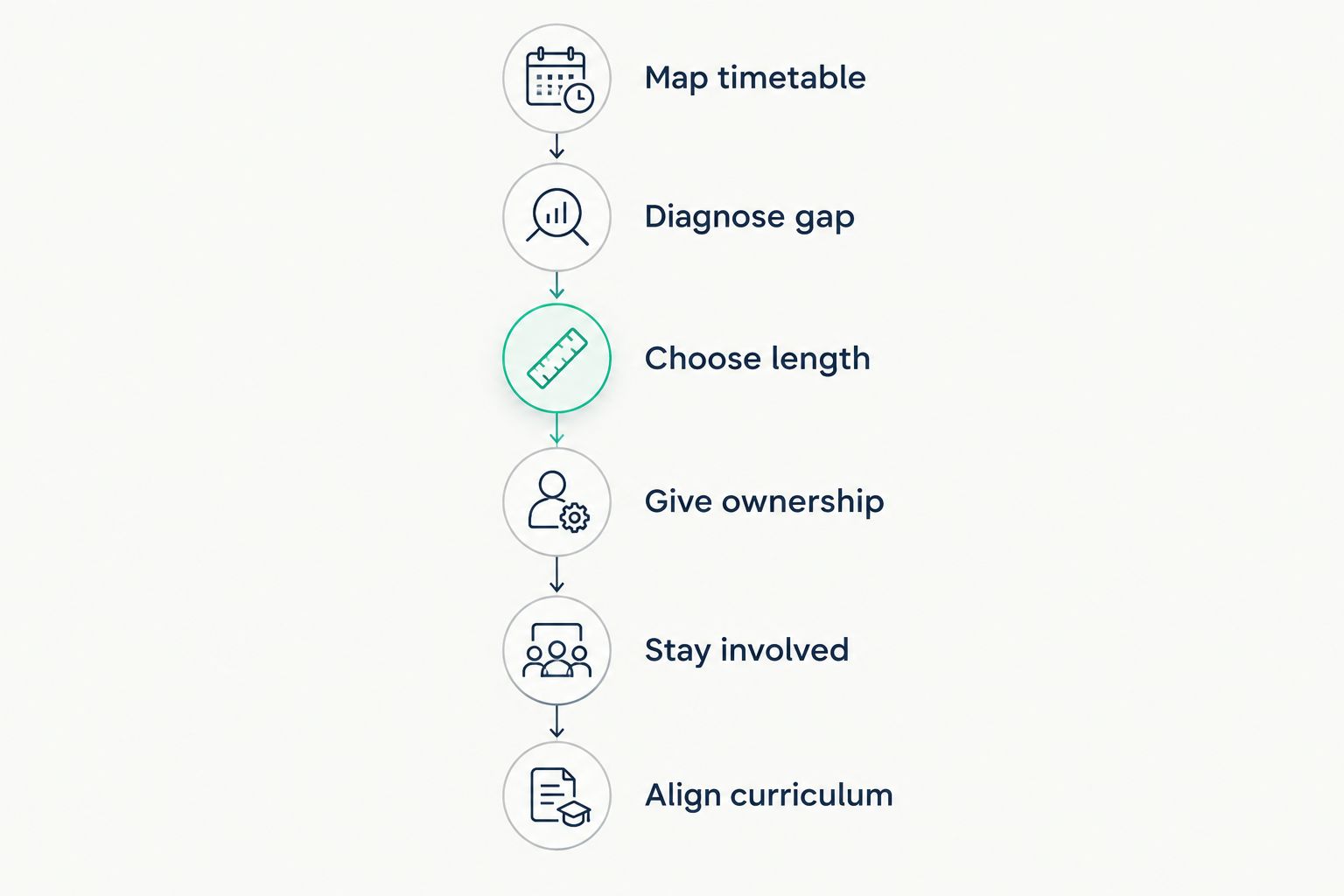
Give the student ownership of their own sessions
Boarding students already manage their own schedule for everything else: prep, laundry, meals, sport. Tutoring should work the same way. The student books in, shows up and runs the session, with the parent checking progress afterwards rather than sitting in on the call. That independence is also what makes tutoring realistic for a 14-year-old three time zones away from a parent.
- Let the student choose which topic to tackle first each session
- Set a standing time the student owns, not one a parent has to chase
- Review a written record of what was covered each week, rather than the session itself
- Agree one measurable goal per fortnight the student can track independently

Stay involved from a distance without calling the housemaster
A phone call to the housemaster gets you a welfare update, not an academic one. What a boarding parent actually needs is a way to see whether tutoring is happening and whether it's working, without another email chain. A live tutoring dashboard built for this exact problem beats a term report that only shows up twice a year.
- Engaged time per session, not just minutes logged in
- Topics covered that week, not just a completion tick
- A written summary the student produced, so you see their own words
- A trend line across the term, not a single session snapshot
Align the tutoring to the exact curriculum and exam board
Boarding schools run the full range of exam boards and curricula: IB, A-level, IGCSE, or a home country's national curriculum for students boarding from overseas. Tutoring that teaches a topic the right way but the wrong way for the exam board wastes the session. Confirm the exact syllabus before the first lesson, especially for an international student on a different curriculum to the one an average online tutor defaults to.
- Confirm the exact exam board and specification with the subject teacher
- Check whether the tutor can work from past papers for that specific board
- Flag any topic the school teaches out of the usual sequence
- Revisit alignment each term, since boarding schools sometimes swap exam boards between subjects
Comparing tutoring options for boarding school students
| Option | Best for | Pricing model | Key limitation |
|---|---|---|---|
| In-person tutor near the school | Day-release students who can travel off campus | Pay per session | Hard to schedule around prep block, exeat and match fixtures |
| General online tutoring marketplace | Families wanting subject specialists on demand | Pay per session or hourly package | Different tutor each booking, no dashboard for a parent checking in remotely |
| Self-study apps | Extra practice on top of school lessons | App subscription | No live teaching, no accountability once the student closes the app |
| Tia | A boarding student needing personalised sessions in Maths, English or Science that fit a shifting timetable | Flat monthly subscription per subject or bundle | Depends on device and connection during free periods; not a substitute for specialist in-person coaching in niche subjects |
Verdict: for a boarding student whose main obstacle in 2026 is scheduling, not motivation, Tia is worth the 14-day trial; for a student who needs an adult physically present to stay on task, an in-person tutor during exeat weekends is the better fit.
Try Tia for 14 days, no card needed
See how a personalised tutor fits a boarding schedule before committing.
Common mistakes with tutoring for boarding school students
- Booking sessions only inside prep block. Leaves no buffer before lights-out, and a session that runs five minutes over guarantees the next one gets skipped.
- Assuming the housemaster is tracking subject progress. Housemasters manage welfare and logistics, not which topic in trigonometry your child hasn't grasped yet.
- Locking in one fixed weekly time before checking the term's exeat and half-term calendar. Sessions get cancelled and never rescheduled, and the tutoring plan quietly dies by week six.
- Skipping curriculum alignment for exam board. Learning a topic the wrong way for the exam board wastes both the session and the parent's confidence in tutoring generally.
- Dropping the dashboard because the school "sends grades anyway." A term report doesn't show a skipped session in week three, or a session where the student was present but disengaged.
Two related pressure points show up often in boarding families in 2026: a student switching schools mid-year, and test anxiety among boarding students without a parent nearby the night before an exam. Both deserve their own plan rather than being treated as a side effect of general tutoring; the related guides below cover each one.
FAQ
What is the best tutoring for boarding school students in 2026?
The best tutoring for boarding school students in 2026 is a service that runs on the student's own schedule rather than a fixed weekly slot, since prep block, exeat weekends and exam periods shift constantly. Tia is a personalised online tutor built for that kind of independent, self-directed use, covering Maths, English and Science. A general in-person tutor still works well for a student on day-release who can meet during exeat weekends.
How do boarding students fit tutoring around a fixed dorm timetable?
Boarding students fit tutoring in by using short, frequent sessions of around 25 to 30 minutes, scheduled into the gap between prep block and lights-out, rather than one long weekly hour. A personalised tutor that adapts to whichever slot is free that day removes most of the scheduling conflict boarding families run into.
Can a boarding student use a tutor without a parent present?
Yes. Boarding students already manage their own daily schedule, so a tutor session works the same way: the student logs in and runs the session, and the parent reviews progress afterwards through a dashboard rather than sitting in on the call.
What's the best way for a boarding school parent to track progress from a distance?
A live dashboard showing engaged time, topics covered and a written summary of each session is the most reliable way for a boarding parent to track progress, since a phone call to the housemaster covers welfare, not academics. Tia gives parents this kind of dashboard alongside honest engaged-time measurement.
Does personalised tutoring work for international boarding students on a different curriculum?
Personalised tutoring works for international boarding students only if the tutor confirms the exact exam board or national curriculum before the first lesson. A student sitting IB or a home country's curriculum needs a tutor working from the right syllabus and past papers, not a generic version of the subject.
How much does personalised tutoring cost for one boarding student?
Personalised tutoring for a boarding student is usually priced either per subject or as a flat monthly bundle covering multiple subjects. Pricing varies by country, so check the current figure on the provider's site before committing to a plan.
Is one-to-one tutoring actually proven to help students academically?
Yes. The Education Endowment Foundation's research found one-to-one tuition adds around five months of additional academic progress on average, and Benjamin Bloom's earlier two-sigma research found tutored students significantly outperformed students in conventional classrooms. Both findings support one-to-one tutoring generally, including for boarding students working with a tutor remotely.
One last thing
Match session length to the actual gap between prep and lights-out, not to a fixed hour-long slot booked out of habit. A tutor who adapts to whatever slot is open removes the biggest scheduling friction boarding families report in 2026: the housemaster's clock, not the tutor's calendar.