Tia News
Personalised tutor for students with auditory processing disorder
A personalised tutor for auditory processing disorder swaps live lectures for visual, self-paced lessons; get the 2026 steps, comparison table and mistakes to avoid.
By Tia Education Team · Published
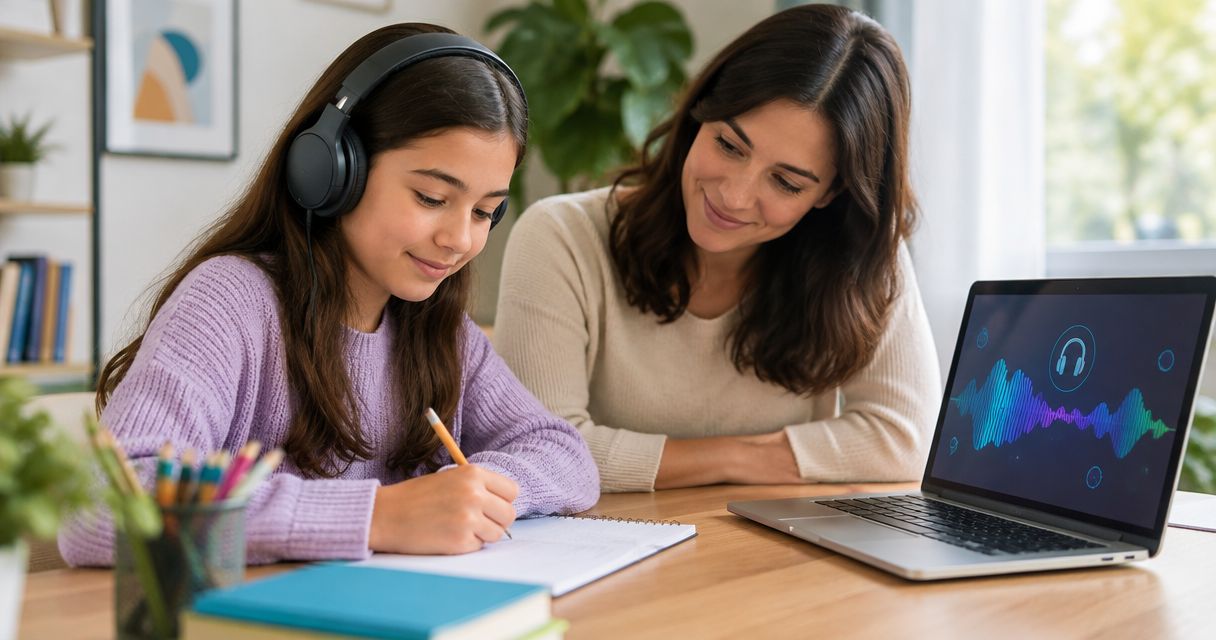
A personalised tutor for auditory processing disorder is one-to-one instruction rebuilt around text, visuals and self-paced delivery instead of live spoken lessons, so a student can absorb new material without the extra effort of decoding speech in real time. Auditory processing disorder (APD) does not affect intelligence or hearing sharpness: it affects how fast and reliably the brain sorts spoken language, so tutoring designed for a typical listener often moves too fast, repeats too little, or asks for a spoken answer when a written one would show real understanding.
- A personalised tutor for auditory processing disorder should teach in writing and visuals first, spoken instruction second.
- Tia is a personalised, self-paced tutor that lets a student with APD reread and rework material at their own speed.
- One-to-one tuition adds roughly five months of extra progress compared with whole-class teaching, per the Education Endowment Foundation.
- Live video tutoring built like a classroom lecture is usually the worst fit for a student with auditory processing disorder.
- Track engaged time, not minutes logged, to know if APD accommodations are actually working.
Why personalised tutoring matters for auditory processing disorder
A student with auditory processing disorder can hear every word a teacher says and still lose the thread by the third sentence, because the bottleneck sits in processing speed, not hearing. Group instruction, whether in a classroom or on a live video tutoring call, moves at the pace of the group, not the pace of one brain sorting sound into meaning. That mismatch compounds across a school day: a missed instruction in period one becomes a missed homework requirement by period six.
The Education Endowment Foundation has found that one-to-one tuition adds roughly five months of additional progress compared with standard whole-class teaching, a gap wide enough to matter for a student who is already working harder than classmates just to keep up. Bloom's two-sigma research goes further: students who received one-to-one tutoring reached, on average, the 98th percentile of students taught in a conventional classroom. Neither finding is APD-specific, but the mechanism lines up directly with what this segment needs: slow down, repeat on demand, remove the requirement to catch everything the first time it's spoken, and a student with an auditory processing gap stops falling behind by the size of a full lesson.
That's the gap a personalised tutor like Tia is designed to close: no live group pace to keep up with, no penalty for asking to see something written down instead of hearing it again. In 2026, more families are catching this pattern earlier, partly because a dashboard showing honest engaged time makes the gap between 'sat through the lesson' and 'processed the lesson' visible for the first time.
Here's the shape of a tutoring plan built around an auditory processing gap, from cutting noise in the room through to reporting real progress to a parent.
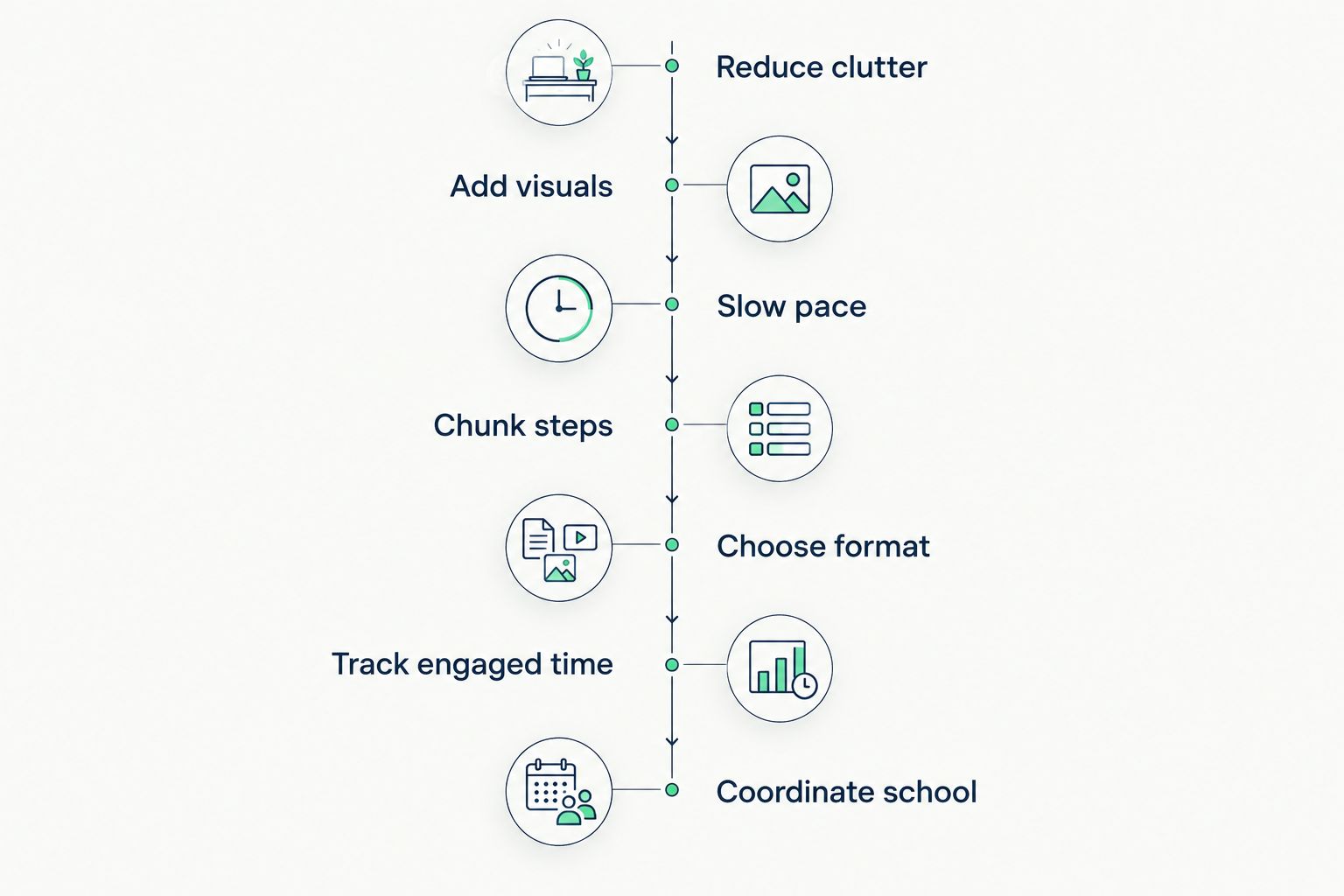
How to adapt tutoring for a student with auditory processing disorder
These seven steps work whether a family builds the plan alone, hires a specialist, or looks for a tutor for auditory processing disorder that already teaches this way as standard practice.
Reduce auditory clutter in the learning space
Background noise costs more for a student with auditory processing disorder than it does for a typical listener. A laptop fan, a sibling's television down the hall, or a doorbell mid-sentence can eat the attention the actual lesson needed.
- Study in the quietest room in the house, not the one with the nicest desk.
- Turn off background music or television during lesson time, even at low volume.
- Use noise-cancelling or closed-back headphones for any audio-based lesson.
- Schedule tutoring or homework blocks away from meal prep, deliveries or sibling pick-up times.
- Close unnecessary browser tabs and notifications during video calls.
Pair every spoken instruction with a written or visual back-up
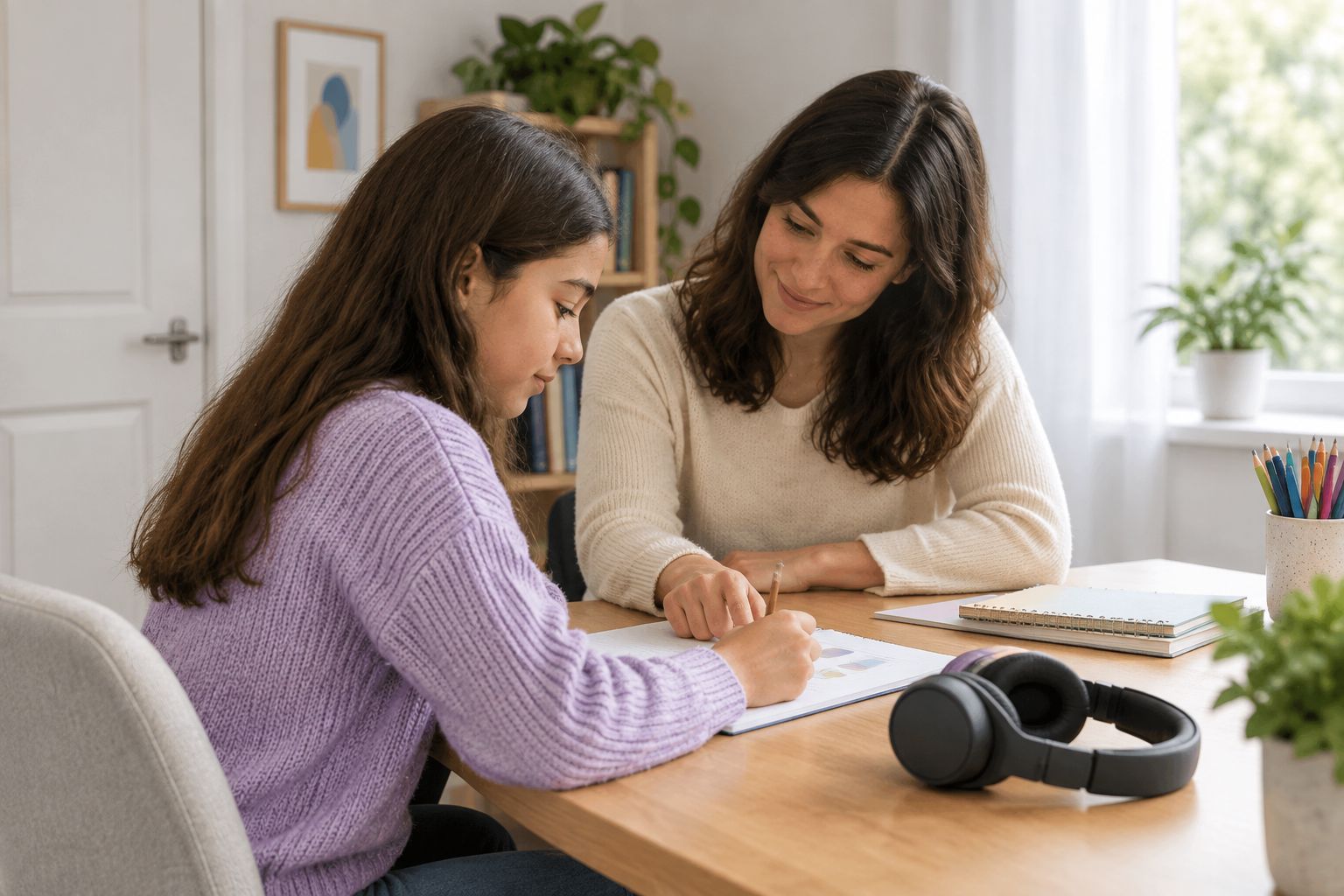
A student with auditory processing disorder often needs to see a word to fully receive it, even seconds after hearing it stated clearly. Writing things down isn't a workaround for laziness; it's the channel that actually lands.
- Write key instructions on a whiteboard or shared document before saying them aloud.
- Add captions to any video lesson, even from a trusted provider.
- Use diagrams or worked examples alongside verbal explanations in maths.
- Send a short written recap after every tutoring session covering what was taught.
Slow the pace and build in processing time
A pause that feels awkward to an adult is often exactly the length a student with APD needs to finish sorting a question before answering it.
- Wait at least five seconds after asking a question before repeating or rephrasing it.
- Avoid rapid-fire quizzing; ask one question, wait, then move on.
- Let the student control playback speed on any recorded lesson.
- Offer rereading of instructions instead of a second verbal repeat on request.
Break multi-step instructions into single steps
A three-part spoken instruction is often processed as one part by a student with auditory processing disorder, with the other two lost somewhere between the ears and the notebook.
- Give one instruction, wait for it to be followed, then give the next.
- Number steps in writing rather than listing them aloud.
- Ask the student to repeat the instruction back in their own words before starting.
Choose a tutoring format that doesn't depend on live listening
Live video tutoring modelled on a classroom lecture asks a student with APD to do the hardest thing for their brain in real time: track continuous speech with no pause button available. A tutor for auditory processing disorder should let the student reread, rewind or rework material at their own pace instead of racing a live clock.
Tia is a personalised tutor that adapts lesson pace and explanation style to each student rather than running a fixed script, and it teaches through the student's own interests instead of a generic worksheet set. Parents get a dashboard that shows honest engaged time, which is useful for confirming a student is actually processing the material rather than sitting through it.
- Look for a tutor or platform that lets the student pause and reread an explanation as many times as needed.
- Prioritise text and diagram-based teaching over long, unbroken audio or video segments.
- Ask whether the pace adjusts automatically to the student or only on request.
- Check whether progress reporting reflects genuine engagement rather than total time logged in.
Measure real engaged time, not just session length
A session log that says 45 minutes can hide 20 minutes of actual attention if the format keeps losing the student mid-explanation. Scheduled time and engaged time are two different numbers, and only one of them predicts progress.
- Ask any tutor or app how it defines 'engaged' versus simply 'logged in'.
- Review a tutoring dashboard weekly rather than trusting a single end-of-month summary.
- Compare engaged time against topics actually mastered, not just topics completed.
- Watch for high logged time paired with low mastery; that combination usually means the format is fighting the student's processing style.
Coordinate home practice with school support
Whatever a tutor works on should echo what the school is doing, not compete with it, especially where a student already has classroom accommodations in place.
- Share the tutor's topic list with the classroom teacher each term.
- Ask the school what classroom accommodations already exist for auditory processing, and mirror them at home.
- Keep a written record of progress that a parent can hand over at a school meeting without translation.
Comparing tutoring options for auditory processing disorder
None of these options is wrong on its own; the question is whether the format bends to the student's processing speed or asks the student to bend to it. As of 2026, families most often choose between a specialist in-person tutor, standard live video tutoring, an independent practice app, or a personalised adaptive tutor.
| Option | Best for | Key limitation |
|---|---|---|
| In-person specialist tutor | Families near a tutor trained in auditory processing support | Scheduling depends on one person's availability and location |
| Live video-call tutoring | A student who processes spoken language well and wants extra practice | Runs at a fixed pace with limited replay or pause control |
| Worksheet or workbook apps | Independent practice once a concept is already understood | No real-time explanation when the student gets stuck |
| Personalised tutor (Tia) | A student who needs the pace, replay and format to bend to how they process | Still needs a parent to check the dashboard to confirm real engagement |
Common mistakes parents make with APD tutoring
Assuming louder or slower speech alone fixes it. Auditory processing disorder is a processing gap, not a volume problem, so repeating an instruction louder just wastes the pause time the student actually needed.
Choosing tutoring by subject expertise alone. A brilliant maths tutor who lectures for 40 minutes straight is still a poor match, regardless of how well they know the subject.
Judging progress by minutes scheduled. A student can sit through a full hour and genuinely process fifteen minutes of it; scheduled time and engaged time are not the same measurement, and only one of them predicts real progress in 2026 report cards or homeschool records.
Waiting for a formal diagnosis before adjusting anything. Written recaps, single-step instructions and extra processing time help immediately, whether or not a formal evaluation has been completed. In-person specialists trained specifically in auditory processing support also remain hard to book quickly in many areas, so waiting for the 'right' tutor often costs a full term.
Dropping the written recaps once things seem to improve. Auditory processing disorder doesn't resolve on a good week; the workaround stays necessary even after real progress shows up on the dashboard.
FAQ
What is auditory processing disorder in a learning context?
Auditory processing disorder is a difficulty sorting and interpreting spoken sound quickly enough to keep pace with typical speech, even though hearing itself tests as normal. In lessons it shows up as missed instructions, requests to repeat, and slower written work despite understanding the content once it's seen in writing.
Is a personalised tutor better than a live video tutor for APD?
For most students with auditory processing disorder, yes: a personalised, self-paced tutor lets the student reread and rework material instead of tracking continuous live speech. Live video tutoring can still work well as extra practice once a concept is already understood.
How much does personalised tutoring cost in 2026?
Pricing varies by provider and country in 2026, so check the current pricing on the provider's own site before enrolling. What matters more for auditory processing disorder is whether the format lets the student control pace and repetition, regardless of price point.
Does APD tutoring require a formal diagnosis first?
No. Adjustments like written recaps, single-step instructions and extra processing time help a student whether or not a formal evaluation has been completed. A diagnosis mainly matters for securing formal school accommodations, not for starting tutoring.
Can Tia teach a student with auditory processing disorder?
Tia is a personalised tutor for Math, English and Science that adapts pace and explanation style to each student, which suits a student who needs to reread or slow down rather than follow a live lecture. Parents can review engaged time on a dashboard to confirm the format is actually working.
What's the difference between APD and ADHD in tutoring terms?
Auditory processing disorder is a speed and accuracy problem in sorting spoken sound; attention difficulties are a focus and impulse-control problem that can exist alongside normal auditory processing. The two often overlap, so a tutoring plan may need both processing-time supports and attention supports at the same time.
How do I know if my student needs written back-up instead of just repeating instructions?
If repeating an instruction more slowly or loudly doesn't help but writing it down does, that's a sign the gap is in processing speed rather than hearing or attention. Track which fix actually works over a week rather than guessing from a single instance.
Should tutoring sessions for APD be shorter than usual?
Shorter, more frequent sessions usually beat one long session, because sustained auditory or verbal processing tires a student with APD faster than a typical listener. Twenty to thirty focused minutes with real breaks often produces more mastery than a continuous hour.
One last thing
The detail parents miss most: a student with auditory processing disorder can test as gifted in reading comprehension and still fail a spoken quiz on the exact same passage, because the skill gap sits in real-time listening, not intelligence or literacy. Heading through the rest of 2026, score any tutoring format on whether it separates those two skills instead of grading both through the same spoken-response channel.