Tia News
Personalised Tutor for Ratios and Proportions: 2026 Guide
Personalised tutor for ratios and proportions in 2026: how to diagnose the gap, rebuild the fraction bridge, and choose the right support for your student.
By Tia Education Team · Published
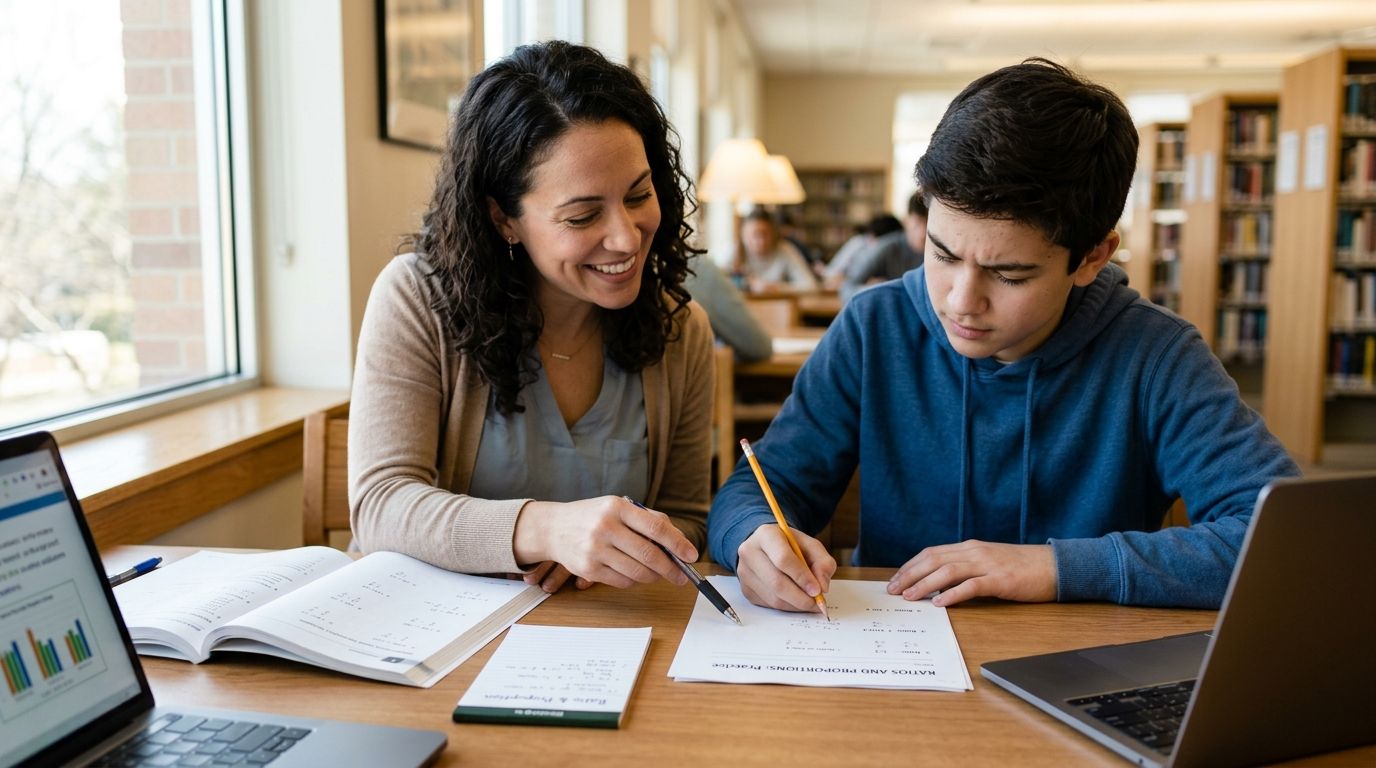
Students struggling with ratios and proportions usually aren't struggling with maths generally: they've hit one specific reasoning gap, and every worksheet after that gap just repeats the same confusion. A personalised tutor for ratios and proportions works by finding that exact breakpoint and rebuilding from there, at the student's pace, rather than cycling through more generic practice.
What makes this segment different from a student who's behind across the board is that ratios and proportions sit on top of fraction sense. If a student never fully locked in what a fraction represents, ratio notation (3:4, or "for every 3, there are 4") looks like a new alien language instead of a relabelling of something they already half know. That's why generic fractions support and ratio support overlap more than parents expect.
- A personalised tutor for ratios and proportions works by isolating the exact reasoning gap, usually a shaky fraction foundation, before adding new formulas.
- Tia adapts pace and difficulty per student and gives parents a live dashboard showing honest engaged time, not just pages completed.
- One-to-one tuition adds roughly five months' extra progress compared with no intervention, according to Education Endowment Foundation research.
- Visual models (bar models, ratio tables) should come before cross-multiplication, not after a failed attempt at the formula.
- Free worksheets and school catch-up sessions work for a quick refresher; ongoing one-to-one support works better for a genuine gap.
Why ratio and proportion support matters for this group of students
Ratios and proportions show up everywhere in the middle-grade curriculum: recipe scaling, map scales, unit rates, similar figures in geometry, even percentage problems later on. A student who never solidifies the concept in Grade 6 or 7 carries the gap forward into every proportional reasoning problem for years, including parts of algebra and chemistry.
Parents feel this pressure directly. According to the Washington Post, 51% of parents doubt their own ability to teach upper-grade material, and ratios and proportions is exactly the kind of topic where a parent's own schooling used a different method than the one the student is being taught now. That mismatch is often what turns a fifteen-minute homework question into a forty-minute argument.
The research on one-to-one support backs up why targeted help closes this gap faster than more worksheets. Bloom's two-sigma finding showed that average tutored students reached the 98th percentile compared with students in conventional classroom instruction, and the Education Endowment Foundation puts the typical gain from one-to-one tuition at roughly five months' extra progress. John Hattie's research adds a related point: teacher expectations are among the strongest influences on a student's achievement, which means how a tutor frames a wrong answer matters as much as the correction itself.
How to help a student who is struggling with ratios and proportions
Diagnose exactly where the reasoning breaks down
Before assigning more practice, find the specific step where the student's logic stops working. Most ratio confusion traces back to one of a handful of spots.
- Can the student explain what a fraction like 3/4 actually represents, in their own words
- Do they understand "for every" language before seeing a colon or fraction notation
- Can they scale a simple ratio up or down without a calculator (2:3 to 4:6)
- Do they confuse a ratio (part to part) with a fraction of a whole (part to whole)
- Can they set up a proportion from a word problem without being told which numbers go where
Rebuild the fraction to ratio bridge
Ratios are fractions with a different job. If step one revealed a fraction gap, close that first rather than pushing forward into cross-multiplication.
- Revisit equivalent fractions using the same visual models (fraction bars, number lines)
- Show the student that 3:4 and 3/4 use the same underlying relationship, phrased differently
- Practise converting between ratio notation and fraction notation until it's automatic
- Use physical objects (counters, coins) before moving to abstract numbers
Use visual models before formulas
Cross-multiplication is fast once a student understands proportions, but it's meaningless as a first move for a student who doesn't yet see the relationship. Models make the relationship visible.
- Bar models: draw two bars split into the ratio parts, then scale both
- Ratio tables: build a table of equivalent ratios by multiplying both sides by the same number
- Double number lines for rate and unit price problems
- Only introduce cross-multiplication once the student can solve a simple proportion using a model
Practise with real proportion word problems
Abstract number practice ('solve for x: 3/4 = x/12') doesn't transfer to real test questions, which are almost always framed as word problems. This is also where word problems support and ratio support overlap directly.
- Recipe scaling ('this serves 4, how much for 10')
- Map and scale drawing questions
- Unit rate and best-value comparisons (price per ounce, speed, pace)
- Similar figures and scale factor problems from geometry
- Mixing and concentration problems (paint, juice, cleaning solutions)
Track engaged time, not just completed pages
A student can sit with a worksheet open for forty minutes and be genuinely focused for six of them. This is where a personalised tutor for ratios and proportions like Tia earns its place in the routine: Tia adapts each session to the student's pace and interests, and the parent dashboard shows honest engaged time rather than just a completion checkmark. That distinction matters because a parent deciding whether extra support is working needs to know if the student is actually reasoning through problems, not just clicking through them.
- Look for a tracking method that separates "time open" from "time engaged"
- Ask whether the tool adjusts difficulty automatically when a student is guessing
- Check whether progress notes explain which specific ratio skill improved, not just a score
- Confirm the record can be exported or referenced for homeschool reporting if needed
Space out review sessions instead of cramming one topic
Ratio and proportion understanding fades fast if it's practised once and never revisited. Spaced review beats a single long session every time.
- Revisit ratio problems briefly a week after the initial lesson, then again after a month
- Mix ratio problems into unrelated topic practice so the student has to identify the method, not just apply it
- Rotate between models (bar model, ratio table, proportion equation) across sessions so the student isn't locked to one crutch
Match pace to the student, not the classroom calendar
A classroom moves at a fixed pace regardless of whether a given student has closed the gap yet. One-to-one support doesn't have that constraint.
- Slow down on the specific sub-skill that's weak, even if the class has moved on
- Speed up through material the student already has solid, so sessions don't feel repetitive
- Reassess every few weeks rather than assuming the plan from week one still fits
Comparing your options for ratio and proportion support
| Option | Best for | Format | Key limitation |
|---|---|---|---|
| Free worksheets and video refreshers | A quick review before a test | Self-paced, no feedback loop | No correction when the student picks the wrong method |
| School extra-help sessions | Catching up on one homework set | Scheduled, teacher-led, group setting | Limited one-to-one time per student |
| In-person private tutor | Families who want face-to-face sessions | Weekly, fixed schedule | Less flexible around pace changes week to week |
| Tia personalised tutor | Ongoing practice that adapts as the gap closes | On-demand, adaptive sessions with a parent dashboard | Requires a device and a quiet space to focus |
Verdict: for a student with a genuine, recurring gap in ratios and proportions rather than a one-off bad test, ongoing one-to-one support that adapts pace closes the gap faster than repeated worksheets. For a single upcoming quiz, a focused review session may be all that's needed.
Common mistakes parents make with ratio and proportion struggles
- Treating it as "more fraction worksheets" instead of directly naming the ratio-specific skill (setting up the proportion, identifying the scale factor) that's actually weak.
- Jumping to cross-multiplication first, before the student has a visual sense of what the two ratios represent.
- Assuming one bad test means "doesn't get maths", rather than isolating the exact step where the reasoning fails.
- Skipping review after the concept "clicks", then being surprised when it's gone a month later.
- Letting low expectations creep in. Hattie's research is clear that expectations shape achievement; a student told "this is hard for everyone" tends to perform closer to that expectation than one told the gap is closable with practice.
See how Tia teaches ratios and proportions
Adaptive Math sessions at your student's pace, with a live parent dashboard.
FAQ
What is the fastest way to help a student who is struggling with ratios and proportions?
Diagnose the exact reasoning gap first, usually a shaky fraction foundation or confusion between part-to-part and part-to-whole comparisons, then rebuild from a visual model before returning to formulas. Jumping straight to more practice problems without finding the gap tends to repeat the same confusion.
Is a personalised tutor better than worksheets for ratios and proportions?
For a genuine, recurring gap, yes: a personalised tutor adjusts to the specific skill that's weak and paces sessions around the student, while worksheets give the same practice regardless of where the student is stuck. For a quick refresher before one test, worksheets can be enough.
At what grade do students usually learn ratios and proportions?
Ratios and proportional reasoning are typically introduced around Grade 6 and built on through Grade 8, then reappear in geometry (similar figures, scale factor) and later in chemistry and statistics. A gap formed in Grade 6 tends to resurface in each of those later topics.
How do I know if my student's ratio problem is a fraction gap or a ratio gap?
Ask the student to explain what a fraction like 3/4 means in their own words. If they can't, the gap is upstream in fraction understanding, not in ratio notation itself, and that's the place to start.
Do bar models and ratio tables actually help, or are they a workaround?
Visual models like bar models and ratio tables build the underlying relationship a student needs before a formula like cross-multiplication means anything. Students who skip straight to the formula often apply it correctly on familiar problems but fail on word problems that require setting the proportion up first.
How is Tia different from a general homework help app for ratios and proportions?
Tia is a personalised tutor that adapts Math sessions to a student's pace and interests, and gives parents a live dashboard with honest engaged-time measurement rather than just a completion count. That distinction matters for judging whether extra support on ratios is actually working.
How often should a student review ratios and proportions once they understand it?
A brief review about a week after the initial lesson, then again after a month, keeps the skill from fading. Ratio reasoning that's practised once and never revisited is one of the more common reasons it resurfaces as a gap in later grades.
One last thing
The detail most parents miss: a student who can solve a ratio equation on a worksheet but freezes on the same ratio hidden inside a word problem doesn't have a maths gap, they have a translation gap. Practising the setup step, turning a sentence into a proportion, closes more ground in 2026 than another page of bare equations ever will.