Tia News
Personalised tutor for creative writing and storytelling
A personalised tutor for creative writing builds voice, structure and revision skills in 2026. See the step-by-step approach and what to track as a parent.
By Tia Education Team · Published
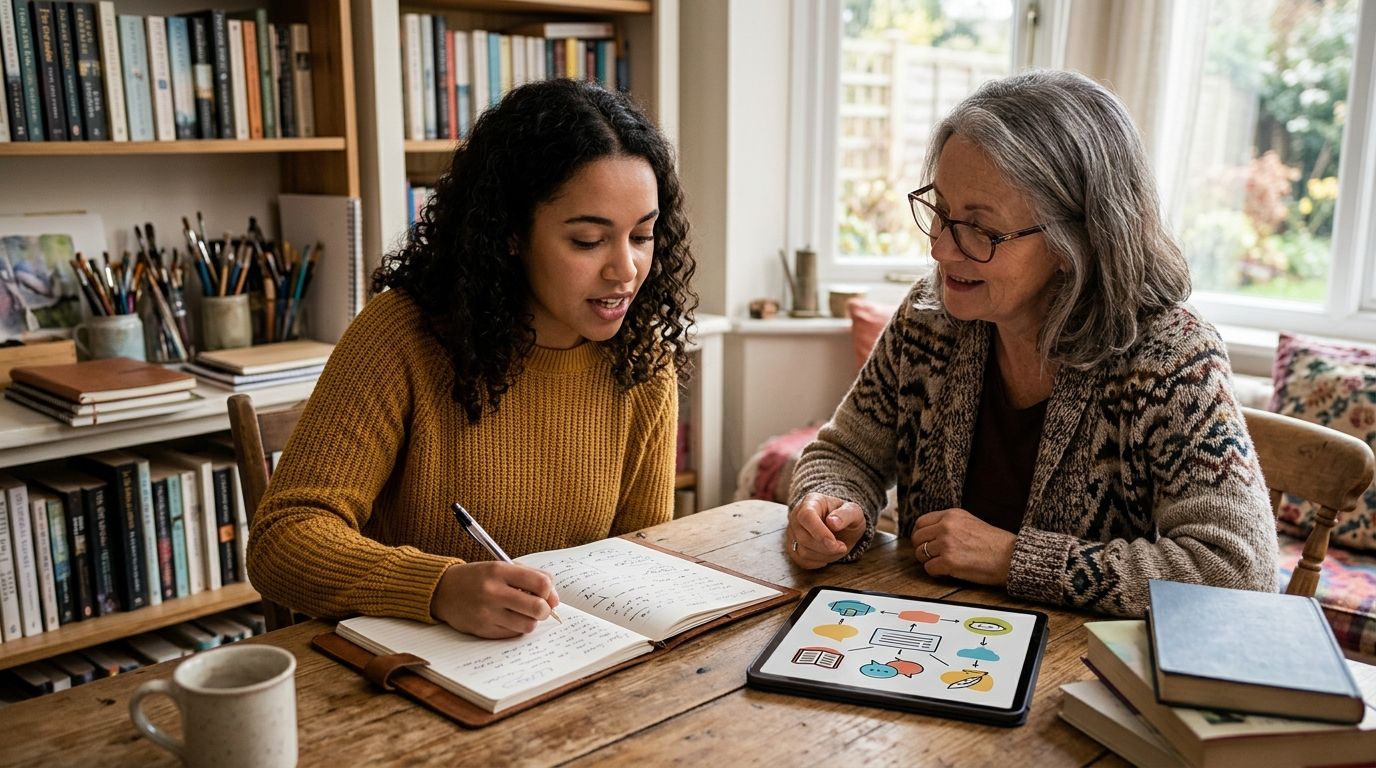
A personalised tutor for creative writing and storytelling, such as Tia, teaches students in grades 5 to 12 to draft, revise and find their own voice, one-to-one and at each student's pace, with the aim of turning a reluctant writer into a confident one. Creative writing students need feedback on ideas and voice before mechanics, which is a different rhythm from essay tutoring or exam prep, where structure and correctness usually come first.
- A personalised tutor for creative writing works best when feedback targets voice and structure before grammar.
- Tia adapts writing prompts to a student's interests and tracks engaged time, not just finished pages.
- The Education Endowment Foundation found one-to-one tuition adds roughly five months' extra progress on average.
- Free tools like freewriting and read-aloud revision solve many blocks before a tutor is needed.
- A personalised tutor for creative writing helps most once motivation or feedback quality has stalled.
Why personalised tutoring matters for creative writing students
Creative writing is the one subject where there is no single correct answer, which makes generic worksheets and one-size lesson plans a poor fit. A student who can outline a plot but freezes on the first line needs a different kind of help to a student who writes pages of dialogue but avoids description entirely.
Research on one-to-one instruction backs this up in general terms. The Education Endowment Foundation has found that one-to-one tuition adds roughly five months of additional progress compared with typical teaching, and Bloom's original two-sigma research found tutored students reaching, on average, the 98th percentile of a comparison group taught in a normal classroom. Neither study is specific to storytelling, but both point to the same mechanism a personalised tutor for creative writing relies on: attention calibrated to one student's actual sticking point, not a class average.
For homeschooling families this matters in a second way. State reporting often asks for a writing sample or portfolio, and self-writing records generated as a student completes pieces turn practice into documentation without extra admin. Tia is a personalised tutor, not a generic AI chatbot, and it adapts prompts, pacing and feedback to how a specific student writes while giving parents a live dashboard that measures engaged time rather than pages submitted.
How to build a creative writing routine that actually works
Diagnose what's actually blocking the story
Before adding any tool, find out whether the block is about ideas, structure, or fear of being judged. The fix differs for each one.
- Time a free write for 10 minutes and see exactly where the pen stops.
- Ask the student to tell the story out loud before writing a single word of it.
- Check whether mid-draft corrections are killing momentum.
- Compare a school-assigned sample against a self-chosen topic sample.
- Note whether the block shows up in fiction only, or across all writing tasks.
Build a daily low-stakes writing habit
Most writing blocks loosen with volume, not instruction. A short daily habit beats one long weekly session almost every time.
- Set a 10-minute timer and ban editing during that window.
- Use a random photo or object as a prompt when the student says there are "no ideas."
- Keep a running list of story ideas somewhere visible: a notes app or the fridge door.
- Let the student narrate a scene out loud before typing it.
- Skip grading the freewrites completely; they are practice, not product.
Teach story structure with a model, not a rulebook
Structure lessons land better when they come from a story the student already loves, not an abstract diagram on a worksheet.
- Map a favourite book or film onto a simple five-part story arc.
- Replace a five-paragraph outline with a one-page story map instead.
- Rewrite one scene from three different points of view to feel what structure actually changes.
- Read one published short story a week, purely as a structure model.
This is usually where a manual approach starts costing real time every week. A personalised tutor for creative writing such as Tia builds structure lessons around whatever genre a student already reads, fantasy, mystery, sports fiction, whatever holds their attention, and paces the lesson so a strong plotter isn't bored while a strong describer catches up. It pairs naturally with personalised essay-writing support once a student needs to carry the same structural instincts into school assignments.
Give feedback on voice before grammar
Correcting spelling in a first draft teaches a student to fear the page. Save it for later in the process.
- Read the piece aloud and mark where the student's own voice speeds up or slows down.
- Underline three strong verbs before circling a single spelling mistake.
- Ask which sentence the student would never actually say out loud, and why they picked it anyway.
- Save grammar marks for the final revision pass, not the first one.
Match mechanics practice to the story, not a worksheet
Grammar sticks better when it comes from a student's own sentence, not a textbook example about someone else's dog.
- Pull the lesson directly from a recurring mistake in the student's own draft.
- Turn one error into a two-minute mini-lesson instead of a full worksheet.
- Practise dialogue punctuation inside the student's own scene, not a generic sentence.
- Revisit the same error a week later to confirm it actually stuck.
A personalised tutor for grammar and writing mechanics can pull these micro-lessons straight from a student's own drafts automatically, which is faster than a parent combing through a paragraph line by line every night.
Give the story a real audience
Writing for a drawer kills motivation faster than any grammar mistake ever will.
- Read one finished paragraph aloud at dinner.
- Share a piece with a grandparent or family friend outside the household.
- Publish a short story on a class or homeschool co-op blog if one exists.
- Enter one age-appropriate writing competition a year, win or not.
Track growth beyond the grade
A single grade hides most of what actually changed in a student's writing. Track process, not just the finished product.
- Keep dated drafts in a folder to show progress across a term, not just a paper's final mark.
- Note engaged minutes on a piece, not just pages finished.
- Ask the student to pick their own "most improved" piece each month.
- Compare the first paragraph of a term's first draft with the first paragraph of its last.
Comparing your options for creative writing help in 2026
Each option below solves a different problem. None of them replaces all the others.
| Option | Best for | Key limitation |
|---|---|---|
| School English class | Baseline instruction, peer deadlines | Little one-to-one time for voice-level feedback in a full classroom |
| Writing club or critique group | Peer motivation, shared feedback | Feedback quality varies by group and isn't consistent week to week |
| Generic AI writing chatbot | Quick brainstorming, fast grammar checks | Doesn't track a student's growth over time or adapt to reading level |
| Personalised tutor for creative writing (Tia) | One-to-one feedback on voice and structure, with a parent dashboard | Doesn't replace class deadlines or peer critique |
“A personalised tutor for creative writing works best paired with a class deadline or a writing club, not instead of one.”
Common mistakes parents make with creative writing tutoring
- Correcting grammar on the first draft. This stops a story before it's fully told and teaches a student to write less, not better.
- Assigning a "serious" genre the student doesn't enjoy. A student who loves fantasy will write more, and better, in fantasy than in forced literary fiction.
- Grading by page count instead of engaged time. Three focused pages beat ten rushed ones almost every time.
- Comparing one student's story to a sibling's or classmate's. Voice isn't comparable the way a test score is.
- Skipping revision because a tired first draft "reads fine." Revision is where craft actually develops, not the first pass.
FAQ
What is a personalised tutor for creative writing?
A personalised tutor for creative writing is one-to-one instruction that adapts prompts, pacing and feedback to a specific student's writing level and interests, rather than a fixed curriculum or worksheet. Tia is one example built for students in grades 5 to 12.
How is creative writing tutoring different from essay tutoring?
Creative writing tutoring prioritises voice, structure and original ideas, while essay tutoring focuses on argument, evidence and a fixed format. Many students need both, but the feedback order should differ: voice first for stories, structure first for essays.
Can a personalised tutor help a student who hates writing?
Yes, when the tutoring starts with low-stakes freewriting on a topic the student already cares about, not a graded assignment. Most resistance to writing comes from fear of correction, not a dislike of storytelling itself.
Is a personalised tutor better than a generic AI writing chatbot for creative writing?
A personalised tutor adapts over multiple sessions and tracks a student's actual progress, while a generic AI chatbot answers one prompt at a time with no memory of prior sessions. For a single brainstorming session, a chatbot is fine; for building a skill across a term, one-to-one tutoring performs better.
How often should a student work with a creative writing tutor?
A short, consistent session two to three times a week builds more writing stamina than one long weekly session. Volume and consistency matter more than session length for creative writing specifically.
What should parents look for in a creative writing tutoring dashboard?
Look for engaged time on a piece, not just a submitted page count, plus a record of what was practised each session. A dashboard that only shows a grade hides most of what actually changed in the student's writing.
Does Tia use AI to tutor creative writing?
Tia is a personalised, adaptive tutor, not a generic AI chatbot. It adapts explanations, pacing and feedback to how each student writes and gives parents a dashboard with honest engaged-time measurement.
How much does personalised tutoring cost in 2026?
Pricing varies by provider and by country, and most personalised tutors charge either per subject or as a monthly bundle. Check the provider's site directly for the current rate in your currency.
One last thing
John Hattie's research on achievement found that teacher expectations are among the strongest single influences on student outcomes, ahead of many instructional techniques themselves. For creative writing in 2026, that translates into one simple move: tell a student their story is worth finishing before touching the grammar, then let a personalised tutor for creative writing handle the craft notes from there.