Tia News
Tia now teaches Nunavut students to the Alberta programs their schools use
Tia now supports Nunavut students in Grades 5 to 12 with Alberta Mathematics, English Language Arts and Science programs, with outcomes visible to parents.
By Tia Education Team · Published
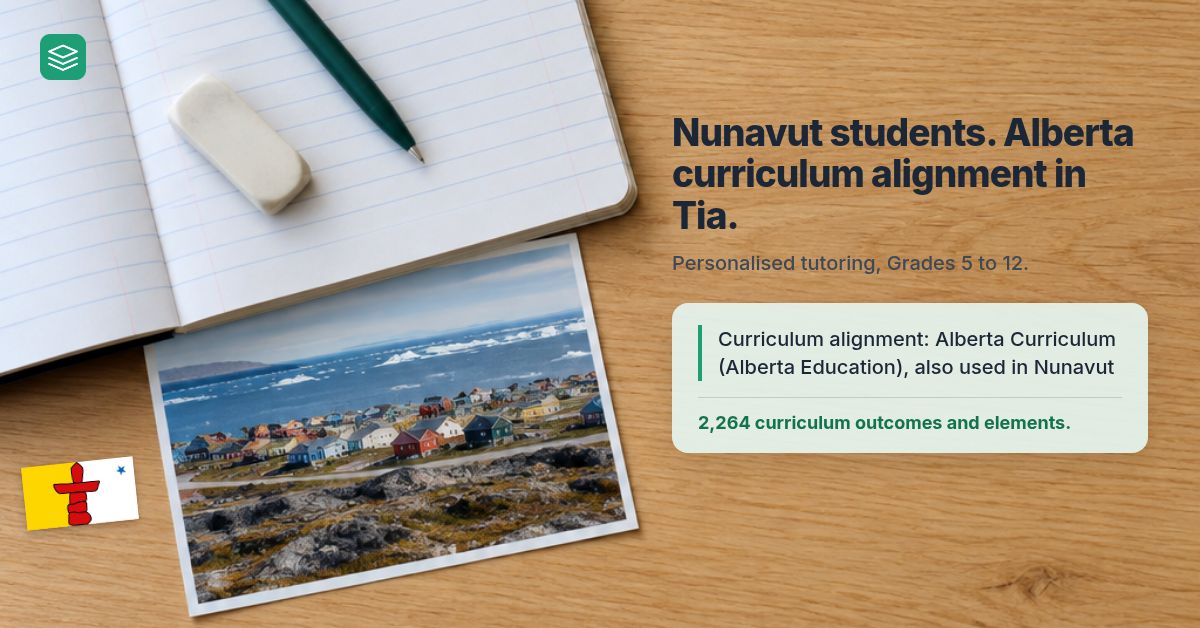
For a family in Iqaluit or Rankin Inlet, an online lesson is more useful when it follows the course their student actually studies. Tia is now live for Nunavut students from Grade 5 through Grade 12 with personalised tutoring aligned to Alberta's Mathematics, English Language Arts and Science programs used in Nunavut schools. Parents can see the outcomes a student worked on, not just the name of a general subject.
- Tia now aligns Nunavut students in Grades 5 to 12 with the named Alberta Mathematics, English Language Arts and Science programs used in their schools.
- Grades 5 and 6 use Alberta's new curriculum, Grades 7 to 9 use Alberta's Programs of Study, and Grades 10 to 12 use the named academic senior high courses.
- The alignment covers 2,264 curriculum outcomes and elements from Alberta Education's published documents.
- Parent reports name the Alberta Curriculum, note that it is used in Nunavut and list the specific outcomes worked on.
The course behind the lesson matters
A student practising Mathematics 10C and a student preparing for Biology 30 do not need a generic Grade 10 or Grade 12 Science label. They need the course name, its published outcomes and teaching that meets them where they are. Tia now uses the Alberta programs of study and senior course names that Nunavut schools use for these three subjects.
That is why a Nunavut progress report can read “Curriculum alignment: Alberta Curriculum (Alberta Education), also used in Nunavut”. It then lists the specific outcomes the student worked on in the source authority's wording. The curriculum comes from Alberta Education; the student and family are in Nunavut. Both details matter.
Tia adapts its explanations to the student's pace, level and interests. The parent can look at the outcome behind the work and decide what support comes next. A family whose student attends school can use it for extra practice. A family home schooling can use the same statement-level record to help document learning.
What is built into Tia from Grade 5 to Grade 12?
For Mathematics, English Language Arts and Science, the Nunavut alignment in Tia follows three stages of Alberta's published curriculum:
| Grade | Published Alberta program in Tia | Subjects and courses |
|---|---|---|
| Grades 5 and 6 | Alberta's new curriculum | Mathematics, English Language Arts and Science |
| Grades 7 to 9 | Alberta's Programs of Study | Mathematics, English Language Arts and Science |
| Grades 10 to 12 | Academic senior high courses | Mathematics 10C, 20-1 and 30-1; English Language Arts 10-1, 20-1 and 30-1; Science 10, Biology 20 and Biology 30 |
This is a subject and course map, not a claim that a student takes every listed course in one year. A parent selects the student's relevant level and course, and the report names the outcomes actually worked on. Alberta Education publishes the curriculum at new LearnAlberta, where families can look up the source programs.
A student in Grade 5 can practise a Mathematics concept tied to that grade's curriculum. A student taking English Language Arts 20-1 can work on the course's specific outcomes. A student in Biology 30 can take more time with a difficult idea while keeping the official course as the reference.
Grades 5 and 6: Alberta's new curriculum
For the two younger grades in this announcement, Tia follows Alberta's new curriculum in Mathematics, English Language Arts and Science. A student working on a concept can try a different explanation or take more time before moving ahead. The outcome in the published curriculum stays visible in the record.
The grade matters. A parent looking for Grade 5 support should be able to see that the lesson was matched to Grade 5 outcomes, not to a broad primary-school topic. The same applies to Grade 6. A progress report shows what the student worked on rather than turning time spent in the app into an unsupported claim of mastery.
For a student attending school in Nunavut, that can make extra practice easier to relate to a classroom subject. At home, it gives a parent a specific curriculum reference when reviewing the student's work. In either setting, the parent can remain involved without having to translate a generic activity name into a curriculum outcome.
Grades 7 to 9: Alberta's Programs of Study
At Grades 7, 8 and 9, Tia aligns the three subjects to Alberta's Programs of Study. Mathematics, English Language Arts and Science have their own grade-level outcomes, and the student's work is connected to those outcomes.
A Grade 8 student might need another route through a Mathematics idea. A Grade 9 student might practise explaining a Science concept or working through an English Language Arts task. Tia can adapt the explanation and pace while the report retains the program outcome as the reference.
This link between a lesson and its source is especially helpful when a parent asks what happened during a session. Instead of seeing only “Science completed,” they can see the particular outcome the student addressed. They can then decide whether more practice is useful or whether to move to the next topic.
Grades 10 to 12: the academic course names
Senior students use named courses, not just a general grade label. For Nunavut, Tia's new academic senior high alignment includes:
- Mathematics: Mathematics 10C, Mathematics 20-1 and Mathematics 30-1.
- English Language Arts: English Language Arts 10-1, 20-1 and 30-1.
- Science: Science 10, Biology 20 and Biology 30.
These course names matter to students making a plan. Mathematics 20-1 and 30-1 are not interchangeable labels, and Biology 20 and Biology 30 have distinct published outcomes. Tia identifies the selected course and works against its Alberta Education program rather than describing all senior study as generic Math, English or Science.
For a student in Iqaluit taking Mathematics 30-1, an explanation can change without losing the course reference. For a student in Rankin Inlet taking Biology 20, the parent can see which Biology outcome was practised. The same clarity applies to the English Language Arts sequence.
Tia supports learning and records the work done in Tia. It does not award school credits or replace a school's assessment of a course. A report of a practised outcome is not a claim that every part of a course has been completed.
What the 2,264 outcomes and elements mean
The Nunavut alignment contains 2,264 curriculum outcomes and elements across the supported grades and courses. They were taken directly from Alberta Education's published programs of study and checked word for word before going live in Tia.
The figure describes the curriculum material available for the named subjects, not a number of lessons, students or results. One outcome may take a student several sessions, and two students may need different explanations for the same idea. Tia adapts the route through the work while keeping the outcome as the reference in the report.
That distinction is useful for parents. The total describes what Tia can support. The individual report lists what their student actually worked on. It names the Alberta Curriculum and notes that the alignment is also used in Nunavut.
For a fuller explanation of what makes a report useful, see what parents should see in a tutoring dashboard. Families wanting to compare the underlying programs can use Alberta Education's curriculum site.
Support for school students and home schooling families
A student who attends school may want extra time on a concept after class, a new way to approach the same outcome or a chance to practise before the next topic. A family in Iqaluit, Rankin Inlet or another Nunavut community can choose the student's course in Tia and see the outcomes worked on in the progress report.
For home schooling families, Nunavut home schooling is arranged through the local District Education Authority (DEA). Tia's reports list the outcomes a student worked on and can support the records the family keeps. Families should confirm the current requirements for registration, educational planning and records with their own DEA. Tia does not claim that its reports satisfy those requirements.
Nunavut's Education Act describes home schooling programs and the roles of local education authorities. The report helps a parent review Tia learning; the DEA remains the right place to check how that record fits a particular home schooling arrangement.
FAQ
Does Tia support Nunavut students from Grade 5 to Grade 12?
Yes. For Mathematics, English Language Arts and Science, Tia now aligns students to the Alberta programs used in Nunavut schools across Grades 5 to 12.
Which curriculum does Tia use for Nunavut Grades 5 and 6?
Tia follows Alberta's new curriculum in Mathematics, English Language Arts and Science for Grades 5 and 6.
Which senior courses are included?
Mathematics 10C, 20-1 and 30-1; English Language Arts 10-1, 20-1 and 30-1; Science 10, Biology 20 and Biology 30.
How many outcomes are included?
The alignment covers 2,264 curriculum outcomes and elements from Alberta Education's published programs of study, checked word for word before going live in Tia.
What does a Nunavut parent see in the report?
The report names the Alberta Curriculum, notes that it is also used in Nunavut and lists the specific outcomes the student worked on.
Can home schooling families use Tia's progress reports?
The reports can support a family's records of learning. Families should confirm their particular home schooling requirements with their local District Education Authority; Tia does not claim its reports satisfy them.
A clearer record of the work
A student in Nunavut can now work in Tia against the Alberta course and outcomes relevant to their grade. Parents see the curriculum reference and the outcomes addressed, whether the student is getting extra support after school or learning at home. The tutoring stays personalised, and the parent stays in charge.
You are invited to start a trial at tia.coach. 14-day free trial, no card needed.