Tia News
Northern Territory, Year 5 to Year 12: Tia now teaches NTCET subjects
Northern Territory students can now use Tia for Australian Curriculum Years 5 to 10 and SACE English, Mathematics and Biology subjects toward the NTCET.
By Tia Education Team · Published
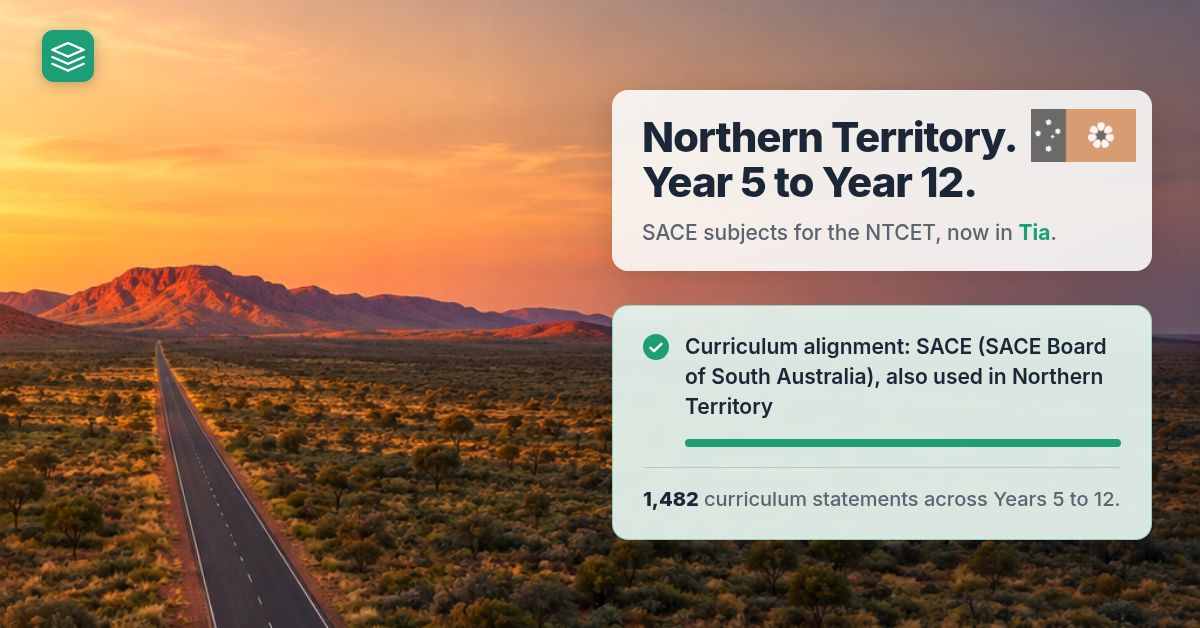
In parts of the Northern Territory, the trip to school is long and a classroom may bring several year levels together. A student still needs support matched to their own year and subject. Tia now gives families from Darwin to Alice Springs and remote communities personalised tutoring aligned to the curriculum taught from Year 5 to Year 12. Mathematics, English and Science in Years 5 to 10 follow Australian Curriculum Version 9. New for senior students are the SACE English, Mathematics and Biology subjects studied toward the Northern Territory Certificate of Education and Training (NTCET). This coverage is live now for families seeking support alongside school and for students learning at home.
- Tia now supports Northern Territory students from Year 5 to Year 12 using Australian Curriculum and named SACE senior subjects.
- Years 5 to 10 align to 390 Australian Curriculum descriptions in Mathematics, English and Science.
- Years 11 and 12 now align to 1,092 SACE subject outline statements across English, Mathematics and Biology.
- Parent reports name the curriculum and list the specific statements worked on in the publishing authority's wording.
Why SACE appears on an NT student's report
A student in Darwin studying Stage 2 Mathematical Methods works from the same SACE subject outline as a student in Adelaide taking that subject. The certificate earned in the Territory is the NTCET, not the South Australian Certificate of Education. The learning reference for these senior subjects is nevertheless the SACE Board of South Australia's own outline.
That distinction now appears in Tia. For a supported Year 11 or Year 12 subject, the parent's progress report names the alignment as “SACE (SACE Board of South Australia), also used in Northern Territory” and lists the statements worked on in the Board's wording. A parent can compare the work with the student's actual course instead of guessing what a generic senior subject label covers.
The SACE Board's NTCET information explains how SACE subjects contribute to the Northern Territory certificate. At Stage 1, the school assesses the work. At Stage 2, 30 per cent of work in each subject is assessed by SACE Board appointed markers, while the rest is school assessed and moderated. Tia supports learning against the outline; it does not mark formal assessments or award credits.
What Tia covers in Years 5 to 12
| Stage | Curriculum shown in Tia | Subjects in this release | Statements |
|---|---|---|---|
| Years 5 to 10 | Australian Curriculum Version 9 | Mathematics, English and Science | 390 |
| Year 11, Stage 1 | SACE Board subject outlines used for the NTCET | English, Mathematics and Biology | Part of 1,092 senior statements |
| Year 12, Stage 2 | SACE Board subject outlines used for the NTCET | English, Mathematical Methods and Biology | Part of 1,092 senior statements |
Together the younger and senior coverage contains 1,482 curriculum statements: 390 Australian Curriculum content descriptions in Years 5 to 10 and 1,092 SACE subject outline statements in Years 11 and 12. Each statement was taken directly from the publishing authority's documents and checked word for word before going live. These are curriculum references, not a count of lessons or guaranteed achievements.
For the younger years, a student studying fractions can work from the relevant Mathematics content description. A senior student taking Stage 2 Biology can work against the subject outline used for the NTCET. Tia adapts how a concept is taught to the student while the report retains the curriculum reference.
Years 5 to 10: Australian Curriculum Version 9
The Northern Territory teaches the Australian Curriculum in the younger years covered here. Tia aligns Mathematics, English and Science in Years 5 to 10 to Australian Curriculum Version 9. The 390 descriptions comprise 149 in Mathematics, 142 in English and 99 in Science.
For a student attending school, that offers another explanation or more practice after a lesson. A Year 5 student can spend more time with fractions; a Year 8 student can revisit a Science idea or practise an English skill. The lesson can change pace or approach without losing the link to the content description.
Parents can see which description was worked on. That is more useful than seeing only an activity title or the length of a session, particularly when a student moves between topics. The report records work in Tia; it does not replace the school's assessment.
The curriculum name also keeps the transition to senior study clear. A Year 10 Australian Curriculum session is reported against the Australian Curriculum. When a student begins a supported SACE Stage 1 subject, the report identifies that subject's SACE alignment.
Year 11: Stage 1 subjects used for the NTCET
The new Stage 1 subjects in Tia are English, Mathematics and Biology. For a Northern Territory student taking one of these subjects toward the NTCET, Tia uses the corresponding SACE Board subject outline rather than a broad Year 11 label.
A Stage 1 Mathematics student can revisit an earlier concept and work toward the statement in the current outline. In Biology, a student can try a different explanation while remaining anchored to the course. English practice is connected to its Stage 1 subject outline too. The parent sees the statements worked on, not a claim that every outline requirement was completed in one session.
Stage 1 is the Year 11 pathway described in this announcement. The NTCET also offers other subjects and ways of earning credits; this article describes Tia's named English, Mathematics and Biology alignments. Families can check the student's course selection with their school against the SACE Board's subject outlines.
Year 12: Stage 2 English, Mathematical Methods and Biology
The supported Stage 2 subjects are English, Mathematical Methods and Biology. A student in Alice Springs preparing for Stage 2 Mathematical Methods can work through the course's mathematics at their own pace. A student in Darwin taking Stage 2 Biology can revisit a concept, then see which Board statement the lesson addressed.
The senior Mathematics name matters: Stage 2 Mathematical Methods follows Stage 1 Mathematics in this Tia coverage. Parents looking at a report should see the outline their student uses, not just “Year 12 Mathematics”. English and Biology are likewise identified by their Stage 2 subjects.
The SACE Board's published NTCET information explains the formal Stage 2 assessment process. Tia gives students personalised teaching and a record of practice. Schools and SACE Board appointed markers retain their assessment roles, and Tia does not award the NTCET or an ATAR.
A student's next question might be whether a difficult idea needs a fresh explanation or more practice. The statement-level record gives the parent a place to start that conversation, rather than asking the student to summarise an entire subject from memory.
What the 1,482 statements mean
The figure describes curriculum coverage across the years and subjects in this announcement. 390 content descriptions come from Australian Curriculum Version 9 for Years 5 to 10. 1,092 statements come from the SACE Board's Stage 1 and Stage 2 outlines used for the named senior subjects. The total is 1,482.
The six subject-by-stage alignments at senior level follow the Board's own outline wording. Statements are checked word for word before being served in Tia. A progress report then lists only those the student worked on, so a parent can distinguish available coverage from completed work.
That matters when a student needs targeted support. Two students in the same year may spend different amounts of time on the same statement. Tia's adaptive approach can change the explanation and pace; the curriculum reference stays visible to the parent.
This Northern Territory release uses the same SACE source material as Tia's South Australia SACE guide, but the Territory report explicitly says the SACE alignment is also used in Northern Territory. The NTCET is the Territory's certificate.
What families can see in a progress report
In Years 5 to 10, the report names the Australian Curriculum and lists the relevant descriptions worked on. In Years 11 and 12, for the supported subjects, it names “SACE (SACE Board of South Australia), also used in Northern Territory” and lists the specific Board statements worked on. The wording follows the publishing authority.
A parent can see whether the session addressed a Year 6 Mathematics description or a Stage 2 Biology statement. That makes a school conversation more concrete. It also helps parents plan the next practice session based on what actually happened, rather than relying on a generic completion tick.
For a fuller view of what to look for in learning records, read what parents should see in a tutoring dashboard. Tia's report describes Tia sessions; it is not a school transcript or formal SACE Board result.
Alongside school and in home education
A student at school can use Tia for extra practice after class or a different route through a difficult explanation. In a remote community where several year levels share a classroom, that support can follow one student's actual year-level description or senior subject rather than a general class topic. Families in Darwin, Alice Springs and elsewhere in the Territory see the curriculum reference used for their student's stage. The parent stays in charge of when and how to use that support.
Families educating at home may keep Tia's statement-level reports alongside their own records. Northern Territory home education requires approval from the Department of Education and Training, and families must maintain evidence of learning. The Territory's home education guidance sets out the current process. Parents should confirm their own requirements with the Department. Tia does not claim its reports satisfy registration requirements.
Home education approval and NTCET certification are separate. The Territory's guidance says home education students do not receive the NTCET through home education. A family planning a senior certificate should confirm the student's available pathway directly with the Department. That does not change how Tia can support learning in the named curriculum; it clarifies how the formal credential is obtained.
FAQ
Does Tia follow the Northern Territory curriculum from Year 5 to Year 12?
Yes, for the subjects named here. Tia uses Australian Curriculum Version 9 for Mathematics, English and Science in Years 5 to 10, then SACE Board subject outlines for the supported Stage 1 and 2 subjects.
Why does an NTCET student's report say SACE?
The Northern Territory Certificate of Education and Training uses SACE subjects. Tia names the SACE Board of South Australia and clarifies that this alignment is also used in Northern Territory.
Which Year 11 subjects are now in Tia for NT students?
The new Stage 1 subjects are English, Mathematics and Biology, aligned to the SACE Board's outlines used for the NTCET.
Which Year 12 subjects are now in Tia for NT students?
The new Stage 2 subjects are English, Mathematical Methods and Biology, aligned to the SACE Board's outlines used for the NTCET.
How many curriculum statements does the NT alignment serve?
Tia serves 1,482 statements across Years 5 to 12: 390 Australian Curriculum content descriptions and 1,092 SACE subject outline statements.
Does Tia assess or award the NTCET?
No. Tia supports learning against named curriculum statements; schools and the SACE Board handle formal assessment and certification.
Can home educating families use Tia's progress reports?
The reports can support records of the statements worked on, but families must confirm registration requirements with the NT Department of Education and Training. Home education approval does not itself award the NTCET.
One last thing
An NT parent can now see the curriculum actually behind a supported Tia lesson: the Australian Curriculum through Year 10, and the SACE Board outline used for the NTCET in Stage 1 or Stage 2. The report shows which statements the student worked on. From Darwin to Alice Springs, that keeps the senior course name clear while the teaching adapts to the student.
You are invited to start a trial at tia.coach. 14-day free trial, no card needed.