Tia News
Tia Now Teaches to the New Brunswick Curriculum
New Brunswick curriculum tutoring with 2,296 checked English, Mathematics and Science descriptors. Personalised support for Grades 5 to 12.
By Tia Education Team · Published
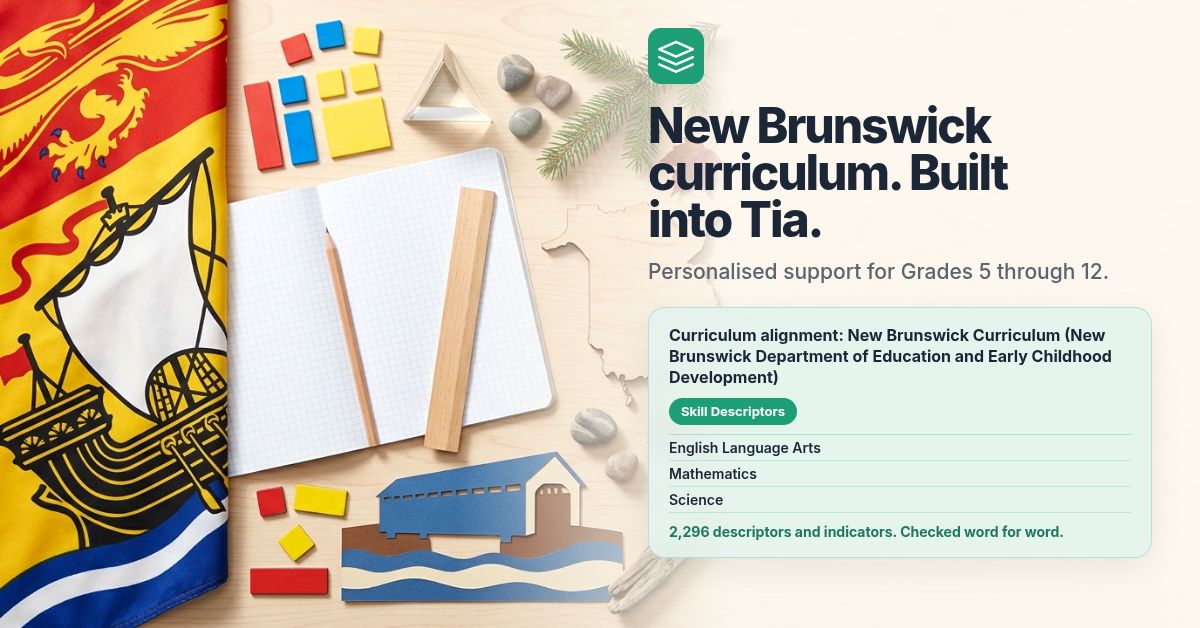
New Brunswick's anglophone curriculum is now built into Tia. Families can use personalised tutoring aligned to the Department of Education and Early Childhood Development's own skill descriptors and achievement indicators.
- The New Brunswick curriculum is live now in Tia.
- English Language Arts and Science cover Grades 5 to 12; Mathematics covers Grades 6 to 12.
- Tia carries 2,296 skill descriptors and achievement indicators in the Department's wording.
- The renewed curriculum published for 2026-27 is included.
- Progress reports name the indicators each student worked on.
New Brunswick's curriculum sets the destination. Tia adapts the pace, level and explanation to the student, while parents see the exact indicators covered.
The New Brunswick curriculum is live now in Tia
Tia now teaches English Language Arts and Science aligned to New Brunswick's anglophone curriculum at every grade from 5 through 12. Mathematics is aligned at Grades 6 through 12.
That coverage is stated deliberately. English Language Arts and Science begin at Grade 5 in Tia. Mathematics begins at Grade 6. All three continue through the New Brunswick high school courses listed below.
| Learning area | Coverage in Tia |
|---|---|
| English Language Arts | Every grade from 5 through 12 |
| Science | Every grade from 5 through 12 |
| Mathematics | Grades 6 through 12 |
Parents can review the source curriculum on the Department's official New Brunswick Curriculum site.
You are invited to start a trial with Tia and choose the New Brunswick curriculum. 14-day free trial, no card needed.
The renewed 2026-27 curriculum is included
New Brunswick has renewed its anglophone curriculum around Big Ideas and Skill Descriptors, supported by grade-by-grade Achievement Indicators. Tia includes the renewed curriculum the Department published for the 2026-27 school year.
The structure is preserved rather than reduced to a list of topic names:
- Strands organise each learning area.
- Big Ideas identify the central understanding.
- Skill Descriptors state what students should know and be able to do.
- Achievement Indicators show what meeting the descriptor looks like at a particular grade or course.
- Global Competencies remain alongside each descriptor for reference.
This matters because a topic name does not show the full expectation. Two students can both be working on algebra while facing different year-level indicators.
A Grade 7 student working on linear relations receives support connected to the Grade 7 indicator. A Grade 11 student studying functions receives help pitched to Pre-Calculus 110, in the Department's language.
The 2026-27 provincial indicator stays fixed as the destination. Tia changes the explanation, pace and examples to help the student reach it.
2,296 descriptors and indicators checked word for word
Tia carries 2,296 skill descriptors and achievement indicators across the three learning areas:
- 1,022 for English Language Arts
- 863 for Mathematics
- 411 for Science
The content was taken directly from the Department's published curriculum on curriculum.nbed.ca. Each descriptor and indicator was checked word for word before going live in 2026.
The Department's wording is preserved in Tia and in parent progress reports. Its Global Competencies remain alongside each descriptor for reference.
Mathematical notation is also carried as the Department publishes it. Fractions, powers, roots and other mathematical forms are not flattened into plain text.
“We worked from the Department's own published curriculum because a summary can lose the relationship between a Big Idea, a Skill Descriptor and its Achievement Indicators. We kept New Brunswick's structure so lessons and reports reflect how the Department expects learning to be understood.”
A parent can connect the wording in a Tia report with the relevant grade, course and learning area on the Department's curriculum site.
Grades 5 through 8 are taught grade by grade
Tia follows New Brunswick's grade-level expectations through the elementary and middle years.
English Language Arts and Science are available from Grade 5. Mathematics is available from Grade 6. Each lesson begins with the relevant Skill Descriptor or Achievement Indicator for that grade.
For a Grade 7 student studying linear relations, Tia can change the route without changing the target. It can use a visual model, a practical example or smaller steps, then return to the indicator the Department expects.
The same principle applies across English Language Arts and Science. A student can receive another explanation while the lesson stays connected to the correct Big Idea, descriptor and indicator.
The curriculum language also gives parents a precise record. Instead of seeing only that a student worked on Mathematics, a parent sees which indicator was covered.
High school follows New Brunswick courses
From Grade 9 onward, Tia follows the courses New Brunswick students take. It does not combine high school into one generic sequence.
Mathematics courses
- Mathematics 9
- Geometry, Measurement and Finance 10
- Number Relations and Functions 10
- Pre-Calculus 110
- Pre-Calculus A 120
- Pre-Calculus B 120
English Language Arts courses
- English Language Arts 9
- ELA Extended 10
- ELA 111, 112 and 113 Extended
- ELA 121, 122 and 123
Science courses
- Science 9: Ecosystem Dynamics
- Science 10: Science for Sustainable Societies
- Biology 111 and 112
- Biology 121 and 122
Course-level alignment makes a practical difference. A student working on Pre-Calculus 110 functions gets support tied to that course's achievement indicator. A Biology 112 student gets help connected to the Department's Biology expectations.
The lesson remains personalised, but the curriculum target is recognisably New Brunswick's.
What a New Brunswick-aligned lesson looks like
Curriculum alignment should shape the lesson, not simply appear as a label in settings.
A New Brunswick-aligned lesson begins with the relevant descriptor or indicator for the student's grade or course. Tia then adjusts how the student works toward it.
Tia can:
- slow down an explanation
- revisit an earlier skill beneath the current indicator
- change the example
- use the student's interests to make an idea more concrete
- offer another practice activity before moving forward
- preserve the Department's mathematical notation
- record the descriptors and indicators covered
The student gets a personalised route without losing sight of the provincial expectation.
For a Grade 7 Mathematics student, that may mean plotting a relationship visually before writing it symbolically. For a Pre-Calculus 110 student, it may mean breaking a function problem into smaller steps while keeping the course indicator in view.
Progress reports name the indicators covered
Every Tia progress report names the New Brunswick curriculum and lists the specific Skill Descriptors and Achievement Indicators the student worked on.
The report uses the Department's wording. A parent sees more than “worked on math” or “completed science.”
A report can show:
- New Brunswick Curriculum as the curriculum alignment
- the learning area, grade or high school course
- the Strand and Big Idea
- the specific Skill Descriptor
- the Achievement Indicator covered
- the related Global Competencies
- the learning activity
- progress and honest engaged time
That detail makes the report useful during a teacher conversation, when reviewing schoolwork or when deciding what the student should revisit next.
It also lets parents compare extra support with the terms used in the student's New Brunswick classroom.
For more on useful learning records, read what parents should see in a tutoring dashboard.
A New Brunswick curriculum tutor alongside school
Students attending anglophone public or independent schools can use Tia for extra support after school, on weekends or during breaks.
A student may need help because a class moved forward before one idea felt secure. Another may understand the topic but need a different explanation before demonstrating the relevant indicator independently.
Families searching for a New Brunswick tutor can use Tia as:
- a New Brunswick English tutor from Grades 5 through 12
- a New Brunswick Science tutor from Grades 5 through 12
- a New Brunswick Math tutor from Grades 6 through 12
- support for a specific high school course
- practice connected to the renewed 2026-27 curriculum
- a clear record of the indicators covered
The student gets another way into the material. The parent can see how the work connects to New Brunswick's anglophone curriculum.
New Brunswick home schooling support
New Brunswick home schooling requires approval from the school district. Families submit the annual application through their district and remain responsible for the education programme they provide.
The Department provides the application and home schooling information through its official anglophone K-12 services.
Tia progress reports can support the records a family keeps by listing:
- the learning area studied
- the grade or high school course used for alignment
- the specific Skill Descriptor
- the Achievement Indicator covered
- the Department's wording
- the learning activity
- progress and engaged time
Families should confirm current approval, programme and record requirements with their school district.
Tia does not claim that its reports satisfy any home schooling requirement. Parents remain responsible for district approval, their programme and their records.
For families comparing New Brunswick home schooling curriculum options in 2026, indicator-level reports make it easier to connect daily learning with the provincial curriculum they have chosen to follow.
New Brunswick joins six provinces with local curriculum
New Brunswick joins Alberta, British Columbia, Quebec, Manitoba, Saskatchewan and Nova Scotia as provinces with their own curriculum in Tia.
The seven are:
- New Brunswick
- Nova Scotia
- Alberta
- British Columbia
- Quebec
- Manitoba
- Saskatchewan
Students in other Canadian provinces currently follow Ontario's curriculum, which is named on their Tia progress reports.
Provincial curricula are not interchangeable. New Brunswick uses its own Strands, Big Ideas, Skill Descriptors, Achievement Indicators and high school courses. Tia preserves that organisation rather than presenting every Canadian student with one generic sequence.
Families can also read how Nova Scotia's curriculum is built into Tia and how British Columbia's curriculum is built into Tia.
FAQ
Is the New Brunswick curriculum live in Tia now?
Yes. New Brunswick's anglophone curriculum is live now in Tia for English Language Arts, Mathematics and Science.
Which New Brunswick grades are covered?
English Language Arts and Science cover every grade from 5 through 12. Mathematics covers Grades 6 through 12.
Does Tia include New Brunswick's renewed 2026-27 curriculum?
Yes. Tia includes the renewed curriculum the Department published for the 2026-27 school year.
How many New Brunswick curriculum statements are built into Tia?
Tia carries 2,296 skill descriptors and achievement indicators: 1,022 for English Language Arts, 863 for Mathematics and 411 for Science.
Does Tia preserve New Brunswick's curriculum structure?
Yes. Tia keeps the Strands, Big Ideas, Skill Descriptors, Achievement Indicators and related Global Competencies.
Which New Brunswick high school courses are covered?
Coverage follows the listed provincial Mathematics, English Language Arts and Science courses from Grade 9 through Grade 12.
Do progress reports show New Brunswick indicators?
Yes. Every report names the New Brunswick curriculum and lists the descriptors and indicators covered in the Department's wording.
Can home schooling families use Tia?
Yes. Families can use New Brunswick-aligned tutoring and indicator-level reports to support their records. They should confirm current requirements with their district.
One last thing
New Brunswick families should not have to choose between provincial curriculum alignment and support that adjusts to the student. In 2026, Tia brings both together: the Department's indicators define the destination, personalised tutoring changes the route, and progress reports show exactly what was covered.