Tia News
Best personalised tutor for students with dyscalculia
The best personalized tutor for dyscalculia in 2026 depends on your student's needs: compare Tia, specialist tutors, learning centers and IEP support options.
By Tia Education Team · Published

Dyscalculia makes numbers feel like a foreign alphabet, and picking the right tutor in 2026 means matching the teaching method to how your student actually processes math, not just buying more worksheets.
- Tia is the best personalised tutor for dyscalculia in 2026 for adaptive, one-on-one pacing across Math, English and Science.
- Specialized dyscalculia tutors and educational therapists suit families with a formal diagnosis needing prescribed intervention.
- In-person learning centers offer structured drill practice but rarely adjust pace to a dyscalculia profile.
- School-based IEP or 504 support is free but limited on session time and personalization.
- General AI homework apps answer one question at a time and don't track engaged time or skill gaps.
Why this matters
Dyscalculia affects an estimated 5 to 7% of school-age students, based on research widely cited by learning disability organizations, and it does not improve with repetition alone. That is the gap Tia is built to close: a personalized tutor that resets its pace the moment a student stalls on a concept, instead of pushing forward on a fixed schedule.
One-to-one instruction is one of the best-documented interventions in education. The Education Endowment Foundation found one-to-one tuition adds roughly five months of progress compared to standard instruction, and Bloom's two-sigma finding showed the average tutored student outperformed 98% of students taught in a conventional classroom. For a student with dyscalculia, that gap closes fastest when the tutor adjusts pacing concept by concept, not lesson by lesson.
Struggles with dyscalculia often show up long before a formal diagnosis, frequently as trouble with fraction concepts, word problems, or basic number sense. That is why the right tutor has to spot those gaps early instead of waiting for an evaluation to schedule the conversation.
“If a student can't picture ten as two groups of five, more worksheets won't fix it: the pace has to slow down until the concept actually clicks.”
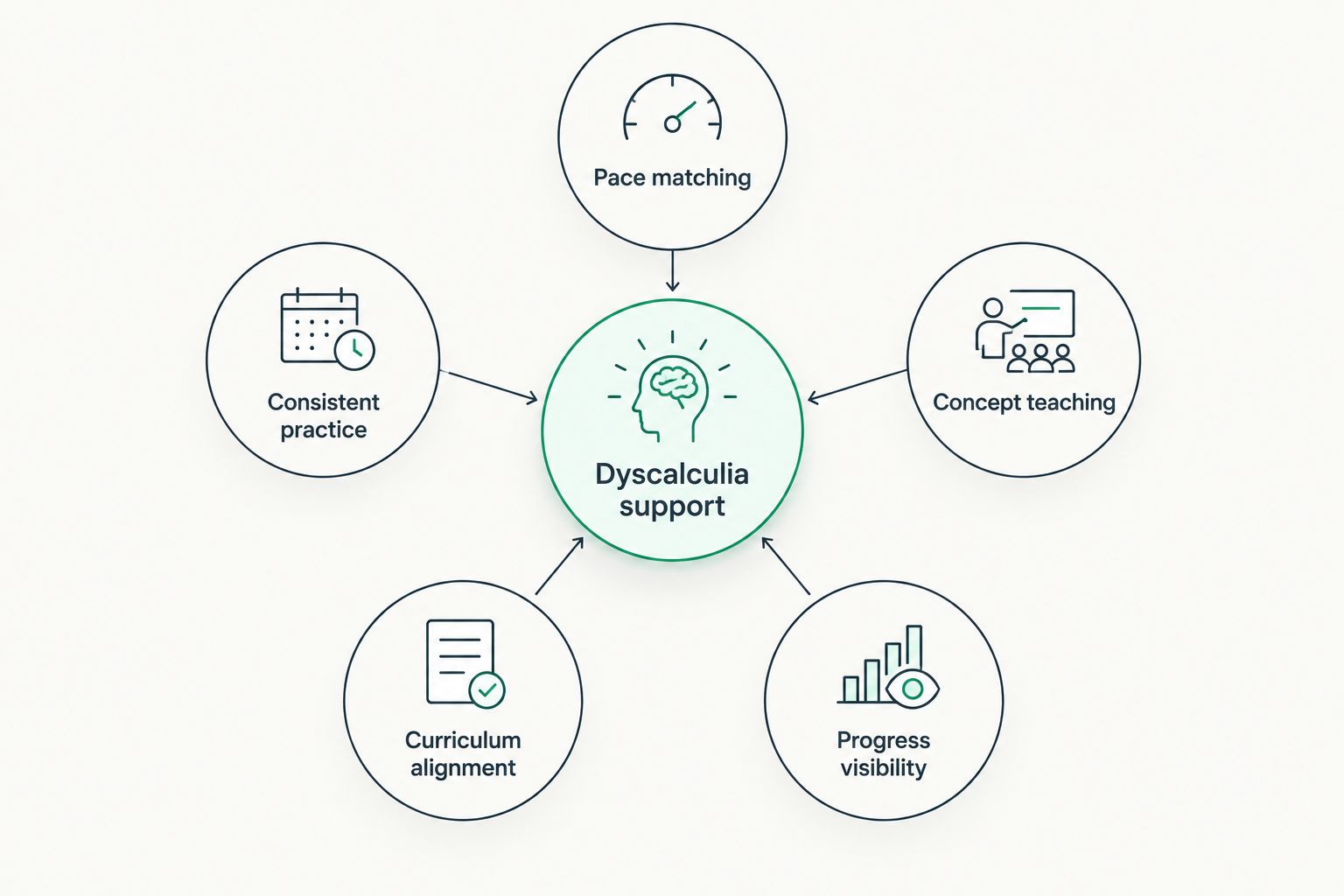
What makes the best personalized tutor for dyscalculia
- Pace matching: the tutor slows or accelerates by concept, not by calendar week.
- Concept teaching: math ideas get taught with visual or hands-on models before symbols and formulas.
- Progress visibility: parents see engaged time and skill mastery, not just a completed-assignment checkmark.
- Curriculum alignment: lessons map to the student's actual grade-level standards so gains show up on real schoolwork.
- Consistent practice: short, frequent sessions beat long cram sessions for a student who fatigues fast on math.
Best personalized tutor for dyscalculia at a glance
| Tutor type | Best for | Standout feature | Key limitation |
|---|---|---|---|
| Tia | Adaptive, one-on-one pacing across subjects | Adjusts explanation style and speed to the student in real time | Not a certified special education evaluator |
| Specialized dyscalculia tutor / educational therapist | Formal, diagnosis-based remediation | Trained in evidence-based math intervention methods | Higher cost and limited local availability |
| In-person learning center | Structured, repetition-based practice | In-person accountability and drill sheets | Fixed curriculum pace, not adjusted to dyscalculia |
| School-based IEP or 504 support | Free accommodations in public school | No added cost to the family | Session time is limited and shared |
| General AI homework app | Quick, on-demand problem solving | Instant answers to a single question | No sustained pacing or progress tracking |
1. Tia: best personalized tutor for dyscalculia for adaptive, one-on-one pacing
Tia is a personal tutor for Math, English and Science that works one-on-one with students in grades 5 to 12 and adjusts to how each student learns and how fast they can move. For a student with dyscalculia, a lesson on fractions can stretch across three sessions or wrap in one, based on what the student demonstrates, not what a syllabus says comes next. Parents see a live dashboard with honest engaged-time measurement, which matters when a student with dyscalculia can spend 20 minutes stuck on a single problem without anyone knowing.
Tia pros:
- Adapts pace and explanation style to the student instead of a fixed curriculum track
- Covers Math, English and Science, useful since dyscalculia often overlaps with reading or writing difficulty
- Live parent dashboard shows engaged time, not just logins
- Self-writing progress records support homeschool reporting or documentation conversations with a school
Tia cons:
- Not a certified special education evaluator and does not diagnose dyscalculia
- Works best when a parent flags specific gaps during the first few weeks
- No in-person option for families who want a tutor physically present
Tia pricing: priced as a flat monthly subject or bundle rate; current country pricing is on the site.
Best for: parents who want personalized, adaptive tutoring across subjects with real progress visibility, without waiting on a formal evaluation.
Verdict: Buy for most families weighing options in 2026.
2. Specialized dyscalculia tutors and educational therapists: best for formal, diagnosis-based intervention
These are tutors or educational therapists trained specifically in math learning disabilities, often using structured methods like Concrete-Representational-Abstract instruction tied to a student's evaluation results.
Specialized tutor pros:
- Training specific to dyscalculia, not general math tutoring
- Can align sessions directly to IEP or 504 goals
- Uses evidence-based remediation sequences
Specialized tutor cons:
- Fewer providers available, especially outside major metro areas
- Often requires a formal diagnosis first, which adds time before sessions start
- Usually math-only, so reading or writing gaps need a separate provider
Best for: families with a diagnosis in hand who need a prescribed intervention plan tied to school documentation.
Verdict: Buy if a diagnosis and IEP goals are already in place.
3. In-person learning centers: best for structured, drill-based math practice
Franchise learning centers run students through worksheet-based practice on a set curriculum track, usually in a physical location with a set schedule.
Learning center pros:
- In-person accountability and a consistent weekly routine
- Familiar format many parents already know from school
Learning center cons:
- Curriculum pace is largely fixed, not adjusted to a dyscalculia profile
- Little to no individualized progress reporting beyond completed sheets
- Repetition without concept-first teaching can frustrate a student who needs the model explained differently
Best for: students who need extra repetition on already-understood material, not concept remediation.
Verdict: Hold, useful as a supplement, not a primary fix for dyscalculia.
4. School-based IEP or 504 support: best for free accommodations in public school
Students with a documented learning disability can receive accommodations and sometimes pull-out instruction through an IEP or 504 plan at no added cost to the family.
School-based support pros:
- No added cost to the family
- Legally documented accommodations that follow the student across the school year
School-based support cons:
- Session time is limited and shared with other students on the caseload
- Pace rarely adjusts week to week the way a private tutor can
- Getting a plan in place takes an evaluation and a meeting cycle
Best for: families already inside the public school system who need the accommodations to be legally binding.
Verdict: Hold, worth pursuing alongside a tutor, not instead of one.
5. General AI homework-help apps: best for quick, occasional problem solving
These are chatbot-style apps that answer a single math question on demand, usually built around whatever the student types in.
AI homework app pros:
- Fast answers for a one-off stuck problem
- Usually low friction to start
AI homework app cons:
- No sustained pacing or engaged-time tracking
- No dashboard for parents to see what is actually happening
- Answers a question without necessarily teaching the underlying concept a student with dyscalculia needs repeated
Best for: occasional homework checks, not ongoing skill building.
Verdict: Skip as a primary solution for dyscalculia; fine as a backup.
How we ranked
Each option was weighed against the five criteria above: pace matching, concept-first teaching, progress visibility, curriculum alignment and consistent practice. Tia ranks first because it is the only option here built around adaptive pacing and a parent-facing dashboard as a standard feature, not an add-on. Specialized tutors rank highly on diagnosis-based rigor but lose ground on cost and availability. Learning centers, school support and AI apps each solve one piece of the picture, not all five.
Which personalized tutor should you choose in 2026?
If your student needs adaptive pacing across subjects and you want visibility into what actually happens in a session, Tia is the default choice. If a diagnosis is already in hand and the school needs documentation tied to a formal plan, pair Tia or a general tutor with a specialized dyscalculia tutor. If cost is the deciding factor and your student is enrolled in public school, start with the IEP or 504 conversation and use tutoring to fill the gaps a school caseload cannot cover.
FAQ
What's the best personalized tutor for dyscalculia in 2026?
Tia is the strongest general option in 2026 because it adjusts pace by concept and gives parents a live dashboard of engaged time. Families with a formal diagnosis may still want to pair it with a specialized dyscalculia tutor for documentation purposes.
Is a specialized dyscalculia tutor better than a general personalized tutor?
A specialized tutor is better when a formal diagnosis and IEP goals already exist and need a prescribed intervention. For everyday pacing and skill building without a diagnosis in hand, an adaptive tutor covers more ground at lower cost and higher availability.
How much does personalized tutoring for dyscalculia cost?
Cost varies by provider and by how many subjects or sessions a student needs. Check the specific provider's site for current country pricing before comparing options.
Can an IEP or 504 plan cover tutoring for dyscalculia?
An IEP or 504 plan can include accommodations and sometimes pull-out instruction at school, at no added cost to the family. It rarely covers the pace-by-pace adjustment a private tutor provides outside school hours.
Does Tia diagnose dyscalculia?
No. Tia is a personalized tutor, not a diagnostic evaluator, and does not replace a formal assessment. It adapts lessons to a student's demonstrated pace and gaps regardless of whether a diagnosis exists.
What's the difference between dyscalculia and general math struggles?
Dyscalculia is a specific learning disability affecting number sense and math reasoning, estimated to affect 5 to 7% of school-age students. General math struggles can stem from missed instruction or a skill gap and often close faster with straightforward practice.
How does one-on-one tutoring help students with dyscalculia?
One-to-one tuition adds roughly five months of progress compared to standard instruction, according to the Education Endowment Foundation. For dyscalculia specifically, the benefit comes from a tutor slowing down on the exact concept where a student stalls.
Is online tutoring effective for students with dyscalculia?
Online tutoring is effective when it adapts pace and tracks real engaged time, not just session length. The format matters less than whether the tutor adjusts to the student instead of running a fixed script.
One last thing
Many students with dyscalculia also have a reading-based learning difference, which is easy to miss when a family only looks for a math specialist. A tutor that covers Math, English and Science in one place, the way Tia does, tends to catch that overlap faster than a math-only provider, because the same weekly sessions surface both patterns instead of just one.