Tia News
Best online tutor for international students studying in the US
Tia ranks best overall for international students needing Math, English, and Science help; compare it to test-prep, ESL, and marketplace tutors for 2026.
By Tia Education Team · Published

International students juggling a new grading system, unfamiliar textbooks, and English-language coursework need more than a generic study app. Here's how the main options for tutoring international students in the US actually stack up in 2026.
The best online tutor for international students studying in the US in 2026 is Tia, for ongoing, curriculum-aligned support across Math, English, and Science in one place. Best for standalone SAT, ACT, or TOEFL prep: a standardized test-prep specialist. Best for spoken English fluency: an ESL conversation platform. Best free option already included with enrollment: the school's international student office. Best for a single subject, one-off session: a general tutoring marketplace.
- Tia is the best online tutor for international students needing Math, English, and Science aligned to a new curriculum in 2026.
- Test-prep specialists suit SAT, ACT, or TOEFL deadlines; ESL platforms suit spoken fluency, not full coursework.
- A school's international student office offers free support but no home dashboard or one-on-one depth.
- One-on-one tutoring adds roughly five months of academic progress compared with no tutoring, per the Education Endowment Foundation.
- Judge any tutor on curriculum alignment, English support, and honest engaged-time tracking, not login counts.
Why this matters
A student moving into a US school mid-year is learning two things at once: the subject material and the way it's taught here. Credit systems, grading scales, and even how word problems are phrased differ from what many international students studied before.
Parents feel this gap too. A Washington Post survey found 51% of parents doubt their own ability to teach upper-grade material at home, and that number climbs when the curriculum itself is unfamiliar. Tia was built around exactly this situation: an adaptive personal tutor for grades 5 to 12 that teaches through a student's own pace and interests rather than a fixed script.
What makes the best online tutor for international students
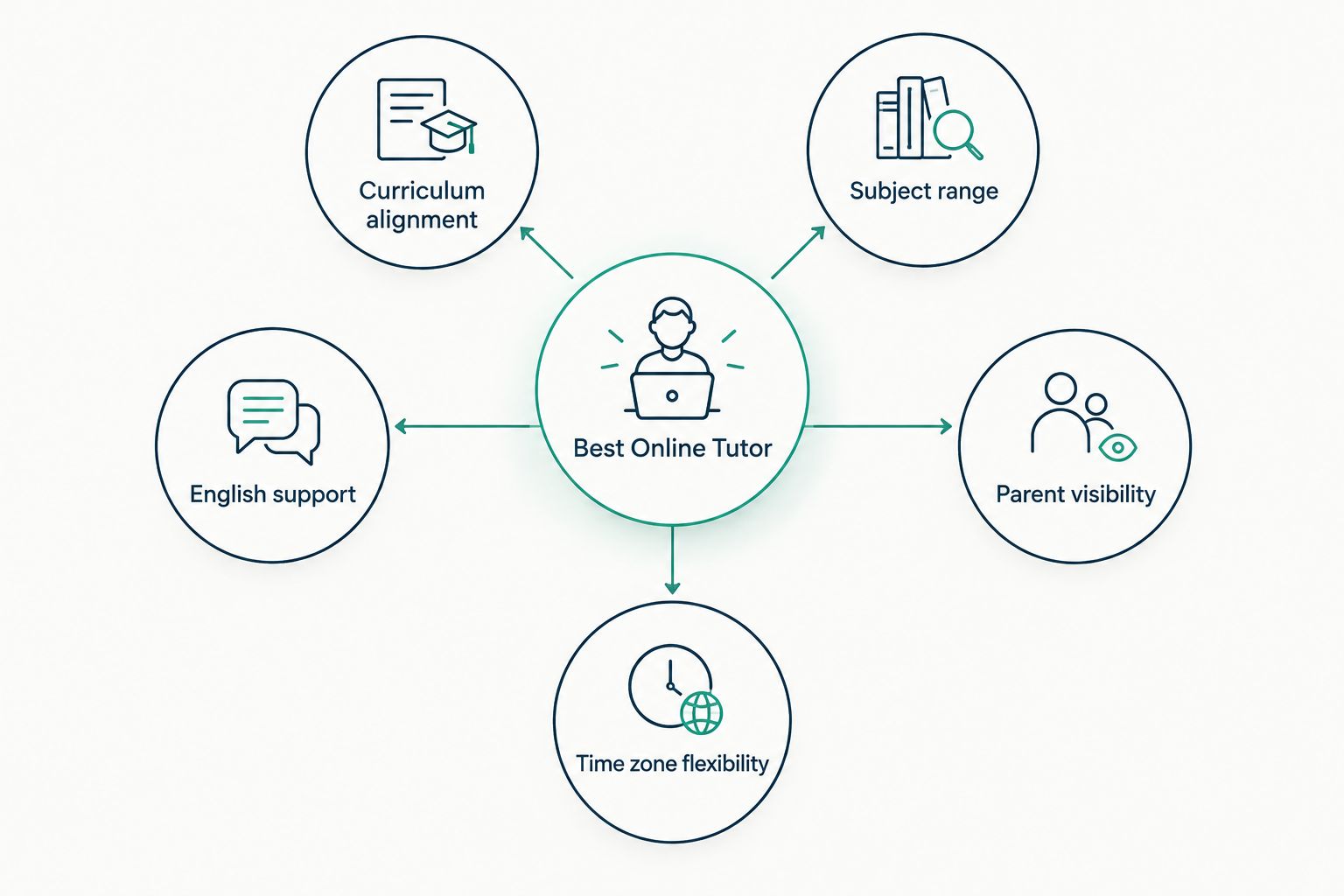
Before ranking anything, judge each option against these criteria:
- Curriculum alignment to the grade level and country the student is now enrolled in
- Subject range across Math, English, and Science, not just one subject
- Built-in English-language support, not a separate add-on you have to buy elsewhere
- Parent visibility into actual engaged time, not just login counts or session totals
- Time zone flexibility for families still connected to a home country
- Reporting that satisfies school enrollment or homeschool documentation requirements
At a glance: comparing your options
| Tutor type | Best for | Standout feature | Key limitation |
|---|---|---|---|
| Tia | Ongoing Math, English, and Science support aligned to a new curriculum | Adaptive lessons plus a parent dashboard with honest engaged-time tracking | No live video conversation partner for spoken English practice |
| General tutoring marketplace | A single subject, one-off session | Choose a specific human tutor by subject and schedule | No built-in curriculum alignment; quality varies by tutor |
| Standardized test-prep specialist | SAT, ACT, or TOEFL prep tied to a test date | Structured practice tests and scoring-focused material | Narrow to test content, doesn't cover regular coursework |
| ESL conversation platform | Spoken English fluency and confidence | Informal, flexible conversation practice | Doesn't cover Math or Science coursework |
| School's international student office | Support already included with enrollment | Integrated with classroom teachers during the school day | Limited one-on-one time; no home dashboard for parents |
1. Tia: best online tutor for international students needing Math, English, and Science in one place
Tia is a personal tutor that teaches Math, English, and Science one-on-one and adapts to how each student learns, using their own interests as the entry point into a lesson. It's built for grades 5 through 12 and aligns to the curriculum of the country the student is actually studying in, which matters for a family navigating a new school system in 2026. Parents get a live dashboard showing honest engaged-time, not just whether a session was opened.
Choosing the right curriculum fit matters more for international students than for students who've been in one system their whole academic life.

Tia pros:
- Adapts lessons to each student's pace, level, and interests instead of a fixed script
- Covers Math, English, and Science in one place, aligned to the student's curriculum
- Live dashboard shows honest engaged-time, not just login counts
- Self-writing progress records help with school or homeschool reporting requirements
Tia cons:
- No live video call with a human tutor for spoken conversation practice
- Depends on a steady home internet connection and a personal device
- Doesn't run dedicated test-day strategy sessions for SAT, ACT, or TOEFL
Tia pricing: subject-based or bundled across all three subjects; check current plans on the site.
Best for: international students who need one place for Math, English, and Science, plus a parent dashboard for reporting. Verdict: Buy.
2. General tutoring marketplaces: best online tutor for international students needing a single subject, one-off session
Marketplaces let a family book an individual human tutor by subject, review, and schedule, paying that tutor directly. There's no shared curriculum engine behind the sessions; each tutor works from their own materials and style.
Marketplace pros:
- Choose a specific tutor for a specific gap, like one hard chapter in chemistry
- Wide selection across niche subjects and languages
- Flexible one-off scheduling with no ongoing commitment required
Marketplace cons:
- Quality varies tutor to tutor; parents do the vetting themselves
- No built-in curriculum alignment across subjects
- No shared dashboard tracking progress over weeks or months
Best for: a family that needs help with one assignment or one topic, not ongoing coverage. Verdict: Hold, useful for a single gap, not a full academic year.
3. Standardized test-prep specialists: best online tutor for international students prepping for SAT, ACT, or TOEFL
Test-prep specialists build their entire program around a test date. Sessions focus on question formats, timing strategy, and practice exams rather than regular coursework.
Test-prep pros:
- Structured around the exact format of the SAT, ACT, or TOEFL
- Includes practice tests and score-focused feedback
- Timeline built backward from the actual test date
Test-prep cons:
- Narrow to test content; doesn't help with day-to-day classes
- Sessions typically wind down once the test date passes
- Little to no support for Science or English coursework outside the exam
For students layering ACT prep on top of regular coursework, this works best as an addition, not a replacement.
Best for: students with a fixed test date approaching. Verdict: Buy if a test is on the calendar, Skip for general coursework support.
4. ESL conversation platforms: best online tutor for international students building spoken English fluency
Conversation-focused platforms pair a student with a native or fluent speaker for informal spoken practice. The goal is confidence and fluency, not grades or curriculum coverage.
ESL platform pros:
- Informal, low-pressure conversation practice
- Flexible, often short sessions that fit around a school day
- Builds spoken vocabulary and accent confidence
ESL platform cons:
- Doesn't cover Math or Science coursework at all
- Not tied to any grade-level curriculum
- Progress tracking is often informal or self-reported
A student who's already working with a tutor for English language learners on academic vocabulary may still want separate conversation practice for everyday fluency.
Best for: students who read and write English adequately but need spoken confidence. Verdict: Hold, pair it with a subject tutor rather than using it alone.
5. School international student offices: best online tutor for international students who want free, in-school support
Most US schools with an international enrollment program run some form of ESL or transition support through the school day, at no extra cost to the family.
School support pros:
- Included with enrollment at no added cost
- Integrated directly with the student's actual classroom teachers
- Accessible during regular school hours
School support cons:
- Limited one-on-one minutes per student given staff-to-student ratios
- No home dashboard or progress reporting for parents
- Doesn't extend into evenings, weekends, or school breaks
Best for: a baseline layer of support that costs nothing extra. Verdict: Hold, use it alongside outside tutoring, not instead of it.
How we ranked
Each option was measured against the same six criteria: curriculum alignment, subject range, built-in English support, parent visibility, time zone flexibility, and reporting quality. Tia leads on curriculum alignment, subject range, and parent visibility. Test-prep specialists and ESL platforms each win a single criterion outright but don't cover the rest. School support wins on cost but loses on visibility and flexibility.
Which online tutor should you choose?
If your student needs ongoing coverage across Math, English, and Science while adjusting to a new curriculum in 2026, Tia is the default pick: it adapts to pace and interests, and the dashboard gives you actual engaged-time data instead of guesswork. Layer in a test-prep specialist only once an SAT, ACT, or TOEFL date is on the calendar, and add conversation-focused ESL practice if spoken fluency, not coursework, is the gap. Treat the school's international student office as a floor, not a ceiling, on support.
FAQ
What's the best online tutor for international students studying in the US in 2026?
Tia is the strongest overall pick because it covers Math, English, and Science in one place and adapts to each student's pace and curriculum. Test-prep specialists and ESL platforms fill narrower, specific gaps around it.
Is a personal tutor better than a tutoring marketplace for international students?
A personal tutor that adapts across subjects works better for ongoing coverage, while a marketplace works better for a single one-off session. The two solve different problems, not competing versions of the same one.
How does an adaptive tutor help a student catch up to US grade-level curriculum?
An adaptive tutor adjusts lesson pace and difficulty to where the student actually is, rather than assuming prior exposure to the same material. Tia does this across Math, English, and Science for grades 5 through 12.
Do international students need a separate ESL tutor alongside a subject tutor?
Often yes, if the gap is spoken conversational fluency rather than academic reading or writing. Subject tutoring covers coursework English; a conversation platform covers everyday spoken confidence.
How much does one-on-one tutoring actually help a struggling student?
The Education Endowment Foundation found one-to-one tuition adds roughly five months of extra academic progress compared with no tutoring. Bloom's two-sigma research found average tutored students reached the 98th percentile of a comparable untutored group.
Can a personalized tutor replace a school's international student support office?
No, they serve different roles. The school office is free and classroom-integrated during school hours; a personal tutor extends support into evenings, weekends, and school breaks.
What should parents look for in a tutoring dashboard?
Look for honest engaged-time measurement rather than login counts, plus records detailed enough to support school or homeschool reporting. A dashboard that only shows completion percentages hides more than it reveals.
Is online tutoring effective for students switching curriculums mid-year?
Yes, particularly when the tutor adapts lesson pace to the new curriculum instead of assuming continuity with the student's prior school system. This is where a fixed-script tutor tends to fall short.
One last thing
The Washington Post survey showing 51% of parents doubt their own ability to teach upper-grade material wasn't measuring international families specifically, but the number likely understates their situation: it's one thing to be unsure about calculus, another to be unsure about calculus taught in an unfamiliar system, in a second language, for the first time in 2026.