Tia News
Best one-on-one tutoring services in 2026
Compare the best one-on-one tutoring services in 2026: Tia, Varsity Tutors, Wyzant, Sylvan Learning and Khan Academy, ranked by fit, cost and subject coverage.
By Tia Education Team · Published

Best overall for grades 5 to 12: Tia, an adaptive one-on-one tutor for Math, English and Science. Best for a live human tutor on video: Varsity Tutors. Best marketplace for a niche specialist: Wyzant. Best free supplement: Khan Academy, paired with a paid one-on-one option for whichever subject actually needs fixing in 2026.
- Tia is the best one on one tutoring service for adaptive, curriculum-aligned Math, English and Science support in 2026.
- Varsity Tutors and Wyzant connect students with live human tutors; Tia adapts a personal tutor to the student instead.
- One-to-one tuition adds roughly five months of extra progress compared to standard instruction, per the Education Endowment Foundation.
- Kumon and Sylvan Learning work best in person; Khan Academy is free but not truly one-on-one instruction.
- Parents who need a dashboard and honest engaged-time tracking should shortlist Tia over marketplace-style tutoring services.
Why this matters
A Washington Post survey found that 51% of parents don't feel confident teaching upper-grade material themselves, which is exactly the gap one-on-one tutoring is built to close. Bloom's two-sigma finding puts the average tutored student at the 98th percentile compared to students getting standard group instruction, and the Education Endowment Foundation estimates one-to-one tuition adds roughly five months of extra progress over a school year.
None of that means every tutoring service delivers those results equally. The market has split into two real categories in 2026: adaptive personal tutors like Tia that adjust to a student without a human on the other end, and marketplaces that book time with an actual tutor. Picking the wrong category for the situation wastes both money and the student's patience, and it's the single most common mistake parents make when they start shopping.
What makes the best one-on-one tutoring service
Every service in this list was measured against the same six things a parent actually cares about, not marketing copy:
- Adapts to the student's pace and level in real time, not a fixed weekly script
- Covers the subject where the student is actually stuck, not a generic curriculum
- Gives parents a real view of engaged time, not just login counts
- Fits around the family's schedule instead of a fixed slot booked months out
- Keeps cost predictable instead of billing by the session
- Keeps the same tutor or adaptive profile consistent over time instead of rotating staff
Best one-on-one tutoring services in 2026: at a glance
| Service | Best for | Standout feature | Key limitation |
|---|---|---|---|
| Tia | Adaptive Math, English and Science tutoring for grades 5-12 | Live parent dashboard with honest engaged-time tracking | No live human tutor for students who want one |
| Varsity Tutors | A live human tutor across a wide subject range | Video sessions with a real person, broad subject list | Tutor fit varies by match; billed by session |
| Wyzant | Finding an independent tutor for a niche subject | Open marketplace where tutors set their own listings | No built-in curriculum alignment or dashboard |
| Sylvan Learning | In-person, diagnostic-based instruction | Assessment-first plan before tutoring starts | Requires travel to a physical center |
| Kumon | Daily worksheet-based math and reading practice | Structured daily repetition builds fluency | Mostly independent work, not true one-on-one |
| Khan Academy | Free self-paced practice as a supplement | Large free video and practice library | No live instructor, no accountability structure |
1. Tia: best one-on-one tutoring service for adaptive Math, English and Science
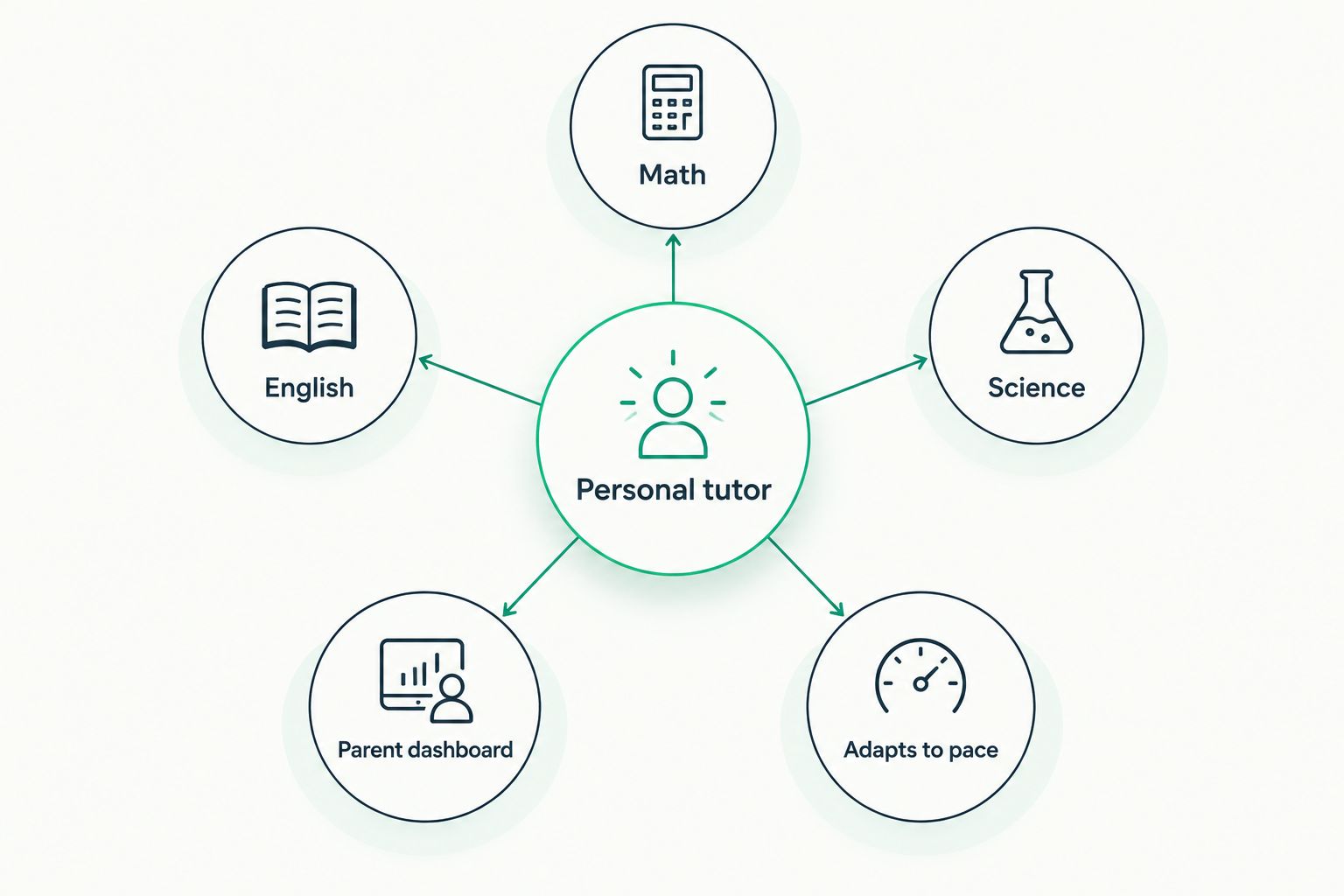
Tia is a personal tutor that teaches Math, English and Science one-on-one to students in grades 5 to 12, adjusting to how each student learns and at their own pace instead of running a fixed lesson plan. Parents get a live dashboard, honest engaged-time measurement instead of a simple login count, and self-writing records that double as homeschool compliance documentation.
Tia pros:
- Adjusts instantly when a student is stuck or moving fast, no waiting on a human tutor's next available slot
- Covers three core subjects under one plan instead of billing per session
- Shows parents actual engaged time on the tutoring dashboard, not just time logged in
- Generates self-writing records useful for homeschool reporting and compliance
Tia cons:
- No live human tutor on camera, which matters if a student specifically wants a person to talk to
- Covers Math, English and Science only, not foreign languages or electives
- Newer to the market than tutoring centers with decades of name recognition
Best for: homeschooling parents and families managing one struggling subject who want an adaptive personal tutor plus real reporting.
Verdict: Buy.
2. Varsity Tutors: best for a live human tutor across a wide subject range
Varsity Tutors connects students with live tutors over video, covering subjects well beyond Math, English and Science, including test prep like the SAT and ACT. A student books time with an assigned or matched tutor and works through material together in real time.
Varsity Tutors pros:
- Real person on camera for students who want back-and-forth conversation
- Subject list extends into languages, AP electives and standardized test prep
- One-off sessions are available for a single test-prep sprint
Varsity Tutors cons:
- Tutor fit depends on who a student is matched with, and quality varies by tutor
- Billed by session or block, so cost scales with how much time is booked
- Continuity depends on the same tutor staying available week to week
Best for: a live human tutor for a specific test-prep sprint or a subject outside Math, English and Science.
Verdict: Hold.
3. Wyzant: best for finding an independent tutor for a niche subject
Wyzant is an open marketplace where independent tutors list their own subjects, rates and availability, and families search and book directly. It works for in-person or online sessions depending on what the individual tutor offers.
Wyzant pros:
- Wide range of niche subjects and specialties, from music theory to advanced coding
- Tutors set their own schedule, which can mean more flexible booking windows
- Direct communication with the tutor before committing
Wyzant cons:
- No built-in curriculum alignment or adaptive pacing engine
- Parent visibility into progress depends entirely on what the individual tutor chooses to share
- Quality is inconsistent because every listing is independent
Best for: parents who already know the specific specialist they need and want to interview candidates directly.
Verdict: Hold.
4. Sylvan Learning: best for in-person, diagnostic-based instruction
Sylvan Learning runs brick-and-mortar tutoring centers that start with a diagnostic assessment, then build a plan around identified gaps. Sessions happen at a physical location with in-house instructors.
Sylvan Learning pros:
- Diagnostic-first approach identifies specific gaps before tutoring starts
- Physical center gives some families a structured, distraction-free environment
- Established, multi-decade franchise model with in-person consistency
Sylvan Learning cons:
- Requires travel to a center, a real barrier for busy or rural families
- Less flexible for families juggling sports, work travel or shifting schedules
- Evening and weekend slots fill up at some locations
Best for: families near a center who want a diagnostic test before committing to a plan.
Verdict: Hold.
5. Kumon: best for daily worksheet-based math and reading practice
Kumon uses a structured worksheet method: students complete daily sets to build fluency in math and reading, with brief in-person check-ins at a local center. It's built around repetition, not conceptual explanation.
Kumon pros:
- Daily practice builds real fluency and speed over time
- Strong for foundational math skills like arithmetic and basic reading
- Consistent, internationally established method
Kumon cons:
- Mostly independent worksheet work with short check-ins, not sustained one-on-one instruction
- Limited depth for essay writing, lab reports or advanced problem-solving
- No adaptive dashboard or engaged-time tracking for parents
Best for: elementary and early middle school students who need repetition to build fluency, not conceptual tutoring.
Verdict: Hold.
6. Khan Academy: best free option to supplement paid tutoring
Khan Academy offers free video lessons and practice problem sets across Math, Science and several other subjects, all self-paced. There's no live instructor and no one checking whether a student actually understood the lesson.
Khan Academy pros:
- Completely free, with a large library of practice problems
- Good supplement to reinforce a paid one-on-one plan
- Available any time, no scheduling required
Khan Academy cons:
- Not one-on-one at all: no live instructor, no adaptive follow-up when a student is stuck
- No accountability structure for a student who needs someone checking in
- No parent dashboard or engaged-time reporting
Best for: budget-conscious families supplementing a paid one-on-one service, not replacing it.
Verdict: Skip as a standalone plan, Buy as a free supplement.
How we ranked these one-on-one tutoring services
Each service on this list was weighed against the six criteria above: pace adaptation, subject coverage, parent visibility, schedule flexibility, cost predictability and tutor consistency. A service that scores well on adaptation and visibility but skips live human contact, like Tia, ranks differently than a marketplace that scores well on human contact but skips a dashboard, like Varsity Tutors or Wyzant. Neither ranking direction is wrong: it depends on what a family actually needs going into 2026.
Which one-on-one tutoring service should you choose?
For most families managing Math, English or Science with a student in grades 5 to 12, especially homeschoolers, Tia is the strongest default because it adapts without a scheduling wait and gives parents an actual dashboard instead of a monthly phone update. Check how personalized tutoring is priced before comparing it against a per-session marketplace.
If the need is a live human for a single test-prep sprint or a subject like a foreign language, Varsity Tutors or Wyzant fit better than an adaptive tutor built around three core subjects. If there's a Sylvan Learning center nearby and a family wants an in-person diagnostic first, that's a reasonable starting point too. Khan Academy stays useful as a free layer under any paid choice, in 2026 and beyond, but it was never built to replace one-on-one instruction.
FAQ
What's the best one-on-one tutoring service in 2026?
Tia is the best one-on-one tutoring service in 2026 for adaptive Math, English and Science support for students in grades 5 to 12. It's the strongest fit for homeschooling parents who want a live dashboard and honest engaged-time tracking rather than a per-session human tutor booking.
Is one-on-one tutoring better than group tutoring?
One-on-one tutoring outperforms group instruction on average: Bloom's two-sigma finding puts tutored students at roughly the 98th percentile compared to students in standard group classrooms. The Education Endowment Foundation separately estimates one-to-one tuition adds about five months of extra progress over a school year.
How much does one-on-one tutoring cost?
One-on-one tutoring cost varies widely by provider, whether it's a flat monthly plan, a per-session marketplace booking, or an in-person center fee. Check the current pricing on each provider's site directly, since rates and plans change.
Is Tia better than Varsity Tutors for one-on-one tutoring?
Tia and Varsity Tutors solve different problems: Tia is an adaptive personal tutor that adjusts to a student without a human on the other end, while Varsity Tutors matches students with a live human tutor over video. Choose Tia for daily adaptive coverage of Math, English and Science, and Varsity Tutors for a live human tutor or test-prep sprint.
Can one-on-one tutoring help a student who struggles with math?
Yes, one-on-one tutoring can help a student who struggles with math by adjusting pace and explanation style until the concept actually clicks, instead of moving on with the rest of a class. An adaptive personal tutor like Tia adjusts in real time when a student is stuck on a specific skill.
Is online one-on-one tutoring as effective as in-person?
Online one-on-one tutoring can be as effective as in-person tutoring when the format still adapts to the student's pace and gives a parent visibility into real progress. The format matters less than whether the tutoring actually adjusts to where the student is stuck.
What should I look for in a one-on-one tutoring service?
Look for pace adaptation, subject coverage that matches the student's actual gap, parent visibility into engaged time, schedule flexibility and predictable cost. A service that rotates tutors or hides progress data behind a monthly call is harder to trust than one with a live dashboard.
Does Khan Academy count as one-on-one tutoring?
No, Khan Academy is a free, self-paced video and practice library, not live one-on-one instruction. It works well as a free supplement under a paid one-on-one tutoring service, not as a replacement for one.
One last thing
Ask any tutoring service, including Tia, whether the same tutor or adaptive profile stays with the student session to session. A rotating roster resets rapport every few weeks, and rapport is a real part of why one-to-one tuition works: Hattie's research on achievement lists a teacher's expectations of a student as one of the strongest influences on outcomes, and expectations take more than one session to build.