Tia News
Best 1-on-1 Science Tutoring for Middle Schoolers in 2026
Compare 1-on-1 science tutoring for grades 5 to 8. See where Tia, live tutors and lab help fit. 14-day free trial, no card needed.
By Tia Education Team · Published
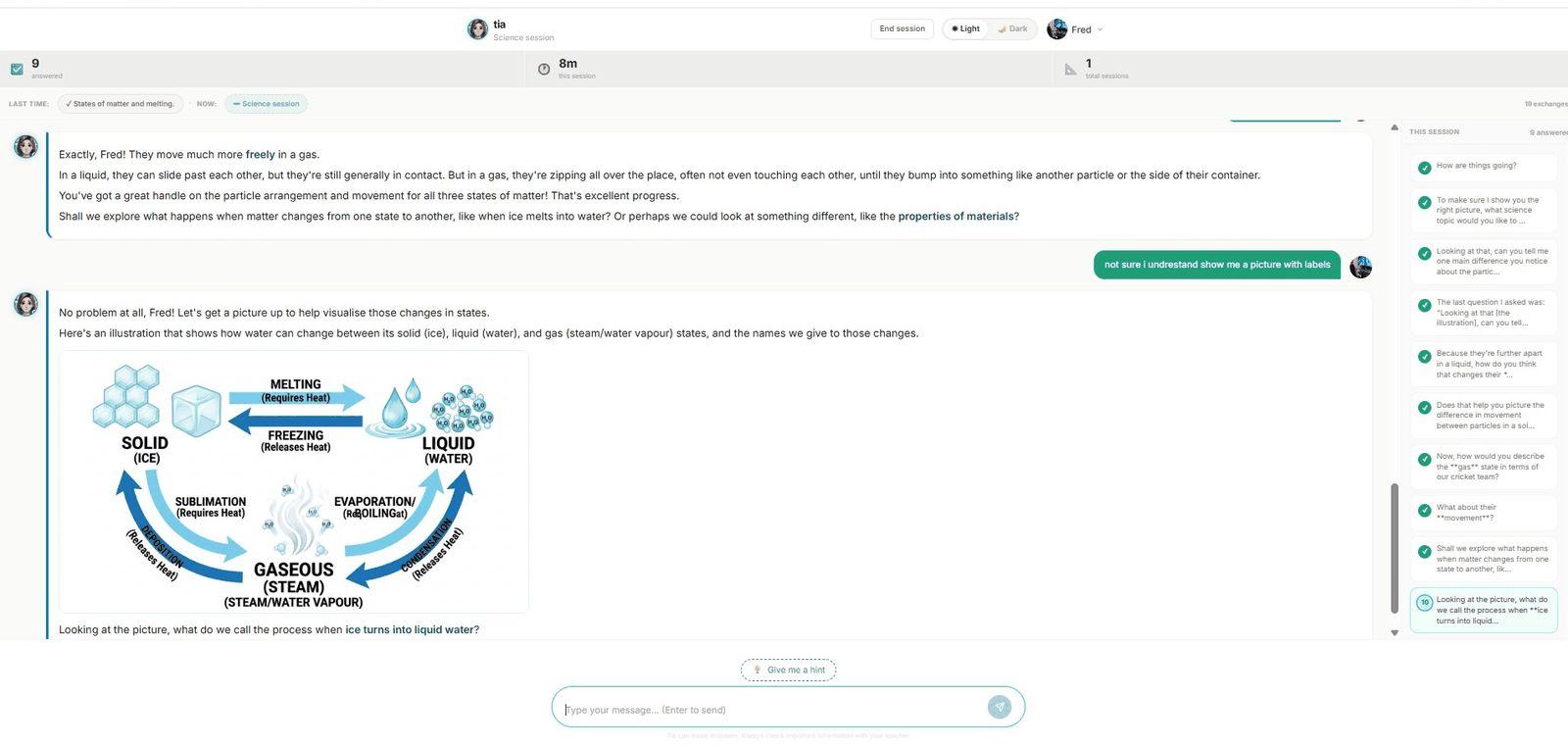
The best 1-on-1 science tutoring for middle schoolers depends on the work your student needs to do. Tia is the best fit for regular, curriculum-aligned explanation with parent visibility; Varsity Tutors or Dojo Tutor is a better fit when you specifically want a live human tutor; an in-person tutor wins when the task requires hands-on lab technique. This guide compares those choices for grades 5 to 8, including the difference between understanding an experiment and physically performing one. For a broader comparison that includes free review tools, see the personalized middle school science tutor guide.
- For ongoing 1-on-1 science tutoring for middle schoolers, Tia fits families who want adaptive explanations and a parent dashboard.
- Varsity Tutors and Dojo Tutor offer live human science tutors; ask how the same tutor and lesson plan carry across sessions.
- For physical lab technique, choose in-person supervision; online tutoring can prepare reasoning but cannot replace hands-on practice.
- Compare support for life, physical and earth science, plus experimental design, before choosing a service.
Why this matters
A student may know the terms in a chapter and still struggle to explain what an experiment shows. One-on-one support is most useful when an explanation can change after the student reveals a specific misconception, whether it is the difference between a cause and a correlation or why seasons change. The goal is not more time looking at a worksheet. It is a clear explanation, a chance to try again and evidence that the student can reason independently.
The Washington Post reported that 51% of parents doubt their ability to teach upper-grade material. That is a reason to seek support, not a verdict on any parent's ability. The Education Endowment Foundation finds that one-to-one tuition adds roughly five months of progress on average in the studies it reviews. Bloom's two-sigma finding found the average tutored student reached the 98th percentile compared with conventional instruction. Neither finding is a promised result for Tia, a marketplace or any particular student; use them as a reason to judge the quality of individual feedback rather than the label on a service.
What does middle school science cover in grades 5 to 8?
Coverage varies by state, district and chosen curriculum. Across grades 5 to 8, families commonly see three strands: life science, including ecosystems and cells; physical science, including forces, energy and matter; and earth and space science, including weather and planetary systems. The thread connecting them is scientific reasoning. A student needs to ask a testable question, use a model, read a graph and explain a conclusion with evidence.
A tutor who can recite definitions but cannot walk a student through a data table is only solving part of the problem. Bring a current assignment, unit outline or lab report to the first session. Ask the tutor to explain one misconception in language the student understands, then ask the student to apply the idea to a fresh example. That test tells you more than a generic claim of subject coverage.
What makes a good one-on-one middle school science tutor?
- A clear match to the student's current course. Ask which grade-level concepts the sessions will cover and how the tutor checks the student's starting point.
- Explanations that change with the student. After a wrong answer, the tutor should find the reasoning gap, not simply reveal the answer.
- Scientific method practice. The student should be able to name a question, identify variables, make a prediction and justify a conclusion from evidence.
- Lab expectations stated honestly. Explaining a lab report online is possible; supervising safe physical technique at a bench is a different service.
- Continuity and parent visibility. Ask what carries into the next session and what a parent can actually see afterward.
- A sensible fit for time and cost. A single upcoming lab assessment calls for a different arrangement than steady support through a school year.
Middle school science tutoring options at a glance
| Option | Best for | How the support works | Main limitation |
|---|---|---|---|
| Tia | Ongoing adaptive science explanation and parent visibility | A personal tutor adjusts to pace, level and interests across sessions | Not a live human tutor and cannot supervise physical lab work |
| Varsity Tutors | Families seeking a live human science tutor | A tutor-profile service with private one-on-one tutoring and subject specialists | Check the individual tutor's fit, continuity and plan |
| Dojo Tutor by ClassDojo | Families who want to try an online teacher-led session | Choose a tutor and try a live online science session | Confirm grade fit and ongoing tutor availability before committing |
| Local in-person science tutor | Physical lab practice or equipment-based work | A person can demonstrate and observe hands-on technique | Availability depends on the local tutor and schedule |
| Khan Academy | Free independent review alongside tutoring | Videos and practice for self-directed study | Not a one-on-one tutor when a student needs a new explanation |
1. Tia: best for ongoing, adaptive science support
Tia is the best fit for middle school families who need a personal science tutor that adjusts to the student and shows the parent what happened. It covers Math, English and Science for grades 5 to 12, with teaching aligned to the curriculum a family chooses. It changes pace, level and examples around the student's interests. The parent dashboard shows engaged time and what the student covered, while self-writing records support homeschool reporting.
Tia strengths:
- A student can revisit a concept without booking another person or restating the problem from scratch.
- The parent can see actual engagement, not just that a tab was open.
- Science support sits alongside Math and English in one account.
Tia limitations:
- Tia is not a live video call with a human tutor.
- It does not observe hand positioning, equipment use or safety in a physical lab.
- A student needs a device and an internet connection to use it.
Best for: a student who needs steady explanations and a parent who wants to see what was covered. Verdict: Choose Tia for ongoing conceptual work; add local lab supervision when the task needs it. Check current US plan details on Tia's pricing page rather than treating any article's price as permanent.
2. Varsity Tutors: best for a live subject specialist
Varsity Tutors has a middle-school science tutor page with individual profiles and FAQs addressing experimental design, lab work and concept-first teaching. Its page describes private one-on-one tutoring and other learning formats. The strength is a live person who can respond to questions in real time and bring subject depth to a difficult unit.
Varsity Tutors strengths:
- Individual profiles help you assess a prospective tutor's background.
- Live discussion makes it easy to ask the next question immediately.
- Its middle-school science page addresses scientific method and data reasoning explicitly.
Varsity Tutors limitations:
- A strong profile is not proof that a particular tutor fits your student's curriculum or learning preferences.
- Ask whether you will keep the same tutor and how progress will be documented between sessions.
Best for: families who want a live human specialist for a defined science unit. Verdict: Choose a profile after a real sample explanation, not just a credential list.
3. Dojo Tutor: best for trying a teacher-led online session
Dojo Tutor's middle-school science page lists individual tutors and describes online, one-on-one science support with a trial session. It discusses life, earth and physical science and says families receive progress updates. That makes it a practical live-session alternative for a parent who wants to meet a tutor before deciding on ongoing support.
Dojo Tutor strengths:
- Tutor profiles show grade coverage and availability so you can shortlist a plausible match.
- The trial session lets you observe how the tutor explains a difficult concept.
- Its page explicitly describes online science lessons and parent progress updates.
Dojo Tutor limitations:
- Not every listed tutor covers every middle school grade or science specialty; inspect the actual profile.
- Session availability and an ongoing plan depend on the tutor chosen.
Best for: a family seeking live online teaching with a chance to test tutor fit. Verdict: Try a relevant tutor and ask for a written plan after the session.
4. Local in-person tutor: best for physical lab technique
A local science tutor can watch how a student handles materials, reads instruments and records observations. This is a distinct advantage when the assignment is practical rather than a conceptual question. Ask about experience with the student's grade-level work and about how safety will be handled before arranging any physical demonstration.
In-person strengths:
- Immediate feedback on equipment and observation skills.
- A tutor can use the student's actual worksheet, notebook and materials.
- A face-to-face session can help with an upcoming practical assessment.
In-person limitations:
- The right tutor may not be available in your area or at the needed time.
- Parent reporting depends on the person unless you request a session summary.
Best for: labs that require physical practice and safe supervision. Verdict: Choose this for hands-on work, not merely because it is in person.
5. Khan Academy: best for free review, not one-on-one tutoring
Khan Academy is a useful free place to revisit a topic after a lesson. Videos and practice can reinforce vocabulary and ideas. It does not play the same role as a one-on-one science tutor who notices the student's particular mistake and changes the explanation in response.
Khan Academy strengths:
- Free review without an appointment.
- A student can pause and revisit a difficult explanation.
- Useful between tutoring sessions for independent practice.
Khan Academy limitations:
- The student must select the right material and notice when they are still confused.
- It does not replace supervised lab technique or a live tutor for a specific misconception.
Best for: reinforcing an idea the student has already had explained. Verdict: Use it as a supplement.
When is one-on-one help worth it?
Look for a repeated pattern, not just one disappointing grade. A student who cannot explain why a variable was controlled, who reads a graph backwards or who knows vocabulary but cannot predict what happens next has an identifiable learning gap. Choose one goal for the first session: for example, read a graph accurately and justify a conclusion. Ask for a second, unfamiliar question afterward to see whether the student can transfer the idea.
If the immediate issue is a single missing definition, a free review resource may be enough. If the student repeatedly needs a new explanation or you need a reliable record of progress, one-on-one support is more useful. If the assignment requires actual equipment, arrange qualified in-person supervision. No online tutor should claim a video or simulation replaces safety practice at the bench.
Lab skills and the scientific method: what to ask a tutor
A tutor can help the student reason about a lab before and after it happens. Start with a question the student can test. Ask them to identify what will change, what they will measure and what they will keep the same. Then have them predict a result and explain what evidence would change their mind. After the lab, they should make a claim supported by observations rather than write that the experiment worked.
For a middle school science unit in 2026, the tutor's plan should include interpretation, not just vocabulary. Ask the student to compare two data sets or identify a possible flaw in a procedure. A good explanation helps them see why a controlled variable matters. If the student can only repeat steps in order, they have not yet shown they can design or evaluate an investigation.
What should a parent see after a session?
Ask for the topic, the specific difficulty noticed, what the student tried independently and what happens next. For a live tutor, agree on a brief written summary. For Tia, the parent dashboard records what was covered and measures engaged time, with records available for families who need to document learning. Engaged time is useful, but it is not proof of mastery on its own. Check the student's explanation on a new question to see whether the idea stuck.
How this guide compares options
This 2026 guide groups services by the task they solve: steady adaptive teaching, live human explanation, hands-on lab technique or free review. Varsity Tutors and Dojo Tutor details come from their public middle-school science pages reviewed in September 2026. Tia capabilities come from its published product description and live site. Individual tutor fit, availability and prices can change, so check each provider directly before booking. No provider's own page is independent evidence of learning outcomes.
Which science tutoring option should you choose in 2026?
For a student who needs ongoing, curriculum-aligned explanations and a parent who wants an honest view of participation, start with Tia. For a student who responds best to a scheduled conversation with a human specialist, compare a Varsity Tutors profile with a Dojo Tutor session and ask both to show how they would teach one current assignment. For safe physical lab technique, choose local in-person supervision. The right answer is the service that solves the actual learning gap, not the service with the longest feature list.
FAQ
What is the best 1-on-1 science tutoring for middle schoolers?
Tia fits steady, adaptive science support with parent visibility. Varsity Tutors and Dojo Tutor fit families who want live human tutors; choose in-person support for physical lab technique.
Does 1-on-1 middle school science tutoring include lab work?
Online tutors can explain experimental design and help interpret data, but physical lab technique requires suitable materials, safety precautions and supervision. Ask a provider exactly what it offers before booking.
Can Tia help a student in grades 5 to 8 with science?
Yes. Tia covers Science, Math and English for grades 5 to 12 and adapts its teaching to the student's pace, level and interests. A parent dashboard shows what was covered and engaged time.
Is a live tutor always better than an adaptive personal tutor?
No. A live tutor suits a student who needs real-time human discussion; an adaptive personal tutor suits regular practice and continuity. Choose based on the task and check what the parent can see afterward.
What should I ask a middle school science tutor before the first session?
Ask which grade-level topics they cover, how they respond to a wrong explanation, whether the same tutor continues and what the parent receives after each session. Bring a current assignment to make their answer concrete.
What science topics should a grades 5 to 8 tutor cover?
Look for life science, physical science, earth and space science, plus experimental design and data interpretation. Exact grade-level content depends on the student's curriculum.
How do I know whether science tutoring is working?
Set a clear concept goal, ask the student to explain it using a fresh example and review what changed between sessions. Time spent is context, not proof of mastery.
One last thing
A tutor who helps a student name variables, predict an outcome and defend a conclusion is teaching a method they can reuse across science topics. In 2026, test that transfer with a new question instead of judging a service by a completed worksheet. If Tia fits your family's need for steady support, start a trial. 14-day free trial, no card needed.