Tia News
Tutoring for Twice Exceptional Students: 2026 Guide
Tutoring for twice exceptional students works best with per-subject pacing. See how Tia adapts in real time and get a 14-day free trial, no card needed.
By Tia Education Team · Published
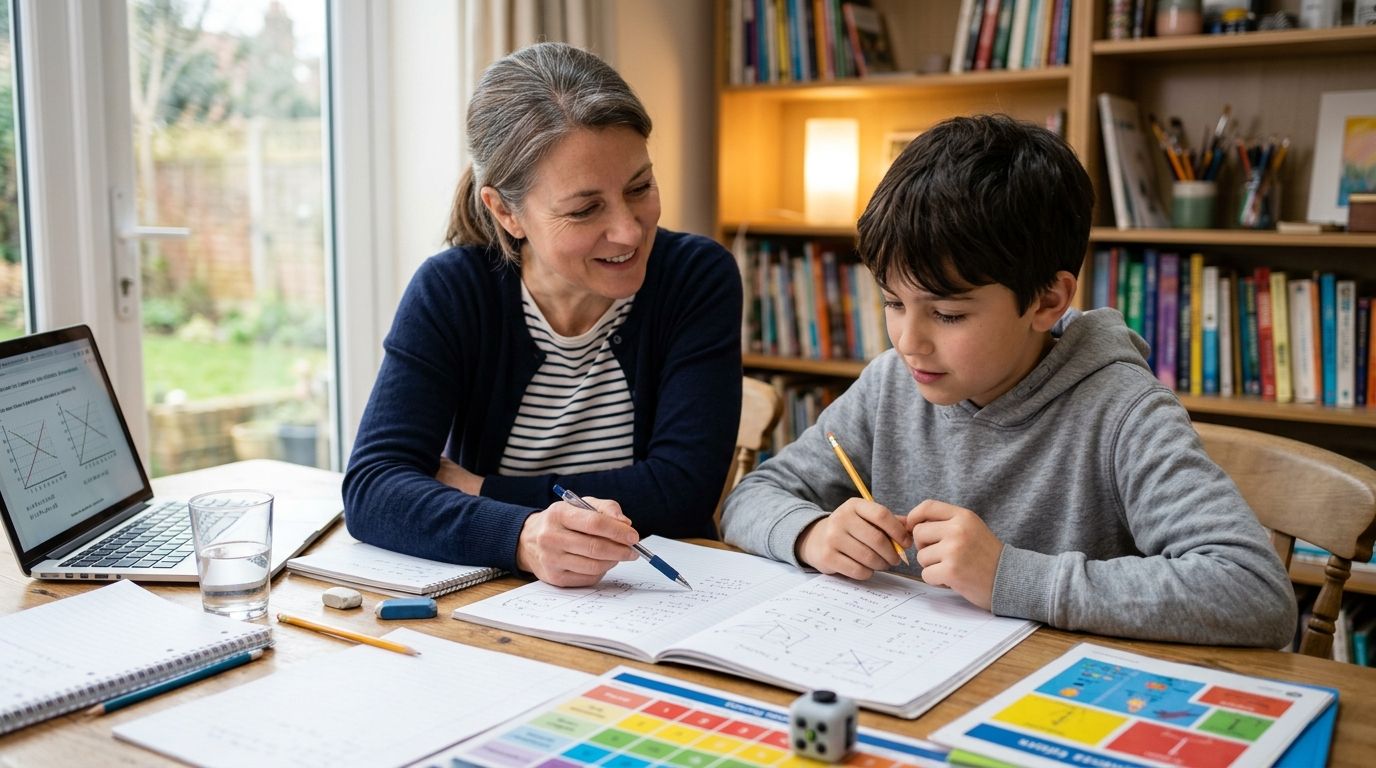
Twice-exceptional students need tutoring that builds their strongest subject while supporting the one that trips them up, often at the same time, in the same session. A gifted student with dyslexia does not need two separate interventions running on two separate tracks; she needs one tutor who can move fast on conceptual reasoning and slow down on decoding without making either skill feel like a consolation prize. Tia works as a personal tutor built for exactly that mismatch, adapting pace subject by subject rather than forcing one grade-level speed across the board.
- Tutoring for twice exceptional students works best when pace is set per subject, not per grade level.
- Tia adapts instruction in real time across Math, English and Science for grades 5 to 12.
- Parents get a live dashboard with honest engaged-time data, useful for IEP and 504 documentation.
- A 14-day free trial with no card needed lets families test the fit before committing in 2026.
Why tutoring for twice exceptional students matters
Twice-exceptional (2e) students carry a gift and a diagnosis at the same time, and schools built around one grade-level pace rarely serve both halves well. A student reading three years above level in English can still stall on multi-step word problems in Math, and a single classroom lesson has no way to serve both realities in the same 45 minutes.
The research on one-to-one instruction backs up why this matters more for 2e students than for most. The Education Endowment Foundation has found that one-to-one tuition adds roughly five months of additional progress compared to standard classroom pacing, and Bloom's two-sigma research found that the average tutored student reached the 98th percentile compared to peers in conventional instruction. For a 2e student, that gap-closing effect has to run in both directions: accelerating the strength while patching the struggle, without treating either one as an afterthought.
John Hattie's research on achievement also points to something specific to this group: teacher expectations are among the strongest influences on how a student performs. A 2e student whose gift gets overlooked because a struggle is loud, or whose struggle gets dismissed because the gift is impressive, ends up underserved either way. Tia exists to remove that guesswork by adapting to what a student actually needs subject by subject, not to a single label.
Identify the gift and the struggle separately
Start by treating the two sides as separate diagnostic questions, not one blended impression of "average." A 2e student's report card often reads as unremarkable because a high score in one area and a low score in another cancel each other out on paper.
- Review report cards and standardized test scores subject by subject, not as a GPA average
- Ask the current teacher where the student finishes work early versus where the student stalls
- Watch for a student who talks like an expert on a topic but resists writing it down
- Note whether frustration shows up as acting out, shutting down, or masking with humor
- Compare in-class behavior notes against out-of-school interests and reading level
Separate pace from grade level
Grade level is an administrative convenience, not a learning plan, and it is the single biggest reason 2e students get miscast as either "gifted, so fine" or "struggling, so remedial." Pace has to be set per subject.
- Let advanced subjects move ahead of grade level without waiting for the class
- Let struggling subjects slow down below grade level without a stigma attached
- Track pace changes over weeks, not single sessions, since 2e students often plateau then jump
- Revisit pacing every quarter as strengths shift and gaps close
This is where an adaptive personal tutor like Tia earns its place over a generic worksheet packet or a one-speed classroom: Tia adjusts pace by subject in real time, so a student can work two grades ahead in Science while getting extra repetition in fraction operations, in the same week.
Build a record that captures both sides
Documentation protects a 2e student from being seen as only the diagnosis or only the gift. Schools, evaluators, and future teachers all rely on a written record, and a thin one hurts the student.
- Keep dated samples of both advanced work and struggling work, not just one or the other
- Log specific behaviors tied to frustration, not just "had a hard day"
- Request formal evaluation notes from any school psychologist or outside specialist involved
- Save communication from teachers describing both the strength and the struggle
- If the student has a 504 plan or an IEP, keep tutoring session notes aligned to the same language used in that plan
Choose instruction that adapts without a human tutor's schedule limits
A private subject tutor who meets once a week cannot restructure a lesson mid-session when a 2e student suddenly needs a slower explanation of one concept and a faster pass through another. This is the point where the manual approach hits a ceiling and adaptive software earns its keep.
- A private tutor brings expertise but is locked into a fixed weekly slot and a fixed lesson plan
- A learning center franchise offers structure but usually teaches to a group pace, not an individual one
- A generic homework help app answers questions but does not track whether the student actually understood the answer
- Tia adapts within a single session, moving faster through material the student already grasps and slower through material that trips them up, across Math, English and Science
Track engaged time, not just completion
A 2e student can "finish" an assignment quickly by skimming a strength area, or spend an hour stalled on one struggle area without producing anything to show for it. Completion alone hides both patterns.
- Ask for time-on-task data, not just whether an assignment got marked done
- Compare engaged time in the strong subject against engaged time in the struggling subject
- Watch for sessions where a student appears active but produces little, a common masking pattern in 2e students
- Tia's parent dashboard reports honest engaged time per session, which is useful evidence for IEP or 504 documentation and for spotting when a subject needs a pacing change
Protect confidence while building skill
Many 2e students internalize the mismatch as a character flaw: "I'm smart, so why can't I do this?" That question does more damage than the actual skill gap. A tutoring approach that only drills the weak area without acknowledging the strength reinforces the wrong story.
- Open sessions in the student's strength area before moving to the struggle area
- Frame the struggle area as a specific skill gap, never as an intelligence problem
- Celebrate small wins in the struggle area at the same rate as wins in the strength area
- Check in on frustration signals before they turn into shutdown or avoidance
Compare your options for tutoring a twice exceptional student
| Option | Best for | Key limitation |
|---|---|---|
| Private in-person subject tutor | Families who want one specialist for one subject | Fixed weekly schedule, cannot flex pace mid-session |
| Learning center or franchise tutoring | Students who do well with group structure | Teaches to a group pace, not an individual profile |
| Generic homework help app | Quick answers on a single problem | No engaged-time tracking, no adaptive pacing across sessions |
| Tia adaptive personal tutor | Students needing different pace per subject, grades 5-12 | No in-person option; works through a screen-based session |
Verdict: for a family managing both a gift and a diagnosed struggle in the same student, Tia is the option built to flex per subject rather than force one pace across the board.
Common mistakes parents make with twice exceptional students
- Treating a high score as proof no support is needed. A 2e student's test average often hides a real gap in one subject, because a strong score elsewhere pulls the average up.
- Focusing tutoring only on the weak subject. Neglecting the strength area for months can cause boredom, disengagement, or regression in the area the student used to enjoy.
- Missing the paperwork trail. Without dated samples and evaluator notes, a school may see only the behavior and miss the underlying gift, or the reverse.
- Assuming one grade-level pace works for both subjects. A student who is two years ahead in reading and one year behind in math needs two different plans, not one blended average.
- Reading frustration as defiance. A 2e student who shuts down or acts out during a hard lesson is often masking confusion, not refusing to cooperate.
FAQ
What does twice exceptional (2e) mean?
Twice exceptional describes a student who is gifted in one or more areas and also has a diagnosed learning difference, disability, or condition such as ADHD or dyslexia. Both traits exist at once, and one often masks the other on a standard report card.
What is the best tutoring for twice exceptional students?
The best option adapts pace by subject rather than applying one grade-level speed to everything. Tia does this across Math, English and Science for grades 5 to 12, moving faster through a student's strength and slower through the struggle area in the same session.
Is one-on-one tutoring better than a classroom for a 2e student?
Research from the Education Endowment Foundation found one-to-one tuition adds roughly five months of additional progress compared to typical classroom pacing. A 2e student benefits from this because a tutor can flex pace in both directions, which a fixed-pace classroom cannot do.
How much does personalized tutoring cost in 2026?
Pricing for Tia in the US is $14.99 per subject or $34.99 for the monthly bundle covering Math, English and Science, with a 14-day free trial and no card needed to start. Other tutoring options vary by provider and format.
Can a tutoring dashboard help with IEP or 504 documentation?
Yes, a dashboard that tracks honest engaged time per subject gives parents dated evidence of where a student struggles or excels, which supports conversations with a school psychologist or IEP team. Tia's parent dashboard reports this data per session.
Do twice exceptional students need a different tutor for each subject?
Not necessarily. An adaptive personal tutor that adjusts pace per subject can cover both the strength and the struggle area without splitting the student's schedule across multiple providers.
How do I know if my student is twice exceptional?
Look for a pattern where advanced ability in one area coexists with a documented struggle in another, often masked by an average-looking report card. A formal evaluation from a school psychologist confirms the diagnosis, but parents often notice the pattern first.
One last thing
The Washington Post has reported that 51% of parents doubt their own ability to teach upper-grade material at home, and that number matters most for 2e families juggling two very different instructional needs in one student. You do not need to become the specialist yourself. You need a system that tracks both sides honestly and adjusts pace without waiting for a grading period to catch up in 2026.