Tia News
1-on-1 tutoring for students in rural areas without local tutors
Tutoring for rural students without local access: what actually works in 2026, how to set it up, and why Tia's online model closes the distance gap.
By Tia Education Team · Published

Tutoring for rural students usually means one of two things: a two-hour round trip to the nearest town with a learning center, or nothing at all. Personalized online tutoring closes that gap without anyone leaving the kitchen table.
- Tutoring for rural students works best online, where distance stops being the deciding factor in whether a student gets help.
- Tia matches Math, English and Science instruction to a student's pace for USD $14.99 per subject or $34.99 for the monthly bundle.
- One-to-one tuition adds roughly five months of progress compared to no tutoring, according to the Education Endowment Foundation.
- A parent dashboard with honest engaged-time tracking matters more in rural households, where no one is driving past the tutoring center to check in.
Why this matters for rural families
Most tutoring advice assumes a tutoring center within a 20-minute drive. That assumption doesn't hold in a farm town, a district with one consolidated middle school, or a family living 40 miles from the nearest city with a learning center franchise. When the option is "no tutor" versus "an online tutor," the online option wins by default, not by preference.
The research on one-to-one tutoring doesn't care where the student lives. Bloom's two-sigma finding showed average tutored students reaching the 98th percentile compared to students in conventional classrooms, and the Education Endowment Foundation puts the added progress from one-to-one tuition at roughly five months. Distance from a physical tutoring center has never been part of that equation, which is why Tia exists as a fully online alternative: a personalized tutor for grades 5 through 12 that works the same in a rural zip code as it does three blocks from a university town.
Rural households also carry a specific version of the pressure the Washington Post identified: 51% of parents already doubt their ability to teach upper-grade material at home. Add in a school district stretched thin across subjects, and the gap between what a student needs and what's locally available only widens as they move into algebra, chemistry, and AP-level coursework.
Get one-on-one help without a local tutor
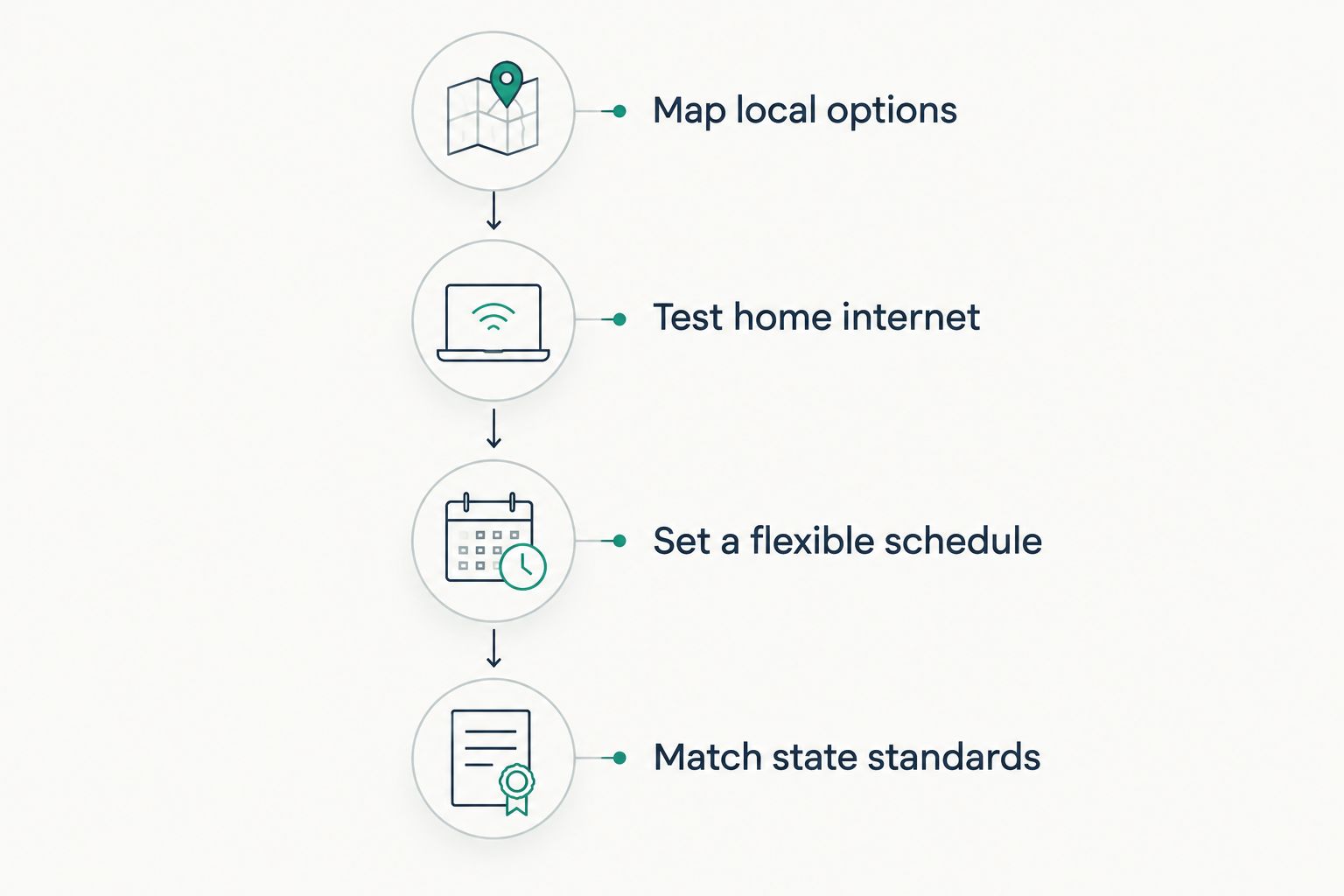
Map what's actually available within driving distance
Before ruling out in-person options entirely, get a clear picture of what exists nearby. This step takes an afternoon and saves you from assuming there's nothing when there's a partial fit.
- Call the district office and ask about Title I tutoring hours or after-school study halls
- Check whether the local library runs a homework help program on set days
- Ask other homeschool or rural families in local Facebook groups what they've actually used
- Look at the community college for dual-enrollment or peer tutoring programs open to high schoolers
- Note the actual round-trip time and gas cost, not just the mileage
Test your home internet and device setup before committing
Rural broadband is uneven, and the biggest source of frustration with any online tutoring option isn't the instruction, it's a connection that drops mid-lesson.
- Run a speed test at the time of day tutoring will actually happen, not midday when usage is lower
- Check whether a wired connection or a spot closer to the router changes the result
- Confirm the device has a working camera and microphone if the tutoring format requires them
- Ask your provider about rural broadband subsidies if speeds are consistently under 10 Mbps
- Have a backup plan, like a phone hotspot, for the days satellite or DSL service is unreliable
Set a schedule that survives bus routes and farm chores
Rural schedules don't look like suburban schedules. Bus rides run longer, chores and 4-H or FFA commitments eat into evenings, and a rigid weekly slot with one human tutor often falls apart by week three.
- Build tutoring around the actual after-school window, not an idealized 4 p.m. slot
- Favor a format the student can start on their own timeline instead of one fixed appointment
- Block off two shorter sessions rather than one long one if energy drops after chores
- Protect at least one flexible day per week for schedule slippage
This is where a personalized online tutor starts to pull ahead of a single human tutor working around one calendar. Tia adapts to whenever the student logs in and adjusts pace to what they need that day, rather than requiring a fixed weekly appointment with one person's availability.
Match tutoring to your state or provincial standards
A generic online tutor that ignores your state's standards creates extra work instead of removing it. Rural students often already deal with a curriculum gap when their district can't offer AP or advanced electives locally, so alignment matters more, not less.
- Confirm the tutoring option covers your state's math sequence, not a generic national average
- Check that science content matches what your student's actual course covers, whether that's biology, chemistry, or physics
- Ask whether English instruction includes grade-appropriate writing standards, not just reading practice
- If you're homeschooling, confirm the option produces records usable for your state's reporting requirements
Track engaged time, not just logged-in time
With no tutoring center to walk past, parents lose the informal check-in that comes from dropping a student off and picking them up. A dashboard has to do that job instead.
- Ask any online option what "engaged time" actually measures, not just total session length
- Look for a weekly or monthly view you can check without asking the student directly
- Confirm the dashboard shows subject-by-subject progress, not one blended score
- If you're homeschooling, check whether records are self-writing enough to support your reporting needs
Tia's dashboard gives parents this exact view: honest engaged-time measurement and self-writing records built for homeschool reporting, which matters most when there's no other adult in the loop to flag a problem. See what to look for in a tutoring dashboard before choosing any option, rural or not.
Loop in the school without waiting for a report card
Rural schools often have fewer specialists per student. A single counselor may cover several grades, which means gaps go unnoticed longer than they would in a larger district.
- Email the teacher directly rather than waiting for parent-teacher conferences
- Ask specifically which standards the student is behind on, not a general "how's it going"
- Bring any tutoring progress data to that conversation so it's a two-way check, not a guess
Comparing the options available to rural families
| Option | Best for | Starting price | Key limitation |
|---|---|---|---|
| Local co-op or community tutor | Families near a homeschool co-op or small-town resource | Varies by provider | Availability depends on population density; many rural areas have none |
| Online tutoring marketplace (live human tutor) | Families wanting one credentialed tutor for a single subject | Varies by provider | Scheduling locked to one tutor's calendar; no built-in progress tracking |
| Personalized online tutor (Tia) | Students needing daily, self-paced support across Math, English and Science | USD $14.99 per subject or USD $34.99 monthly bundle | Requires a reliable home internet connection |
| School study hall or after-hours help | Quick homework help during the school day | Free (school-provided) | Group setting, not one-on-one; unavailable outside the school calendar |
Verdict: for rural families without a local tutor within driving distance, a personalized online option like Tia covers more subjects at a more predictable cost than assembling separate local and marketplace tutors.
Start a 14-day free trial
No card needed. Try Tia across Math, English and Science before you commit.
Common mistakes rural parents make
- Waiting for the school to flag a gap. With fewer staff per student, a rural school may not catch a slipping grade until a report card arrives, months after it started.
- Assuming online tutoring needs a fixed weekly appointment. That's a holdover from in-person tutoring logistics; it's not how self-paced personalized tutoring actually works.
- Underestimating how weather and road conditions disrupt in-person plans. A single snowed-in week can wipe out a month of scheduled drives to a tutoring center.
- Not tracking engaged time. Logged-in time and actual working time aren't the same thing, and without a dashboard, there's no way to tell the difference.
- Picking a tutor without checking state standards alignment. A student can spend hours on content that doesn't match what their actual course or state exam covers.
FAQ
What's the best tutoring option for rural students with no local tutor?
A personalized online tutor is the most practical option for rural students because it removes distance entirely. Tia covers Math, English and Science for grades 5 through 12 and adapts to each student's pace instead of requiring a fixed local appointment.
Is online tutoring as effective as in-person tutoring for rural students?
The research on one-to-one tutoring, including the Education Endowment Foundation's finding of roughly five months of added progress, is about the tutoring format, not the delivery method. Format and consistency matter more than whether the tutor is in the same room.
How much does personalized tutoring cost for a rural family?
Tia's US pricing is USD $14.99 per subject or USD $34.99 for the monthly bundle covering all three subjects, with an annual bundle option at USD $384.89. Pricing is flat regardless of location.
What internet speed do rural families need for online tutoring?
Run a speed test at the actual time tutoring will happen, since rural connections often slow during peak evening use. A wired connection or a spot closer to the router can resolve most stability issues.
Can online tutoring replace a school's advanced coursework in a rural district?
Online tutoring can supplement content a rural school can't offer locally, such as AP-level material, but it works best paired with the school, not as a full replacement for enrolled coursework.
How do parents know if online tutoring is actually working?
Check a dashboard that tracks engaged time and subject-by-subject progress rather than relying on the student's own report. Without a local tutoring center to walk past, the dashboard is the only consistent check-in point.
Does rural tutoring need to match state standards?
Yes. A generic tutoring option that ignores your state's math sequence or science course content creates extra work instead of closing a gap, so confirm standards alignment before starting.
Is Tia good for homeschooling families in rural areas?
Tia produces self-writing records built for homeschool reporting, which matters for rural families who may be homeschooling due to limited local school options. The dashboard doubles as documentation for state reporting requirements.
One last thing
The detail most rural parents miss isn't the tutor, it's the schedule. A student who's on a bus for 50 minutes each way doesn't have the same after-school window a suburban student does, and forcing a fixed weekly appointment onto that schedule is often what breaks a tutoring plan by week three, not the quality of the instruction itself. Fix the schedule assumption before evaluating anything else in 2026.