Tia News
Personalized tutoring for Common Core math
Personalized tutoring for Common Core math fixes the real gap, number sense and word problems, not the whole subject. See the 2026 comparison and steps.
By Tia Education Team · Published · Updated

Common Core math tutoring is one-on-one instruction built around Common Core's own methods: number sense, multiple solution strategies, and multi-step word problems, with the aim of closing a specific gap before it grows into a subject-wide grade problem. Parents trying to help run into a wall that has nothing to do with how smart the student is: the strategies taught in class (area models, number lines, decomposing numbers) often look nothing like the math the parent learned. That mismatch, not the math itself, is usually the real obstacle.
- Personalized tutoring for Common Core math works best when it rebuilds number sense first, not when it drills the standard algorithm early.
- Tia is a personal tutor that adapts pacing across Math, English and Science for one flat monthly price.
- The Education Endowment Foundation found one-to-one tuition adds roughly five months of extra progress on average.
- Word problems, not raw computation, are where most Common Core math grades actually fall apart.
- USD $14.99 covers one subject; USD $34.99 covers a monthly bundle of all three.
Why personalized tutoring for Common Core math matters
A Washington Post survey found that 51% of parents doubt their own ability to teach upper-grade material, and Common Core math is exactly where that doubt shows up first. A fourth grader's homework can use a method the parent has genuinely never seen, which turns a ten-minute check-in into a shared frustration session. Tia exists for that exact moment: a personal tutor that shows the current strategy instead of substituting the parent's own.
Benjamin Bloom's two-sigma research found that the average tutored student reached the 98th percentile compared to a standard classroom, a gap that holds up even at modest weekly dosage. The Education Endowment Foundation puts the average effect of one-to-one tuition at roughly five months of added progress across a school year, in 2026 still the most cited figure in the field. John Hattie's research adds the piece that matters most for a stuck student: teacher expectations are among the strongest single influences on achievement, which is one reason a tutor who treats a struggling student as capable, not behind, moves the needle faster than another worksheet packet.
Fixing the gap, one Common Core shift at a time
Common Core math struggles rarely mean the whole subject is broken. They usually trace to one shift the student hasn't fully caught up to yet.
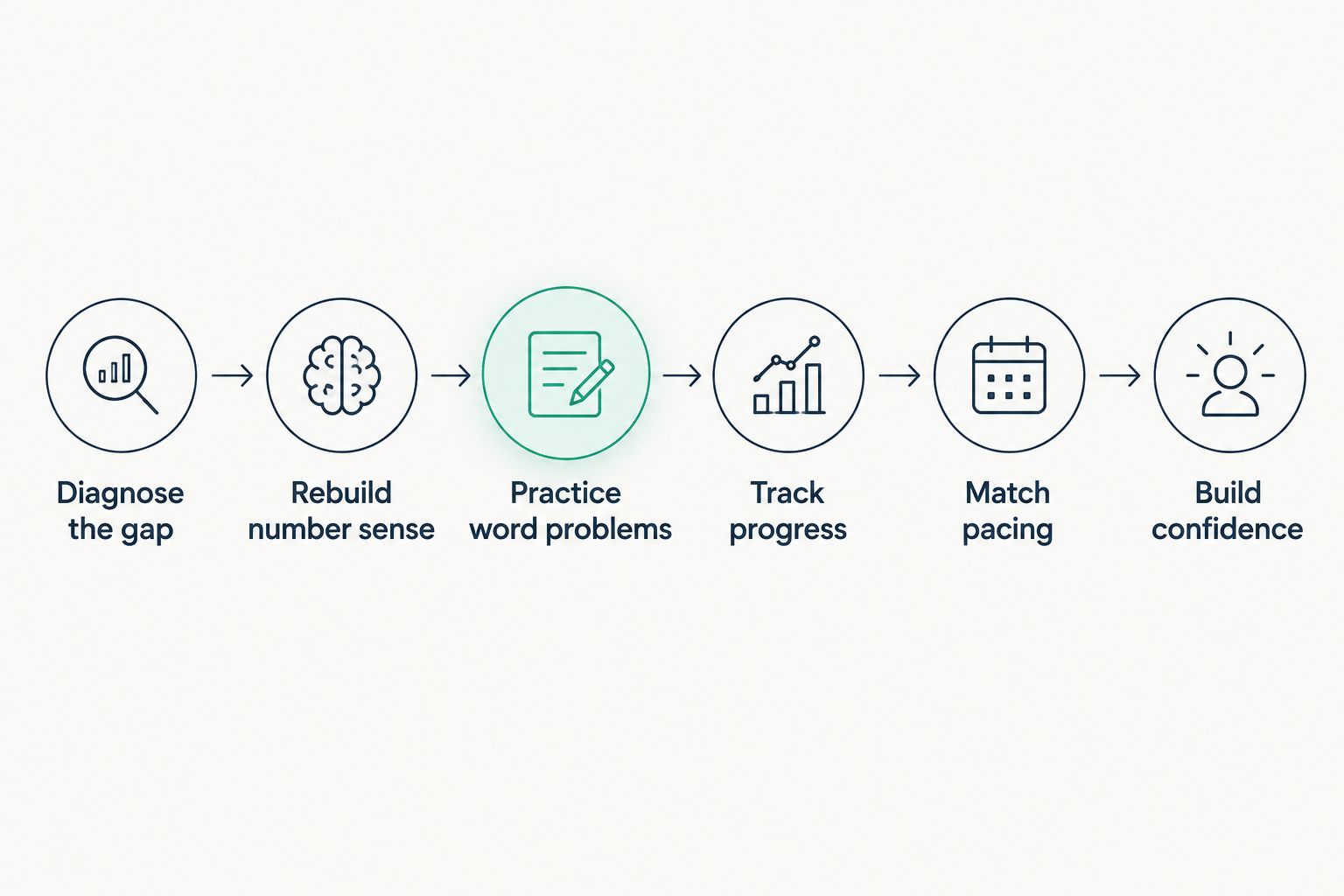
Diagnose which Common Core shift is behind the struggle
Before assigning more practice, find out which specific shift is causing the trouble.
- Number sense: the student follows the steps but can't explain why they work
- Multiple strategies: the student was taught three ways to solve one problem and settled on none
- Word problems: the student computes fine but can't translate a paragraph into an equation
- Fluency pacing: the student is pushed to be fast before being asked to be accurate
- Vocabulary: terms like "expression," "equation" and "unknown" get used at home before they're actually defined
Rebuild number sense before drilling the algorithm
The free version of this step uses objects, not worksheets, and it works.
- Use base-ten blocks or a hundreds chart to show how regrouping moves value around
- Ask the student to explain a step out loud instead of just completing it
- Compare two strategies for the same problem and ask which one is faster and why
- Hold off on the standard algorithm until the underlying concept is solid
- Spend five minutes on last year's standard before starting this year's lesson
Practice word problems with the reasoning shown, not just the answer
This is where most Common Core math grades actually collapse, and it's also where a personal tutor earns its keep faster than a stack of printouts.
- Read the problem twice before writing anything down
- Underline the question being asked, separate from the numbers given
- Draw a quick model, a bar model or number line, before choosing an operation
- Check whether the answer makes sense in the story, not just on the page
This is the step where Tia adapts to the student's pace and shows the reasoning behind each move rather than skipping to the answer, closer to guided word-problem practice than a generic answer key.
Track progress with more than a worksheet grade
A grade tells you almost nothing about which Common Core standard actually improved.
- Watch engaged time, not just minutes logged
- Check which specific standard moved, not the overall subject grade
- Ask for self-written work samples over time, not just quiz scores
- Compare the start of a unit to where the student is now
- Watch for confidence signals, like starting homework without stalling first
A parent dashboard that separates honest engaged time from idle screen time turns this from guesswork into an actual read on progress, which is the whole point of tracking anything.
Match pacing to the standard, not the school calendar
- Slow down on the standard that's genuinely weak, even after the class has moved on
- Speed up on standards the student already has, to avoid boredom-driven mistakes
- Revisit a prerequisite skill from a prior grade when a gap traces back further
- Set a weekly check-in instead of waiting for the next test
- Watch whether math frustration is dragging down effort in other subjects too
Build confidence before the next unit test
- Open a session with a problem the student can already solve
- Normalize needing more than one strategy to reach an answer
- Skip comparisons to a sibling's or classmate's pace
- Praise the strategy used, not only a correct final answer
- Keep sessions short and frequent instead of long and rare
Comparing Common Core math help options
| Option | Best for | Starting price | Key limitation |
|---|---|---|---|
| Free practice sites (Khan Academy, IXL) | Extra reps on one isolated skill | Free | No correction of the reasoning behind a wrong answer |
| Asking the classroom teacher | Quick clarification on one assignment | Included in school | Limited one-on-one minutes per student |
| In-person learning center | A fixed weekly session on a set schedule | Varies by location | Curriculum isn't always matched to the exact standard in play |
| Private hourly tutor | One specific test or one specific gap | Varies by tutor | Cost scales with hours; progress tracking stays informal |
| Tia | Ongoing, standards-aligned practice with a parent dashboard | USD $14.99 per subject or USD $34.99 monthly bundle | Not a diagnostic tool for a formal learning disability evaluation |
For a student stuck on one or two Common Core standards, the per-subject option makes more sense than the full bundle; for a student behind across math, English and science together, the $34.99 monthly bundle covers all three for less than three single-subject sessions elsewhere.
Start Tia's 14-day free trial
No card needed. See how Tia adapts to Common Core math in the first session.
Common mistakes parents make with Common Core math
- Teaching the standard algorithm the parent learned, which conflicts with the strategy the teacher expects on that week's test
- Treating a word problem as a reading issue and skipping the math modeling step entirely
- Judging progress only by the worksheet grade instead of which standard actually improved
- Waiting for the report card before looking into a personal tutor or extra practice
- Assuming the whole subject is broken when the real gap is one standard, like fraction and ratio work
FAQ
What is Common Core math tutoring?
Common Core math tutoring is one-on-one instruction focused on the specific strategies Common Core uses: number sense, multiple solution methods and multi-step word problems. It targets the standard causing trouble rather than reteaching the whole subject.
Is Common Core math actually different from regular math?
The end goal is the same, but Common Core introduces strategies like area models and number lines before the standard algorithm, which is why the homework can look unfamiliar to parents. The underlying math hasn't changed; the sequence of methods has.
How much does personalized tutoring for Common Core math cost?
Tia's US pricing runs USD $14.99 per subject or USD $34.99 for a monthly bundle covering Math, English and Science, with an annual option at USD $384.89. Other options, like private hourly tutors or learning centers, vary by tutor and by location.
Can a personal tutor actually teach Common Core methods correctly?
A personal tutor that adapts to the student's current strategy, rather than substituting a different method, keeps the student consistent with what the classroom expects on tests. Tia is built to work this way rather than defaulting to a generic method.
How do I know if my student needs help with Common Core math?
Watch for homework that takes far longer than it should, avoidance behavior before starting math, or a grade drop tied to one specific unit rather than the whole subject. A single weak standard is easier to catch early than a full-semester slide.
What's the best way to help with Common Core word problems?
Have the student underline the question separately from the numbers given, then draw a quick model before choosing an operation. This step, not more computation practice, is where most Common Core word-problem struggles actually live.
How long does it take to see progress with Common Core math tutoring?
The Education Endowment Foundation found one-to-one tuition adds roughly five months of progress on average across a school year, though a single narrow standard can improve faster with focused weekly sessions.
Is Tia good for Common Core math specifically?
Tia adapts to a student's pace and current strategy across Math, English and Science, with a parent dashboard showing engaged time rather than just time logged. It works best as ongoing support alongside classroom instruction, not as a replacement for a formal evaluation.
One last thing
Most Common Core math grades don't drop because the whole subject is too hard. They drop because one specific standard, hiding inside a mixed-review worksheet, never got fixed. A parent who can name that standard, not just the general topic, gets a personal tutor to the actual fix in one session instead of three, and that's the difference between a rough month and a rough year in 2026.