Tia News
How to Track Your Child's Tutoring Progress (2026)
Learn how to track your child's tutoring progress online in 2026: engaged time, topic mastery, work samples and homeschool records, explained step by step.
By Tia Education Team · Published · Last updated
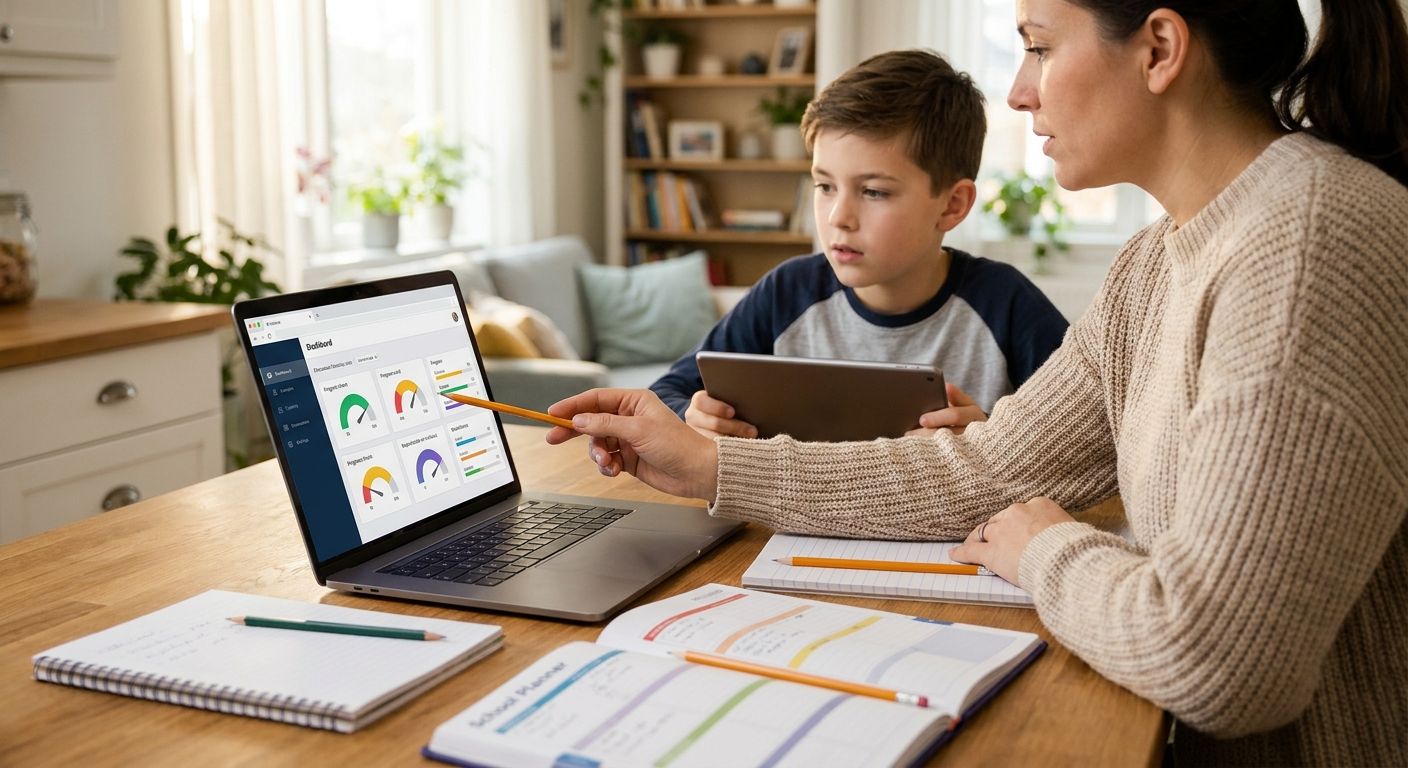
You track your child's tutoring progress online by watching three things every week: engaged time, mastery by topic and dated work samples, not a single end-of-month grade. A platform that only reports a final score hides whether your child spent 40 focused minutes on fractions or clicked through problems to finish faster. In 2026, a live dashboard that updates after every session is the standard to expect, whether the tutor is a person or an adaptive platform like Tia.
- Track engaged time, topic mastery and dated work samples weekly, not a monthly grade recap.
- A live dashboard that updates after every session beats a PDF summary at month end.
- One-to-one tutoring adds roughly five months of progress, per the Education Endowment Foundation.
- Homeschool parents need self-writing records for compliance, not just a percentage score.
- Tia gives parents honest engaged-time data and a dashboard built for grades 5 to 12.
Why this matters
Most parents cannot sit in on a tutoring session. You are trusting a screen, an app and a stranger's teaching method with your child's actual learning time, and the only proof you get is whatever the platform decides to show you. A Washington Post survey found 51% of parents doubt their own ability to teach upper-grade material, which is exactly why they hire outside help in the first place, and exactly why they need to see what that help is actually doing.
The research on why tutoring works is not vague. Benjamin Bloom's two-sigma finding showed tutored students reaching the 98th percentile compared to peers in a standard classroom, and the Education Endowment Foundation puts the typical gain from one-to-one tuition at roughly five months of extra progress. Those numbers only mean something for your child if you can see the sessions that produced them. That is what tracking is for.
How to track your child's tutoring progress online
Use this sequence to check any tutoring platform, whether your child works with a human tutor or an adaptive one:
- Open the dashboard weekly, not monthly. If the platform only emails a recap once a month, you are seeing history, not a signal you can act on.
- Look for engaged time, not just login time. A student can be logged in for an hour and actually working for twenty minutes; the two numbers should be reported separately.
- Check mastery by topic, not one overall grade. A single score can hide that your child aced reading comprehension but is still stuck on inference questions.
- Review dated work samples. Essays, problem sets and written answers show you the actual work, not just whether it was marked correct.
- Save or export records if you homeschool. Self-writing records and progress logs double as documentation for state reporting requirements.
- Set a ten-minute weekly check-in. Same day, same time, so tracking becomes a habit instead of a scramble before report cards.
Tia's dashboard was built around this exact sequence: engaged time, topic mastery and self-writing records, all in one place for a flat monthly price, updated after every session rather than at the end of a billing cycle.
What a good tutoring dashboard should show
Engaged time, measured honestly
A dashboard that reports "time on platform" without separating active work from idle screen time is not giving you a real number. Engaged time should reflect actual problem-solving and reading, not a browser tab left open in the background. This is one of the most commonly inflated metrics in online learning tools, and it is worth asking any platform directly how they calculate it.
Mastery broken down by topic
A 7th grader who is "on grade level in math" overall might still be behind on negative numbers and ahead on geometry. Topic-level mastery tells you where to focus a Saturday afternoon of review, while an overall grade tells you nothing actionable.
Work samples with dates
An essay draft from September and a revised draft from November, side by side, show growth in a way a grade never can. This matters most for writing, where progress is about clarity and structure, not just correctness.
Records built for compliance, not just curiosity
Homeschooling parents in particular need documentation that satisfies state reporting requirements. Homeschool-specific tracking should generate records automatically, so you are not manually logging hours after the fact.
Why tracking methods vary
Not every platform tracks the same things, for reasons that usually come down to one of these:
- Subject. Math progress tracks cleanly by topic and problem accuracy; writing progress is harder to quantify and needs actual samples, not just scores.
- Human tutor vs. adaptive platform. A live tutor may only summarize a session verbally, while an adaptive platform can log every interaction automatically.
- Age and grade level. Younger students need simpler summaries; high schoolers preparing for standardized tests need granular, topic-level data.
- Homeschool vs. supplemental use. Homeschool families need compliance-ready records; a family adding tutoring to a full school schedule mainly wants a weekly signal.
- How the platform defines "engaged." Some count login time, some count keystrokes, some measure actual problem-solving activity, and the gap between these can be large.
- Reporting frequency. Real-time dashboards give you a running picture; monthly-only summaries give you a rearview mirror.
“A grade tells you what happened. Engaged time and topic mastery tell you why.”
Is a weekly grade report enough to track tutoring progress?
No, a weekly grade report is not enough on its own, because a grade compresses dozens of small decisions into one number and hides where a student actually struggled. Pair any grade with topic-level mastery data and at least one work sample per week to get a full picture.
How often should you check your child's tutoring dashboard?
Once a week is enough for most families, ideally the same day so it becomes routine rather than a reaction to a bad test grade. Parents managing a first year of homeschooling often check daily for the first month, then settle into a weekly rhythm once they trust the data.
What's the difference between logged-in time and engaged time?
Logged-in time counts every minute a device is connected, including idle gaps; engaged time counts only active work, like solving a problem or writing a sentence. The gap between the two numbers is often the most revealing data point on a dashboard, since a large gap usually means distraction, not learning.
See a real progress dashboard
Start a 14-day free trial, no card needed, and watch engaged time and mastery update after every session.
FAQ
How do I track my child's tutoring progress online in 2026?
Track it through a live dashboard that shows engaged time, mastery by topic and dated work samples, checked weekly rather than waiting for a monthly recap. Platforms that only send a final grade at month end leave out the data that actually explains progress.
What's the best tutoring app for parents tracking progress?
Look for an app built specifically around parent visibility, with a dashboard that updates after every session rather than on a delay. Tia is built for grades 5 to 12 with honest engaged-time measurement and self-writing records included as part of the standard experience.
Is tutoring actually worth it based on outcomes data?
Yes, one-to-one tutoring adds roughly five months of extra progress according to the Education Endowment Foundation, and Bloom's two-sigma research found tutored students reaching the 98th percentile compared to classroom-only peers. The gains show up fastest when parents can see and reinforce what happens in each session.
Do I need separate records for homeschool compliance?
Yes, most states require some form of documented progress for homeschooled students, and self-writing records generated automatically save hours compared to manual logging. A tutoring platform that produces these records as a byproduct of normal sessions removes an entire admin task from your week.
What's the difference between an adaptive tutor and a human tutor for tracking?
An adaptive platform logs every interaction automatically, giving you granular topic-level data without relying on a tutor's memory of the session. A human tutor can offer verbal nuance a dashboard cannot, but usually requires you to ask directly for a written summary.
How much engaged time is normal for a tutoring session?
There is no single universal number, since it depends on session length and subject, but the gap between logged-in time and engaged time matters more than the raw total. A large, consistent gap between the two is the clearest sign a student is distracted rather than working.
Can I track progress across multiple subjects in one place?
Yes, platforms built for multiple subjects, like Math, English and Science together, let you compare engaged time and mastery side by side instead of checking three separate tools. This is especially useful for parents of students who learn differently and need to spot patterns across subjects, not just within one.
One last thing
The single most useful habit is not the dashboard itself, it is the ten-minute weekly check-in. Parents who look at engaged time and one topic-mastery chart every week, same day, same time, catch a slipping topic in days instead of finding out at the next report card. Teacher expectations are among the strongest influences on student achievement, according to John Hattie's research, and the same logic applies at home: a parent who visibly expects to see progress data tends to get a student who takes the sessions more seriously.