Tia News
Best math tutoring services in 2026
Compare the best math tutoring services in 2026: Tia, Mathnasium, Kumon, Khan Academy, Varsity Tutors and Wyzant, with honest pros, cons and verdicts.
By Tia Education Team · Published

Six services get compared here head to head so you can pick the one that actually fits your student's grade, subject gap and schedule, not just the one with the biggest ad budget. Best overall pick among the best math tutoring services in 2026: Tia, which adapts each lesson to a student's pace across grades 5 to 12 and gives parents a live dashboard. Best for in-person, walk-in help: Mathnasium. Best free option: Khan Academy, though it has no live tutor and no parent reporting.
- Tia ranks best overall among math tutoring services in 2026 for adaptive pacing and parent dashboards.
- Mathnasium wins for families who want in-person, walk-in math help at a physical center.
- Khan Academy is the best free math tutoring resource but offers no live tutor or reporting.
- One-to-one tutoring adds about five months of progress on average, per the Education Endowment Foundation.
- Kumon and Wyzant fill narrower niches: daily worksheet drills and independent tutor search.
Why this matters
A math gap that opens in 6th grade rarely closes on its own by 9th grade; it compounds, because algebra sits on top of fractions and fractions sit on top of basic operations. The Education Endowment Foundation found that one-to-one tuition adds roughly five months of academic progress compared to classroom instruction alone. Bloom's original two-sigma research found the average tutored student reached the 98th percentile of a conventional classroom, a benchmark the tutoring industry still measures itself against decades later.
A Washington Post survey found 51% of parents doubt their own ability to teach upper-grade math or science material, which explains why outsourcing that work, whether to a person or to adaptive software, works for so many households in 2026. The service you pick matters less than whether it actually does what the research says works: one-to-one attention, tracked consistently, over weeks not days.
What makes the best math tutoring service
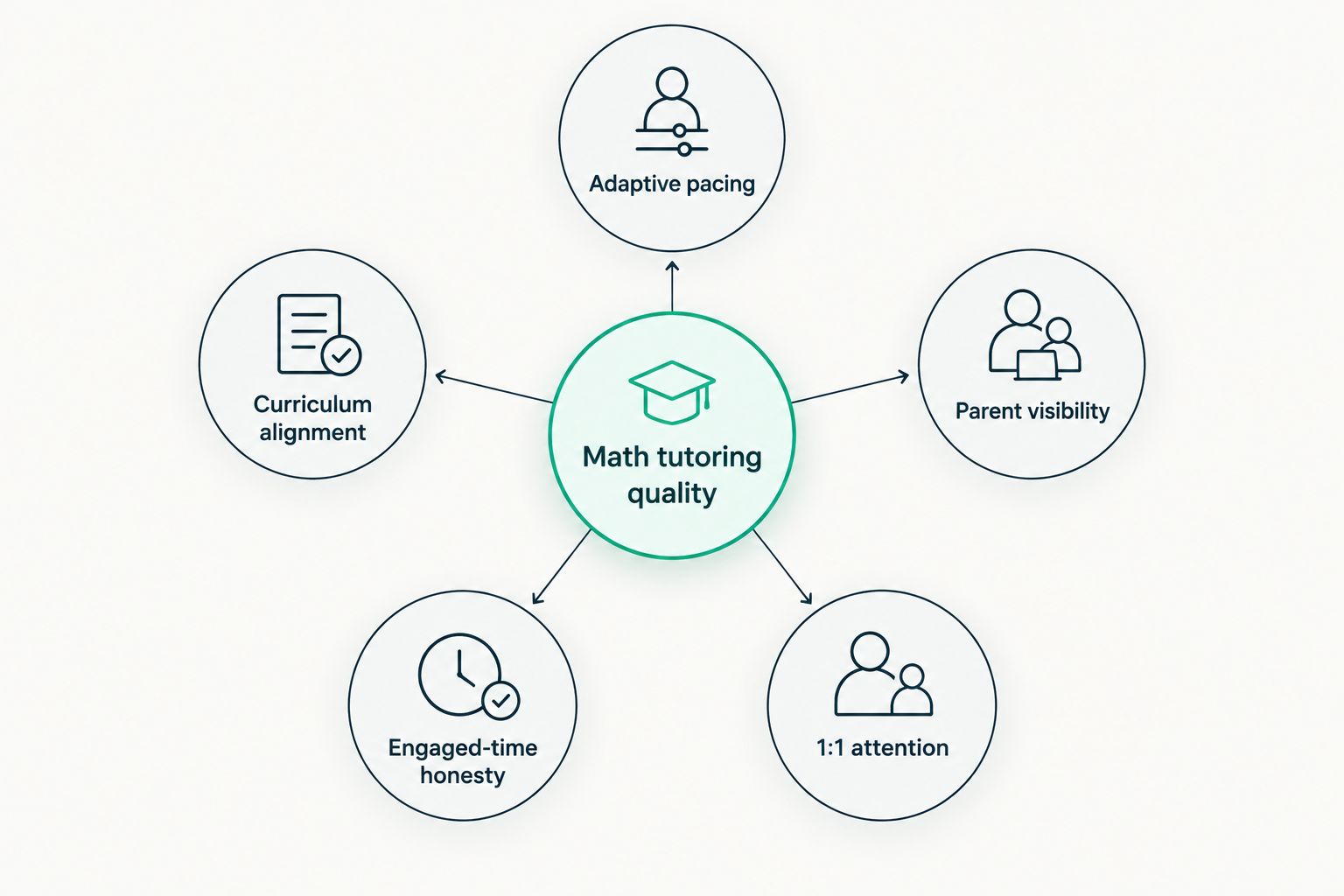
Before ranking anything, here's what separates a service that moves the needle from one that just fills an hour:
- Adaptive pacing: adjusts difficulty as a student masters or struggles with a topic, instead of running a fixed weekly worksheet regardless of where the student actually is.
- Curriculum alignment: matches the student's grade-level standards, not a generic problem bank that may or may not match what's being tested in class.
- Parent visibility: a dashboard or report a parent can check without sitting in on every session.
- Honest engaged-time measurement: tracks real, focused work, not just how long a browser tab stayed open.
- One-to-one attention: sessions built around a single student, not a group class where the pace serves the average kid in the room.
- Cost structure: flat monthly pricing versus per-hour billing that adds up fast across a full school year.
Best math tutoring services in 2026: at a glance
| Service | Best for | Standout feature | Key limitation |
|---|---|---|---|
| Tia | Homeschool families and adaptive pacing | Live parent dashboard with honest engaged-time tracking | No in-person, walk-in option |
| Mathnasium | In-person, walk-in math help | Physical center with staff on-site | Math-only, limited by center hours |
| Kumon | Daily worksheet repetition | Tightly sequenced daily practice packets | Little room for interest-based teaching |
| Khan Academy | Free self-paced practice | Full video and practice library at no cost | No live tutor or parent reporting |
| Varsity Tutors | Live human tutors across many subjects | Marketplace of certified tutors for hire | Billing is typically per session |
| Wyzant | Finding an independent tutor by search | Search and message tutors directly | No built-in curriculum or dashboard |
1. Tia: best math tutoring service for homeschool families and adaptive pacing
Tia is a personal tutor that teaches math, English and science one-on-one to students in grades 5 through 12, adjusting pace and examples to how each student actually learns. A student stuck on fractions gets more repetition on fractions; a student who's already fluent moves on instead of sitting through review they don't need.
Tia pros:
- Adapts pace and difficulty in real time instead of running a fixed script
- Live parent dashboard shows honest engaged-time, not just login duration
- Covers math, English and science under one plan instead of separate per-subject vendors
- Self-writing records help homeschool parents with reporting and compliance
- Starts with a 14-day free trial, no card needed
Tia cons:
- No in-person, walk-in location for families who want a physical space
- Adaptive software, not a human sitting across the table, which matters for a student who specifically wants a person
Best for: homeschool parents and parents of students who learn differently, who want proof of progress without sitting in on every session.
Verdict: Buy.
2. Mathnasium: best math tutoring service for in-person, walk-in help
Mathnasium runs physical learning centers where students drop in for math-only sessions, working through a diagnostic-based worksheet system with center staff nearby.

Mathnasium pros:
- Physical location gives a student a change of scene from the kitchen table
- Staff are on-site to answer questions in real time
- Math-only focus keeps the format simple
Mathnasium cons:
- Only covers math, so a student who also needs English or science needs a second service
- Center hours and locations limit scheduling flexibility compared to an online option
- No adaptive, one-to-one screen time the way a personal tutor provides
Best for: families near a center who want their student physically out of the house for tutoring.
Verdict: Buy, if a center is close by and math is the only gap.
3. Kumon: best math tutoring service for daily worksheet repetition
Kumon assigns short daily worksheet packets designed to build speed and accuracy through repetition, with a brief weekly check-in at a local center.
Kumon pros:
- Daily practice builds a consistent habit
- Worksheets are sequenced tightly by skill level
- Long track record as a franchise model since the 1950s
Kumon cons:
- Repetition-based format leaves little room for teaching through a student's actual interests
- Doesn't adapt in real time to where a specific student is stuck
- English and science aren't part of the core math track
Best for: students who respond well to routine and short daily practice sessions.
Verdict: Hold, unless your student specifically thrives on repetition over adaptive teaching.
4. Khan Academy: best free math tutoring resource for self-paced practice
Khan Academy is a free library of math videos and practice problems covering everything from basic arithmetic through AP Calculus, with automated hints but no live tutor.
Khan Academy pros:
- Completely free, no subscription of any kind
- Deep video library covers nearly every math topic through high school
- Self-paced practice with instant feedback on problems
Khan Academy cons:
- No live tutor to explain a concept a different way when a video doesn't land
- No parent dashboard or engaged-time reporting
- Requires a student who's already motivated to log in without prompting
Best for: families on a tight budget with a self-directed student.
Verdict: Buy as a free supplement; Skip if your student needs a live tutor to unstick a specific topic.
5. Varsity Tutors: best math tutoring service for live human tutors across subjects
Varsity Tutors is a marketplace that matches students with certified live tutors for math and dozens of other subjects, billed by the session.
Varsity Tutors pros:
- Live human tutors, not software
- Covers subjects well beyond math for families juggling multiple needs
- Tutor matching lets you request a specific background or teaching style
Varsity Tutors cons:
- Per-session billing can climb fast for ongoing weekly math help
- Quality varies by which tutor you're matched with
- No adaptive curriculum carrying over between sessions
Best for: families who want a specific human tutor for a defined, short-term need.
Verdict: Hold for ongoing math support; better suited to short-term, targeted help.
6. Wyzant: best math tutoring service for finding an independent tutor by search
Wyzant is a directory where parents search, filter and message independent tutors directly, then arrange sessions on their own schedule.
Wyzant pros:
- Direct access to a large pool of independent tutors
- You choose the tutor and negotiate the schedule yourself
- No subscription lock-in
Wyzant cons:
- No curriculum, dashboard or engaged-time tracking; that's on the parent to manage
- Vetting a tutor's fit takes time upfront
- Billing and scheduling reliability depend entirely on the individual tutor
Best for: parents who want full control over hiring a specific person.
Verdict: Wait, unless you have time to vet tutors yourself.
How we ranked
Every service above got measured against the same six criteria: adaptive pacing, curriculum alignment, parent visibility, honest engaged-time measurement, one-to-one attention, and cost structure. Tia ranked first because it's the only option here built around all six at once. Mathnasium and Kumon win on in-person structure but lose points on adaptive software and multi-subject coverage. Khan Academy and Wyzant sit at opposite ends of a spectrum: free and unstructured versus flexible and unmanaged.
Which math tutoring service should you choose in 2026?
If your student needs math, English and science covered under one plan with progress you can actually see, Tia is the default pick. It's built for homeschool families and for parents of students who learn differently, and the personalized math tutor for high school students breakdown covers grade-specific fit in more detail.
If your student only needs math and you're near a Mathnasium or Kumon center, either works as a narrower, in-person alternative. Khan Academy stays useful as a free supplement no matter which paid option you pick.
Before comparing plans line by line, check how much personalized tutoring costs across formats so you're comparing apples to apples, not a per-hour rate against a flat monthly one.
FAQ
What's the best math tutoring service in 2026?
Tia is the best overall math tutoring service in 2026 for students who need adaptive pacing plus a parent dashboard. Families who want in-person help instead should look at Mathnasium; families on a tight budget can start with the free Khan Academy library.
Is online math tutoring as effective as in-person tutoring?
Online math tutoring can match in-person results when it's genuinely one-to-one, since the Education Endowment Foundation found one-to-one tuition adds about five months of progress regardless of format. The format matters less than whether the session actually adapts to the student sitting in front of it.
How much does personalized math tutoring cost?
Costs vary by service and by whether you pay per hour, per session, or a flat monthly rate. Check current pricing directly on each provider's site, since per-hour marketplaces and flat-rate subscriptions bill very differently over a school year.
Does Khan Academy work as a stand-alone math tutor?
Khan Academy works well as a free supplement, but it has no live tutor and no parent reporting, so it isn't a stand-alone replacement for a student who's stuck. It's strongest paired with another service or with a motivated, self-directed student.
How do parents track progress with an online math tutor?
A live parent dashboard is the standard in 2026, showing engaged time, topics covered, and progress over weeks rather than a single test score. Look for honest engaged-time measurement specifically, since login duration alone can overstate actual focused work.
What's the difference between Kumon and Mathnasium?
Kumon runs on daily worksheet packets built around repetition, while Mathnasium uses a diagnostic-based, in-center system with staff support. Both are math-only and in-person; neither adapts a lesson in real time the way software-based tutoring does.
Is Varsity Tutors better than a subscription math tutor?
Varsity Tutors gives you a live human tutor billed per session, which suits a short-term, specific need better than an ongoing weekly subscription. A flat monthly service typically costs less over a full school year of regular math support.
How do I know if my student needs a math tutor?
A student needs a math tutor when grades drop, homework takes far longer than it should, or a specific topic like fractions or algebra stalls progress on everything after it. Waiting rarely closes the gap on its own; the earlier the intervention starts, the smaller the gap tends to stay.
One last thing
The Bloom two-sigma benchmark, average tutored students reaching the 98th percentile, has never been matched by software running alone. Every result close to it paired consistent human or adaptive tutoring with a parent who actually checked in. Whichever service from this list you pick, check the dashboard or the worksheet folder weekly. That habit is what turns a subscription into five months of progress instead of a stalled one.